Guide


Table of Contents
Good new year goals have a number to reach, a deadline and a first step you can take in the first week of January. Below are 68 resolution ideas for 2027 across eight areas of life. Each one turns a vague resolution into a goal you can track: "read more" becomes "read 12 books by December 31", and the first step is to choose the first book by January 5.
The eight areas:
Work and career
Health and fitness
Money
Relationships, family and friends
Personal growth and learning
Mind and rest
Home
Fun and creativity
You don't need an idea from every area. Pick one to three, change the numbers to fit your life, and use the section after the lists to keep them going past January.
Key takeaways
Pick one to three resolutions for 2027, not one from every area.
Write each one as something to start doing, with a number and a deadline.
Give each goal one weekly habit and check its number once a month.
Griply's goal chart shows the pace you need, so you see early if you're behind.
Work and career resolutions
Many career goals, like a raise or a new job, depend on other people. Pair the result you want with a number you control, such as how many people you talk to or how many wins you write down.
Resolution | Goal | First step |
|---|---|---|
Earn more | Look up the pay range for your role by January 10 | |
Get promoted | Ask your manager what the next level needs by January 15 | |
Change careers | Message the first two by January 12 | |
Get a qualification | Book the exam date by January 15 | |
Grow your network | Have 24 coffee chats with people in your field by December 31 | Message two former colleagues by January 9 |
Stop working late | Add a 5:45 p.m. wrap-up reminder on January 4 | |
Speak up more | Offer to present at a team meeting by January 22 | |
Do more focused work | Block 2 hours of focus time on 3 mornings a week through June | Book next week's three blocks on January 4 |
Health and fitness resolutions
Where you can, count what you do, such as runs, steps or minutes of exercise, because that's what you control from week to week. For a benchmark, the WHO recommends 150 to 300 minutes of moderate activity a week for adults.
Resolution | Goal | First step |
|---|---|---|
Get fit | Do the first walk-run session on January 3 | |
Run further | Pick a race and sign up by January 15 | |
Move more | Check last week's daily step average on January 2 | |
Exercise more | Exercise 150 minutes a week, every week through June | Put three 50-minute sessions in your calendar on January 3 |
Get stronger | Time your longest dead hang on January 5 | |
Build upper-body strength | Test how many you can do now, on January 4 | |
Be more flexible | Measure how far your hips are from the floor on January 5 | |
Train for an event | Choose a race and book it by January 20 | |
Drink more water | Put a full bottle on your desk on January 4 | |
Lose weight | Lose 10 pounds by June 30 | Write down your starting weight on January 2 |
Eat healthier | Eat vegetables with lunch and dinner on 5 days a week through March | Buy vegetables for next week's lunches on January 3 |
Drink less alcohol | Have 31 alcohol-free days in January | Clear the drinks out of your fridge on January 1 |
Money resolutions
Money resolutions already come with numbers. Divide the yearly target by 12, and you know roughly what each month needs.
Resolution | Goal | First step |
|---|---|---|
Save more | Set up a $250 monthly automatic transfer on January 2 | |
Get out of debt | List every debt with its balance and interest rate by January 7 | |
Stick to a budget | Add up last month's spending by January 10 | |
Start investing | Open an investment account by January 15 | |
Spend less | List the essentials you'll still pay for by January 25 | |
Eat out less | Cut takeout spending from $300 to $150 a month by March 31 | Check last month's takeout total on January 3 |
Earn extra income | Earn $2,000 from a side project by December 31 | Write down three ideas and pick one by January 12 |
Save for retirement | Raise your retirement contributions by 2% of your pay by March 31 | Check your current contribution rate by January 10 |
Relationship, family and friendship resolutions
Closeness is hard to measure, so count how often you show up: calls, dinners and date nights.
Resolution | Goal | First step |
|---|---|---|
Spend more time with your partner | Put the first two dates in your calendar by January 5 | |
Communicate better | Hold a 20-minute weekly check-in with your partner, 40 weeks this year | Agree on a day and time for the first one by January 6 |
Make new friends | Sign up for one weekly class or club by January 15 | |
Stay in touch | List 10 people you'd like to hear from more by January 4 | |
Set better boundaries | Write down the 3 situations that drain you most by January 8 | |
See family more | Visit or video-call your parents twice a month, 24 times this year | Book the first visit by January 10 |
Be more present with your kids | Spend 30 phone-free minutes with your kids on 5 days a week through March | Choose the time of day by January 4 |
Host more | Host friends for dinner once a month, 12 times this year | Invite the first guests by January 10 |
Personal growth and learning resolutions
Learning goals work best with a finish line, such as a number of books, lessons or hours, plus a weekly slot in your calendar.
Resolution | Goal | First step |
|---|---|---|
Read more | Choose the first book by January 5 | |
Learn a language | Hold a 10-minute conversation in your new language by December 31 | Pick a course and do the first lesson by January 6 |
Take a course | Finish one online course by April 30 | Enroll and block 3 hours a week in your calendar by January 10 |
Write more | Publish 12 articles or newsletters by December 31 | Choose the first topic by January 7 |
Learn to code | Build and share one small app or website by September 30 | Do a beginner tutorial by January 12 |
Volunteer | Volunteer 48 hours by December 31, about 4 a month | Contact one local organization by January 15 |
Try new things | Do four 30-day challenges, one each quarter | Pick January's challenge by January 2 |
Give more | Donate 1% of your income to causes you care about by December 31 | Choose the causes by January 20 |
Mind and rest resolutions
Rest is the first thing to go when the year gets busy, which is a good reason to count it: hours of sleep, minutes of meditation, days off taken.
Resolution | Goal | First step |
|---|---|---|
Sleep better | Set a 10 p.m. wind-down alarm on January 2 | |
Stress less | Do a 5-minute guided session on January 2 | |
Reflect more | Write your first entry on January 3 | |
Spend less time on your phone | Get daily screen time under 2 hours by March 31 | Check your current daily average on January 2 |
Get outside more | Spend 2 hours outdoors every week, 50 weeks this year | Plan a weekend walk for January 9 |
Take real time off | Use all your vacation days by December 31 | Book your first week off by January 31 |
Practice gratitude | Write down 3 good things on 5 evenings a week through February | Put a notebook by your bed on January 2 |
Slow down | Keep one evening a week free of plans, 40 weeks this year | Pick the evening and block it in your calendar by January 5 |
Home resolutions
Some home resolutions are one-off jobs with nothing to measure, like painting the hallway. Treat those as projects: a list of steps you work through until it's done. For ongoing ones, like cooking or tidying, count how often you do them.
Resolution | Goal | First step |
|---|---|---|
Get organized | Declutter 12 rooms or areas by December 31, one a month | Pick January's room and set a Saturday for it by January 9 |
Cook more | Cook dinner at home 4 nights a week, 40 weeks this year | Plan next week's 4 dinners on January 3 |
Keep the house tidy | Do a 15-minute evening reset on 5 days a week through March | Set a 9 p.m. reminder on January 4 |
Finish house projects | Finish 4 home projects by December 31 | List them all and pick the first by January 10 |
Grow your own food | Choose your 3 crops and order seeds by January 31 | |
Own less stuff | Sell or donate 100 things you don't use by June 30 | Fill the first box on January 9 |
Lower your bills | Cut your energy bill by 15% by December 31 | Find last year's total on your bills by January 15 |
Learn basic repairs | Do 5 small repairs yourself by June 30 | Buy a basic toolkit by January 15 |
Fun and creativity resolutions
Give fun resolutions a date or a count too, or they end up on a "someday" list.
Resolution | Goal | First step |
|---|---|---|
Travel more | Pick the first trip and set a savings target by January 15 | |
Find a hobby | Book a beginner class by January 20 | |
Learn an instrument | Practice for 15 minutes on January 3 | |
Learn to surf | Find a surf school and check its dates by January 31 | |
Learn a fun skill | Do 5 minutes of wall holds on January 3 | |
Be more creative | Fill a 100-page sketchbook by December 31 | Draw for 10 minutes on January 4 |
Take more photos | Make a photo book of your 50 best photos by December 31 | Take one photo a day for the first week of January |
Go out more | See 10 concerts, plays or games by December 31 | Buy tickets for the first one by January 15 |
How to turn a resolution into a new year goal you keep
If you've dropped your resolutions by February before, it was probably for one of three reasons: you had too many, you had no weekly plan for them, or you never set a time to check how they were going. Three changes help.
Pick one to three things to start
Choose one to three ideas from the areas that matter most to you this year, and write each as something you'll start doing. Keep the numbers realistic by starting from where you are today: if you run once a month now, a spring 5K is a better target than a marathon. In a year-long study of more than 1,000 people's New Year's resolutions, 58.9% of people who resolved to start something said they had kept it, compared with 47.1% of those trying to stop something. So "read for 20 minutes before bed" is more likely to last than "stop scrolling at night".
Add one weekly habit to each goal
A goal says where you want to be by the deadline. A habit is what you do each week to get there. For "read 12 books by December 31", that could be reading for 20 minutes before bed on weeknights, a habit our Atomic Habits summary sets up step by step with the book's four laws. Choose a version you enjoy: in a study of New Year's resolutions, people who enjoyed the activity were more likely to still be sticking with their resolution, while how much they valued the long-term benefit didn't predict it.
Check your number once a month
Block 15 minutes in your calendar on the first of each month. Update the number, compare it with where you need to be, and adjust the habit if you're behind. If you start late or miss a month, the first of the next month is a good day to pick it up again. It also helps to tell someone: a review of 141 studies found that goals changed behavior most when they were hard and set publicly. Share your number with a friend and send them your monthly update.
For the full yearly process, from reviewing 2026 to planning your first quarter, follow our guide on how to plan your goals for 2027.
Track your new year goals in Griply
Griply, the goal app we make, shows at a glance whether each resolution is on pace. It helps most if ticking off tasks doesn't feel like progress to you. You give a goal a start value, a target and a deadline, and its chart draws the pace you need as a line. Every number you log shows up as a point above or below that line. So in February you can see whether "read 12 books by December 31" is ahead or behind, with most of the year left to catch up.
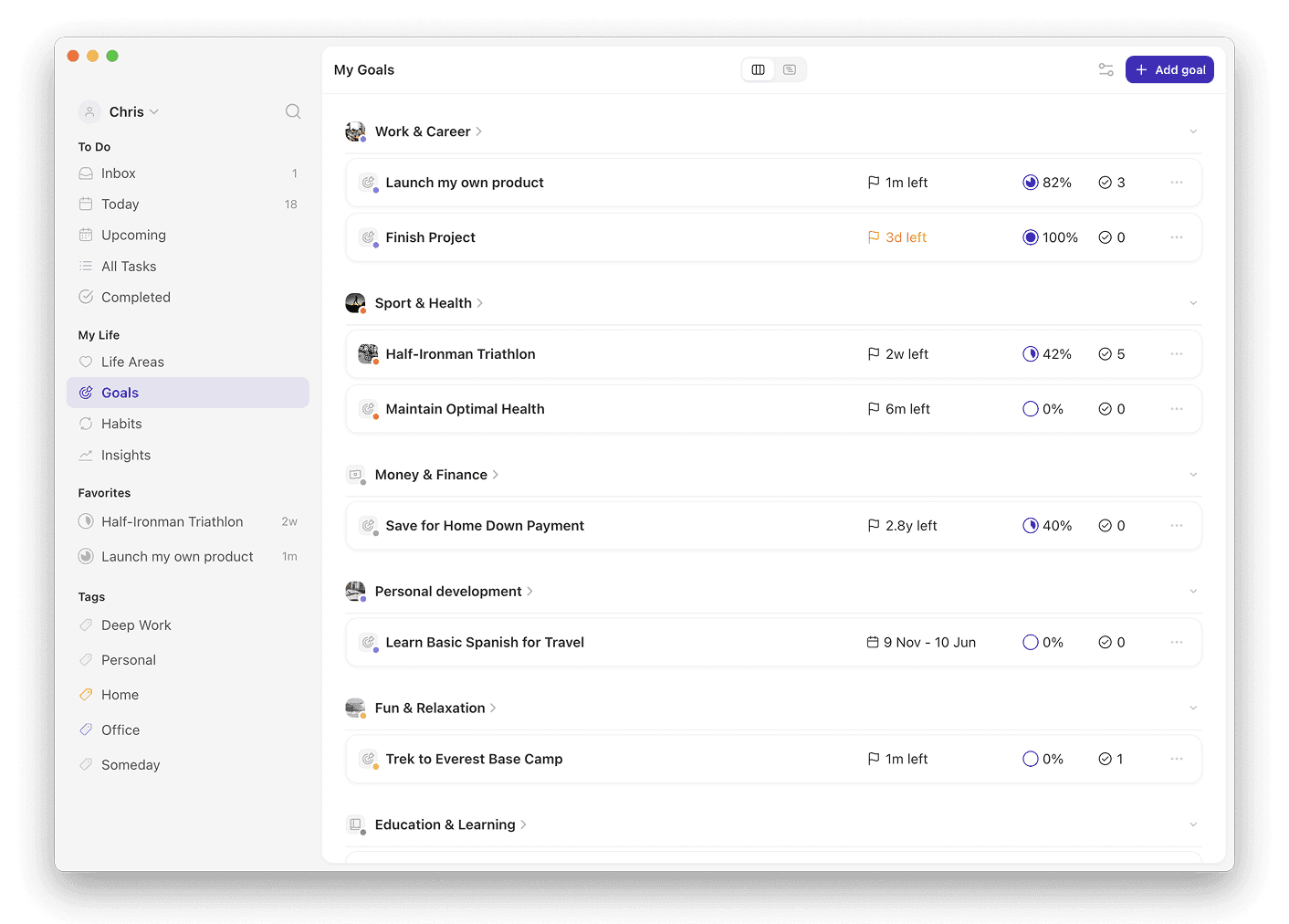
You can link the weekly habit to its goal, and when you open the goal you see how often you've done the habit right next to the chart. Doing the habit doesn't change the goal's number, so you update that yourself after each book. Your goals, habits and tasks stay in one place, and you can group your goals by life area, such as Work & Career or Sport & Health.
The free plan covers 2 goals and 2 habits, enough for two resolutions with a habit each. See how Griply's goal planner works. To compare Griply with other apps, see the best app for New Year's resolutions.
Frequently asked questions
What are good new year goals?
Good new year goals have a number to reach, a deadline and a first step for January. "Read 12 books by December 31" works better than "read more", because in March you can see whether you're on track. Pick one to three from the areas of life you care most about this year.
How many New Year's resolutions should you set?
One to three. Each goal needs time every week, and with more than three, some usually get none. If you've dropped your resolutions by February before, start with one. Add the next once the first is part of your week.
What's the difference between a New Year's resolution and a goal?
A resolution is a decision to change something, like "get fit". A goal adds a number and a deadline, like "run 5K without stopping by April 30". The goal tells you during the year whether you're on track. The resolution only tells you in December whether you kept it.
What is a New Year's intention?
An intention describes how you want the year to feel, such as "slow down" or "be more present". It's a good place to start, but it gives you nothing to check. Use it to choose your goals: "slow down" could become "keep one evening a week free of plans, 40 weeks this year".
The best new year goals are the ones you can check in March
Any idea in these tables can be a good resolution for 2027. What helps it last is knowing, partway through the year, how it's going. A goal with a number and a deadline answers that every month. A first step in the first week of January gets the number moving while the year still feels new.
So pick one to three ideas, change the numbers to fit your life, and put each first step in your calendar now. On February 1, look at where each number stands. If one is behind, adjust the habit or push the deadline back, and keep going. Adjusting a goal in March is part of keeping it.
Related Guides
Oscarsson, M., Carlbring, P., Andersson, G., & Rozental, A. "A Large-Scale Experiment on New Year's Resolutions: Approach-Oriented Goals Are More Successful than Avoidance-Oriented Goals." PLOS ONE, 2020. https://journals.plos.org/plosone/article?id=10.1371/journal.pone.0234097
Woolley, K., & Fishbach, A. "Immediate Rewards Predict Adherence to Long-Term Goals." Personality and Social Psychology Bulletin, 2017. https://pubmed.ncbi.nlm.nih.gov/27899467/
Epton, T., Currie, S., & Armitage, C. J. "Unique Effects of Setting Goals on Behavior Change: Systematic Review and Meta-Analysis." Journal of Consulting and Clinical Psychology, 2017. https://pubmed.ncbi.nlm.nih.gov/29189034/
Bull, F. C., Al-Ansari, S. S., Biddle, S., et al. "World Health Organization 2020 Guidelines on Physical Activity and Sedentary Behaviour." British Journal of Sports Medicine, 2020. https://pubmed.ncbi.nlm.nih.gov/33239350/