


Table of Contents
Hitting 10,000 steps a day consistently comes from raising your step count gradually, from your real starting point, until the higher number feels normal. The figure itself is not magic: it began as a 1965 marketing name for a Japanese pedometer and never came from research. Even so, more daily walking is one of the simplest things you can do for your health, and building toward a solid daily target is a goal worth setting alongside your other everyday health goals. This plan shows you how to find your baseline, add steps a little at a time, and hold the habit once you get there.
Key takeaways
Building to 10,000 steps a day works best as a gradual ramp from your real baseline over several weeks.
The 10,000 figure came from 1965 pedometer marketing, and around 7,000 to 8,000 already delivers most of the measured benefit.
Total steps are what count, so add them any way that fits your day.
In Griply you set a daily step target as one goal, run it on a daily walking habit, and tick off each ramp checkpoint as a task.
The plan, stage by stage
Here is the whole plan before you start. Each stage raises your daily floor a little, so the higher count builds without a jarring jump.
Stage | Target to hit before moving on | Rough time |
|---|---|---|
1. Find your baseline | Track 7 days untouched, know your daily average | Week 1 |
2. Add your first 1,000 | Hold your baseline plus 1,000 a day for a week | 1 week |
3. Reach 6,000 a day | 6,000 steps on most days for a week | 1-3 weeks |
4. Reach 8,000 a day | 8,000 steps on most days for a week | 2-4 weeks |
5. Reach 10,000 a day | 10,000 steps on most days for a week | 2-4 weeks |
6. Hold 10,000 | 10,000 on 5 or more days a week for a month | ongoing |
Raising your floor by about 1,000 steps a week is a manageable step that adds up, and since the health benefit keeps rising as you walk more, the gradual climb is worthwhile in its own right.
Why it feels hard
Ten thousand steps is roughly seven to eight kilometres of walking, which is a lot to fit into a day spent mostly sitting. The fix is to raise the floor gradually, so each week asks for only a little more. The health benefit of walking rises with your step count and then flattens out, around 7,000 to 8,000 for many adults, so treat 10,000 as a good goal to aim for, knowing the health payoff already arrives below it.
Each rung of the ramp is small enough to actually clear, which is the whole point. Setting each step-count checkpoint as its own short-term goal keeps the climb concrete, so a quiet day costs you one checkpoint and never the target itself. You cannot always control a busy day. You can control whether you take the walk you planned.
How to add steps
You do not need one big workout. Total steps are what matter for your health, however you accumulate them, so stack small walks through the day. Giving your target a number and raising it only once you hold the current one keeps the ramp realistic.
A daily anchor walk
One scheduled walk of 20 to 30 minutes adds around 2,000 to 3,000 steps and is your most reliable block. Put it at the same time each day, like after lunch.
Walk after meals
A ten-minute walk after each meal adds a thousand steps or more and steadies your blood sugar. It attaches to something you already do three times a day.
Take calls and meetings on your feet
Pace during phone calls and one-on-ones for another thousand or two steps. It works at home and at the office.
Add distance to trips you already make
Park farther away, get off a stop early, or take the stairs. Each adds a few hundred steps with no extra time carved out.
Movement snacks
Stand up and walk for two or three minutes each hour. Across a workday that adds up, and it breaks long stretches of sitting.
A day that adds up to 10,000
Stacked together, these reach the number with no single long workout. A typical day: a desk day starts around 4,000 steps, a 25-minute anchor walk after lunch adds about 2,500, three ten-minute post-meal walks add roughly 3,000, and taking the stairs plus parking farther out add another 500, which lands you near 10,000.
Build the habit
A daily number sticks when the walk becomes automatic. Tie it to a cue you already have, like walking right after your morning coffee, so you are not relying on memory. Attaching a new habit to a routine you already have is one of the most reliable ways to make it stick, and a repeatable cue, routine, and reward loop keeps the walk happening on the days you would skip it.
Common mistakes
A few things trip people up on the way to a daily number:
Jumping straight to 10,000 from a low base. Ramp by about 1,000 steps a week so the habit holds and your legs adjust.
Skipping the baseline week and guessing your starting point. A week of untouched tracking tells you where to build from.
Trying to bank all your steps in one evening walk. Spreading them through the day is easier to hit and steadier for your blood sugar.
Treating a low day as a failure. Some days run short, so hold the average across the week.
Chasing the number through pain or injury. Hold your current floor until you have recovered, then build again.
Set it up in Griply
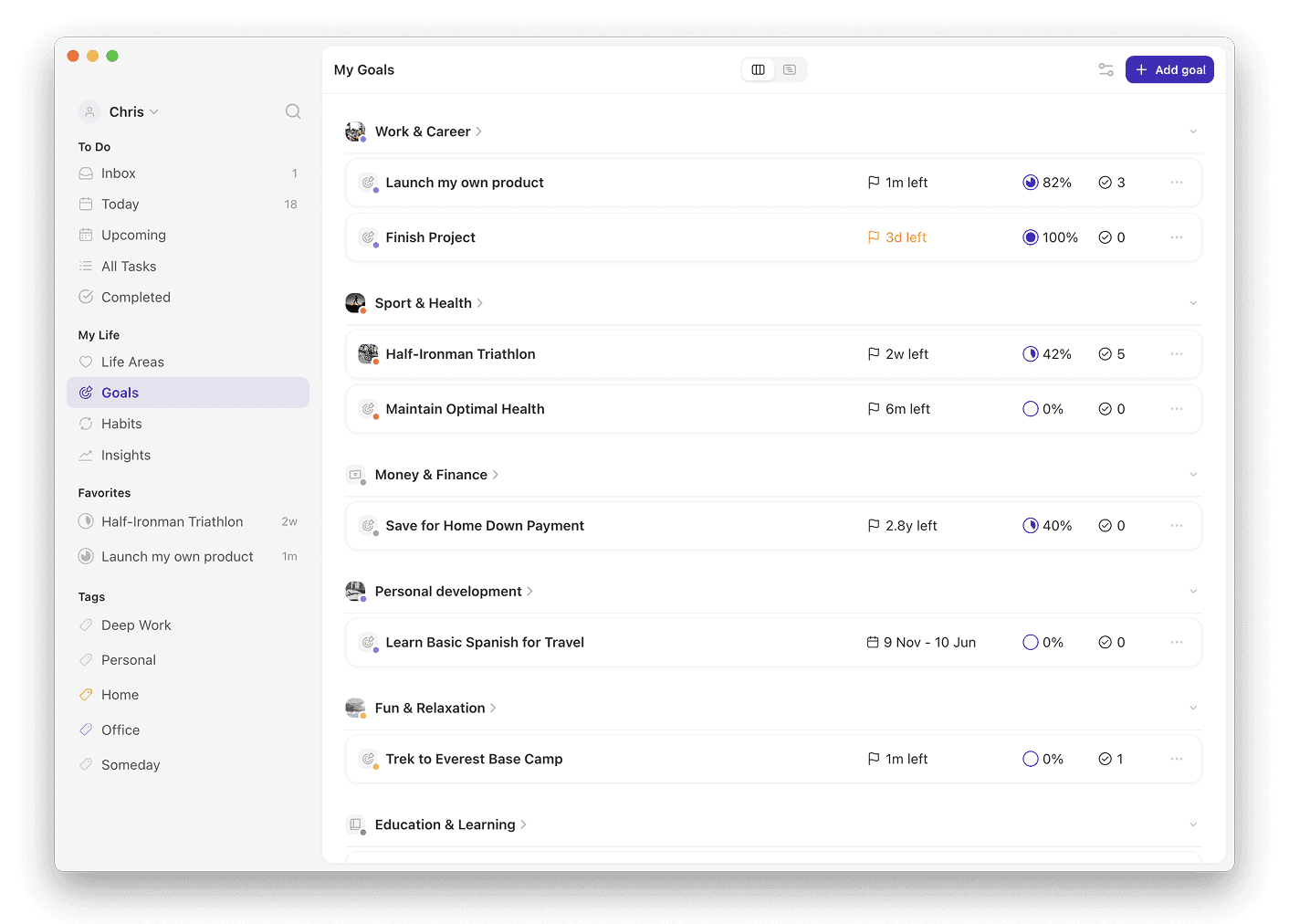
The hard part is rarely wanting to walk more. It is seeing whether your daily count is actually climbing. In Griply the whole plan becomes one template under your Sport & Health life area:
Goal: Walk 10,000 steps a day (metric: Unit-based, steps, your baseline to 10,000)
Habit: Take a walk (schedule: every day)
Task: track your baseline for a week
Task: hold 6,000 steps a day for a week
Task: hold 8,000 steps a day for a week
Task: hold 10,000 steps a day for a week
You log your daily step count, so the progress line climbs from your baseline toward 10,000 and turns green when you hold it. The Habit Tracker keeps the goal, the daily walk, and your ramp checkpoints in one view, so the plan you just read becomes a template you can reuse for the next health goal. Habit targets and progress charts are part of Griply's paid plan; the free plan covers two goals and two habits.
Frequently asked questions
How far is 10,000 steps?
For most people, 10,000 steps is roughly seven to eight kilometres, or about five miles, depending on your height and stride. That works out to around 90 to 100 minutes of walking spread across the day.
Is 10,000 steps a day enough?
It is a solid target, though not a strict requirement. The measured health benefit rises with your step count and levels off for many adults around 7,000 to 8,000, so anything in that range and up is genuinely good for you.
Do you need 10,000 steps a day?
No single number is essential. The 10,000 figure came from a 1965 pedometer name, not research. Fewer steps still help a lot, especially if you are starting from a low base, so aim high but do not treat it as pass or fail.
How do you fit 10,000 steps into a busy day?
Stack small walks: a walk after each meal, pacing during calls, taking the stairs, and one longer daily walk. Adding steps to trips you already make gets you most of the way without carving out extra time.
How long does it take to build up to 10,000 steps?
Ramping from a typical baseline of 4,000 to 6,000 up to 10,000 usually takes six to ten weeks, adding about 1,000 steps a week. Building gradually is what makes the higher count stick.
Raise the floor
Getting to 10,000 steps a day is not about one heroic walk. It is about lifting your daily floor a little each week, stacking short walks into the day, and letting the higher count become your new normal. You find your baseline, add roughly 1,000 steps a week, and tie the walk to a routine you already keep.
When you can watch your daily average climb from a few thousand toward ten, the target stops feeling far off and becomes the number you hold most days. Once the daily walk is automatic, it makes a natural runway into your first 5k. Add steps where they fit, keep the walk automatic, and the rest follows.


Related Guides
Lee IM, Shiroma EJ, Kamada M, Bassett DR, Matthews CE, Buring JE. "Association of Step Volume and Intensity With All-Cause Mortality in Older Women." JAMA Internal Medicine, 2019. https://pmc.ncbi.nlm.nih.gov/articles/PMC8417757/
Paluch AE, Bajpai S, Bassett DR, et al. "Daily steps and all-cause mortality: a meta-analysis of 15 international cohorts." The Lancet Public Health, 2022. https://pmc.ncbi.nlm.nih.gov/articles/PMC9289978
Saint-Maurice PF, Troiano RP, Bassett DR, et al. "Association of Daily Step Count and Step Intensity With Mortality Among US Adults." JAMA, 2020. https://pmc.ncbi.nlm.nih.gov/articles/PMC7093766