Guide


Table of Contents
Life goals are long-term goals measured in years or decades: the work you want to be known for, the health you want to carry into old age, the relationships you want to keep and the experiences you want to have had. A yearly goal is often one step inside a life goal.
Most people who search for life goals examples want a list to copy. The list is the easy part. A copied list of 100 life goals is also the easiest to drop, because nothing on it came from your own picture of a good life. The goals that last trace back to a specific area of your life and a written description of what that area looks like when it's going well.
Below are 70+ life goals examples for adults, grouped by area of life. Each area ends with a first step you can measure this year. If you're after shorter-term goals for the next few months, see these personal goals examples. Both pages use the same goal setting method: decide what you want from an area of life, then give it a number and a date.
The life goals examples below, by area of life:
Career and craft
Health and longevity
Money and freedom
Relationships and family
Learning and growth
Travel and experience
Contribution and legacy
Key takeaways
Write what an area of life looks like going well before choosing its goal.
Give each life goal a step you can measure this year, with a deadline.
Favour goals about growth and relationships; wealth and image goals are linked to lower well-being.
Griply charts each goal's progress against its deadline, so ten-year goals show movement this month.
What counts as a life goal, and how it differs from a yearly goal
A life goal is an outcome measured over years or decades, not weeks. "Run a marathon this spring" is a yearly goal. "Stay strong and mobile enough to hike with my kids when I am sixty" is a life goal, and the marathon is one step inside it.
The difference is the time horizon, and the fact that a life goal usually describes the person you want to be.
That distinction changes how you write them. A yearly goal needs a tight number and a near deadline so you can act this week. A life goal needs a clear picture of the end state first, because the number only makes sense once you know where you're heading over the next ten years.
A good set of life goals also covers more than one area of life, and a list that only names career outcomes leaves most of your life out. When you set goals in several areas, check that they fit together. People whose goals conflict report more negative feelings, for example when a career goal needs every evening and a family goal needs the same evenings. Goals you value and have already made progress on are linked to more positive feelings.
Why most things to accomplish in life never get accomplished
The common life goals you see on every list are abandoned for a reason that has nothing to do with effort. They were never connected to a real picture of your life, so when a busy month arrives they are the first thing to drop.
One part of the explanation is how close you feel to your future self. People who feel connected to their future self, and can picture that person in concrete detail, save more and make choices that favour the long term. People who treat their future self as a stranger discount that person's needs, and a vague life goal keeps your future self a stranger.
The second reason is the goal itself. People who centre their lives on wealth, fame and image tend to report lower well-being than people who put personal growth, close relationships and community first.
Many copied life-goals lists lean heavily on wealth and image because those goals photograph well. So which things to accomplish in life you choose matters as much as whether you reach them.
Career and craft life goals examples
Career life goals work best when they name the skill you want to master or the contribution you want to make. A job title depends on an employer. A skill stays yours.
Become expert enough in one discipline that people seek you out for it.
Build or lead something you are proud to have your name on.
Get to where you choose which work you take on.
Mentor a set number of people through a transition you once made yourself.
Write the book, talk, or body of work you want to be known for.
Reach the top tier of pay or seniority in your field.
Start a business that supports you without a salary from anyone else.
Speak at a major conference in your industry.
Train 10 people who go on to outgrow you.
Earn a mastery or credential that takes years, not weeks, to reach.
Move once into work that matches your values, on purpose.
A first career step for this year
Take "become expert enough in one discipline that people seek you out for it." This year's version: publish one piece of work on that subject each month, going from 0 to 12 by 31 December. A talk, an article or a case study all count, and each one gives people a reason to seek you out.
Health and longevity life goals examples
Health goals on most lists stop at a number on a scale. Over a lifetime, the better question is what you want your body to still be able to do decades from now.
Be able to carry your own bags and climb stairs without help into your seventies.
Complete one big physical challenge each decade, like a long hike or a triathlon.
Keep a sleep and movement routine you stick to even in your busiest seasons.
Reach and maintain a level of strength that protects you from common age-related injuries.
Run a marathon, or build up to a half if running is new to you.
Stay active enough to keep playing a sport you love into your sixties.
Hike a long-distance trail, such as a multi-day national park route.
Learn to cook 20 healthy meals you look forward to eating.
Get to where you sleep seven to eight hours on most nights.
Quit a habit that is quietly costing you years, like smoking or daily drinking.
Be strong enough to lift your own bodyweight well into middle age.
A first health step for this year
Take "be able to carry your own bags and climb stairs without help into your seventies." Staying strong is what keeps that possible, so this year's goal is 80 strength sessions by 31 December, starting from 0. That is fewer than two a week, with room for busy months.
Money and freedom life goals examples
Money is the area where a goal most easily turns into chasing a number for its own sake, so it helps to write each one as the freedom the money buys you.
Build enough of a financial cushion that a lost job becomes a manageable inconvenience.
Reach the point where your investments cover your basic living costs.
Own your home outright before you stop working.
Fully fund one thing that matters, like a child's education or a sabbatical.
Save enough to step back from full-time work in your fifties.
Build a full year of living costs into an emergency fund.
Become completely debt-free, mortgage included.
Reach a net worth that lets you take a year off without fear.
Give away a meaningful amount each year once your own needs are met.
Buy back your time by paying for help with work you dislike.
Leave enough behind that your family starts a step ahead.
A first money step for this year
Take "build a full year of living costs into an emergency fund." If your costs are $3,000 a month, the full fund is $36,000, which is too far away to plan a year around. This year's goal is three months: from $0 to $9,000 by 31 December, or $750 a month.
Relationships and family life goals examples
Relationships are the area most people leave off a life-goals list, even though people with strong social relationships live longer: across 148 studies, they were 50% more likely to survive the follow-up period.
Stay close to a core group of friends across decades.
Be the kind of parent or partner your family would describe in specific, warm terms.
Repair one important relationship that matters more than being right.
Build a wider community you contribute to and can rely on.
Keep five close friendships going for thirty years or more.
Be the parent who shows up to the events your kids remember.
Build a partnership that still feels like a choice decades in.
Host the gatherings that become your family's traditions.
Get to know your parents as people before you lose the chance.
Make one new close friend in each decade of adult life.
Be the person three people would call first in a crisis.
A first relationships step for this year
Take "keep five close friendships going for thirty years or more." Name the five people, then set this year's goal at 20 meetups by 31 December, four with each friend. A long phone call counts. Logging them shows you by March which friendships you've let slide.
Learning and growth life goals examples
Growth goals describe who you want to become. They name a future version of you, which makes them the easiest life goals to picture.
Read deeply enough in one field to form your own view of it.
Develop a creative skill, like painting or photography, to a level that satisfies you.
Become someone who stays steady when things go wrong.
Build a habit of yearly reflection so you keep adjusting the list as you change.
Read 1,000 books across your lifetime.
Learn an instrument well enough to play for people without notes.
Become conversational in a second language and use it on a trip.
Master a craft, such as woodworking or pottery, over years.
Finish a degree or deep course you started purely for yourself.
Write often enough that your thinking gets sharper on the page.
Face a real fear directly, such as public speaking or deep water.
A first growth step for this year
Take "read 1,000 books across your lifetime." This year's goal is 24 books, from 0 to 24 by 31 December. At that pace, 1,000 books takes about 40 years, so the yearly number also tells you whether the lifetime number is realistic.
Travel and experience life goals examples
Experience goals make up most of the classic bucket list, and they're usually goals you want for their own sake, not to impress anyone.
Live in a country other than your own for at least a year.
See a specific natural wonder you have wanted to see since you were a child.
Watch the sunrise from the top of a mountain you climbed yourself.
Take one trip that frightens you slightly because of its scale.
Visit 50 countries, or set foot on every continent at least once.
See the northern lights, a total eclipse, or another rare event in person.
Take a months-long trip with no fixed return date.
Walk a pilgrimage route such as the Camino de Santiago.
Learn a skill abroad, such as diving, sailing, or surfing.
Spend a milestone birthday somewhere you have always wanted to be.
Road-trip the full length of a country you love.
A first experience step for this year
Take "visit 50 countries." If you've been to 12, your start value is 12 and this year's goal is 14 by 31 December. Starting from what you've already done means the goal shows progress from day one. At two new countries a year, 50 is 19 years away.
Contribution and legacy life goals examples
Legacy goals ask what you want to leave behind. They are easy to skip and hard to regret setting.
Give a meaningful amount of time or money to a cause over your lifetime.
Pass on a skill, a story, or a value to the next generation on purpose.
Leave one place, team, or community better than you found it.
Create something, written or built, that outlasts you.
Mentor young people in your field across several decades.
Plant trees or restore land so you leave somewhere greener.
Record your family's stories before the people who hold them are gone.
Volunteer 1,000 hours across your life for something you believe in.
Build a fund or tradition that keeps giving after you stop.
Teach one skill to enough people that it outlives your involvement.
Be remembered by name in a community you helped build.
A first contribution step for this year
Take "volunteer 1,000 hours across your life for something you believe in." This year's goal is 50 hours by 31 December, about one hour a week. Twenty years at that pace reaches 1,000.
From life goal to this year's goal
Every first step above was built the same way, and you can repeat it for any life goal on this page.
Start with the area of life the goal belongs to. Write a few sentences on what that area looks like when it's going well. If you're not sure which areas need a goal right now, this guide to areas of life lists the main ones and helps you pick.
Then check that the goal is yours. Goals that match your own values, called self-concordant goals, get more sustained effort and lead to more well-being than goals taken on to meet other people's expectations. The few sentences you wrote are the test: if the goal doesn't fit them, it probably came from someone else's list.
Finally, work back to this year. Ask what would need to be true by 31 December for the life goal to be on track, and write that as a goal with a start value, a target and a deadline. The marathon sits under the lifelong-fitness goal, and this year's savings target sits under financial freedom. Then pick the first task for this month.
How Griply keeps a lifetime goal in front of you
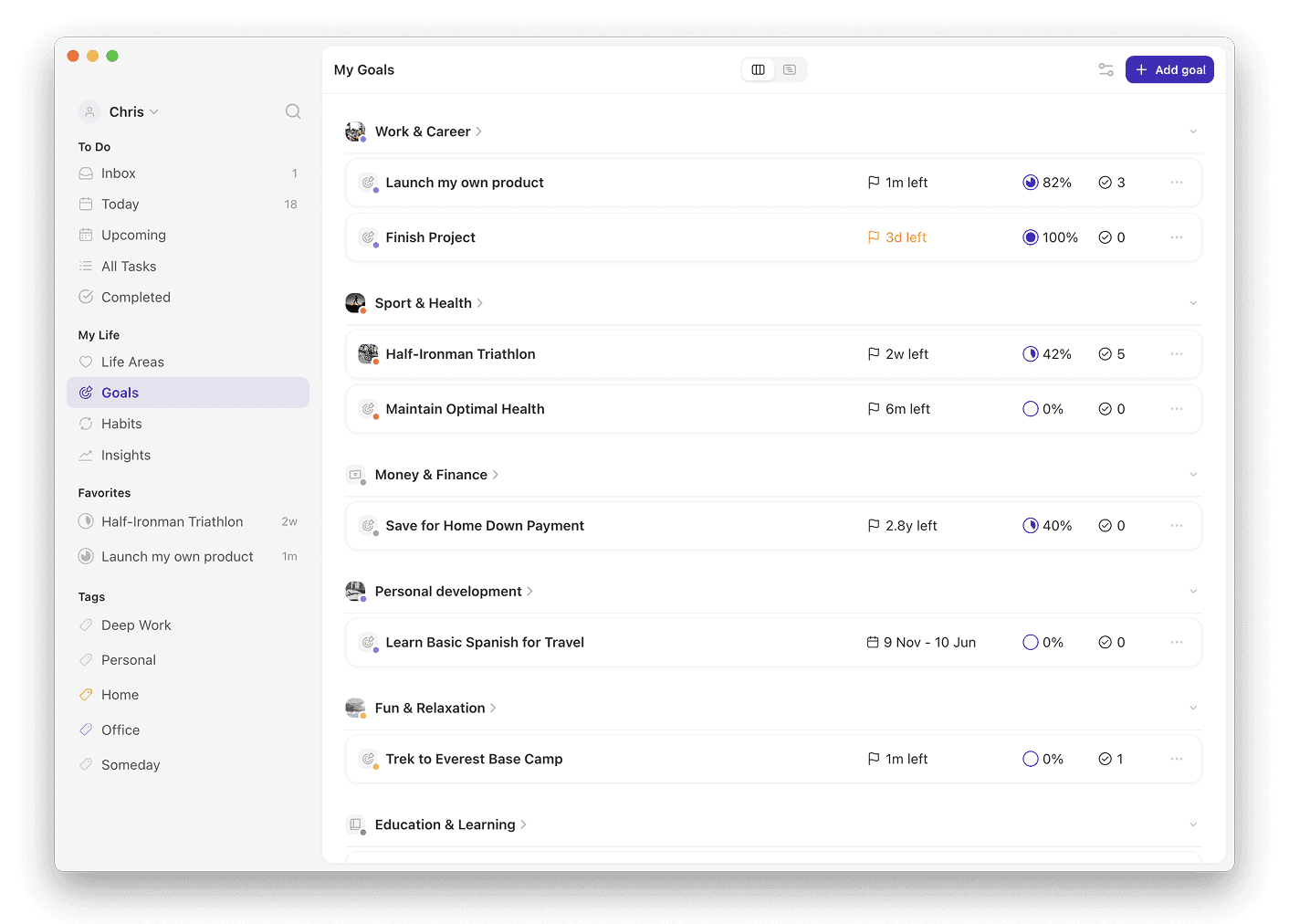
Most life goals get forgotten because you write them once and never look at them again. Griply keeps the goal, the vision behind it and your progress in one place, so you can see whether the years are adding up to what you wanted.
Each life area in Griply has a Vision field, where you describe what that area looks like when it's going well. The life planner keeps your areas and visions together, so every long-horizon goal sits next to the picture that made you set it.
Every goal has a start value, a target value and a deadline. Griply draws your progress on a line chart next to the pace you need to reach the target, and the chart stays readable for goals that run five years or more. A goal you'd normally measure in decades shows movement this month.
With Premium, you can split a lifetime goal into subgoals: this year's goal sits under the life goal, and you can link this month's tasks and habits to this year's goal. The structure runs from life area and vision down to goals, subgoals and the projects, tasks and habits behind them, the same order this guide asks you to write in.
Frequently asked questions
What is a life goal?
A life goal is a long-horizon goal measured in years or decades, such as staying fit into your seventies, becoming an expert in your field or keeping close friends for life. It usually describes the person you want to be. Yearly goals sit inside it as the steps you can measure now.
What are good things to accomplish in life?
Good life goals cover several areas of life: career, health, money, relationships, growth, experiences and contribution. The strongest are intrinsic, meaning they centre on growth, relationships and community. Research links those to higher well-being than goals built around wealth, fame or image.
What are three goals you want in life?
A practical set of three is one health goal, one relationship goal and one career or growth goal, so no single area takes over. Pick an outcome in each that you can picture clearly, write a few sentences on what that area looks like when it's going well, then set a first step for this year.
How many life goals should I have?
A handful is enough, usually one for each area of life that matters to you right now. Each one needs a first step this year, and you only have so many evenings. Check that they fit together too: goals that conflict with each other are linked to more negative feelings.
What is the difference between a bucket list and a life goal?
A bucket list is usually a flat list of experiences you want to have. A life goal can also describe a skill, a relationship or a version of yourself you want to grow into. A bucket list answers "what do I want to do?", while life goals also answer "who do I want to become?"
The things to accomplish in life that last are the ones you can picture
The things to accomplish in life that last are the ones you can picture yourself living, tied to a specific area of your life. A list copied from someone else gives you nothing to picture. Write a few sentences about each area first, then let the life goal follow from it.
The step that makes a life goal real is the one for this year. A goal that takes twenty years gives you nothing to do on Monday, while 24 books, 80 strength sessions or $9,000 saved by December does. Log progress on that yearly goal and you can see the life goal move with it. A list you wrote yourself, with a first step you can measure, is the one you'll still be working from next year.
Related Guides
Hershfield, Hal E. "Future Self-Continuity: How Conceptions of the Future Self Transform Intertemporal Choice." Annals of the New York Academy of Sciences, Vol. 1235, 2011. https://pmc.ncbi.nlm.nih.gov/articles/PMC3764505/
Kasser, Tim and Richard M. Ryan. "Further Examining the American Dream: Differential Correlates of Intrinsic and Extrinsic Goals." Personality and Social Psychology Bulletin, Vol. 22, No. 3, 1996. https://doi.org/10.1177/0146167296223006
Emmons, Robert A. "Personal Strivings: An Approach to Personality and Subjective Well-Being." Journal of Personality and Social Psychology, Vol. 51, No. 5, 1986. https://doi.org/10.1037/0022-3514.51.5.1058
Holt-Lunstad, Julianne, Timothy B. Smith and J. Bradley Layton. "Social Relationships and Mortality Risk: A Meta-analytic Review." PLoS Medicine, Vol. 7, No. 7, 2010. https://doi.org/10.1371/journal.pmed.1000316
Sheldon, Kennon M. and Andrew J. Elliot. "Goal Striving, Need Satisfaction, and Longitudinal Well-Being: The Self-Concordance Model." Journal of Personality and Social Psychology, Vol. 76, No. 3, 1999. https://pubmed.ncbi.nlm.nih.gov/10101878/