


Table of Contents
A 10k training plan takes someone who can already run 5k and builds them up to 10k over six to eight weeks, mostly by growing one weekly long run. You keep most of your running easy, add a longer run each week, and taper before race day. A plan that says exactly when and how far you will run also makes you far more likely to follow through, since writing down when and how you will act raises your odds of doing it. This plan assumes you can already run a slow 5k; if you cannot yet, build that first with a couch to 5k plan. From there, the stages below take you to 10k.
Key takeaways
A 10k plan builds from a 5k base to 10k in six to eight weeks by growing one weekly long run.
Most of your running stays easy and conversational, and only about one session a week is hard.
Increase your long run gradually, roughly half a kilometre to a kilometre each week, and take rest days.
In Griply you set the 10k as one goal measured in distance, add each week's runs as tasks, and attach a running habit.
The plan, week by week
Here is the whole plan, ready to copy, with the long run at the weekend. It assumes you can already run a slow 5k. Each week is three runs, so add a fourth easy run only if you have the time, and keep every easy run conversational, slow enough to talk in full sentences.
Week | Run 1 (easy) | Run 2 | Run 3 (long run) |
|---|---|---|---|
1 | 4 km easy | 4 km easy | 6 km |
2 | 4 km easy | 5 km easy | 7 km |
3 | 5 km easy | 5 km easy | 8 km |
4, cutback | 4 km easy | 4 km easy | 6 km |
5 | 5 km easy | Intervals: 6 x 1 min hard, 2 min easy jog between | 9 km |
6 | 5 km easy | Tempo: 15 to 20 min comfortably hard | 10 km |
7, cutback | 5 km easy | 4 km easy | 8 km |
8, taper and race | 3 km easy | 3 km easy with a few short strides | Race day, 10 km |
Most people build from 5k to 10k in six to eight weeks. Short on time? Drop to six weeks by cutting two of the early weeks. Repeat any week that felt hard before you move on.
Why it feels hard
Doubling your distance from 5k to 10k asks your legs and lungs to keep going far longer than they are used to. You build that endurance by running more, most of it slow. The biggest endurance gains come from a large volume of easy running with only a small share done hard, which is why easy runs make up most of the plan.
The 10k is a distance you can pin to a number and chase in stages. Giving the goal a concrete figure and growing your long run toward it turns a vague plan to run more into a target you can watch approach. You cannot force endurance faster than your body builds it. You can control whether you run easy and add distance gradually.
How to run it
Most weeks look the same: two or three easy runs of about 3 to 5 km, or 20 to 35 minutes each, and one longer run that grows. Keep the easy runs conversational, slow enough to talk in full sentences, since they should feel almost too slow. If you train with a heart-rate monitor, that easy effort is roughly zone 2, about 60 to 70 percent of your maximum heart rate, but the talk test does the same job with no kit. Once a week, run your long run slower than you think, and add about half a kilometre to a kilometre over the last one.
Once your base feels solid, you can swap one easy run for an optional faster session. Intervals mean six one-minute efforts at a hard but controlled pace, with about two minutes of easy jogging between them. A tempo run means about 15 to 20 minutes at a comfortably hard pace, where you can only get a few words out at a time. Both sharpen your 10k pace, and finishing needs neither.
Build the distance gradually. Sudden jumps in how far you run are a common cause of running injuries, so trust the small weekly steps. Advancing your long run only when the current distance felt controlled keeps you healthy and on track. Take one or two rest days a week.
Cutbacks and the taper
Two planned easy periods keep your legs fresh. A cutback week, every third or fourth week, drops your long run and total distance by about a third so your body absorbs the training, then you carry on building. The taper is the final five to seven days before race day: cut your total running by roughly half while you keep a little intensity, keep your last long run to about 6 to 7 km and at least four days out, run one or two short easy sessions to stay loose, and rest the day or two before the race.
Build the habit
Three to four runs a week is the engine, with the long run as the anchor. The easy runs and the rest days do the quiet work of building endurance between long runs. The 10k is the goal and the weekly runs are the habit that gets you there, so pairing a clear goal with the habit underneath it keeps you moving on the weeks motivation dips.
Common mistakes
A few errors trip up most 5k-to-10k runners:
Running the easy runs too hard. This is the most common mistake, and the easy runs should feel almost too slow, so save your effort for the long run and any speed session.
Adding more than about a kilometre to the long run each week, which is where injuries start.
Skipping the long run to fit in more short runs. The long run is what builds the distance.
Running every day with no rest. One or two rest days a week are when your endurance actually forms.
Trying to run the full 10k over and over in training. Reaching it once is enough before race day.
Set it up in Griply
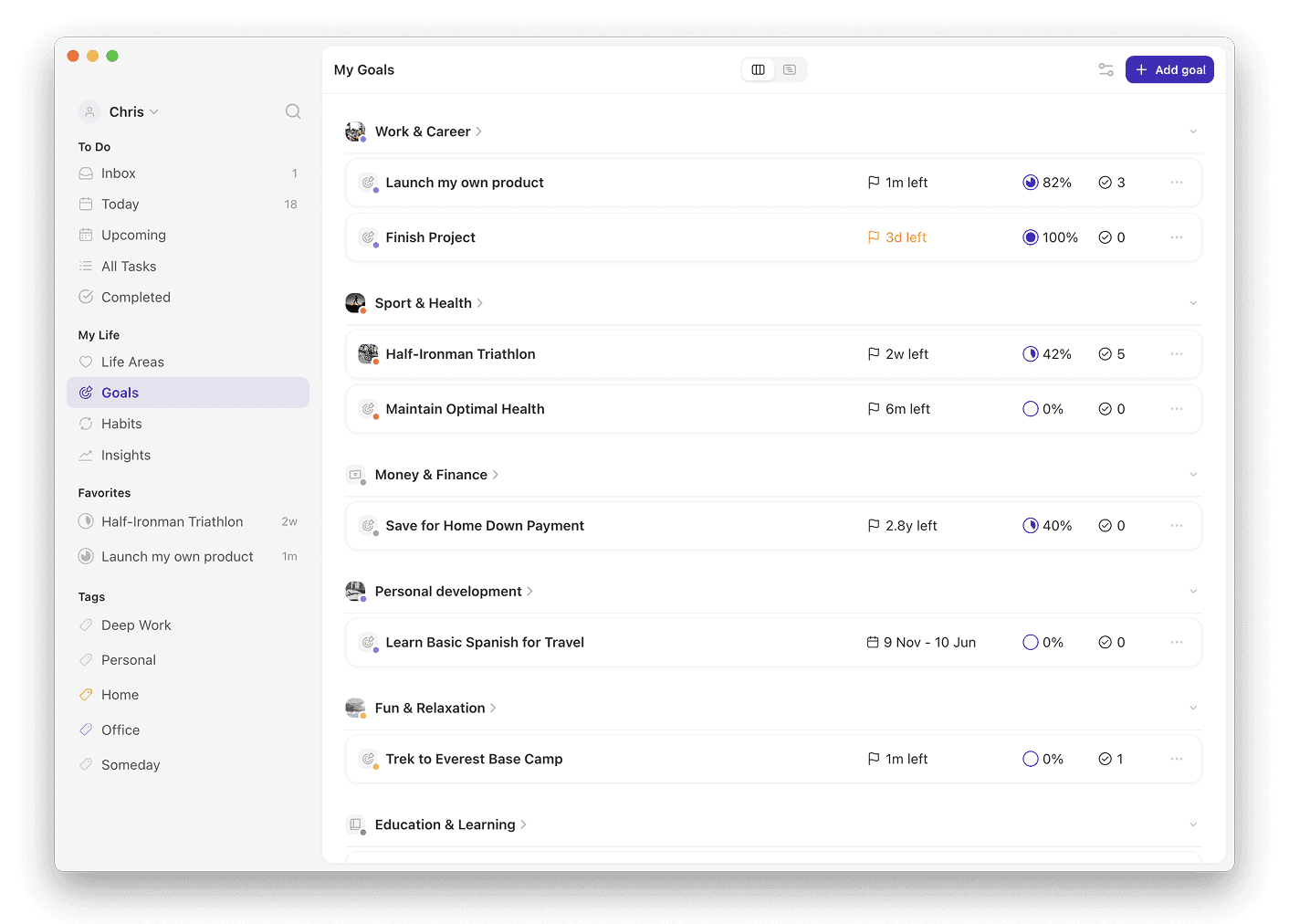
The hard part is rarely the plan. It is holding six weeks of runs in one place and seeing your long run grow. In Griply the whole plan becomes one template under your Sport & Health life area:
Goal: Run 10k (metric: Unit-based, distance, 5 to 10 km)
Task: each week's runs as tasks, grouped in a section per week
week 1, long run: 6 km
week 1, easy run: 4 km
and so on, up to the 10 km long run
Habit: Go for a run (schedule: 3 to 4 times a week, including one long run)
You tick off each run and log your longest run's distance, so the progress line climbs toward 10 km and turns green when you hit it. The Goal Planner keeps the goal, its weekly runs, and the running habit in one view, so the plan you just read becomes a template you can reuse for your next distance. Habit targets and progress charts are part of Griply's paid plan; the free plan covers two goals and two habits.
Frequently asked questions
How long does it take to train from 5k to 10k?
Six to eight weeks for most people who can already run a 5k, adding about a kilometre to the long run each week. If you need more time, extending it to ten weeks is completely fine and often smarter.
Can a beginner run a 10k?
Yes, once you can run a 5k. If you are starting from nothing, build to a 5k first, then follow this plan. The long run grows gradually, so 10k arrives without a sudden jump.
How many times a week should you run to train for a 10k?
Three to four runs a week: two or three easy runs and one long run. The rest days between them are part of the plan, since your endurance builds while you recover.
How far should your long run be before a 10k?
Reaching a 10k long run in training is enough, and many plans stop there. Some runners go slightly beyond, but there is no need to run the full distance more than once before race day.
Do you need rest days when training for a 10k?
Yes. One or two rest days a week let your body absorb the training, and a cutback week every three to four weeks prevents burnout. Running every day raises your injury risk and slows progress.
Grow the long run
A 10k comes from one simple pattern repeated for a few weeks: run easy most days, add a little to your long run each week, and rest enough to absorb it. You keep the pace conversational, build the distance in small steps, and taper before the race.
When you can watch your long run climb from 5k to 6k to 10k, the distance stops feeling far and becomes the next number to reach, ready to line up beside the rest of your training goals. Run easy, grow the long run slowly, and let the weeks carry you to the start line.
Related Goal Plans


Related Guides
Peng B, Othman AT, Yuan F, Liang J. "The Effectiveness of Planning Interventions for Improving Physical Activity in the General Population: A Systematic Review and Meta-Analysis of Randomized Controlled Trials." International Journal of Environmental Research and Public Health, 2022. https://pmc.ncbi.nlm.nih.gov/articles/PMC9223740/
Nøst HL, Aune MA, van den Tillaar R. "The Effect of Polarized Training Intensity Distribution on Maximal Oxygen Uptake and Work Economy Among Endurance Athletes: A Systematic Review." Sports (Basel), 2024. https://pmc.ncbi.nlm.nih.gov/articles/PMC11679080/
Nielsen RO, Buist I, Sørensen H, Lind M, Rasmussen S. "Training Errors and Running Related Injuries: A Systematic Review." International Journal of Sports Physical Therapy, 2012. https://pmc.ncbi.nlm.nih.gov/articles/PMC3290924/
Wang Z, Wang Y, Gao W, Zhong Y. "Effects of tapering on performance in endurance athletes: A systematic review and meta-analysis." PLoS One, 2023. https://pmc.ncbi.nlm.nih.gov/articles/PMC10171681/