

Table of Contents
Paying off debt is the process of clearing what you owe on a fixed schedule, by paying the minimum on every debt and putting every spare pound toward one target debt until each balance reaches zero. Most people try to pay a little off everything at once, watch the balances barely move, and lose heart. A structured plan works better. You add up what you owe, pick an order to clear the debts in, and send a fixed extra amount at one debt at a time. Clearing whole balances one at a time is what keeps people going until the debt is gone. The steps below take you from your first list of debts to a zero balance.
Key takeaways
Paying off debt comes from paying minimums on all debts and extra on one.
The snowball clears the smallest balance first; the avalanche clears the highest rate first.
Paying more than the minimum is what shortens years of interest to months.
In Griply you set your total balance as one goal and attach a payday payment habit.
The plan, step by step
Here is the whole plan before you start. Each step has one thing that tells you it is done, so you always know what to work on next.
Step | What done looks like | Rough time |
|---|---|---|
1. List every debt | Every balance, rate, and minimum in one place | A day |
2. Pick snowball or avalanche | Your debts ranked in a payoff order | A day |
3. Free up extra money | A fixed extra amount you can pay each payday | 1-2 weeks |
4. Attack the first debt | Minimums on all, all extra on one target | weeks to months |
5. Roll to the next debt | The freed payment added to the next debt | ongoing |
6. Clear the last debt | Your total balance at zero | the milestone |
Most people clear their debts in one to three years, depending on the size of the balance and how much extra they can pay. You set up the first three steps in your first week, then the plan runs on the same monthly loop until the balance reads zero.
How to do each step
Set the first three steps up in one sitting, then the plan runs on autopilot. Here is how to do each one.
1. List every debt with its balance, rate, and minimum
Write down every debt you owe: credit cards, store cards, loans, overdrafts, and buy-now-pay-later balances. For each one, note the balance, the interest rate, and the minimum monthly payment. Your interest rate, or APR, is what you pay each year to borrow, charged on the balance you still owe. Add the balances up. That total is the number you are driving to zero.
2. Choose the snowball or the avalanche
The two proven methods are the snowball and the avalanche. The snowball ranks your debts from the smallest balance to the largest and clears the smallest first. The avalanche ranks them from the highest interest rate to the lowest and clears the highest rate first. The avalanche saves you the most in interest. The snowball gives you a cleared debt sooner, which keeps many people going. Both clear the debt, so pick the one you will keep up.
3. Free up extra money each month
Your extra payment is the engine, so find a fixed amount you can add every payday. Even £50 or £100 a month clears debt far faster than minimums alone. Look for it in subscriptions you no longer use, eating out, or a temporary pause on non-essential spending, and a budget is the quickest way to find it. Pick an amount you can sustain for months without burning out.
4. Pay the minimum on all, the extra on one
Every payday, pay the minimum on every debt so none fall behind and trigger a late fee, then send your whole extra amount to your one target debt. Keep the other debts ticking over on their minimums until the target is clear. Splitting your extra evenly across every debt is what leaves them all crawling.
5. Roll each cleared payment to the next debt
When your first debt hits zero, keep that freed-up money in the plan. Add the payment you were making on the cleared debt to your extra amount, and point the new, larger payment at the next debt on your list. This rolling payment is why the method speeds up as you go. Giving your balance a number you watch fall keeps you honest about which debt is next.
6. Automate the payments and avoid new debt
Set up automatic minimum payments on every debt so you never miss one. Then stop adding to the pile: pause or freeze the cards you are paying down, and pay with cash or a debit card while you clear them. New spending on a card you are trying to clear undoes the progress you just made.
Why it feels hard
Debt feels heavy because the interest keeps growing the balance while you pay, so minimum payments barely move it. Paying only the minimum can stretch a balance across years, because most of each payment goes to interest. You change that by paying more than the minimum and aiming it at one debt.
The zero balance is the outcome you want, and the payments you make each payday are the process. Tracking the total balance as one number dropping toward zero is what stops you quitting while the balance is still high. You cannot control the interest rate on your cards. You can control how much extra you send and where you send it.
Build the habit
Paying off debt runs on one repeated action: the extra payment you make every payday. Set it as a habit so it happens whether or not you feel like it. Concentrating your whole extra payment into one debt each time keeps your motivation to get out of debt high, so aim the habit at a single target until it clears.
A repeatable cue, routine, and reward loop for payday, like moving the money the morning your salary lands, carries the plan between milestones without relying on willpower.
Common mistakes
A few habits keep people in debt longer than they need to be:
Paying only the minimums. Most of each payment is interest, so balances barely move.
Spreading your extra across every debt. Concentrate it on one so a debt clears.
Adding new debt while you pay. New charges on a card you are clearing undo progress.
Absorbing freed-up payments back into spending. Roll each cleared payment onto the next debt.
Starting with no list. You cannot rank a payoff order without every balance and rate.
Setting an extra payment you cannot sustain. Pick an amount you can keep for months.
Set it up in Griply
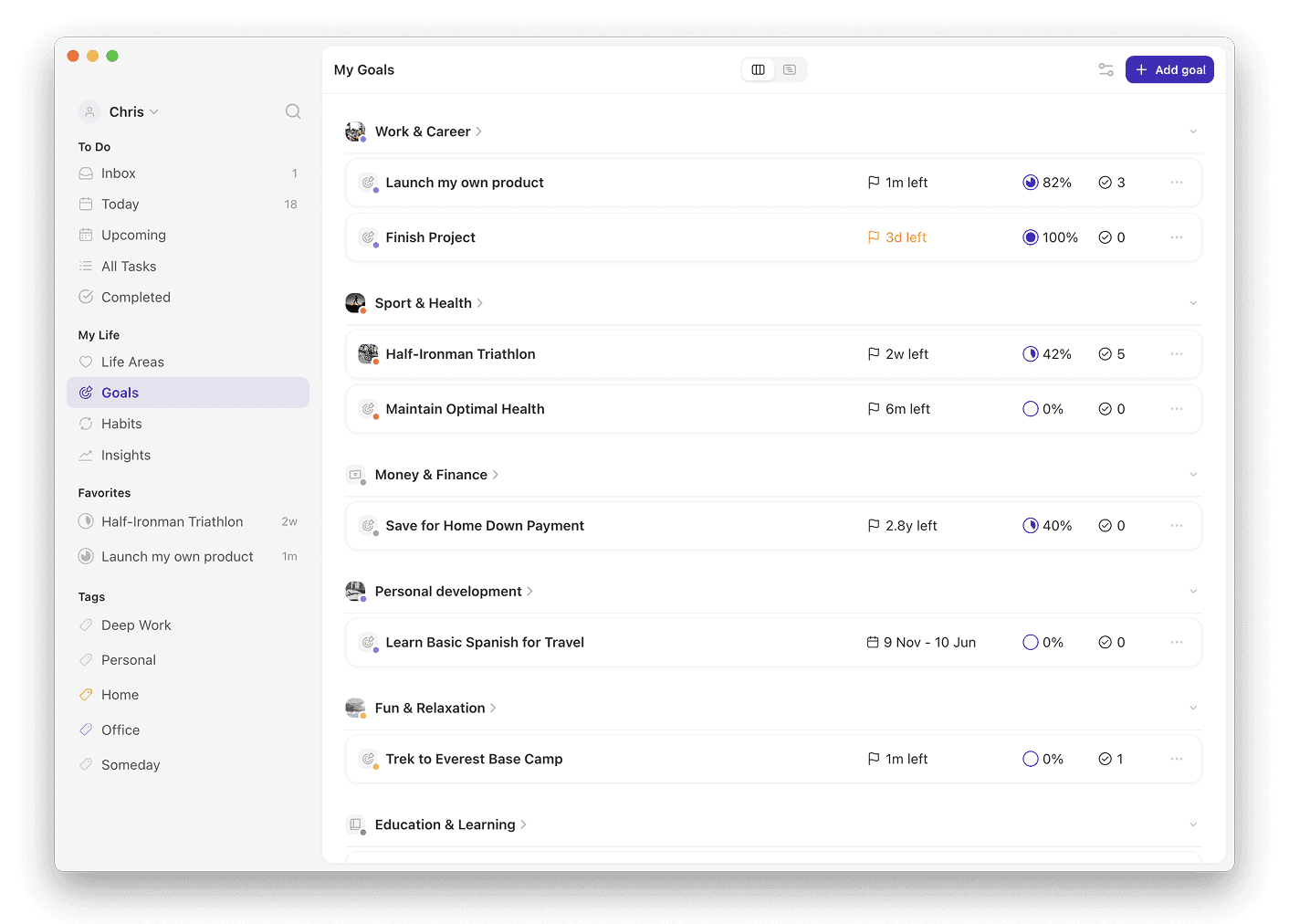
The hard part is rarely the plan. It is holding every debt in one place and seeing whether the total is actually falling. In Griply it becomes one scannable template under your Money & Finance life area:
Goal: Pay off debt (metric: Unit-based, total balance, £8,000 to £0)
Task: list every debt with its balance, rate, and minimum
Task: rank your debts by the snowball or avalanche order
Task: set up automatic minimum payments on every debt
Task: freeze the cards you are paying down
Habit: Pay a fixed extra amount at your target debt (schedule: every payday)
You log your new total balance after each payment, so the progress line falls toward zero and turns green when your balance hits £0. The Goal Planner keeps the goal, its setup steps, and the payday habit in one view, so the plan you just read becomes a template you can reuse for the next money goal. Habit targets and progress charts are part of Griply's paid plan; the free plan covers two goals and two habits.
Frequently asked questions
What is the fastest way to pay off debt?
The avalanche method is fastest in pure cost. You pay minimums on everything, then put every spare pound toward your highest-interest debt, which saves the most in interest. The snowball clears the smallest balance first, which keeps many people going long enough to finish.
How do I pay off debt if I live paycheck to paycheck?
Start with any amount, even £20 extra a month, aimed at one debt. Free up more by pausing non-essential spending and cancelling unused subscriptions. The habit of paying a fixed extra every payday matters more than the size of that extra.
Should I use the snowball or the avalanche method?
Use the avalanche if you want to save the most on interest, since it targets your highest rate first. Use the snowball if you need an early cleared debt to stay motivated. Both work, so pick the one you will actually keep up.
Is it better to pay off debt or save first?
Keep a small starter emergency fund, around one month of essentials, then focus on debt. High-interest debt usually grows faster than savings earn, so clearing it first saves you money. Once the debt is gone, redirect the payments into savings.
How much debt is too much?
There is no single number. A common guide is keeping your total non-mortgage debt payments under about 20% of your take-home pay. Above that, repayment gets hard. The plan is the same at any size: list it, rank it, and clear one debt at a time.
One debt at a time
Paying off debt comes from one repeated move: pay the minimum on everything, then send a fixed extra at one target debt until it clears. You list what you owe, rank it by balance or by interest rate, and roll each freed-up payment onto the next debt.
When you can watch your total balance fall from week to week, the payoff stops being a vague worry and becomes the next number to beat. Keep the extra payment steady, protect it from new spending, and let the rolling payment do the work. Once the first debt hits zero, the same routine takes down the next one faster, and then the one after that, until the balance reads zero. With the balance gone, the same discipline powers your bigger money picture.
Related Goal Plans


Related Guides
Gal D, McShane BB. "Can Small Victories Help Win the War? Evidence from Consumer Debt Management." Journal of Marketing Research, 2012. https://journals.sagepub.com/doi/10.1509/jmr.11.0272
Kettle KL, Trudel R, Blanchard SJ, Häubl G. "Repayment Concentration and Consumer Motivation to Get Out of Debt." Journal of Consumer Research, 2016. https://academic.oup.com/jcr/article-abstract/43/3/460/2200459
Consumer Financial Protection Bureau. "How to reduce your debt." consumerfinance.gov, 2024. https://www.consumerfinance.gov/about-us/blog/how-reduce-your-debt/
Consumer Financial Protection Bureau. "A box on my credit card bill says that I will pay off the balance in three years if I pay a certain amount. What does that mean?" consumerfinance.gov. https://www.consumerfinance.gov/ask-cfpb/a-box-on-my-credit-card-bill-says-that-i-will-pay-off-the-balance-in-three-years-if-i-pay-a-certain-amount-what-does-that-mean-do-i-have-to-pay-that-much-if-i-pay-that-much-and-make-new-purchases-will-i-still-owe-nothing-after-three-years-en-36/