

Table of Contents
Starting meditation means setting aside a few quiet minutes each day to rest your attention on one thing, usually your breath, and gently returning to it every time your mind wanders. How to start meditating comes down to three simple choices: how long to sit, where to put your attention, and what to do when thoughts pull you away. You do not need a cushion, an app, or an empty mind. You need a fixed time, a comfortable spot, and a few minutes you protect each day. Structured mindfulness programs show moderate reductions in anxiety and low mood, which is why so many people start. This plan gives you a beginner routine you can run today and build on over a month.
Key takeaways
Start with five minutes a day, then add a minute or two as sitting gets easier.
Rest your attention on your breath, and treat a wandering mind as the practice itself.
Pick a fixed time and spot so meditating turns into an automatic daily cue.
In Griply you run meditation as a daily habit and count on-target days toward a 30-day goal.
The plan at a glance
Here is the whole plan before you start. Pick a time, keep the sessions short, and let the daily repetition do the work.
Step | What to aim for | How to start |
|---|---|---|
Pick a time and spot | The same few minutes and place each day | Right after waking or before bed |
Set a length | Five minutes to begin | Use a timer so you are not clock-watching |
Get your posture | Upright, relaxed, hands resting | Sit on a chair or cushion, eyes closed |
Anchor your attention | The feeling of your breath | Follow each breath in and out |
Handle wandering | Notice, then return to the breath | Expect it to happen many times |
Build up | Add a minute every week or two | Grow toward 10 to 20 minutes |
Most beginners settle into a daily five-minute sit within a couple of weeks, then stretch to 15 or 20 minutes over a month or two. You can lengthen your sessions and refine your technique at the same time.
Why it feels hard
Meditation feels hard because the mind is built to wander. People spend close to half their waking hours thinking about something other than what they are doing, so a busy head during meditation is completely normal, even expected. The goal is simple: notice when your attention has drifted, and gently return it to the breath. That return is the rep that trains your focus.
Feeling calm and clear is the outcome you want. The daily sit is the habit that gets you there, and knowing how that habit differs from the goal it serves is what stops you quitting when a session feels messy. You cannot stop thoughts from arising. You can control whether you sit down and practice.
How to meditate
Once your time and spot are set, a session is short and always follows the same shape. Here is what to do from the moment you sit down.
Sit in a comfortable position
Sit on a chair with your feet flat, or cross-legged on a cushion. Keep your back upright but relaxed, rest your hands on your knees or in your lap, and let your eyes close or soften toward the floor. Comfort matters more than a perfect posture.
Settle on your breath
Take a few slower breaths, then let your breathing find its own pace. Rest your attention on the physical feeling of it, the air at your nose or the rise and fall of your chest. Let the breath move on its own while you simply watch it.
Notice when your mind wanders
Your attention will drift into thoughts, plans, and memories within seconds. When you catch it, note where it went, and gently bring it back to the breath. Even a few short sessions of this practice measurably improve attention and lower anxiety, so every return counts as training, even on a restless day.
Pick a technique or a guided app
Breath focus is enough to start. If silence feels hard, a guided audio session or a body scan, where you move attention slowly through your body, gives your mind a track to follow. Giving your practice a length and logging each day makes a skipped day obvious early and keeps the streak honest.
Build the habit
A meditation practice sticks when it runs at the same time every day. Ten minutes of daily practice over a month is enough to lower anxiety and lift well-being, so consistency matters more than long sessions. Attach the sit to something you already do, like your first coffee or getting into bed, and build it into a habit that runs without willpower. If you also keep an evening journaling habit, a few quiet breaths right before you write pair the two well. Start at five minutes so the bar is low enough to clear on a bad day, then add time as it becomes routine.
Common mistakes
A few habits trip up most beginners:
Trying to clear your mind. Thoughts keep coming for everyone, so let them pass and return to the breath.
Giving up the moment you get distracted. Noticing the drift and coming back is the whole point.
Starting with 30-minute sessions. Long sits are hard to repeat, so keep them short and daily.
Meditating at a different time each day. A fixed cue is what turns the practice into a habit.
Judging each session as good or bad. A restless sit still counts and still trains attention.
Set it up in Griply
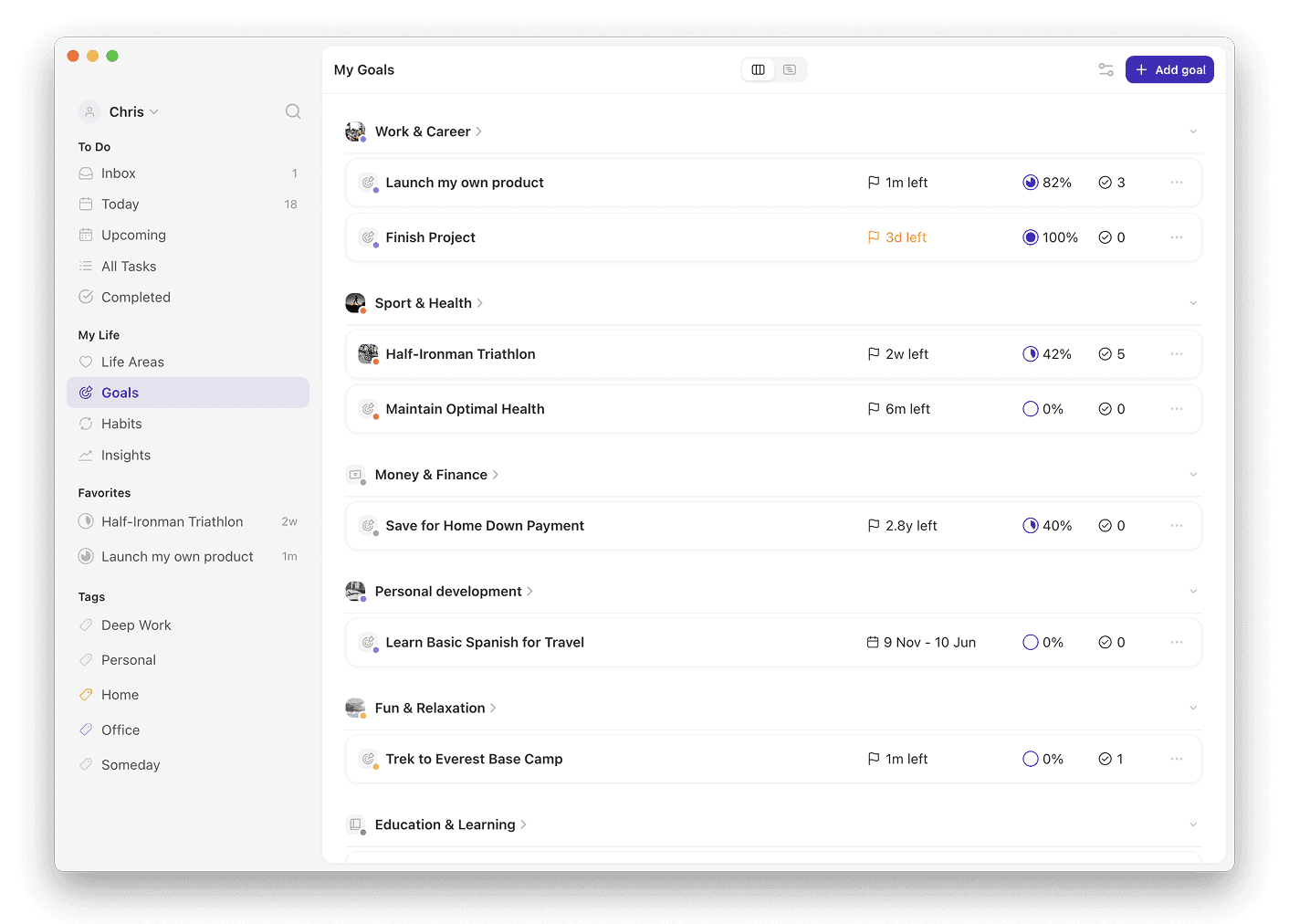
The hard part is rarely wanting to meditate. It is remembering it every day and seeing whether it is becoming a habit. In Griply the plan becomes one simple template under your Personal Development life area:
Goal: Meditate daily (metric: Unit-based, days on target, 0 to 30)
Task: pick a fixed time and a quiet spot
Task: choose a technique or a guided app
Habit: Meditate, starting at five minutes (schedule: every day)
Meditation is one repeated daily action, so the daily habit is the engine and the two setup tasks get you started. The habit tracks each day you sit, and you count a day toward 30 every time you meditate, so the goal fills up as the practice sticks. The Habit Tracker keeps your daily sits and your run of on-target days in one view. Habit targets and progress charts are part of Griply's paid plan; the free plan covers two goals and two habits.
Frequently asked questions
How long should a beginner meditate?
Start with five minutes a day. That is short enough to do even when you are busy or tired, which is what builds the habit. Once five minutes feels easy, add a minute or two every week or so and work up toward 10 to 20.
What do you do when your mind wanders?
Notice that it wandered, and gently bring your attention back to your breath. This is the practice itself. Your mind will drift many times in one session, and each time you return is a rep that trains your focus.
Do you have to clear your mind to meditate?
No. A blank mind is a myth. The aim is to rest your attention on one thing, usually the breath, and return to it when thoughts pull you away. Thoughts will keep coming, and that is completely normal, even for experienced meditators.
What do you say when meditating?
You do not have to say anything. Most beginners simply follow their breath in silence. If a focus point helps, you can silently repeat a single word or phrase, called a mantra, or count each breath from one to ten and begin again.
Do you need an app to start meditating?
No. You can meditate with just a timer and a quiet spot. A guided app or audio can help early on by giving your attention a track to follow, but it stays optional. Free options work fine, and you can drop the guidance as focusing gets easier.
Five minutes is enough
Starting meditation comes down to sitting for a few minutes, resting your attention on your breath, and coming back every time it drifts. You pick a time, keep the sessions short, and let the daily repetition do the work.
When five minutes at the same time each day becomes automatic, meditating stops feeling like a task you have to remember. Add a minute here and there, keep the spot and the time steady, and let the habit carry the practice. A calmer, clearer head supports your other personal-development goals. The days you least feel like sitting are often the ones that help most, so show up, follow one breath, and begin again.
Related Goal Plans


Related Guides
Goyal M, Singh S, Sibinga EMS, et al. "Meditation Programs for Psychological Stress and Well-being: A Systematic Review and Meta-analysis." JAMA Internal Medicine, 2014. https://pmc.ncbi.nlm.nih.gov/articles/PMC4142584/
Killingsworth MA, Gilbert DT. "A Wandering Mind Is an Unhappy Mind." Science, 2010. https://greatergood.berkeley.edu/images/uploads/A_Wandering_Mind_Is_an_Unhappy_Mind.pdf
Zeidan F, Johnson SK, Diamond BJ, David Z, Goolkasian P. "Mindfulness meditation improves cognition: Evidence of brief mental training." Consciousness and Cognition, 2010. https://pubmed.ncbi.nlm.nih.gov/20363650/
O'Donnell K, Dunbar M, Speelman D. "Effectiveness of Daily Mindfulness Meditation App Usage to Reduce Anxiety and Improve Well-Being During the COVID-19 Pandemic: A Randomized Controlled Trial." Cureus, 2023. https://pmc.ncbi.nlm.nih.gov/articles/PMC10448000/