

Table of Contents
A no-spend month is a set period where you pause all discretionary spending and pay only for true essentials like rent, bills, and groceries. Discretionary spending means anything you buy by choice, so takeout, new clothes, and impulse buys go on hold while the lights stay on. The point is to break impulse-buying patterns, see where your money actually goes, and keep more of it. It is a short reset that supports the money goals you are working on.
A clear rule is easier to hold than a vague plan to spend less. Across 29 studies, financial self-control strategies cut spending and lifted saving by a meaningful amount, and making money harder to reach was one of the strategies that showed up everywhere. The version here gives you a rule you can write in five minutes, a free swap for each spending trigger, and a daily habit you can track. Start by writing your rules.
Key takeaways
A no-spend month means paying for essentials only and pausing every discretionary purchase for 30 days.
Write clear rules first, so no purchase is a judgment call once you start.
Plan a free swap for each spending trigger, like boredom, stress, or eating out, before it hits.
In Griply you run the challenge as one goal measured in no-spend days, driven by a daily no-spend habit.
The plan, week by week
The month has four simple phases: set your rules, ride out the early urges, bank the momentum, then finish and add it up. Nothing here needs willpower on tap, because the work is deciding once and then repeating a small daily choice.
Week | What to nail this week | Rough time |
|---|---|---|
1 | Rules written, saved cards removed, one free swap ready per trigger | Days 1 to 7 |
2 | Use a swap every time an urge hits, and log each no-spend day | Days 8 to 14 |
3 | Keep the streak and note what you do not actually miss | Days 15 to 21 |
4 | Reach 30 no-spend days and tally what you saved | Days 22 to 30 |
The whole thing runs 30 days. The phases overlap in practice, since the habit you build in week one is the same one carrying you through week four.
Why it's harder than it looks
Spending is quick, frictionless, and often automatic, so the urge usually arrives before any decision does. Saved cards and one-tap checkout remove the pause that used to make you think twice. Paying with a card or phone dulls the pain of paying, the small sting of handing over money, which is why a tap feels like nothing and a stack of taps adds up fast.
Having more money at the end is the outcome you want, and holding each no-spend day is the process. Setting one specific rule and a 30-day finish line is what turns a vague wish into a daily choice you can actually make. You cannot control every price or bill. You can control whether you reach for a discretionary purchase today.
How to hold the line
Most of the work happens before day one. Decide the rules, cut the friction that leads to spending, and line up a swap for each trigger, so the month runs on the setup you did once.
Write your rules
Split your spending into two lists. Essentials are the things that keep your life running: rent or mortgage, utilities, groceries, transport, insurance, medical costs, and minimum debt payments. Off-limits is everything discretionary: takeout, coffee out, clothes, gadgets, books, apps, and any impulse buy. Write both lists down before you start, because a purchase you have to think about mid-month is a purchase you will talk yourself into. Giving the month a clear target and counting no-spend days is what makes a slip obvious the same day it happens.
Cut the friction
Remove saved cards from your browser, your phone wallet, and your favourite shopping apps, so buying takes real effort again. Unsubscribe from sale emails and pause the subscriptions you can live without for a month. If online shopping is your weak spot, log out of the sites entirely. The harder it is to spend on autopilot, the fewer choices you have to win by willpower.
Swap your triggers
Most discretionary spending is tied to a feeling or a moment, so name yours and give each one a free replacement. Bored, so you browse a shop: go for a walk or open a book instead. Stressed, so you buy something to feel better: try a short wind-down you already like. Meeting friends usually means dinner out: suggest a walk, a potluck, or coffee at home. Hungry with no plan, so you order takeout: cook what is already in the pantry. Decide the swap in advance and the urge has somewhere to go.
Park the wants
Cutting discretionary spending does not mean pretending you want nothing. Keep a running want list, and every time you feel the pull to buy something, write it down instead. Most urges fade within a day or two, and the ones that survive the whole month are the purchases worth making after it ends. The list also shows you, in your own words, how much of your spending was impulse.
Build the habit
A no-spend month comes down to one repeated daily choice, so build it as a daily habit. Habits are triggered by the situations around you, which is why removing saved cards and swapping your triggers does more than trying to resist in the moment. Change the cue and the new response gets easier every day.
Anchor the daily check to something you already do, like a coffee each morning, and mark the day as a no-spend day when you have earned it. A repeatable cue, routine, and reward loop is what carries a streak past the first hard week. When an urge does hit, reach for your swap first and your want list second.
Common mistakes
A few things quietly derail a no-spend month:
Vague rules. Decide up front what counts as essential, or every purchase becomes a debate you lose.
No plan for triggers. Name the moments that make you spend and set a free swap for each one.
All-or-nothing thinking. One slip is one day, so log it and keep the streak going from the next.
Stocking up right before you start. Buying a month of treats on day zero is gaming your own challenge.
Banning true essentials. Cut discretionary spending, keep groceries and bills, or you rebound the moment it ends.
Doing it alone in secret. Tell someone, since a person who knows makes a quiet slip less likely.
Set it up in Griply
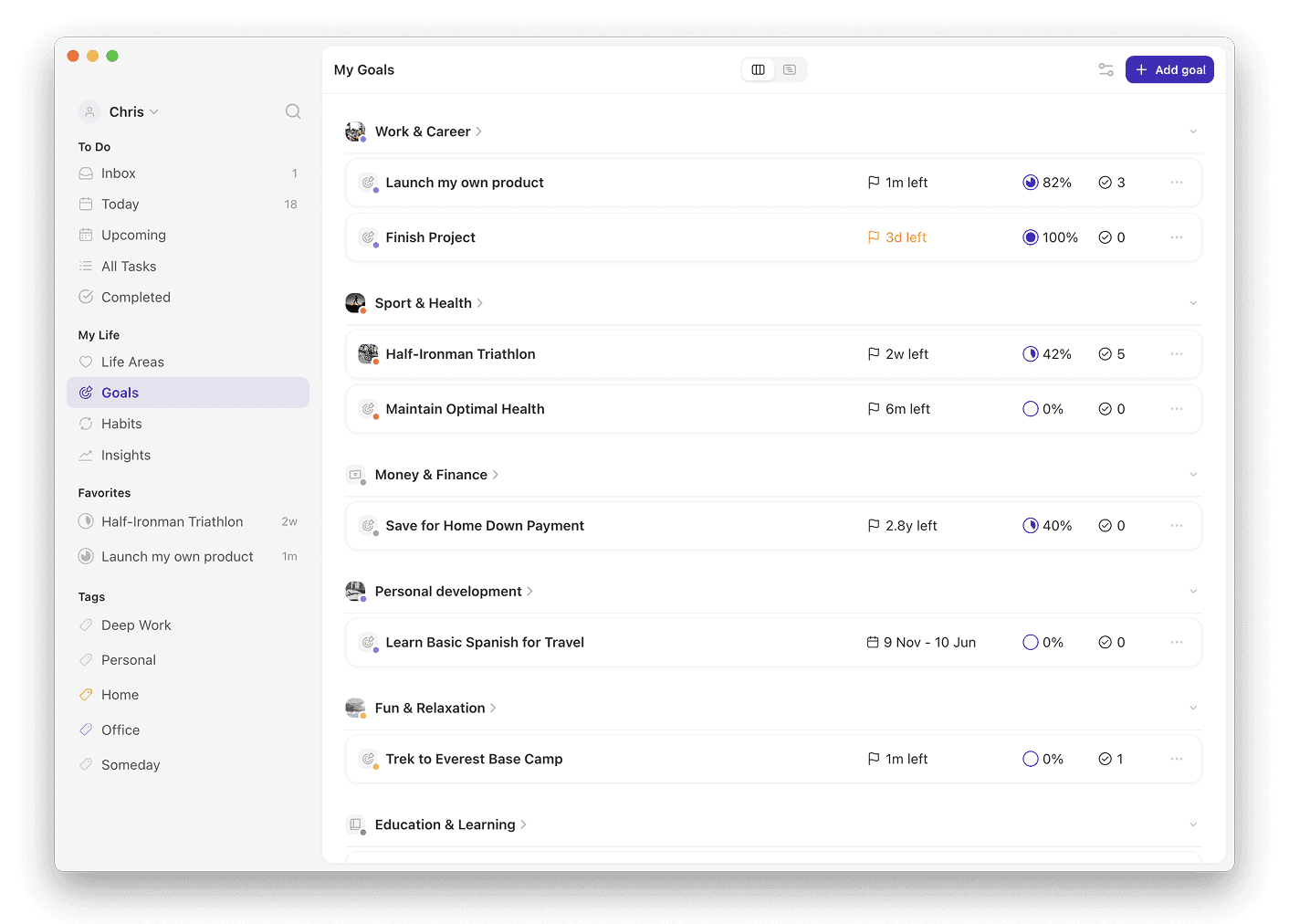
The hard part is rarely deciding to spend less. It is holding the line for 30 days and seeing whether the streak is building. In Griply the whole challenge becomes one template under your Money & Finance life area:
Goal: Do a no-spend month (metric: Unit-based, no-spend days, 0 to 30)
Habit: Spend nothing outside your essentials (schedule: every day)
Task: write your rules, what counts as essential and what is off-limits
Task: list your usual triggers and a free swap for each
Task: pick a start date and tell someone you trust
The daily habit does the work, and you log a no-spend day each time you hold the line, so the progress line climbs from 0 toward 30 and turns green when you finish. The Habit Tracker keeps the daily habit and the goal in one view, so the plan you just read becomes a template you can reuse next month. Habit targets and progress charts are part of Griply's paid plan; the free plan covers two goals and two habits.
Frequently asked questions
How does a no-spend month work?
You pick a start date and pay only for essentials like rent, bills, and groceries for 30 days, pausing all discretionary spending. You decide your rules up front, swap the habits that usually make you spend, and count every no-spend day toward 30.
What counts as essential in a no-spend month?
Essentials are the costs that keep your life running: rent or mortgage, utilities, groceries, transport, insurance, medical costs, and minimum debt payments. Everything you buy by choice, like takeout, clothes, and gadgets, goes on hold. Write both lists before you start so nothing is a judgment call.
Do no-spend months save money?
Yes, when the rules are clear. Structured self-control strategies meaningfully cut spending, and pausing discretionary purchases for a month frees up whatever you would have spent on them. The bigger payoff is spotting which of those purchases were impulse, which changes how you spend after the month ends.
What do you do if you slip up and buy something?
Log the slip, keep the money lesson, and start the next day fresh. One purchase is one day off, and the streak resumes the next morning. If the same trigger keeps catching you, tighten that swap and keep the challenge running.
Is a no-spend week better than a full month for beginners?
A no-spend week is a fair first run if a month feels steep. It teaches the same rules and swaps with lower stakes, and you can repeat it or step up to 30 days once the daily habit feels normal. The month gives a clearer picture of your patterns.
Spend on what matters
A no-spend month works when the rules are simple and the triggers are handled: pay for essentials, pause the rest, swap the moments that usually make you buy, and count each no-spend day toward 30. The daily choice is small, and the setup you did on day one is what makes it repeatable.
When you reach day 30, the money you kept is only half the point. The want list in your hand shows how much of your spending was impulse, and the few items still on it are the ones worth buying on purpose. That is the habit you carry forward, whether you run it again next month or fold the lesson into your everyday budget.
Related Goal Plans


Related Guides
Davydenko M, Kolbuszewska M, Peetz J. "A meta-analysis of financial self-control strategies: Comparing empirical findings with online media and lay person perspectives on what helps individuals curb spending and start saving." PLoS One, 2021. https://pmc.ncbi.nlm.nih.gov/articles/PMC8266115/
Ma Q, Tan Y, He Y, Cheng L, Wang M. "Why does mobile payment promote purchases? Revisiting the pain of paying, and understanding the implicit pleasure via selective attention." PsyCh Journal, 2024. https://pmc.ncbi.nlm.nih.gov/articles/PMC11444724/
Wood W, Neal DT. "A new look at habits and the habit-goal interface." Psychological Review, 2007. https://dornsife.usc.edu/wendy-wood/wp-content/uploads/sites/183/2023/10/wood.neal_.2007psychrev_a_new_look_at_habits_and_the_interface_between_habits_and_goals.pdf