


Table of Contents
Sleeping better comes down to a handful of daily habits: a consistent sleep and wake time, a wind-down routine, and managing light, caffeine, and screens. None of them is complicated, but they work together, so the payoff comes from doing several most nights. This plan lays out the levers that matter and how to start each one. It is for ordinary poor sleep; if you have chronic insomnia or a suspected sleep disorder, see a doctor, since these habits are not a treatment for a medical condition.
Key takeaways
Better sleep comes from a few daily habits done consistently, above all a regular sleep and wake time.
A wind-down routine, morning light, and managing caffeine, alcohol, and screens all move the needle.
If you cannot fall asleep after about 20 minutes, get out of bed and return when you feel sleepy.
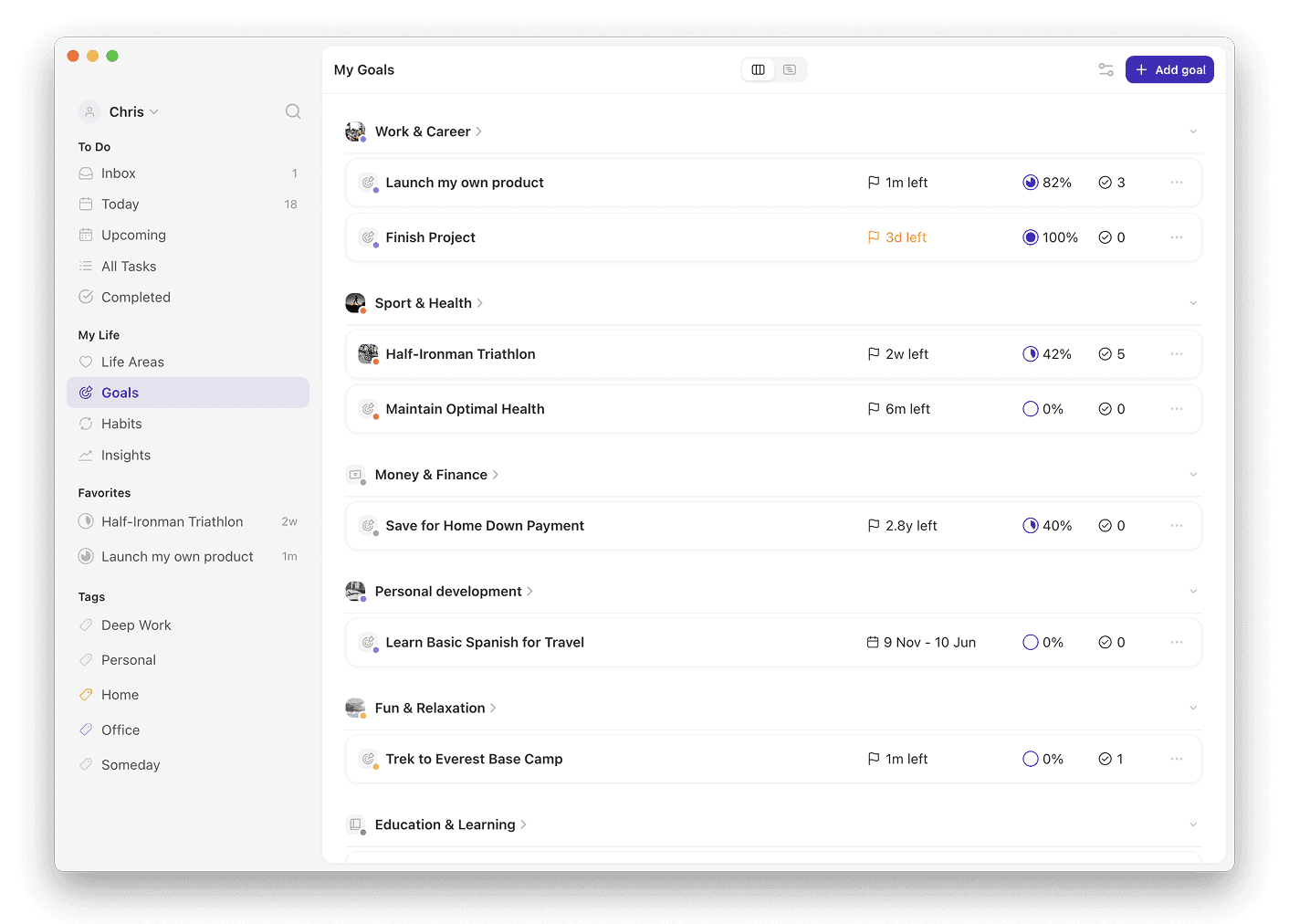
In Griply you set better sleep as one goal, attach a consistent-bedtime habit and a wind-down habit, and track it.
The levers at a glance
These are the levers that shape your sleep. Together, these everyday habits and conditions are what "sleep hygiene" means: the daily choices around schedule, light, caffeine, screens, and your bedroom that make good sleep more likely. You do not need all of them at once, so start with a consistent schedule and a wind-down routine, then add the rest. Giving your sleep a number to track, like your average hours or the nights you kept the routine, makes progress visible.
Lever | What to aim for | How to start |
|---|---|---|
Consistent schedule | Same sleep and wake time, within 30 min, 7 days a week | Pick a wake time you can keep daily, count back 7.5-8 hours |
Wind-down routine | A 30-60 min pre-bed routine every night | Dim the lights and run the same short sequence at a fixed time |
Morning light | 10-30 min of daylight within an hour of waking | Open the curtains and step outside soon after you get up |
Caffeine timing | No caffeine within about 8 hours of bed | Have your last cup by early afternoon |
Alcohol timing | Avoid alcohol within 3-4 hours of bed | Move drinks earlier and keep them moderate |
Screens | No bright screens 30-60 min before bed | Dim your phone, use night mode, or read on paper |
Bedroom | Cool, dark, and quiet, around 18°C | Blackout curtains or an eye mask, earplugs or white noise |
When you can't sleep | Out of bed after about 20 minutes awake | Do something calm in dim light, return when sleepy |
Why it feels hard
Sleep is not something you can force by trying harder, and the harder you chase it, the more it slips. What you can change are the conditions around it. How regular your sleep and wake times are is closely linked to better health, arguably more than how many hours you get, which is why a consistent schedule is the first lever to fix.
Falling asleep is the outcome you want. The evening habits are the process, and keeping the two separate is what stops one bad night from spiralling. You cannot command sleep to come. You can control the routine that invites it.
The levers, one by one
Start with the first two levers, then layer on the rest over a couple of weeks. A simple order: week one, lock in a fixed wake time and a wind-down routine; week two, add morning light and an earlier caffeine cutoff; week three, add alcohol timing and dimmed screens; and set up the bedroom once as a one-off. They reinforce each other, so each one you fix makes the next easier.
Keep a consistent sleep and wake time
Pick a wake time you can hold every day, including weekends, and count back about eight hours for lights-out. Keeping weekends within an hour of weekdays avoids the Monday-morning grogginess that a big lie-in causes.
Build a wind-down routine
For 30 to 60 minutes before bed, dim the lights and run the same calm sequence: a shower, a book, some light stretching. Stopping work and email when it begins signals your body that the day is done. Here is a sample evening for a 7:00 wake and an 11pm lights-out: last coffee by about 2pm, last drink by 7pm, at 9:30 dim the lights and move your phone out of the room, 10:00 shower, 10:20 read or stretch, and 10:50 lights out. Anchoring the routine to a fixed clock is what teaches your body the cue.
Get light early
Bright light within an hour of waking is the strongest signal for your body clock. Open the curtains and step outside for ten to thirty minutes, since daylight in the morning helps you feel sleepy at the right time that night. A brisk walk while you are out there doubles as progress toward 10,000 steps a day.
Cut caffeine early
Caffeine within about six hours of bed measurably harms your sleep, even when you do not feel it, so have your last cup by early afternoon. It has a long half-life, so an afternoon coffee can still be working at midnight.
Move alcohol earlier
A nightcap helps you fall asleep faster but fragments the second half of the night, so keep drinks moderate and finish them three to four hours before bed.
Dim screens before bed
Bright screen light in the evening suppresses melatonin and pushes your body clock later, so avoid bright screens for the last half hour to hour. Dim your phone, use night mode, or read on paper, and charge the phone outside the bedroom.
Make the bedroom cool, dark, and quiet
Aim for around 18 degrees, blackout curtains or an eye mask, and earplugs or white noise. Keep the bed for sleep, so your body links it with rest.
Get up if you cannot sleep
If you are still awake after about 20 minutes, get out of bed and do something calm in dim light, then return when you feel sleepy. Lying there clock-watching trains your body to associate bed with frustration.
Build the habits
The two habits worth locking in first are a consistent bedtime and a wind-down routine, since the rest follow more easily once those hold. Building the wind-down into a habit your body expects, like the same three steps at the same time each night, is what turns good intentions into something automatic.
Common mistakes
A few habits quietly undo the rest:
Sleeping in on weekends. A big lie-in resets your body clock, and a steady wake time is the strongest lever you have.
Lying in bed awake for ages. After about 20 minutes, get up and do something calm in dim light, then return when sleepy.
Using the bed for work or scrolling. Keep it for sleep, so your body links it with rest.
A nightcap to fall asleep. Alcohol helps you drop off but fragments the second half of the night, so finish drinks a few hours before bed.
Trying to fix all the levers at once. Start with the schedule and wind-down, then add the rest over a couple of weeks.
Going to bed earlier without moving your wake time. Hold the wake time steady first, and the bedtime settles once the schedule does.
Set it up in Griply
The hard part is rarely knowing the levers. It is holding them together night after night and seeing whether your sleep is improving. In Griply the whole plan becomes one template under your Sport & Health life area:
Goal: Sleep 8 hours a night (metric: Unit-based, average hours)
Habit: Keep a consistent bedtime and wake time (schedule: every day)
Habit: Run your wind-down routine (schedule: every night)
Task: make the bedroom cool and dark
Task: move screens out of the bedroom
You log your hours each morning, and the progress line trends toward your target and turns green when you hold it. The Habit Tracker keeps the goal, its habits, and your setup tasks in one view, so the plan you just read becomes a template you can keep. Habit targets and progress charts are part of Griply's paid plan; the free plan covers two goals and two habits.
Frequently asked questions
How can I fall asleep faster?
Keep a consistent bedtime, dim the lights and screens for the last hour, and run a short wind-down routine. If you are still awake after about 20 minutes, get up and do something calm until you feel sleepy again.
Why do I wake up in the middle of the night?
Common causes are alcohol, a warm or bright room, and caffeine still in your system. Finishing drinks earlier, cooling and darkening the bedroom, and cutting afternoon caffeine often reduces night-time waking. Persistent waking is worth raising with a doctor.
Does a consistent sleep schedule matter on weekends?
Yes. Keeping your wake time within about an hour on weekends avoids resetting your body clock, which is what makes Monday mornings feel so rough. Regularity across all seven days is one of the strongest sleep habits.
How long before bed should you stop drinking caffeine?
About eight hours, so your last cup lands by early afternoon for a normal bedtime. Caffeine has a long half-life, and even a mid-afternoon coffee can measurably affect your sleep that night, even when you do not feel wired.
What should you do if you cannot sleep?
Get out of bed after about 20 minutes, keep the lights low, and do something calm like reading until you feel sleepy, then go back. This keeps your body linking the bed with sleep, so it stays a place you rest.
Fix the conditions
Better sleep is not about one trick. It is about a few habits held most nights: a steady schedule, a wind-down routine, morning light, and sensible timing on caffeine, alcohol, and screens. Each lever you fix makes the next one easier, so you do not have to change everything at once.
When your bedtime is steady and your evenings wind down the same way, falling asleep stops being a nightly battle. Start with the schedule and the routine, add the rest over a couple of weeks, and let the conditions do the work. The same steady approach carries the rest of your everyday health goals.
Related Goal Plans


Related Guides
Windred DP, Burns AC, Lane JM, et al. "Sleep regularity is a stronger predictor of mortality risk than sleep duration: A prospective cohort study." Sleep, 2024. https://pmc.ncbi.nlm.nih.gov/articles/PMC10782501/
Drake C, Roehrs T, Shambroom J, Roth T. "Caffeine effects on sleep taken 0, 3, or 6 hours before going to bed." Journal of Clinical Sleep Medicine, 2013. https://pmc.ncbi.nlm.nih.gov/articles/PMC3805807/
Irish LA, Kline CE, Gunn HE, Buysse DJ, Hall MH. "The role of sleep hygiene in promoting public health: A review of empirical evidence." Sleep Medicine Reviews, 2015. https://pmc.ncbi.nlm.nih.gov/articles/PMC4400203/
Chang AM, Aeschbach D, Duffy JF, Czeisler CA. "Evening use of light-emitting eReaders negatively affects sleep, circadian timing, and next-morning alertness." PNAS, 2015. https://pmc.ncbi.nlm.nih.gov/articles/PMC4313820/