

Table of Contents
A weekly date night is a recurring block of couple time you protect on a set day and treat as a standing commitment, the same as any other appointment you would not miss. Most couples know date nights matter and still let them slide, because couple time is the easiest thing to cut when work, kids, and chores fill the week. A fixed slot solves that. You pick a cadence, put it in both calendars, and defend it. Planning the date in advance also beats waiting for a spontaneous free evening, because couples who plan their dates report more exciting time together and feel closer afterwards. The plan below shows how to set a cadence you can keep, protect it against a busy week, and keep it fresh over months, so regular date nights become part of how your week runs.
Key takeaways
A set, protected date night beats a good intention once the week fills up, because it survives as a booked commitment.
Pick a cadence you can actually keep. Every two weeks you defend beats a weekly plan you cancel.
Rotate in new and slightly novel activities, since shared novelty is what lifts how close a date leaves you feeling.
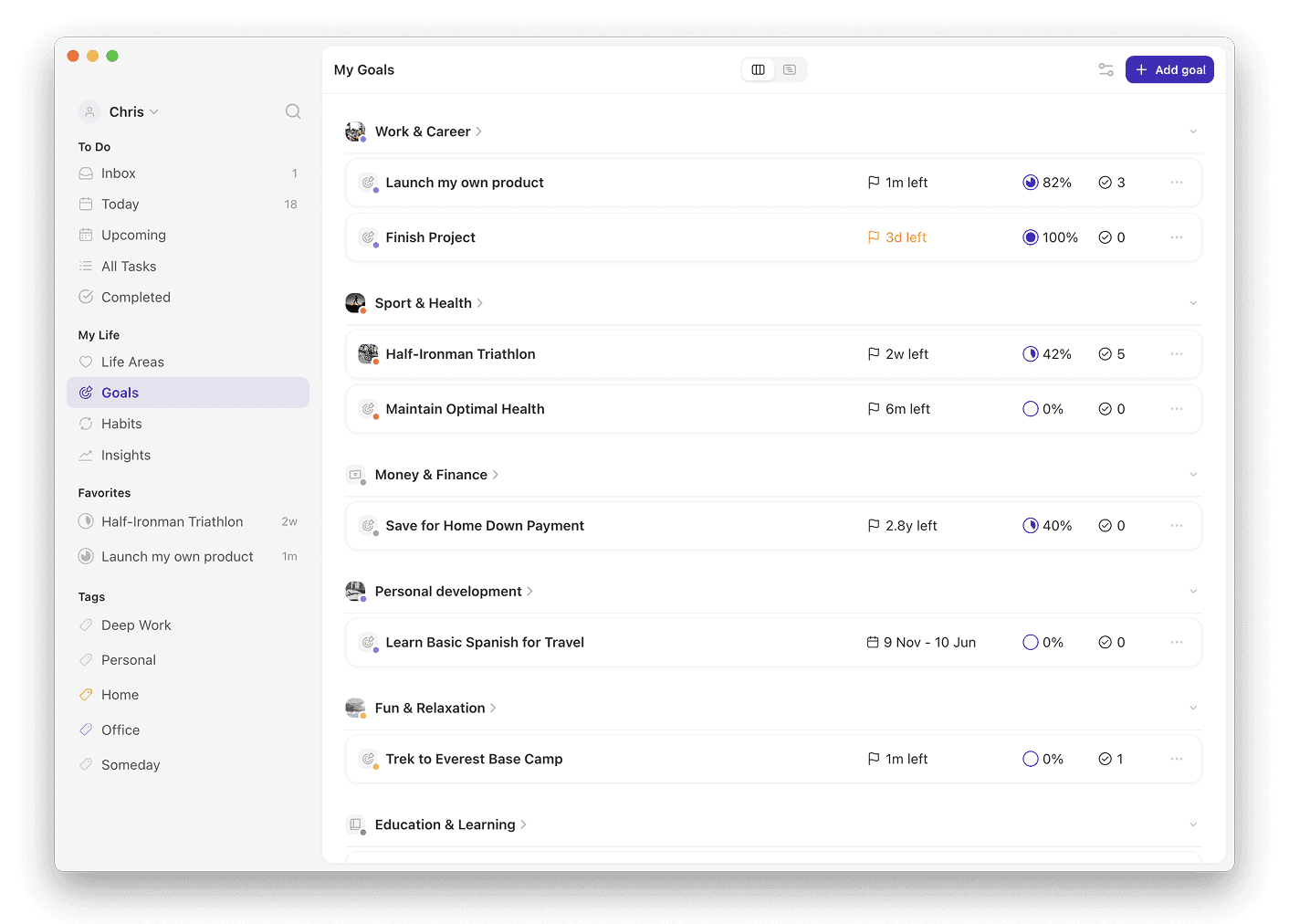
In Griply you set date nights as one goal, run the night as a weekly habit, and count each one toward your target.
The plan, step by step
Here is the whole plan before you start. The first three steps are a one-off setup; the last three repeat every date night.
Step | What to aim for | How to start |
|---|---|---|
Pick a cadence | Weekly, or every two weeks if weekly is unrealistic | Choose the night you both protect most easily |
Block the slot | The same day and time in both calendars | Add it as a repeating event you both accept |
Sort logistics once | A sitter, a small budget, and a backup agreed | Line up one regular sitter or a swap with friends |
Build an ideas list | Ten or more dates you both want to do | Add easy nights in plus a few bigger novel ones |
Run the date | Phones away, no chores or logistics talk | Agree the one topic that is off-limits tonight |
Keep it fresh | A new or novel date every few weeks | Alternate an easy favourite with something new |
Track it | Every date night logged and reviewed monthly | Tick the night off and count it toward your target |
Most couples settle into the rhythm within a month or two. Once the slot and the logistics are set, the weekly part is just showing up and picking the next idea off your list.
Why it slips
Date night is usually the first thing to go when the week gets full, because the cost of skipping one feels small and the payoff is spread out over months. That is the trap. A close relationship is the outcome you want. The date night itself is how you get there, and setting it as a goal the two of you plan together is what stops you trading it away for a busy Tuesday. You cannot control how connected you feel on any given week. You can control whether you show up for the night you booked.
Regularity is what pays off. Couples who make time for a regular date night are more likely to report being happy in their marriage and to rate divorce as unlikely than couples who rarely get couple time. The night is small. The compounding over a year is not.
How to protect the slot
Protecting the slot is the whole game. Start by picking a cadence you can keep every time, because a fortnightly date you never cancel builds more trust in the plan than a weekly one you skip half the time. Put it in both calendars as a repeating event, at a time you both have energy. An early evening usually works better than a late one after the kids finally sleep.
Defend the slot like a standing appointment. When something wants the evening, move the date to another night the same week so it still happens. Sort the recurring logistics once: a regular sitter, a small budget, and a no-cost backup for the weeks money is tight, so each date does not start with a fresh negotiation. Logging each date night on a simple weekly tracker makes a slipping month obvious before it becomes a lost season.
Keep it fresh
A date night that becomes dinner at the same place every week slowly stops feeling like a date. The fix is novelty. Couples who share new and slightly exciting activities report higher relationship quality than couples who stick to pleasant but familiar routines, so build a little newness into the rotation.
You do not need a grand gesture every week. Alternate an easy favourite with something neither of you has done: a class, a new neighbourhood, a walk somewhere unfamiliar, a game you have never played. Keep a shared list so you are never planning from a blank page at six. A simple month might run: week one an easy dinner out, week two a cooking class, week three a favourite film at home, week four a hike with a picnic.
Build the habit
A date night sticks when the night itself becomes automatic. A repeatable cue, routine, and reward loop, like the sitter arriving every other Friday at seven, carries the plan on the weeks neither of you feels like organising anything. Tie the date to a fixed anchor in your week so it runs without a fresh decision each time. The night also gives you a natural place to communicate better with your partner, away from chores and logistics.
Common mistakes
A few habits quietly undo most couples:
Cancelling the date whenever work runs late. Move it to another night the same week.
Repeating the same dinner every week until it feels like a chore. Rotate in something new.
Turning the night into a logistics meeting about bills, kids, and chores.
Booking it so late that you are both too tired to enjoy it.
Scrolling your phones through dinner, which cuts the date short.
Set it up in Griply
The hard part is rarely deciding date night matters. It is protecting the slot week after week and seeing whether it is becoming a habit. In Griply it becomes one simple template under your Love & Relationships life area:
Goal: Have regular date nights (metric: Unit-based, date nights done, 0 to 12)
Habit: Have a date night (schedule: once a week)
Task: pick your night and block it in both calendars
Task: build a shared list of date ideas together
Task: line up a regular sitter or a no-cost backup
You run the date as a weekly habit and log each one, so the goal fills toward twelve across the quarter and your run of on-schedule weeks sits in one view. The Habit Tracker keeps the recurring night and your setup steps together, so the plan you just read becomes a template you can reuse. Habit targets and progress charts are part of Griply's paid plan; the free plan covers two goals and two habits.
Frequently asked questions
How often should couples have a date night?
Once a week is a common target, but every two weeks is a realistic floor for busy couples. Consistency matters more than frequency, so pick a cadence you can protect and keep it every time you set it.
Is a weekly date night too much?
For most couples, no. A weekly date night is an aspiration many couples struggle to reach, so the usual risk is too few dates. If weekly feels forced or keeps getting cancelled, drop to every two weeks and protect that slot.
What counts as a date night if you cannot go out?
Anything that is intentional couple time with no chores, work, or phones. A cooked meal after the kids sleep, a shared film, a game, or a long walk all count. The protected attention matters more than the venue.
How do you keep date night from getting boring?
Rotate in new activities. Shared novelty, a class, a new place, something neither of you has tried, lifts how close a date leaves you feeling. Alternate easy favourites with one fresh idea, and keep a shared list so you never plan from scratch.
What if you have kids and no babysitter?
Set up an at-home date after bedtime, or swap childcare with another couple so each pair gets a night out. Line up one regular sitter if you can. A fixed backup plan keeps the date from collapsing when childcare falls through.
Protect the slot
Regular date nights come down to one repeated decision: protect the slot, and keep it interesting enough that you both look forward to it. You pick a cadence you can actually keep, defend it against the busy weeks, and rotate in enough novelty that the night never becomes routine.
When the sitter is booked, the night is in both calendars, and the next idea is already on your shared list, date night stops depending on whoever remembers to organise it. Log each one and glance at the month, and a slipping stretch is obvious while you can still fix it. The couples who keep this going are rarely the ones with the most free time. They are the ones who decided the night was non-negotiable and built a small system around it, the same system that carries the rest of your relationship goals.
Related Goal Plans


Related Guides
Aron A, Norman CC, Aron EN, McKenna C, Heyman RE. "Couples' shared participation in novel and arousing activities and experienced relationship quality." Journal of Personality and Social Psychology, 2000. https://pubmed.ncbi.nlm.nih.gov/10707334/
Harasymchuk C, Walker DL, Muise A, Impett EA. "Planning date nights that promote closeness: The roles of relationship goals and self-expansion." Journal of Social and Personal Relationships, 2021. https://pmc.ncbi.nlm.nih.gov/articles/PMC8170361/
Wilcox WB, Dew J. "The Date Night Opportunity: What Does Couple Time Tell Us About the Potential Value of Date Nights?" National Marriage Project, 2023. https://nationalmarriageproject.org/2023-date-night-opportunity