


Table of Contents
Drinking more water comes down to picking a realistic daily target and building a habit of hitting it. For most adults that is roughly 1.5 to 2.5 litres, or six to eight glasses of total fluid a day, and more when it is hot or you exercise. The familiar "eight glasses" rule is a rough guide, not a hard scientific requirement, and food and other drinks count toward the total. This plan gives you a target you can actually reach and simple ways to hit it every day, one of the easiest wins among your everyday health goals.
Key takeaways
Most adults need roughly 1.5 to 2.5 litres of total fluid a day, and food and other drinks count.
The "eight glasses" rule is a rough guide, and pale straw-coloured urine is a better daily gauge.
You hit a daily target by tying glasses to routines you already have, then tracking them.
In Griply you run your daily water target as a habit and count your on-target days toward a 30-day goal.
The plan at a glance
Here is the whole plan before you start. Pick a target, use a simple gauge, and make the glasses easy to remember and count.
Step | What to aim for | How to start |
|---|---|---|
Set a target | About 6 to 8 glasses, roughly 2 litres, a day | Pick a round number you will actually hit |
Use a gauge | Pale straw-yellow urine most of the day | Check the first few times you go |
Get one bottle | A marked bottle you refill | Keep it in sight and count the refills |
Anchor your sips | A glass at a few fixed daily cues | On waking, before meals, with coffee |
Track it | Log the target hit or missed each day | Check off each glass as you drink it |
How much water do you need
For most adults, total water intake of about 2 litres a day for women and 2.5 for men covers it, including the water in food and all your drinks, so plain water is not the only path. Drink more in heat, during exercise, when ill, or in pregnancy. Pale straw-coloured urine is a better everyday signal than counting exact millilitres. More is not always better, since drinking a very large volume very fast can overwhelm your kidneys and dilute your blood sodium, so spread your intake across the day and aim for pale straw, staying short of completely clear.
Why it's harder than it sounds
Water is easy to forget when nothing reminds you, and thirst often lags behind what your body needs. Even mild dehydration can dent your mood, concentration, and energy, so the cost of falling short is real before you feel thirsty.
Being hydrated is the result you want, and drinking the glasses is how you get there. Turning a vague intention into a countable daily habit is what makes progress visible. You cannot always feel when you are low. You can control whether you take the sips you planned.
How to hit your target
The trick is to stop relying on memory. Tie glasses to things you already do every day: one on waking, one before each meal, one with every coffee, and one before bed. Those fixed glasses get you most of the way, so add a top-up mid-morning and mid-afternoon to reach your number. Attaching sips to a routine you already keep removes the effort of remembering. Keep a marked bottle in sight so the glasses are countable, and add fruit, cucumber, or mint if plain water bores you. Making the target specific and measurable, like eight glasses logged, is what makes a missed day obvious early.
Build the habit
A daily target sticks when drinking becomes automatic. Pinning each glass to something you already do, like a glass every time you sit down at your desk, keeps the habit going without willpower. Watch for the signs you are running low, such as thirst, dark urine, a headache, or trouble concentrating, and top up before they build.
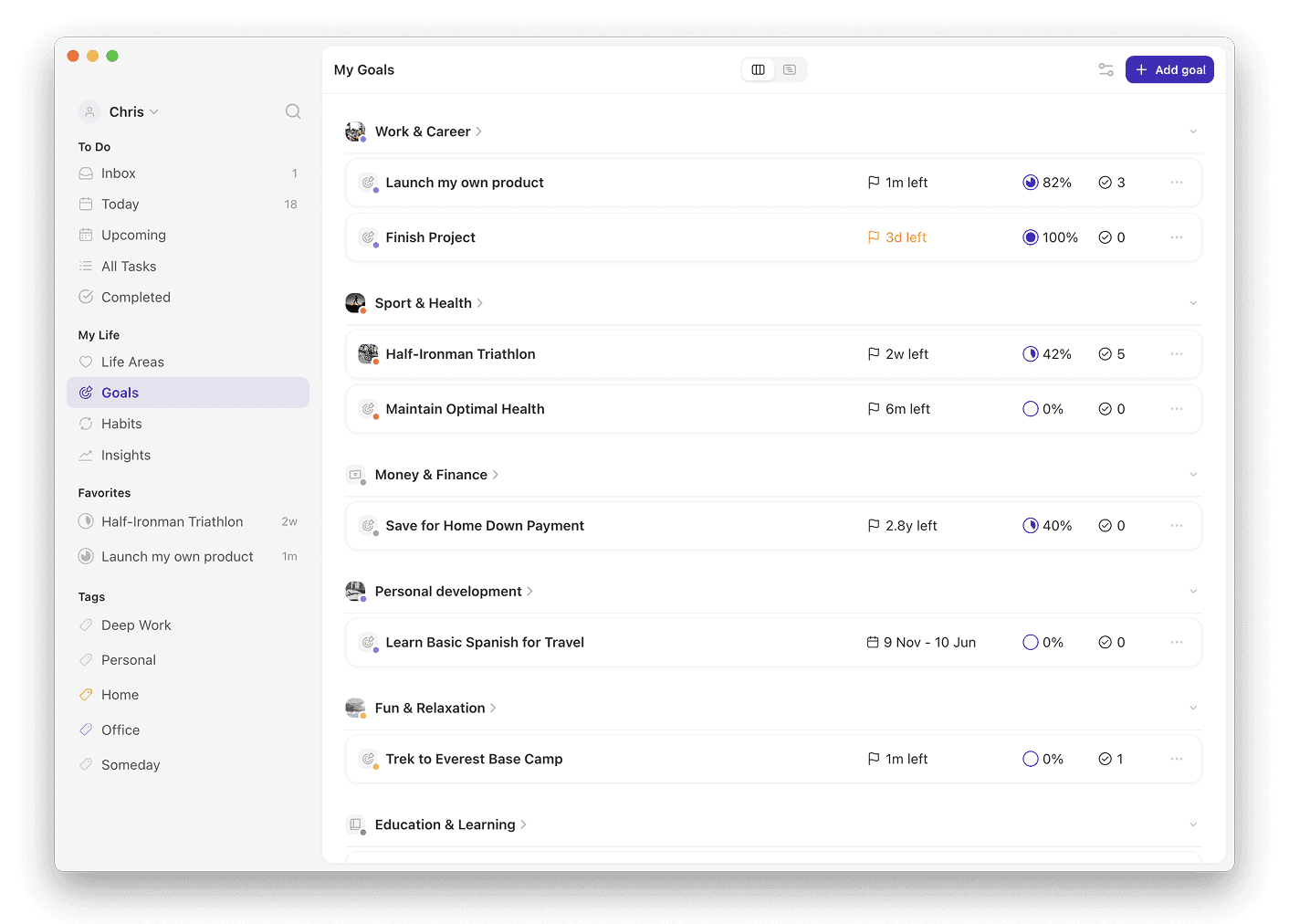
Set it up in Griply
The hard part is rarely wanting to drink more. It is remembering day after day and seeing whether it is becoming a habit. In Griply the plan becomes one simple template under your Sport & Health life area:
Goal: Drink 2L of water a day (metric: Unit-based, days on target, 0 to 30)
Habit: Drink your target, counted glass by glass (schedule: every day)
A hydration goal is one repeated daily action with no ladder of milestones, so the daily habit is the whole engine. The habit tracks each day glass by glass, and you count a day toward 30 every time you hit your target, so the goal fills up as the habit sticks. The Habit Tracker tallies your glasses and your run of on-target days in one view. Habit targets and progress charts are part of Griply's paid plan; the free plan covers two goals and two habits.
Frequently asked questions
How much water should you drink a day?
For most adults, about 1.5 to 2.5 litres of total fluid, or six to eight glasses, and more in heat or with exercise. Food and other drinks count toward the total, so you do not need to hit it all with plain water.
Do you need eight glasses of water a day?
Not as a strict rule. The "eight glasses" figure is a rough guide, and no study proves you need exactly that. Use pale straw-coloured urine as your gauge, and drink to thirst plus a bit more, adjusting up on hot or active days.
Does tea, coffee, and food count toward your water intake?
Yes. All drinks, including tea and coffee, and water-rich foods like fruit and vegetables count toward your daily total. The old idea that coffee dehydrates you does not hold for normal amounts.
What are the signs you are not drinking enough water?
Thirst, dark yellow urine, a headache, tiredness, and trouble concentrating are common signs. Mild dehydration is enough to affect your mood and focus, so treat these as a simple cue to drink and top up.
Can you drink too much water?
Rarely, but yes. Drinking a very large volume very fast can dilute your blood sodium, which is dangerous. Spread your intake across the day and aim for pale straw, staying short of completely clear. A normal daily target is safe.
Make it easy
Drinking more water is not about forcing down litres. It is about a target you can hit, a bottle you keep in sight, and a few glasses tied to things you already do each day. You pick a number, use pale urine as your gauge, and count the glasses as you go.
When a glass on waking and one before each meal become automatic, hitting your target stops taking any thought. The same daily loop is what carries better sleep and the rest of your routine. Keep the bottle handy, anchor the sips to your routine, and let the habit carry it.
Related Goal Plans


Related Guides
EFSA Panel on Dietetic Products, Nutrition and Allergies. "Scientific Opinion on Dietary Reference Values for water." EFSA Journal, 2010. https://efsa.onlinelibrary.wiley.com/doi/10.2903/j.efsa.2010.1459
Valtin H. "'Drink at least eight glasses of water a day.' Really? Is there scientific evidence for '8 x 8'?" American Journal of Physiology, 2002. https://journals.physiology.org/doi/full/10.1152/ajpregu.00365.2002
Popkin BM, D'Anci KE, Rosenberg IH. "Water, hydration, and health." Nutrition Reviews, 2010. https://pmc.ncbi.nlm.nih.gov/articles/PMC2908954/
Yamashiro M, Hasegawa H, Matsuda A, et al. "A Case of Water Intoxication with Prolonged Hyponatremia Caused by Excessive Water Drinking and Secondary SIADH." Case Reports in Nephrology and Urology, 2013. https://pmc.ncbi.nlm.nih.gov/articles/PMC3924712/