

Table of Contents
Asking for a raise means making a prepared, deliberate case to your manager for higher pay: you research what your role pays, gather your results with numbers, pick the right moment, and state a specific figure. Most people never do it. When a pay conversation feels awkward, the awkwardness usually wins, and the raise goes to whoever spoke up. Yet most workers who do negotiate walk away with more than they were first offered. A raise is rarely a reward that arrives on its own. It is the outcome of a short, deliberate campaign, and this plan covers the concrete steps that earn one. It sits alongside the rest of your work and career goals as a move you can plan and run. Start by finding out what your role is actually worth.
Key takeaways
A raise is decided by your manager inside a budget you cannot see, so you control the preparation and the ask.
The steps that earn one: research your market rate, build a numbered case, time it well, and ask for a specific figure.
Most people never ask, and most who do get more than they were first offered.
In Griply you set the raise as one goal, add the steps as tasks, and keep a weekly habit of logging wins.
The plan, step by step
Here is the whole plan before you start. The steps run over a few weeks of prep, then one conversation, so you always know what to have ready and roughly when.
Step | What to have done | Rough time |
|---|---|---|
1. Know your number | Market-rate range for your role, written down | Week 1 |
2. Build your case | A wins log, each win with a number | Week 1-2 |
3. Set your target | The exact figure you will ask for, plus a floor | Week 2 |
4. Time it right | The review or budget window picked | Week 2 |
5. Book the 1:1 | A meeting set to talk pay | Week 3 |
6. Make the ask | Your number said out loud, backed by the case | The conversation |
7. Handle the reply | A yes, a counter, or a written path to yes | After |
Most people can run this in two to four weeks. The steps overlap, so you build the wins log while you research the market rate, and you set your number the same week you pick the window.
How to do each step
The prep is short, and each step feeds the next. Here is how to do each one.
Research your market rate
Market rate is what people in your role, level, and location are paid now. Pull it from salary sites like Glassdoor, Levels.fyi, and Payscale, from recent job posts for your title, and from one or two peers you trust. Write down a range, then place yourself in it honestly based on your experience and results.
Build a numbered case
List what you have delivered since your last pay change, and put a number on each item: revenue won, cost saved, hours saved, users added, tickets closed, whatever your team counts. Giving each win a number turns "I work hard" into evidence your manager can repeat to their own boss. Aim for two or three results framed in your company's own metrics.
Set your target number
Decide the exact figure you will ask for, and a floor you will accept. Aim near the top of your market range when your results support it. The first specific number on the table tends to pull the final figure toward it, so name a researched number yourself. That opening figure is your anchor, the reference point the rest of the conversation moves around, so make it a real number and say it with a straight face.
Time the ask
Pick a moment when your value is fresh and money is on the table: just after a visible win, at a performance review, or when budgets are set, often at year-end or the start of a quarter. Steer clear of the week of a bad result or a company cost freeze, when the answer is a reflex no.
Book the 1:1
Ask your manager for a short meeting and name the topic, so they arrive ready. A line like "I would like 20 minutes to talk about my compensation" beats springing it at the end of a status call. A heads-up gives them time to check the budget before you sit down.
Make the ask
Say your number out loud, then back it with the case: your market data and your two or three quantified wins. Keep it short and calm, then stop talking and let them respond. Silence after the ask is normal and works in your favour, so resist the urge to fill it or to talk yourself down.
Handle the reply
You will get a yes, a counter, or a "not now." A counteroffer is their number sent back to you, and it is the start of the negotiation. For a counter, restate your figure once and ask what would close the gap. For a no, ask exactly what would make it a yes and by when, then get that answer in writing so the next cycle has a clear target.
Why it feels hard
A raise depends on a decision your manager makes inside a budget you cannot see, so it can feel like it rests on luck or nerve. It rests on more than that. The raise is the outcome, and the surest route to it is to start from the ask and work back to the steps that earn it, so preparation replaces nerves when the money conversation looms.
The parts you can build are the parts that move the result. Negotiators who go in prepared and who treat the ask as a skill they can learn tend to claim more value than those who wing it. You cannot control the budget or the final answer. You can control whether you walk in with a researched number and a case that earns it.
Build the habit
The case is built over weeks, so a weekly habit is the engine. Once a week, add the past week's wins to your log with numbers, and rehearse the ask out loud until your figure leaves your mouth without a flinch. A repeatable cue, routine, and reward loop for that review keeps your case current, so whenever a window opens you can ask that week with the evidence already in hand.
Practising the words matters as much as the log. Say the exact sentence you will use, out loud, a few times before the meeting, so the number feels ordinary by the time you are across the table.
Common mistakes
A few habits keep good people underpaid:
Waiting to be noticed. A raise goes to whoever makes the case, so book the conversation.
Asking with no number. Bring a specific figure and a floor, or you hand the anchor to your manager.
Listing finished tasks. Put a number on each win so it travels to the people who decide.
Leading with your bills. Pay tracks your value to the team, so build the case around results.
Springing it in a status meeting. Give a heads-up so your manager arrives ready to talk pay.
Filling the silence. After you say your number, stop talking and let them respond.
Ignoring timing. Line the ask up with reviews or budget windows, when the money is actually decided.
Set it up in Griply
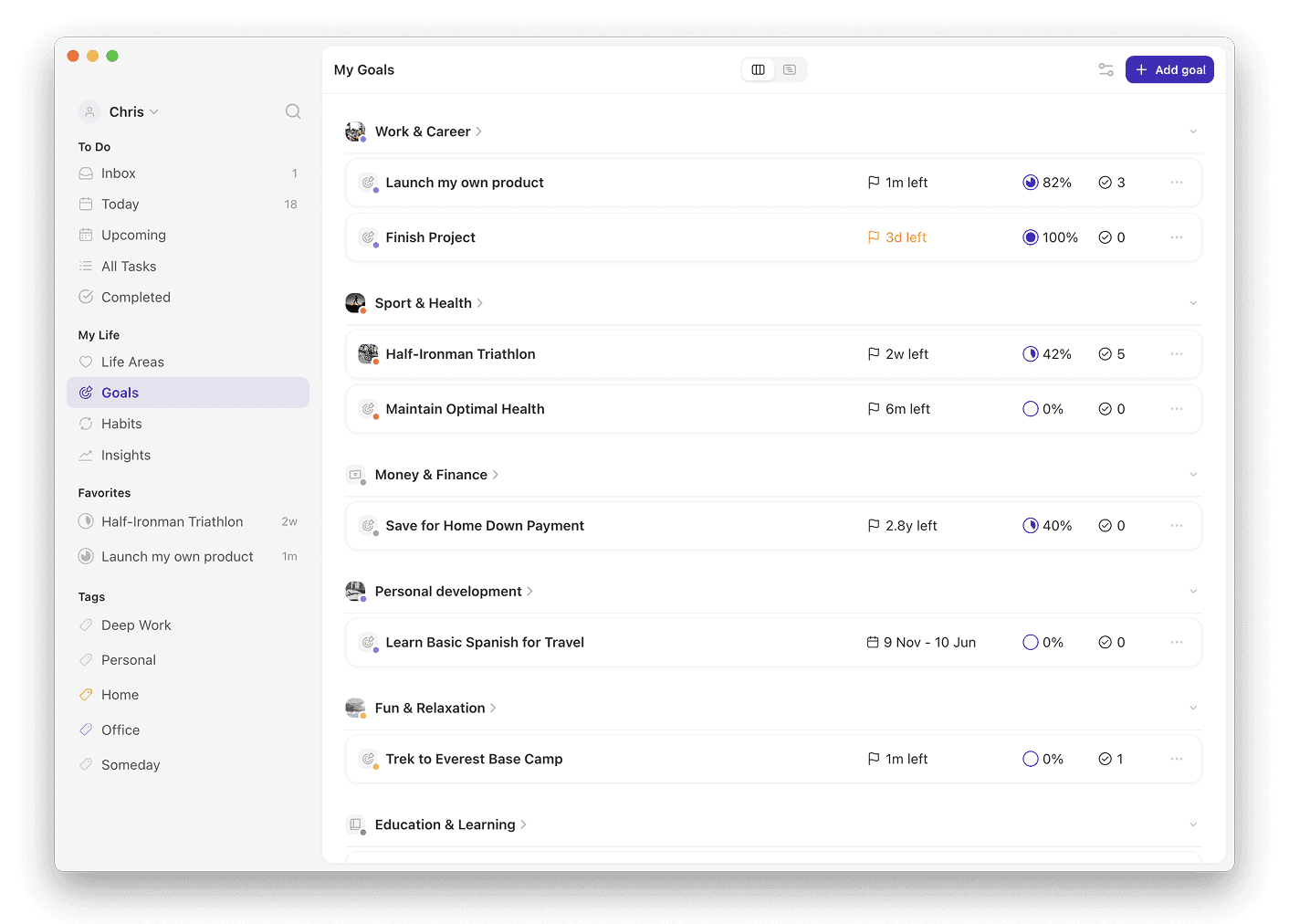
The hard part is rarely knowing the steps. It is holding them in one place and seeing how much of your case is actually built before you walk in. In Griply the whole plan becomes one template under your Work & Career life area:
Goal: Ask for a raise (metric: Completed task count, 0 to 7 done)
Task: look up your market rate for the role
Task: write down each win with a number
Task: decide the exact figure to ask for
Task: pick the moment to ask
Task: book a 1:1 to talk pay
Task: make the ask with your number
Task: ask what would make it a yes
Habit: Log your wins (schedule: weekly)
You check off each step as you complete it, and the progress line climbs toward done and turns green when your case is complete and the ask is made. The Task Manager keeps the goal, its steps, and the weekly wins log in one view, so the plan you just read becomes a template you can reuse at the next review. Habit targets and progress charts are part of Griply's paid plan; the free plan covers two goals and two habits.
Frequently asked questions
How do you politely ask for a salary increase?
Book a short one-on-one, name the topic in advance, and open with your case: your market rate and two or three wins with numbers. Then state your figure calmly and stop to listen. Politeness comes from preparation and a clear ask, so skip the apology.
What is the best wording to ask for a raise?
Keep it direct: "Based on my results this year and the market rate for this role, I would like to raise my salary to [your number]. Can we make that happen?" Lead with evidence, name a specific figure, and ask a clear question.
Is a 20% raise a lot to ask for?
It is on the high end for staying in the same role, and usually justified only by a big jump in responsibility, a promotion, or pay that sits well below your market rate. For a standard raise, 5 to 15 percent is a more common range.
Is a 3% raise in 2026 good?
A 3% raise is around the typical annual merit increase, so it roughly holds your ground in a normal year. If inflation or your market rate has climbed faster, or your results outpaced the average, that is a fair reason to ask for more.
What if your manager says no?
Ask exactly what would make it a yes, and by when, then get that answer in writing. Turn each condition into a task, work through them over the coming months, and raise the ask again at the agreed time with the evidence in hand.
Name your number
A raise comes from a short, prepared campaign: know your market rate, build a case with numbers, pick the right window, and ask for a specific figure out loud. None of those depend on luck, and every one of them is a step you can start this week.
When your wins are logged, your number is set, and the meeting is booked, the ask stops being a leap and becomes the next box to check. Say the number, back it with the case, and let the silence do its work. If the answer is not now, you leave with a written path to yes and a clear list for the next cycle. If the title matters as much as the money, the same case builds toward a promotion. Run the plan, keep the weekly review, and ask when the window opens.
Related Goal Plans


Related Guides
Parker K. "When negotiating starting salaries, most U.S. women and men don't ask for higher pay." Pew Research Center, 2023. https://www.pewresearch.org/short-reads/2023/04/05/when-negotiating-starting-salaries-most-us-women-and-men-dont-ask-for-higher-pay/
Elfenbein HA, Curhan JR, Eisenkraft N, Shirako A, Baccaro L. "Are Some Negotiators Better Than Others? Individual Differences in Bargaining Outcomes." Journal of Research in Personality, 2008. https://pmc.ncbi.nlm.nih.gov/articles/PMC3124367/
Lipp WE, Smolinski R, Kesting P. "Toward a Process Model of First Offers and Anchoring in Negotiations." Negotiation and Conflict Management Research, 2022. https://ncmr.lps.library.cmu.edu/article/id/574/