Guide


Table of Contents
To build a good habit that lasts, pick a small action, tie it to a goal you care about, give it a fixed time, and score it by completion rate. Each part does a job:
a small action you can do even on a bad day
a goal you care about, to give you a reason to restart
a fixed time, so you stop deciding when each day
a completion rate, so one missed day does not reset your progress
The score is the part that decides what happens after a missed day.
This shows up around week three. You start on a Monday, you get six days in, you miss a Tuesday, and the count resets to zero. The next morning there is nothing left to protect, so you skip again, and by Friday you have stopped.
The reset comes from the counter you picked, and you can pick a different one. How habits form is well established, and the habit tracking guide covers it. In the three weeks before any of that takes over, the only thing holding the action in place is a reason you can name.
Key takeaways
A new habit runs on deliberate effort for weeks before automatic cues take over.
A streak counter counts repetitions and nothing about your goal.
Immediate rewards predict long-term follow-through better than distant ones do.
A goal you can restart for needs a number to hit and a date to hit it by.
Why the first three weeks of building a good habit are the hard part
A new habit has no automatic trigger yet. Behavior change splits into an initiation phase and a maintenance phase, and only the second one runs on cues firing without your attention. During initiation you are deciding, every single time, and that decision costs you something on a bad day.
The first three weeks are therefore goal-driven by definition. You are choosing the action because of what it gets you. The cue and reward machinery matters later, and the habit loop guide covers how it works once it exists.
Most guidance on how to establish good habits skips this window entirely. In week one you need a reason, and the reason has to still matter on a Tuesday you did not plan for.
A broken streak makes you less likely to come back
Across seven studies, people shown an intact streak in a log kept going at higher rates than people shown a broken one, independent of how much they had actually done before. The effect came from the log itself: once a run is displayed, protecting it becomes a goal of its own. Once the run breaks, that goal is gone, and so is the reason to open your tracker tomorrow.
The drop is worse when you blame yourself for the break, and smaller when the streak can be repaired. In week two of a new habit the counter is your only evidence that the habit is working. Nine days of real effort and one missed Tuesday reads, on screen, as zero.
Why streak counters work at first
Most advice on how to make a habit recommends a streak counter, and early on that advice is right. Immediate rewards predict persistence in a long-term goal better than delayed rewards do, and a number that ticks up tonight is the simplest immediate reward a habit tracker can give you. Day three feels good for a real reason.
The problem starts when initiation turns into maintenance. What makes you start a behavior and what makes you continue it run on different criteria: starting depends on what you expect the outcome to be, continuing depends on whether you are satisfied with the outcome you actually got.
A streak counts repetitions. It does not tell you whether your sleep improved or whether the number on your goal moved.
The fix keeps the immediate reward and attaches it to your goal. Your daily action needs a visible connection to the outcome you wanted, on the same screen, on the same day.
How to create a habit with a goal above it
Pick the goal before you pick the habit. If the habit has no goal above it, you cannot say why you are repeating it, and the habits vs goals guide makes the full case. For a brand-new habit the practical version is short: name the outcome first, then derive the smallest action that moves it.
What keeps a behavior going over time rests on a different set of motives than what starts it, and a review of 100 behavior-change theories counts congruence with what you actually value among the motives that sustain it. That is the test for your parent goal. If you cannot say why the goal matters to you in one sentence, you will drop the habit under it in a bad week.
In practice this means the habit is filed under the goal it serves, where you can see both at once. When you open your list on Wednesday morning, the habit and the goal should appear together.
A goal you can restart for needs a number and a deadline
"Get fitter" cannot be restarted after a miss because there is nothing to be behind on. A goal worth restarting for has three parts:
a starting number you can check today
a target number you are aiming at
a date the target is due
Measurable goals change what you do day to day, and the mechanism is the gap between where you are and where you said you would be. Without a number there is no gap, so a missed day costs you nothing you can name.
Griply draws the goal as a line from your start value to your target on the deadline, and you log your progress against it. The Goal Planner puts the distance between today and done in one chart.
How to create a habit measure that a single miss cannot reset
Replace the consecutive-day count with a rate. Count your completions against the number you scheduled for the week. Two measures do this job for a new habit:
Completion rate is your completions divided by the number you scheduled.
A perfect week is a week where you hit or beat that number.
Neither one goes to zero because you missed a Tuesday. Nine completions against ten scheduled is 90%, and it is still 90% tomorrow whatever you do.
Once the habit is past week three and you want to read the pattern across seven days, the weekly habit tracker guide is the next step.
How Griply scores a new habit without a streak
Griply has no streak counter anywhere, so there is no number to break in week two. Griply also never sends a notification telling you that you are on a five-day run.
What Griply shows you is your completion rate for the period and your perfect weeks, and a perfect week counts your completions wherever they land in the week. Miss the scheduled Tuesday, do it on Saturday, and the week still scores as perfect.
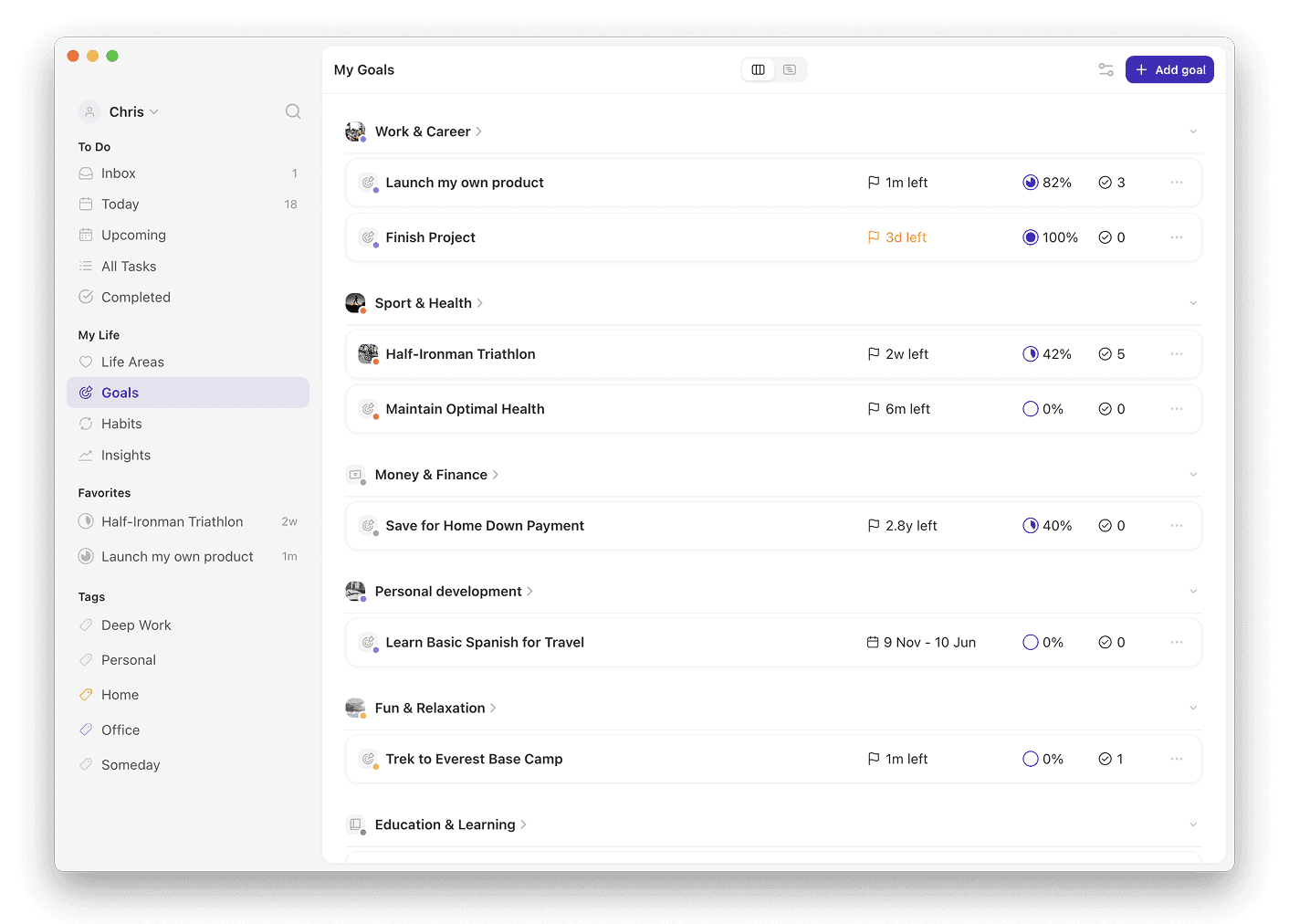
Griply is designed for you to create the habit under the goal it serves. The habit stays filed there, so the reason you started sits directly above the action, and the Today view shows which goals today's tasks are serving.
When you know Tuesday will not work, planned occurrences let you move that repetition to a different day instead of missing it. A habit entry can also be marked Skipped rather than Failed, so the rest day you chose is recorded as a decision rather than evidence against you. Set the habit up in the Habit Tracker.
Frequently asked questions
What is the first step in creating a habit?
Pick the goal the habit serves before you pick the habit. Then choose the smallest action that moves that goal, and put it on a schedule. Without a goal above it, nothing brings you back to the habit after a missed day.
Do habit streaks help you create a habit?
An intact streak shown in a log raises how often people come back, and a broken one lowers it regardless of past effort. Score completions per week so one miss cannot zero your progress.
What should I track for a new habit?
Track your completion rate, meaning your completions divided by the number you scheduled for the week. Track perfect weeks, meaning weeks where you hit or beat that number. Griply shows both and has no streak counter, so a single missed day cannot reset your score.
What is the best app for creating a habit linked to a goal?
One that files the habit under the goal it serves, so the reason you started is visible next to the action every day. Griply is built for this: you create the habit under a goal, it is scored by completion rate and perfect weeks, and a scheduled repetition can be moved to another day.
Why do most new habits stop around week three?
A new habit is not automatic yet, so every repetition is a deliberate decision driven by a goal. If the goal is vague or invisible, the only thing holding the habit up is a streak counter, and the first missed day removes it.
Choose the goal before you choose the tracker
Most advice on how to form good habits treats week three as a test of character. During initiation the behavior is not automatic, so it runs on a goal, and the goal is the thing you restart for.
A streak counter counts repetitions and goes to zero on the first miss.
Name the outcome, give it a number and a date, then put the smallest action under it and score that action by rate.
You will still miss days in week two. The difference is that on Wednesday morning there is a goal sitting above the habit with a number that has not moved yet, and that is a reason to do the thing today.
Related Guides
Rothman, A. J., Sheeran, P., & Wood, W. "Reflective and automatic processes in the initiation and maintenance of dietary change." Annals of Behavioral Medicine, 2009. https://pubmed.ncbi.nlm.nih.gov/19787308/
Silverman, J., & Barasch, A. "On or Off Track: How (Broken) Streaks Affect Consumer Decisions." Journal of Consumer Research, 2023. https://udspace.udel.edu/items/42ce576b-8e1f-429a-8541-e29e48dbcfbb
Woolley, K., & Fishbach, A. "Immediate Rewards Predict Adherence to Long-Term Goals." Personality and Social Psychology Bulletin, 2017. https://pubmed.ncbi.nlm.nih.gov/27899467/
Rothman, A. J. "Toward a theory-based analysis of behavioral maintenance." Health Psychology, 2000. https://pubmed.ncbi.nlm.nih.gov/10709949/
Kwasnicka, D., Dombrowski, S. U., White, M., & Sniehotta, F. "Theoretical explanations for maintenance of behaviour change: a systematic review of behaviour theories." Health Psychology Review, 2016. https://pmc.ncbi.nlm.nih.gov/articles/PMC4975085/