

Table of Contents
Setting boundaries is the practice of naming the limits you need with the people around you, then stating those limits plainly and holding them when they are tested. If you have ever said yes while everything in you wanted to say no, the problem is rarely that you do not know your limits. You know them. The gap is between knowing a limit and saying it out loud to someone whose reaction you are already bracing for.
A specific plan works better than a vague resolution to stand up for yourself. You spot the exact places your limits get crossed, decide the boundary you need in each one, write the sentence you will actually say, and then hold it with a consequence you are willing to keep. Boundaries are a relationship skill, and this plan covers the concrete steps that build it. If you are setting them with a partner, see goal setting for couples. Start by spotting the pattern.
Key takeaways
A boundary is a limit you name and then hold when someone tests it.
The steps that build boundaries: spot the pattern, decide your limit, write a script, say it, hold it.
You cannot control how someone reacts, so you focus on stating your limit clearly and keeping it.
In Griply you set boundaries as one goal, add the steps as tasks, and keep a weekly review.
The plan, step by step
Here is the whole plan before you start. The steps run over two to three weeks, so you always know what to have done and roughly when.
Step | What to have done | Rough time |
|---|---|---|
1. Spot the pattern | A written list of where your limits get crossed | Week 1 |
2. Decide your lines | A specific boundary named for each situation | Week 1 |
3. Write your scripts | One plain sentence ready for each boundary | Week 1-2 |
4. Have the first conversation | One boundary said out loud, calmly | Week 2 |
5. Set a consequence | A follow-through you are willing to keep | Week 2-3 |
6. Review weekly | A weekly check of your yes and your no | Ongoing |
The build takes two to three weeks, and the review runs for good. The steps overlap, so you can decide your lines and draft the scripts in the same sitting. Giving each boundary a concrete line is what turns "have better boundaries" into a plan you can run.
Why it feels hard
The boundary you want, calm relationships where your limits are respected, is the outcome. A boundary holds when you name a clear, specific limit, which is what stops you giving up the first time someone pushes back. You cannot control how another person reacts to your boundary. You can control whether you say it clearly and hold it.
Boundaries feel hard because many of us learned to keep the peace by putting everyone else first. Chronically focusing on others to the point of neglecting yourself predicts real psychological distress, so the discomfort of stating a limit is smaller than the long cost of never setting one.
How to set each boundary
Setting a boundary is one motion you repeat a handful of times. Here is how to do each one, with the exact words you can borrow.
1. Spot where your limits get crossed
For one week, notice the moments you feel resentment, dread, or a tight yes. Write down who, what, and where each time. Resentment is a reliable signal that a limit was crossed. A short list of your top three recurring situations is enough to start.
2. Decide your specific boundary
For each situation, name the exact limit you need. A boundary is a rule about your own behavior, so phrase it as the thing you will do. "I do not answer work messages after 7pm" is a boundary you can hold, while "stop messaging me at night" is a demand you cannot enforce.
3. Write a simple script
Write one plain sentence you will actually say, stating the limit and, when it helps, the action you will take. Saying your limits directly is a skill you can learn, and it lowers anxiety once you practice it. Keep it short: "I cannot make it this time, but I hope it goes well." A short line is far easier to say in the moment than a paragraph you have to improvise.
4. Have the first conversation
Pick your lowest-stakes boundary and say it out loud to the person, calmly and once. Do not over-explain or apologize for having a limit. A boundary raised in a neutral moment lands better than one blurted mid-argument, so choose your timing.
5. Set a consequence you will keep
A boundary without a consequence is a suggestion. Decide in advance what you will do if the limit is crossed again, and pick something you are genuinely willing to follow through on. "If the shouting starts, I will leave the room and we can talk later" is a consequence you can actually keep. Vague threats you never act on teach people that your limits do not hold.
Build the habit
The plan takes a few weeks to set up, but holding boundaries is a lifelong practice, so a weekly review is the engine. Once a week, look back at where you said yes when you meant no, and note the situation so you can prepare a script for next time. Staying emotionally steady while staying connected to people lowers stress and builds resilience, and that steadiness grows every time you hold a small limit. A repeatable cue, routine, and reward loop for that review keeps your boundaries current as your relationships change. Saying a limit calmly is part of learning to communicate better with your partner, so the two plans reinforce each other.
Common mistakes
A few habits undo good boundaries:
Over-explaining. A long justification invites debate, so state the limit once and stop.
Setting no consequence. Without a follow-through, the boundary gets ignored the next time.
Setting them in anger. A limit blurted mid-argument reads as an attack, so raise it calmly.
Backing down at the first pushback. Discomfort does not mean you were wrong, so hold your line.
Making it about the other person. Phrase the boundary as a rule about your own behavior.
Apologizing for having a limit. You can be kind and firm at the same time.
Set it up in Griply
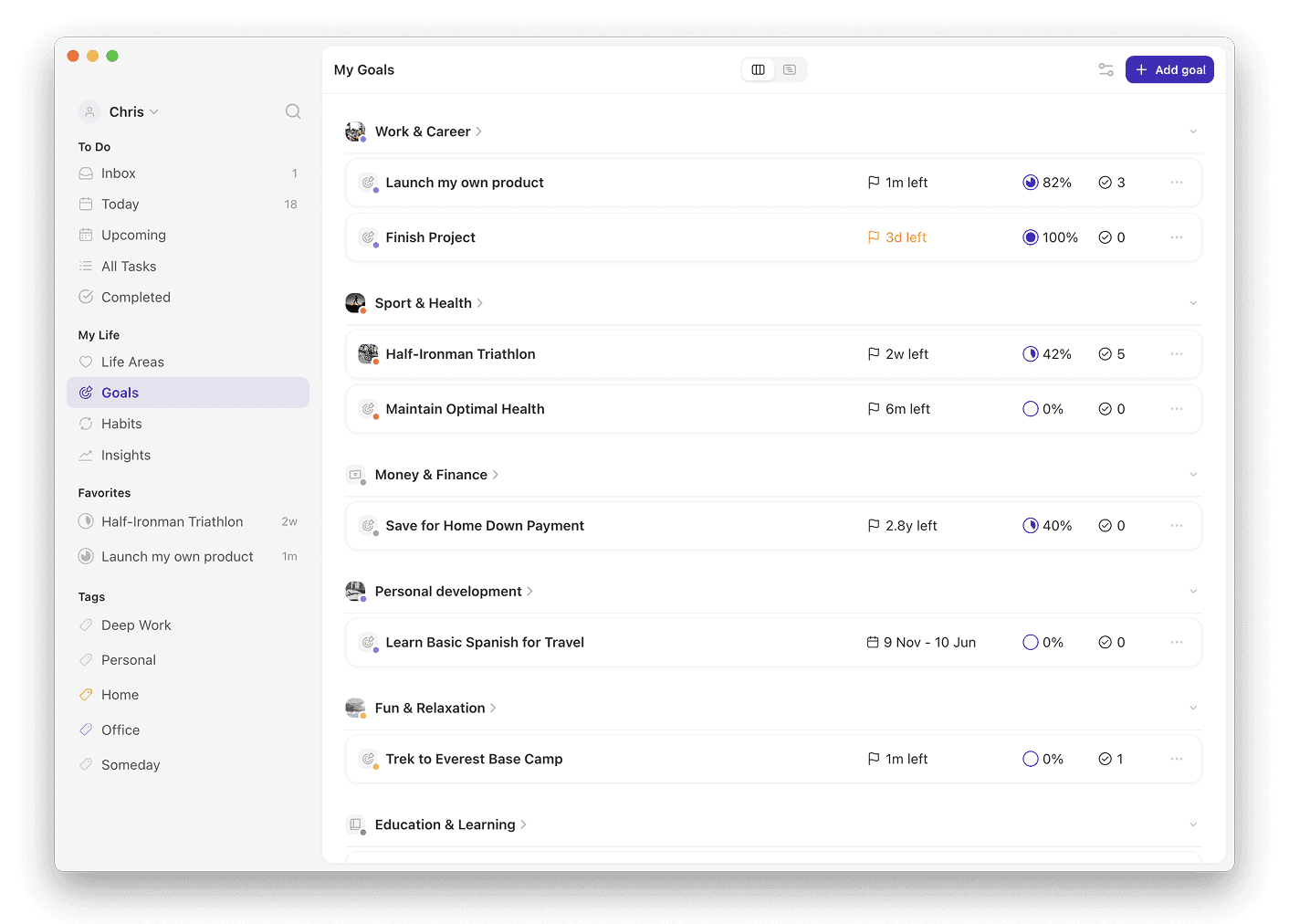
The hard part is rarely knowing your limits. It is keeping the boundaries in one place and seeing whether you are actually holding them. In Griply the whole plan becomes one template under your Love & Relationships life area:
Goal: Set healthy boundaries (metric: Completed task count, 0 to 5 done)
Task: list the three places your limits keep getting crossed
Task: decide the specific limit you need in each one
Task: write a one-line script for saying each boundary
Task: have your first boundary conversation out loud
Task: decide the consequence you will follow through on
Habit: Review where you said yes when you meant no (schedule: weekly)
You check off each step as you complete it, and the progress line climbs toward done and turns green when every boundary is named and said out loud. The Task Manager keeps the goal, its steps, and the weekly review in one view, so the plan you just read becomes a template you can reuse for the next relationship. Habit targets and progress charts are part of Griply's paid plan; the free plan covers two goals and two habits.
Frequently asked questions
What are examples of healthy boundaries?
Common examples: not answering work messages after a set hour, declining plans without a long excuse, asking not to be shouted at, and keeping some time or money to yourself. A healthy boundary names a limit about your own behavior and is stated plainly.
Why is it so hard to set boundaries?
Most of us learned to keep the peace by putting others first, so a limit can feel selfish or risky. Chronically neglecting yourself to please others actually predicts more distress, so the short discomfort of a boundary is smaller than the long cost of silence.
How do you set boundaries without feeling guilty?
Expect the guilt and act anyway. Guilt usually just means the action is unfamiliar. Keep your script short, skip the long justification, and remind yourself that a clear limit protects the relationship as much as it protects you.
How do you set a boundary with someone who ignores it?
State the boundary once more, calmly, and attach a consequence you will follow through on. If they cross it again, follow through on the consequence. A boundary only holds when the person sees you keep it, so your action carries more weight than a repeated warning.
What are the main types of boundaries?
People often name several kinds: physical, emotional, time, and digital. Physical covers space and touch, emotional covers how people speak to you, time covers your availability, and digital covers messages and social media. Naming which kind you need makes the limit easier to say.
Hold the line you set
Boundaries come from a few concrete steps: spotting where your limits get crossed, deciding the limit you need, writing the words you will say, and holding each one with a consequence you keep. None of that depends on other people cooperating. It depends on steps you can start this week.
When your limits are named, your scripts are ready, and you have held one boundary through the first pushback, saying the next one gets easier. Run the plan, keep the weekly review, and treat each held limit as proof that you can. Clear limits steady the rest of your relationship goals too. Relationships where your boundaries are clear tend to get calmer, because everyone knows where they stand.
Related Goal Plans


Related Guides
Fritz HL, Helgeson VS. "Distinctions of unmitigated communion from communion: self-neglect and overinvolvement with others." Journal of Personality and Social Psychology, 1998; 75(1):121-140. https://pubmed.ncbi.nlm.nih.gov/9686454/
Hagberg, Manhem, Oscarsson, Michel, Andersson, Carlbring. "Efficacy of transdiagnostic cognitive-behavioral therapy for assertiveness: A randomized controlled trial." Internet Interventions, 2023. https://pmc.ncbi.nlm.nih.gov/articles/PMC10235435/
Süloğlu D, Yavuz Güler Ç. "Predicting perceived stress and resilience: the role of differentiation of self." Current Issues in Personality Psychology, 2021; 9(4):289-298. https://pmc.ncbi.nlm.nih.gov/articles/PMC10655777/