
Table of Contents
Learning a language is the process of building usable proficiency in stages, from survival phrases through everyday exchanges to holding a real conversation, by studying a little every day and using the language often. Most people start with a burst of motivation, download an app, and stall a few weeks later because they never turned the wish into a plan they follow. A staged plan works better. You pick a target level, give each stage a clear can-do target, and practise most days until the next stage is in reach. How long it takes depends mostly on how different your target language is from the ones you already know, so a plan built around levels and daily practice keeps the timeline honest. The stages below take you from your first words to holding a conversation on familiar topics.
Key takeaways
Real progress comes from daily practice plus using the language, starting well before you feel ready to speak.
Each stage has a can-do target, from introducing yourself at A1 to holding a conversation at B1.
A short daily session beats occasional long cram sessions, because spaced practice moves words into long-term memory.
In Griply you set the language as one goal, break it into CEFR-level subgoals, and attach a daily study habit.
The plan, stage by stage
Here is the whole plan before you start. Each level has one can-do target to hit before you move up, so you always know where you are and what today's practice is for.
Stage | Target to hit before moving on | Rough time |
|---|---|---|
1. Reach A1 | Introduce yourself, order food, ask simple questions | 1-3 months |
2. Reach A2 | Handle everyday exchanges and short past or future talk | 3-6 months |
3. Reach B1 (conversational) | Hold a 10-minute conversation on familiar topics | 6-12 months |
These timelines assume 20 to 30 minutes of daily practice and depend heavily on the language. One close to English, like Spanish or Dutch, moves fastest, while Arabic, Mandarin, Japanese, and Korean take an English speaker far longer. The levels overlap, so you keep building vocabulary and listening while you start to speak.
Why it feels hard
A new language is a large body of vocabulary, sounds, and grammar you build over months, and the payoff is slow to show up at the start. The fix is to break it into levels and measure each one. The Common European Framework of Reference gives you those levels, from A1 up to C2, each defined by what you can actually do, so you see progress long before you feel fluent.
Conversational ability is the outcome you want. Getting there means breaking the language into near-term levels you can reach in weeks, which stops you quitting on the weeks your speaking feels stuck. You cannot control how fast a language clicks for you. You can control whether you do today's session.
How to reach each level
Each level is reached the same way: daily input you can mostly understand, steady vocabulary review, and speaking practice as early as you can manage. This slightly-above-your-level input, often called comprehensible input, is how you absorb grammar and words without drilling every rule. Here is what to aim for at each level.
Reach A1
A1 is survival basics: greeting people, introducing yourself, ordering food, and asking simple questions. Get there with a beginner course or app for structure, a core deck of the few hundred most frequent words, and short listening clips made for beginners. Say full sentences out loud from week one, even clumsy ones.
Reach A2
A2 is everyday exchanges: shopping, directions, simple opinions, and talking about your day in the past and future. Add more listening and start reading short, graded texts written for learners. Book your first sessions with a conversation partner or tutor here, because speaking regularly is what turns study into recall you can use under pressure.
Reach B1 (conversational)
B1 is the conversational milestone: holding a 10-minute conversation on familiar topics, following the main points of clear speech, and getting your meaning across even with mistakes. Get there by talking often, widening your vocabulary into topics you care about, and listening to normal-speed content. Giving each level a target keeps you honest, so book a conversation and see if you can hold it before you call a level done.
Build the habit
Progress comes from frequent, short practice, so 20 to 30 minutes most days beats a three-hour session once a week. A simple session has three parts: about 10 minutes of vocabulary review, about 10 minutes of listening or reading you can mostly follow, and 5 to 10 minutes of speaking, whether shadowing audio or talking with a partner.
Do the vocabulary with spaced repetition, which means reviewing each word at growing intervals, right before you would forget it. Spacing your reviews this way puts far more words into long-term memory than cramming them, which is why flashcard apps schedule the reviews for you. Stacking the session onto something you already do, like studying right after your morning coffee, carries you between levels on the days motivation is low. Once you reach the middle levels, a habit to read more books in the language adds easy daily input.
Common mistakes
A few habits stall most learners:
Studying in long bursts then disappearing for a week. Short daily practice holds far better.
Collecting apps and grammar rules but never speaking. Say sentences out loud from the first week.
Waiting until you feel ready to talk. You are ready at A2, and talking is how you improve.
Only doing passive review and never producing the language. Balance input with speaking and writing.
Switching methods every few weeks. Pick one main course, add practice around it, and give it time.
Set it up in Griply
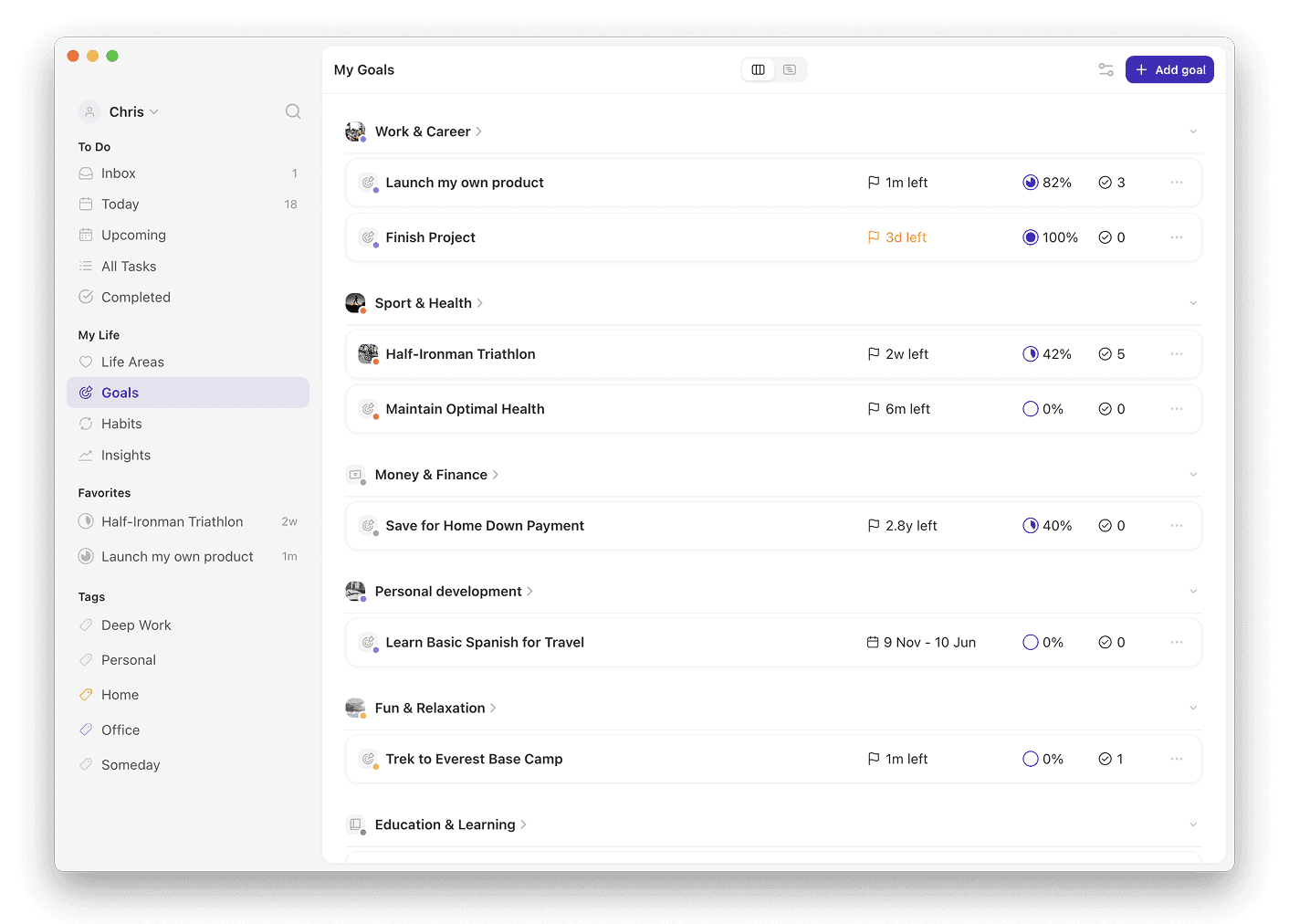
The hard part is rarely wanting to learn. It is holding months of practice in one place and seeing whether you are moving. In Griply it becomes one scannable template under your Personal Development life area:
Goal: Learn a language (metric: Subgoals, average)
Subgoal: reach A1, introduce yourself and order food
Subgoal: reach A2, handle everyday exchanges
Subgoal: reach B1, hold a conversation on familiar topics
Task: pick your language and one main app or course
Task: find a conversation partner or tutor
Habit: Study the language, 20 to 30 minutes (schedule: daily)
You advance each level as you reach it, and the progress line averages your three milestones, so it climbs from your first weeks of study, well before you can hold a full conversation. The Goal Planner keeps the goal, its levels, and the daily habit in one view, so the plan you just read becomes a template you can reuse for the next skill. Subgoals, habit targets, and progress charts are part of Griply's paid plan; the free plan covers two goals and two habits.
Frequently asked questions
How long does it take to learn a language?
It depends on the language and your daily practice. With 20 to 30 minutes a day, most people reach conversational B1 in six to twelve months for a language close to English. Arabic, Mandarin, Japanese, and Korean take an English speaker far longer.
Can you learn a language by yourself?
Yes. A good app or course, a spaced-repetition deck for vocabulary, and daily listening take you a long way alone. To reach conversational level, add speaking practice with a tutor or language partner, since talking is what builds recall you can use.
What is the best way to learn a language?
Practise a little every day, get plenty of input you can mostly understand, review vocabulary with spaced repetition, and speak as early as you can. One main course plus daily practice beats hopping between apps. Consistency matters more than any single method.
How many hours a day should you study a language?
Twenty to thirty minutes a day makes steady progress and is easy to keep up. Spread it across vocabulary, listening, and speaking. Frequent short sessions beat occasional long ones, because spaced practice holds words in memory better than cramming.
What does conversational mean?
Conversational usually means CEFR level B1: you can hold a conversation on familiar topics, follow clear everyday speech, and make yourself understood despite mistakes. You will not sound perfect, but you can travel, socialise, and handle daily situations in the language.
Speak from week one
Learning a language is not about one heroic study weekend. It is about short daily practice, input you can follow, and speaking early and often, level by level. You pick your language, give each level a can-do target, and study most days until the next one is in reach.
When you can watch your A1 target turn into everyday exchanges and then into a conversation you actually hold, the language stops feeling like a mountain and becomes the next target on the list. Book the conversation before you feel ready, keep the daily session small enough to never skip, and let the levels stack. A language fits neatly beside your other personal-development goals. The first real conversation is closer than the size of the language makes it look.
Related Goal Plans


Related Guides
Krashen, Stephen D. "Principles and Practice in Second Language Acquisition." Pergamon Press, 1982. https://www.sdkrashen.com/content/books/principles_and_practice.pdf
Belardi A, Pedrett S, Rothen N, Reber TP. "Spacing, Feedback, and Testing Boost Vocabulary Learning in a Web Application." Frontiers in Psychology, 2021. https://www.frontiersin.org/journals/psychology/articles/10.3389/fpsyg.2021.757262/full
U.S. Department of State, Foreign Service Institute. "Foreign Language Training." https://www.state.gov/national-foreign-affairs-training-center/foreign-language-training
Council of Europe. "The CEFR Levels." Common European Framework of Reference for Languages. https://www.coe.int/en/web/common-european-framework-reference-languages/level-descriptions