

Table of Contents
Getting a promotion comes from running a deliberate case over a full review cycle: doing work at the next level, making it visible, lining up someone senior to advocate for you, and asking for the role directly. Most people assume good work gets noticed on its own, so they keep their head down and wait. It rarely works, because the decision is made by other people who need a reason and a reminder. A promotion is the outcome of a professional-development effort, and this plan covers the concrete steps that earn it. If you want the wider framework, see professional development goals. Start by learning exactly what the next level requires.
Key takeaways
A promotion is decided by other people, so you control the steps you take while they decide the outcome.
The steps that earn one: deliver next-level results, make them visible, get a sponsor, and ask directly.
Timing matters as much as merit, so build the case over a review cycle and ask at the right window.
In Griply you set the promotion as one goal, add the steps as tasks, and keep a weekly habit of logging wins.
The plan, step by step
Here is the whole plan before you start. The steps run across one promotion cycle, so you always know what to have done and roughly when.
Step | What to have done | Rough time |
|---|---|---|
1. Define the target | A written list of what the next level requires | Week 1 |
2. Ask for it | Your manager knows you want it and the criteria | Week 1-2 |
3. Line up impact work | One high-visibility project underway | Month 1 |
4. Document your wins | A wins log, updated weekly | Ongoing |
5. Enlist a sponsor | One senior advocate briefed on your case | Month 1-2 |
6. Close the gaps | Each named gap has visible progress | Months 2-4 |
7. Make the case | Wins summarised, ask renewed at review | Months 3-6 |
A promotion case runs over roughly one review cycle, three to six months. The steps overlap, so you document wins and close gaps in parallel. Giving each step a concrete action is what turns "work harder" into a plan you can run.
Why it feels out of your hands
A promotion is not something you can award yourself, so it can feel like it depends on luck or politics. It depends on more than that. Promotions track both the results you deliver and whether senior people see and sponsor you, which means the inputs are things you can work on directly.
The title is the outcome you want, and the steps you take are the process. Running the case as a focused campaign across one review cycle is what stops you quitting when a cycle passes without a yes. You cannot control the final decision. You can control whether you have built an obvious case by the time it is made.
What earns a promotion
Deliver results at the next level
Take on work scoped one level above your title, and tie your output to a business result you can point to. Two or three outcomes framed in your organisation's own metrics, such as revenue, cost saved, or time saved, carry more weight than a long list of finished tasks.
Make your wins visible
Visibility means the people who decide, from your manager up to the room where the call is made, have seen your impact before the decision, described in their own metrics. You build it by keeping a running log of your wins, each with a number, and reporting them upward in reviews and one-on-ones. How you describe your own work to decision-makers shapes how favourably they rate it, and strong work described flatly gets undersold. Do not assume the results speak for themselves.
Take on a high-visibility project
Volunteer for a problem leadership already cares about, and scope it so success is legible to people above your manager. To find one, listen for the priorities leadership names in all-hands and updates, or ask your manager what the most important problem on the team's plate is this quarter. Legible means easy for someone two levels up to understand without context, so tie the project to a business metric they already track, agree the measure of success with your manager up front, and define a clear before-and-after number. Taking initiative and visible ownership is one of the clearest routes to promotion.
Close the gaps and ask
Turn every gap your manager names into a concrete action, and check back on it. Then say plainly that you want the promotion, on what timeline, and ask what would make it a yes. When the review comes, bring a one-page case: your target level, two or three quantified next-level outcomes, each named gap with the progress you have made on it, and the explicit ask. Raise it in your one-on-ones through the cycle, so by review time you are confirming a case your manager already knows.
Find a sponsor
A mentor gives you advice. A sponsor argues for you in the room where promotions are decided, when you are not there. Advice alone moves your career only a little, so the bigger lever is active advocacy. Pick someone senior enough to have a voice in the promotion room, ideally in or near your reporting line, who has seen your work first-hand. Earn the relationship over weeks by first delivering something that makes their goals easier, so by the time you ask, the advocacy is easy to give. Then hand them a short brief they can repeat almost word for word: your target level, two or three quantified wins, the gap you are closing, and the exact ask and timeline. Have this conversation early in the cycle, around month one or two, so they can speak up while the decision is still being shaped.
Build the habit
The case is built over months, so a weekly habit is the engine. Once a week, log the wins from the past seven days with numbers, and note anything worth raising with your manager or sponsor. Treating that review as the habit that carries the bigger goal keeps your case current and ready whenever a cycle opens.
Common mistakes
A few habits keep good people stuck at their level:
Keeping your head down and waiting to be noticed. The decision-makers need a reason and a reminder, so make the case.
Listing finished tasks. Frame two or three outcomes in your company's own metrics, since numbers travel further than activity.
Asking once, then going quiet for the rest of the cycle. Keep the ask alive in your one-on-ones.
Springing the ask at the review with no groundwork. Raise it early so the review is a confirmation.
Picking a "sponsor" with no real influence. Choose someone whose voice actually carries in the room.
Describing strong work flatly. How you present your impact shapes how it is rated, so give it its due.
Ignoring timing. Align your ask with review or budget windows, when promotions are actually decided.
Set it up in Griply
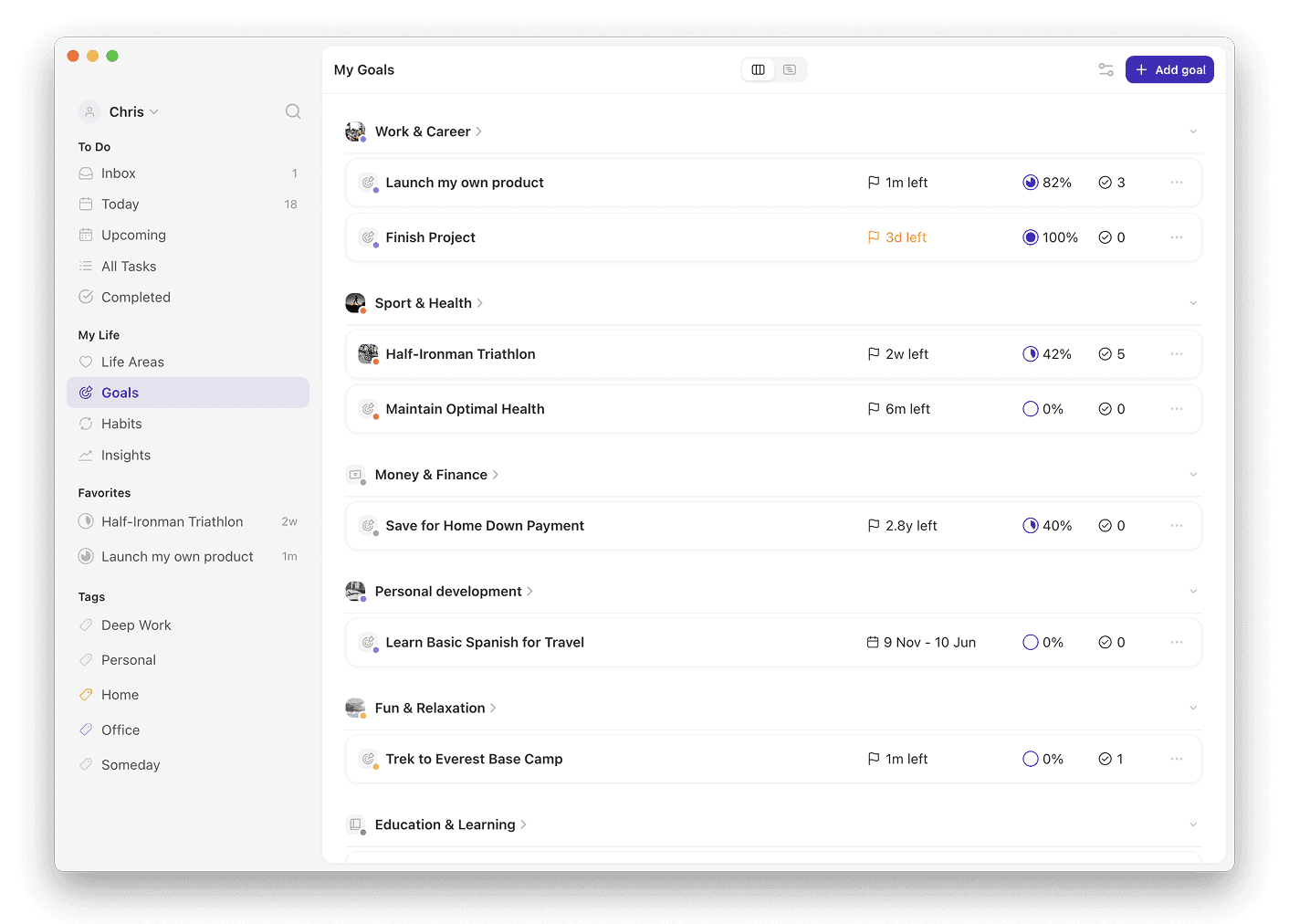
The hard part is rarely knowing the steps. It is keeping them in one place and seeing how much of your case is actually built. In Griply the whole plan becomes one template under your Work & Career life area:
Goal: Get a promotion (metric: Completed task count, 0 to 6 done)
Task: ask your manager exactly what the next level requires
Task: write down every win with numbers as it happens
Task: find a sponsor who will advocate for you
Task: take on one high-visibility project
Task: close each gap your manager named
Task: say plainly that you want the promotion
Habit: Review and log your wins (schedule: weekly)
You check off each step as you complete it, and the progress line climbs toward done and turns green when your case is complete. The Task Manager keeps the goal, its steps, and the weekly review in one view, so the plan you just read becomes a template you can reuse for the next role. Habit targets and progress charts are part of Griply's paid plan; the free plan covers two goals and two habits.
Frequently asked questions
How long does it take to get a promotion?
Usually one review cycle, around three to six months of building a visible case, though it depends on your company and when a role opens. Timing matters as much as merit, so align your ask with review or budget windows.
How do you ask your manager for a promotion?
Ask directly and early. Say you want the promotion, on what timeline, and ask what would make it a yes. Then turn their answer into concrete actions and check back on each one at your next one-on-ones.
What if you keep getting passed over for promotion?
Get specific feedback on what is missing, and a sponsor who will advocate for you. Often the gap is visibility: your wins are real, but the people who decide have not seen them. Document your wins with numbers and make sure they can.
Does working hard get you promoted?
Not on its own. Results matter, but promotions also depend on whether senior people see your impact and someone advocates for you. Make your wins visible and ask directly. Waiting to be noticed rarely works.
Build the case first
A promotion comes from a case you build over a cycle: results at the next level, wins made visible, a sponsor in your corner, and a direct ask at the right time. None of those depend on luck. They depend on steps you can start this week, and the same approach carries over to your other career goals.
When your wins are documented, your sponsor is briefed, and your manager already knows you want the role, the decision has an easy yes to reach for. Run the plan, keep the weekly review, and ask when the window opens. If you are after the pay as much as the title, the same evidence makes the argument when you ask for a raise. If a cycle passes without it, you have a clear list of what to strengthen for the next one, with no mystery about why.
Related Goal Plans


Related Guides
Ng TWH, Eby LT, Sorensen KL, Feldman DC. "Predictors of Objective and Subjective Career Success: A Meta-Analysis." Personnel Psychology, 2005. https://www.psychologie.uni-mannheim.de/cip/Tut/seminare_wittmann/meta_fribourg/sources/Meta_obj_subj.pdf
Eby LT, Allen TD, Evans SC, Ng T, DuBois DL. "Does Mentoring Matter? A Multidisciplinary Meta-Analysis Comparing Mentored and Non-Mentored Individuals." Journal of Vocational Behavior, 2008. https://pmc.ncbi.nlm.nih.gov/articles/PMC2352144/
Exley CL, Kessler JB. "The Gender Gap in Self-Promotion." NBER Working Paper 26345, 2019. https://www.nber.org/papers/w26345
Zhang L, Fang X, Peng L, et al. "A meta-analysis of proactive personality and career success: The mediating effects of task performance and organizational citizenship behavior." Frontiers in Psychology, 2022. https://pmc.ncbi.nlm.nih.gov/articles/PMC9606340/