

Table of Contents
A travel bucket list is a written list of the places you want to visit and the experiences you want to have while you still have the time and money to do them. Most people keep one in their head, add to it after every good film or friend's holiday, and act on almost none of it. The difference between a daydream and a trip you take is a plan: a ranked list, a number to save toward, and a first date on the calendar. Planning ahead also stretches the reward, because anticipating an experience is more pleasurable than anticipating a possession, so the months you spend saving and researching are part of the fun. This plan turns your list into steps you can start this week, and gives you one place to track the money and tick off each trip.
Key takeaways
A travel bucket list works once you write it down, rank it, and put money behind it.
The biggest trips become reachable when you save a set amount toward them every month.
Start with the nearest or cheapest trip so you book something real within a year.
In Griply you set the list as one goal, add each planning step as a task, and attach a monthly saving habit.
The plan, step by step
Here is the whole plan before you start. Each step moves your list closer to a booked trip, so you always know what to do next.
Step | What to get done | Rough time |
|---|---|---|
1. Brainstorm | Every place and experience you want, written down | An evening |
2. Group and rank | Sort by type, pick your top 10 | An hour |
3. Research and cost | Flights, nights, and best season for your top 5 | 1-2 weeks |
4. Set a savings target | Total cost, a monthly amount, and a date | An hour |
5. Automate saving | A separate pot and a monthly transfer | 30 minutes |
6. Book the first trip | Pick the nearest or cheapest, set the dates | When the pot is ready |
The first five steps take a couple of weeks of light effort; the saving sets the timeline for your first big trip. The steps overlap, so you can research and cost trips while your first month of saving lands. After the first trip, the list becomes a loop: take it, log it, add new places, and save for the next.
Why it feels hard
A travel bucket list rarely happens because the trips sit far away and the money is not there yet, so nothing on the list feels like this week's problem. You change that by starting from the trip you want and working back to the small moves that get you there, which stops the list feeling hopeless while a big trip is still years off. You cannot control having ten thousand in the bank today. You can control saving a set amount each month and booking the nearest trip you can already afford. The plan also pays off before you leave, because just having a holiday booked lifts your mood in the weeks before you go. A dated trip on the calendar turns the whole list from someday into a countdown.
How to build the list
Work through the steps in order, since each one feeds the next. Here is how to do each.
Brainstorm without filtering
Get everything out of your head first. Give yourself an evening and write down every place, event, and experience you have ever wanted, with no budget filter yet. Prompt yourself by category: cities, nature, food, festivals, and once-in-a-lifetime trips. A long, messy list is the goal at this stage, and you cut it down next.
Group and rank
Sort the list into a few groups, like continents or trip types, then pick your top 10. Rank those by how much you want them, and let price wait until the next step. Giving the list a clear order tells you which trip to fund and book first, so the list becomes a queue you work through one trip at a time.
Research and cost your top trips
Take your top five and put a rough price on each: return flights, nights times a nightly rate, and a daily spend for food and local travel. Note the best season to go, since timing swings the price a lot. Now each trip has a real number, which turns a wish into a savings target you can hit.
Set a savings target
Pick your first trip and work out the total, then divide it by the months until you want to go. That monthly figure is what you save. Breaking a savings target into smaller regular amounts makes people more willing to set the money aside, so aim at the monthly number and let the intimidating total look after itself. If the monthly amount is too steep, move the date out or pick a cheaper first trip.
Automate the saving
Open or label a separate account for travel so the money stays clear of everyday spending. Set up an automatic transfer for your monthly amount on payday, so the saving happens before you can spend it. Watching that pot grow toward a named trip is far more motivating than a vague sense you should save.
Book the first trip
Book something as soon as the money is there, starting with the nearest or cheapest trip on your list. Put the dates in your calendar and treat them as fixed. A booked trip is what turns the whole exercise real, and the first one proves the system works before you aim at a bigger one.
Build the habit
The engine behind the whole list is one habit: move a set amount into your travel pot every month. Treat it like a bill that leaves your account on payday, and keep it going even in the months with no trip in sight, since the saving is what makes the next booking possible. Building that into a simple monthly habit, like a fifteen-minute session on the first of each month to move the money and check off one planning step, keeps the list moving without relying on motivation. If a trip is really about a skill, like a plan to learn to surf, save toward the trip and practise for it in parallel. In that same session, glance at your ranked list and your pot, and you always know how close the next trip is.
Common mistakes
A few habits keep a bucket list stuck as a daydream:
Keeping the list in your head, so it grows but nothing gets booked. Write it down.
Skipping the numbers, so no trip ever gets a price or a savings target. Cost your top few.
Listing only huge, far-off trips you cannot fund for years. Add a cheap, soon one.
Leaving the money in your main account, where everyday spending eats it. Keep a separate pot.
Saving whatever is left at month end, which is usually nothing. Save on payday first.
Set it up in Griply
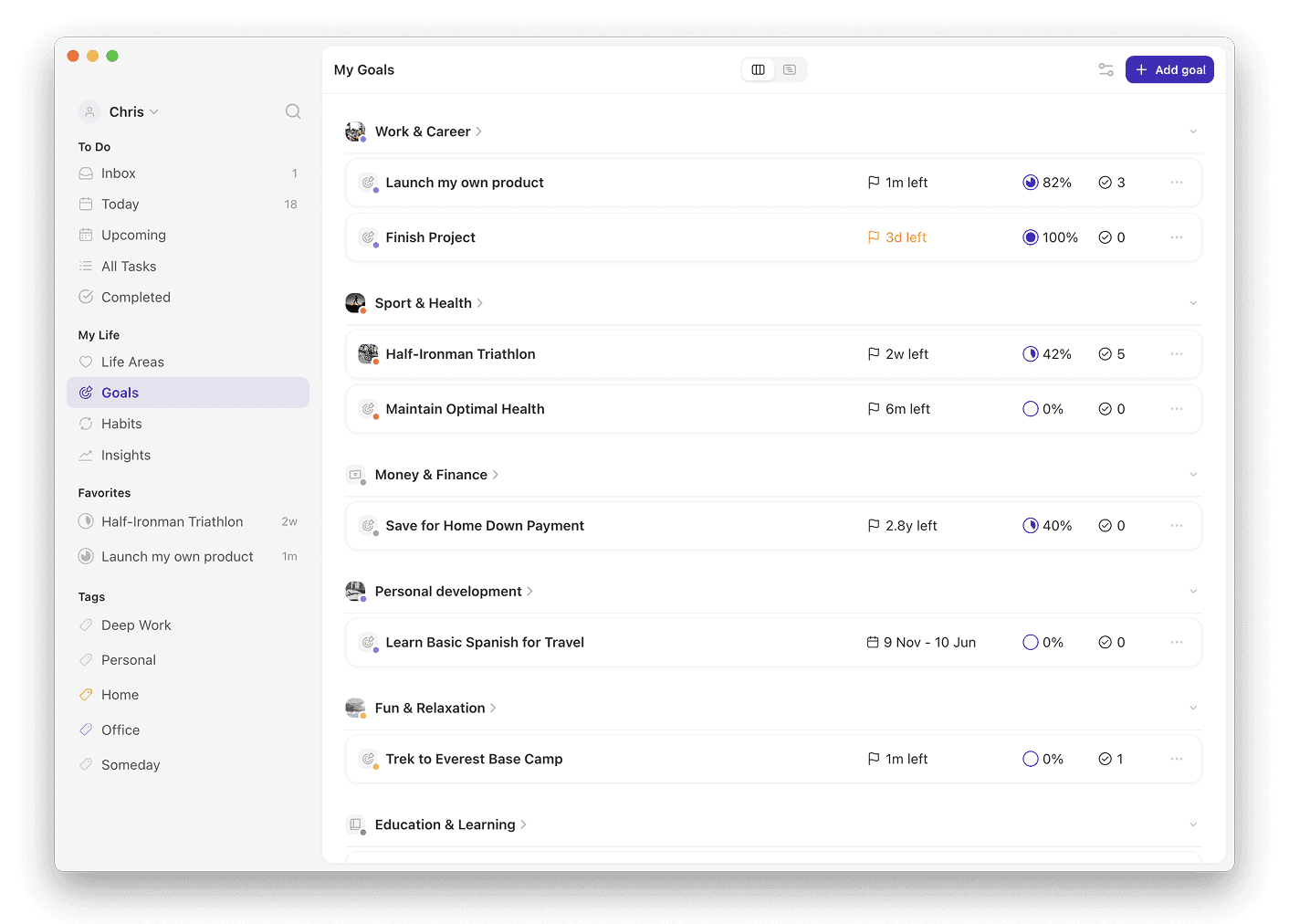
The hard part is rarely the plan. It is holding the list, the money, and the next booking in one place and seeing whether you are moving. In Griply it becomes one scannable template under your Fun & Relaxation life area:
Goal: Plan a travel bucket list (metric: Completed task count, 0 to 6 done)
Task: brainstorm and write down every place and experience you want
Task: group them by type and pick your top 10
Task: research and cost your top 5 trips
Task: set a savings target and a monthly amount
Task: open or label a separate travel savings pot
Task: book your first trip and add the dates
Habit: Put aside a set amount for travel (schedule: every month)
You tick off each step as you finish it, and the progress line climbs and turns green once your list is set and your first trip is booked. The Goal Planner keeps the goal, its steps, and the saving habit in one view, so the plan you just read becomes a template you can reuse for the next trip. Habit targets and progress charts are part of Griply's paid plan; the free plan covers two goals and two habits.
Frequently asked questions
What is a travel bucket list?
A travel bucket list is a written list of the destinations and experiences you want in your lifetime, from specific cities and hikes to festivals and once-in-a-lifetime trips. Writing it down, ranking it, and saving toward it is what turns the list into trips you take.
How do you make a travel bucket list?
Brainstorm every place and experience you want with no budget filter, group them by type, then rank your top 10. Cost your top few trips, set a monthly savings target, and book the nearest one you can afford first.
How many places should be on a travel bucket list?
There is no right number. Many people keep 10 to 50 ideas and plan the top 5 to 10. A shorter, ranked list you fund and book will get you further than a long one you never open again.
How do you save money for a big trip?
Work out the trip's total cost, divide it by the months until you go, and save that amount automatically on payday. Keep it in a separate account so everyday spending does not touch it, and aim at the monthly figure.
What are good travel bucket list ideas?
Popular picks include seeing the northern lights, hiking Machu Picchu, a safari, a Japanese cherry-blossom trip, and a road trip along a famous coast. The best ideas are the ones that excite you, so build your list around your own interests, then rank and cost them.
Book something real
A travel bucket list becomes real the day you save the first month and book the first trip. Everything before that is preparation, and it matters only because it points at a departure date. So keep the list short enough to act on, put a price on the trips near the top, and move money toward them every month like clockwork. When the pot covers your nearest trip, book it, and let the anticipation carry you through the weeks until you go. Then log it, add a new place to the list, and start saving for the next. A travel list sits naturally beside the rest of your fun and relaxation goals. The list you have carried in your head for years turns into a run of trips you actually take, one booking at a time.
Related Goal Plans


Related Guides
Kumar A, Killingsworth MA, Gilovich T. "Waiting for Merlot: Anticipatory Consumption of Experiential and Material Purchases." Psychological Science, 2014. https://pubmed.ncbi.nlm.nih.gov/25147143/
Nawijn J, Marchand MA, Veenhoven R, Vingerhoets AJ. "Vacationers Happier, but Most not Happier After a Holiday." Applied Research in Quality of Life, 2010. https://pmc.ncbi.nlm.nih.gov/articles/PMC2837207/
Colby H, Chapman GB. "Savings, subgoals, and reference points." Judgment and Decision Making, 2013. https://www.cambridge.org/core/journals/judgment-and-decision-making/article/savings-subgoals-and-reference-points/DD1CB5AF3F2127517B3669C14452BBC9