


Table of Contents
Pull-up progression is the process of building up to your first pull-up through easier, measurable stages, starting with dead hangs and slow negatives long before you pull your chin over the bar. If you have ever jumped up, hung there, and dropped straight back down, the problem is rarely willpower. A pull-up is a specific skill, and you reach it by training the movement in stages you can complete today.
Most people try to force a pull-up by attempting full reps and failing, week after week. A staged plan works better. You start where you are, give each stage a number, and train the movement a few times a week until the next stage is in reach. A specific plan you can follow also beats a vague intention to get stronger, because if-then plans that tie an action to a set time and place raise your odds of following through. The stages below take you from a dead hang to your first clean rep, built the same patient way as a handstand.
Key takeaways
Your first pull-up comes from training the movement itself, starting well before you feel strong enough.
Each stage has a measurable target, from a 30-second dead hang to five clean pull-ups.
Training two or three times a week at a submaximal effort beats occasional all-out attempts.
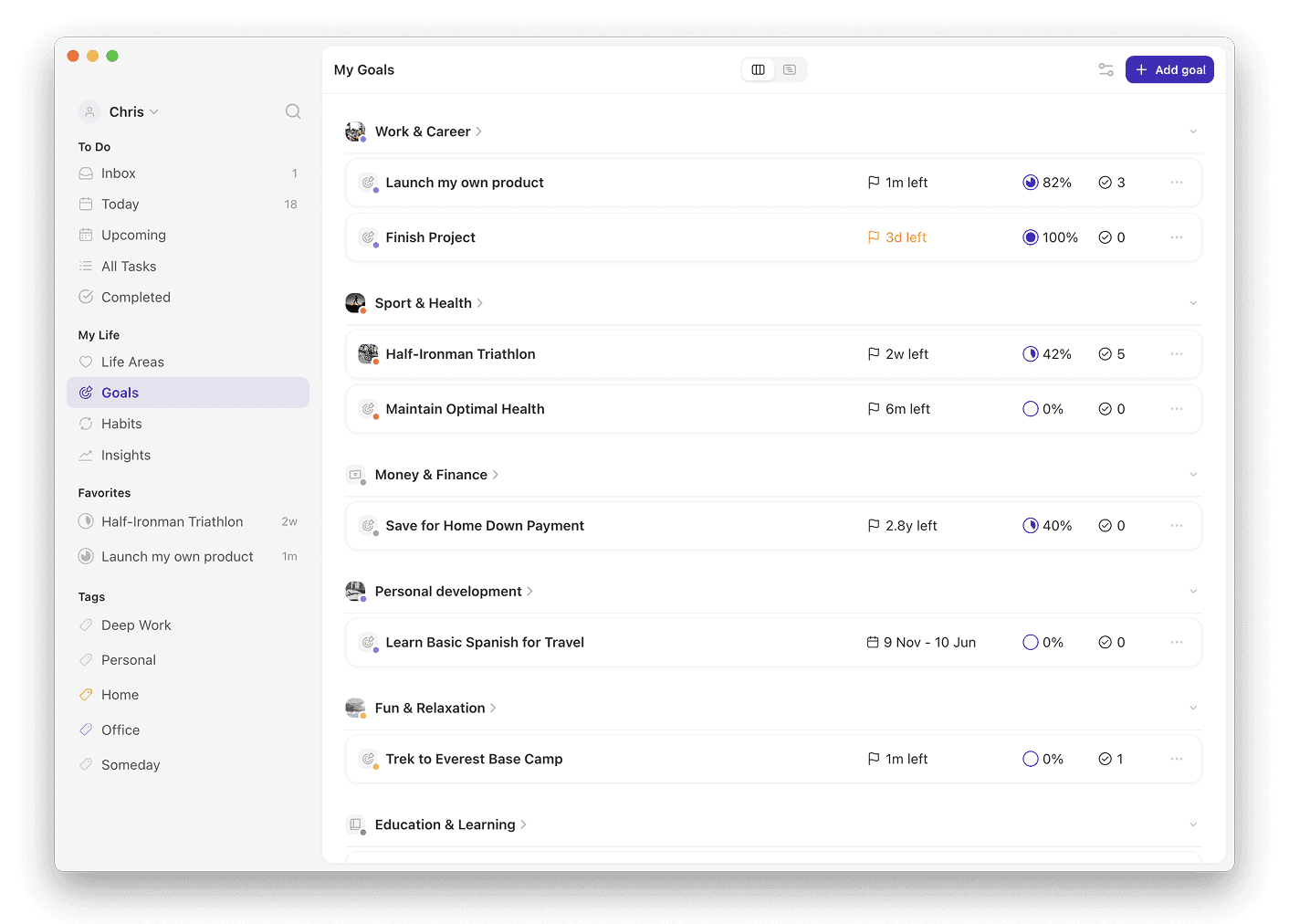
In Griply you set the pull-up as one goal, break it into milestone subgoals, and attach a training habit.
The plan, stage by stage
Here is the whole plan before you start. Each stage has one target to hit before you move to the next, so you always know where you are and what to work on today.
Stage | Target to hit before moving on | Rough time |
|---|---|---|
1. Dead hang | Hold the bar for 30 seconds | 1-2 weeks |
2. Scapular pulls | 10 controlled reps from a dead hang | 1-2 weeks |
3. Inverted rows | 10 reps with your body at an angle | 2-3 weeks |
4. Negatives | 3 controlled lowers, 3+ seconds each | 2-3 weeks |
5. Band-assisted reps | 5 reps with a light resistance band | 2-4 weeks |
6. Your first rep | 1 clean, unassisted pull-up | the milestone |
7. Build volume | 5 pull-ups in a row | 3-6 weeks |
Most beginners reach their first rep in two to four months. Some stages overlap, so you can train scapular pulls and inverted rows in the same weeks early on, and move up a stage the day you hit its target.
Your weekly routine
Whichever stage you are on, the session is the same, so you never have to guess. Train the movement three times a week on non-consecutive days, for example Monday, Wednesday, and Friday. Each session is:
3 to 5 sets of your current stage's move (a dead hang, a set of negatives, and so on).
2 to 3 minutes rest between sets, so each set is fresh.
Stop 2 to 3 reps before your form breaks, never grinding a set to failure.
A session takes about 15 minutes. Add a little each week, one more second on the hang, one more rep, or a lighter band, and move up to the next stage the day you can hit its target twice on a fresh day.
How to do each move
The early stages build the pieces a pull-up needs before you attempt the full movement. Here is how to do each one.
1. Dead hang
Hang from a bar with an overhand grip, hands about shoulder-width apart and arms straight. Keep your shoulders slightly active rather than fully relaxed, and hold for time. This builds the grip and shoulder strength every later stage relies on.
2. Scapular pulls
From a dead hang with straight arms, pull your shoulder blades down and together so your body rises a few centimetres, then lower under control. Your elbows stay straight the whole time. This teaches your shoulders to start the pull.
3. Inverted rows
Set a bar at about waist height and hang underneath it with a straight body and straight arms. Pull your chest toward the bar, then lower with control. The more horizontal your body, the harder it gets, so lower the bar as you get stronger.
4. Negatives
Jump or step to the top position with your chin over the bar, then lower yourself as slowly as you can until your arms are straight. Lowering under control builds strength with less perceived effort than a full rep, so aim for three seconds or more on the way down. If you cannot control a three-second lower yet, start by holding the top position with your chin over the bar for as long as you can, then add a slow one- to two-second lower and build up from there.
5. Band-assisted pull-ups
Loop a resistance band over the bar and place one foot or knee in it. Start with the band that lets you do about five clean reps with two still in reserve, pull up until your chin clears the bar, then lower under control. When you can do eight to ten clean reps on that band, drop to the next lighter one.
6. Your first unassisted pull-up
From a dead hang, pull until your chin is over the bar, then lower with control. Keep it clean, with no kicking or swinging your legs to cheat the rep.
7. Build volume
Repeat clean reps, resting as long as you need between them, until you can do five in a row. Stop each set before your form breaks down.
Inside each stage, make it a little harder every week: one more second on the hang, one more rep, a lighter band. You are ready to move up when you can hit the stage target twice on a fresh day. Giving each stage a number keeps you honest about when you have earned the next one.
Why it feels impossible
A pull-up is heavy because you are lifting your entire bodyweight with muscles that rarely get trained that way. You change that by adding a little difficulty at a time, which is the core of any strength gain. For a beginner, that progression can come from adding reps or reducing band assistance, so every session has a clear way to get slightly harder.
A first pull-up is a sharp, well-formed target: one clean rep, no cheating, easy to judge. Shaping the goal so it is specific and measurable is what keeps you training when the result is slow to arrive. You cannot control the day your chin clears the bar. You can control whether you train the stages that get you there.
Build the habit
Strength comes from frequent practice, so the three short sessions above beat one exhausting attempt. Training the movement at least twice a week, with pulling as the specific stimulus, is what drives the gain, because your body adapts to the exact thing you practise. Spreading practice across the week also lets you train while fresh, so the reps stay clean and each one counts.
A repeatable cue, routine, and reward pattern for showing up, like training every Monday, Wednesday, and Friday morning, carries you between milestones without relying on motivation.
Common mistakes
A few habits stall most beginners:
Kicking or swinging your legs to force a rep, which trades the strength you are building for one that does not count. Keep the reps clean.
Grinding every set to failure, which leaves you too sore to practise often. Stop with two or three reps in reserve.
Skipping the hangs, scapular pulls, and rows and only attempting full pull-ups. Those early stages build the strength the full rep needs.
Using a grip that is too wide or too narrow. Keep your hands about shoulder-width, palms facing away.
Training again while your lats and grip are still sore. Strength develops during the two days of recovery between sessions, so leave a rest day.
Set it up in Griply
The hard part is rarely the plan. It is holding the whole progression in one place and seeing whether you are moving. In Griply it becomes one scannable template under your Sport & Health life area:
Goal: Do 5 pull-ups (metric: Subgoals, average)
Subgoal: hold a 30-second dead hang
Subgoal: 10 scapular pulls
Subgoal: 10 inverted rows
Subgoal: 3 controlled negatives
Subgoal: 1 band-assisted pull-up
Subgoal: 1 unassisted pull-up
Subgoal: 5 pull-ups in a row
Habit: Pull-up training (schedule: 2 to 3 times a week)
You advance each stage as you build it, and the progress line averages your milestones, so it climbs from your very first week of training, well before your first full rep. The Goal Planner keeps the goal, its milestones, and the training habit in one view, so the plan you just read becomes a template you can reuse for the next strength goal. Subgoals, habit targets, and progress charts are part of Griply's paid plan; the free plan covers two goals and two habits.
Frequently asked questions
How long does it take to get your first pull-up?
Most beginners reach a first pull-up in two to four months of consistent training, depending on starting strength and bodyweight. Training two or three times a week and tracking each stage keeps the timeline realistic and visible.
Can you learn a pull-up without any equipment?
You need something to hang from, like a doorway bar or a sturdy outdoor bar. A resistance band helps with assisted reps, but you can still progress with dead hangs and negatives if a bar is all you have.
How many times a week should you train pull-ups?
Two to three sessions a week works best for most beginners. That frequency gives you enough practice to build strength while leaving time to recover between sessions, which is when the strength actually develops.
Do negative pull-ups build strength?
Yes. Lowering yourself slowly from the top of the bar builds pulling strength with less perceived effort than a full rep, which makes negatives one of the most effective starting points for beginners.
What if you cannot hold a dead hang yet?
Start shorter and build up. Hang for as long as your grip allows, rest, and repeat, adding a few seconds each session until you reach 30 seconds. Grip strength improves quickly with regular practice.
The first rep follows
Your first pull-up comes from training the movement two or three times a week, moving through stages you can measure, and tracking each one until the next is in reach. You build the strength by showing up for those stages, in the order they come.
When you can watch your dead hang climb past 30 seconds and your negatives slow down, the first rep stops being a mystery and becomes the next number on the list. Every session gives you a number to beat, which keeps the plan moving on the weeks you do not feel like training. Once you own that first clean rep, the same method takes you to five: add a rep each week, log it, and watch the target line close. The same method powers the rest of your strength goals.
Related Goal Plans


Related Guides
Plotkin D, Coleman M, Van Every D, et al. "Progressive overload without progressing load? The effects of load or repetition progression on muscular adaptations." PeerJ, 2022. https://pmc.ncbi.nlm.nih.gov/articles/PMC9528903/
Ansari M, Hardcastle S, Myers S, Williams AD. "The Health and Functional Benefits of Eccentric versus Concentric Exercise Training: A Systematic Review and Meta-Analysis." Journal of Sports Science & Medicine, 2023. https://pmc.ncbi.nlm.nih.gov/articles/PMC10244982/
Currier BS, D'Souza AC, Fiatarone Singh MA, et al. "American College of Sports Medicine Position Stand. Resistance Training Prescription for Muscle Function, Hypertrophy, and Physical Performance in Healthy Adults." Medicine & Science in Sports & Exercise, 2026. https://pmc.ncbi.nlm.nih.gov/articles/PMC12965823/
Gollwitzer PM, Sheeran P. "Implementation Intentions." National Cancer Institute, Health Behavior Constructs, 2008. https://cancercontrol.cancer.gov/sites/default/files/2020-06/goal_intent_attain.pdf