

Table of Contents
Making a budget means writing a simple plan for your money: what comes in, what goes out, and a limit for each type of spending, so you decide where your money goes before the month starts. Most people can build one in an evening. The harder part is staying on it once the month gets busy and the small purchases start adding up. A budget is the anchor for the rest of your money goals, from saving to paying down debt.
That is why this plan splits the work in two. First you build the budget, a one-off task you finish in a sitting. Then you keep it, which is the recurring part: tracking what you spend and checking it against your limits each week. A budget that you track and revisit is the one that changes anything, and the steps below cover both halves, from your first income figure to a weekly review you can hold.
Key takeaways
Building the budget is a one-off; staying on it week to week is the real work.
Split your take-home income into needs, wants, and savings, with 50/30/20 as a starting point.
Track what you spend and review it weekly, so small overspends surface before they pile up.
In Griply you set staying on budget as one goal, attach a spending-log habit and a weekly-review habit, and track your on-track weeks.
The steps at a glance
Here is the whole plan before you start. The first five steps build the budget in one sitting; the last three are the weekly and monthly routine that keeps it going.
Step | What to aim for | How to start |
|---|---|---|
List your income | Know your monthly take-home pay | Add up every after-tax source for the month |
List fixed costs | Every recurring bill in one place | Rent, utilities, insurance, loan minimums, subscriptions |
Set category limits | A cap for needs, wants, and savings | Use the 50/30/20 split as a first draft |
Plan for irregular costs | A monthly amount set aside | Divide yearly bills by 12 and save that each month |
Pick a method | One place you will keep using | An app, a spreadsheet, or cash envelopes |
Track your spending | Every purchase logged | Note it as you pay, in your app or a notebook |
Weekly money review | 10 minutes, once a week | Compare what you spent against each limit |
Adjust monthly | A budget that fits real life | Move money between categories where limits missed |
Building the budget takes an evening. Sticking to it is ongoing, and the tracking and weekly review are what carry the plan from one month to the next.
Why it feels hard
A budget is quick to write and hard to keep, because the plan sits on paper while the spending happens in dozens of small moments across the month. Prices rise, a car repair lands, a friend books dinner, and the plan you made in a calm evening drifts by the second week. About one in eight adults could not cover a $400 emergency by any means, which is how one surprise turns into a broken month, so a budget that sets money aside for the unexpected holds up better than one that assumes a smooth month.
The saving is the outcome you want, and the tracking and the weekly review are the process. Setting a specific, measurable limit on each category is what stops one overspent week from ending the whole plan. You cannot control every price or surprise bill. You can control whether you track your spending and adjust the plan when it slips.
Build the budget
You build the whole budget in one sitting. Work through these five steps in order, and by the end you have a plan with a number on every part of your spending.
List your take-home income
Add up every source of money that lands in your account after tax for the month: salary, freelance payments, benefits, anything regular. Use your take-home pay, the amount that hits your bank after tax and deductions. Your headline salary is higher than what you can budget, so work from the lower figure. If your income varies month to month, use a recent low month so the plan still works in a lean one.
List your fixed costs
Write down every bill that is the same each month: rent or mortgage, utilities, insurance, loan and card minimums, and subscriptions. These are your fixed costs, the ones you cannot change quickly. Total them and subtract from your income, so you can see what is left for everything else before you start dividing it up.
Set your category limits
Split what is left into three groups: needs, wants, and savings. A simple first draft is the 50/30/20 rule from Elizabeth Warren and Amelia Warren Tyagi: 50% of your take-home pay for needs, 30% for wants, and 20% for savings, like building an emergency fund, and paying down debt. Needs are rent, food, transport, and minimum payments. Wants are dining out, hobbies, and subscriptions you could drop. Dividing your money into named categories makes each one easier to hold, an effect known as mental accounting. Giving each category a number you can check against is what makes overspending visible.
Plan for irregular costs
The costs that break budgets are the ones that do not arrive monthly: car insurance, a birthday, an annual subscription, a dentist visit. Add up these yearly costs, divide by 12, and set that amount aside every month in your savings category. That way the bill is already covered when it lands, so no single month takes the full hit.
Pick a method that fits you
Choose one place to run the budget: a budgeting app, a spreadsheet, or physical cash envelopes for each category. The best method is the one you will keep opening. Logging your spending by hand keeps you aware of where the money goes, since writing each purchase down makes you notice it, so pick whatever makes that quick and painless.
Make it stick
The budget you just built does nothing on its own. These three habits are what turn it into spending that matches the plan.
Track every purchase
Log what you spend as you spend it, in your app or a note on your phone. It takes seconds and it is the single most useful habit here: people who track their spending shift a smaller share of their money to non-essential buys, because seeing the number makes you pause before the next purchase. If logging every item feels like too much, start by tracking one category, like eating out.
Do a weekly money review
Once a week, spend 10 minutes checking what you spent against each category limit. Here is the routine: open your tracker, add up each category for the week, and compare it to a quarter of the monthly limit. Green means you are under, so carry on. Over on one category means you pull back there for the rest of the month, or move a little room over from a category you underspent. Pick a fixed time, like Sunday evening, so the review becomes automatic.
Adjust the budget monthly
At the end of each month, look at where the plan matched reality and where it did not. If you went over on groceries every week, the limit was too low, so raise it and trim somewhere else. A budget is a first guess that you correct, and the monthly adjustment is what makes the numbers fit the life you live.
Build the habit
Two habits keep a budget alive: logging your spending daily and running the weekly review. Lock those two in first, because the monthly adjustments take care of themselves once you have a month of tracked data to look at. Building the weekly review into a habit that lasts, like reviewing your spending every Sunday with a coffee, turns the review from a chore you forget into something your week expects.
Common mistakes
A few habits quietly sink most budgets:
Not tracking. A budget you never check against real spending is a wish, so log purchases as you go.
Setting limits too low. Limits far below your real spending fall apart by week two, so start from what you spend now and trim gradually.
Forgetting irregular costs. Insurance, gifts, and annual bills wreck a monthly plan, so set money aside for them every month.
Making categories too detailed. Twenty tiny categories are hard to keep up, so start with five or six broad ones.
Budgeting nothing for fun. A plan with zero room for wants rarely lasts, so give yourself a realistic wants category.
Building it once and never reviewing. The weekly check is what keeps the budget connected to your spending.
Set it up in Griply
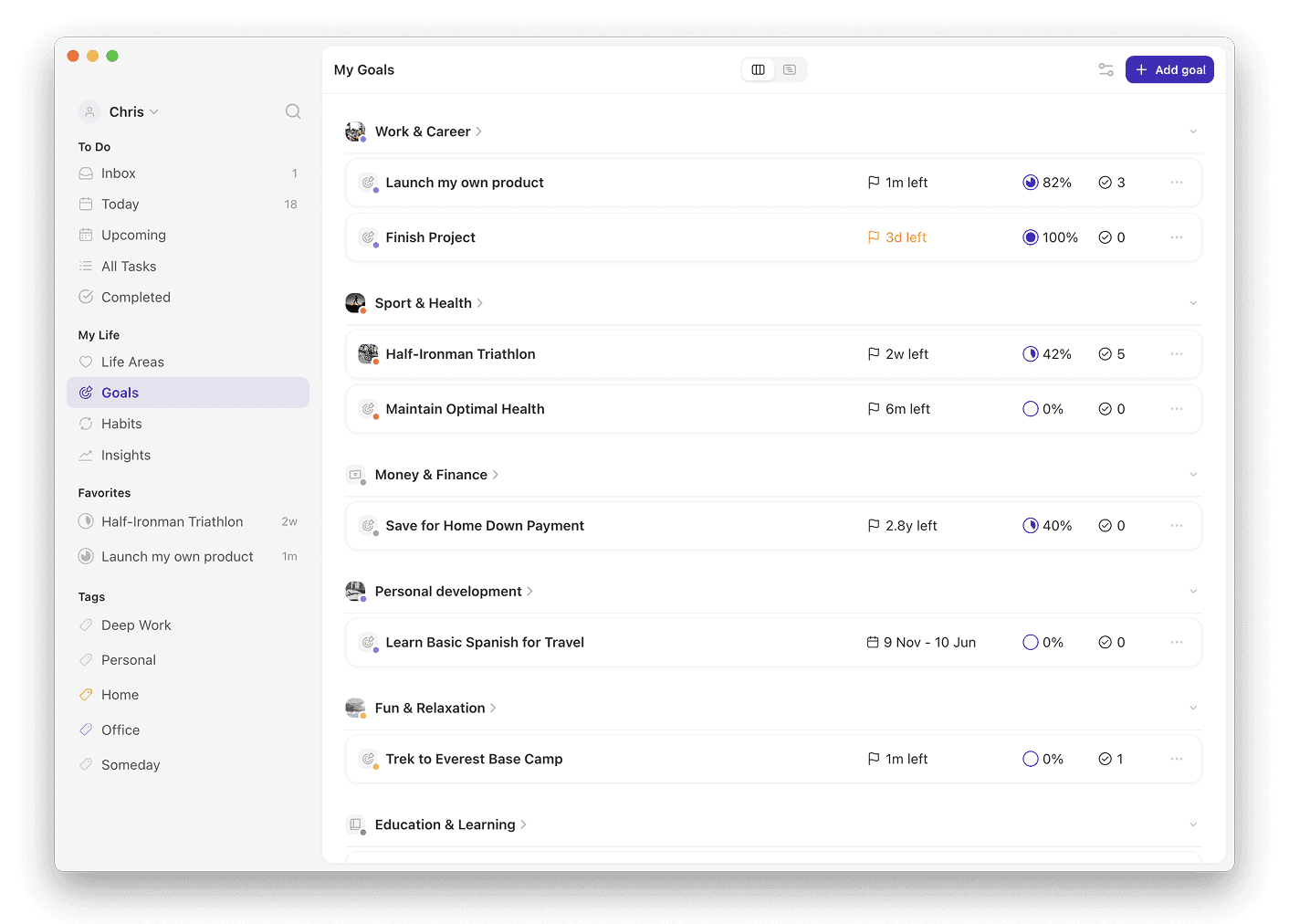
The hard part is rarely writing the budget. It is logging your spending night after night and seeing whether you are holding the line. In Griply the whole plan becomes one template under your Money & Finance life area:
Goal: Stick to a budget (metric: Unit-based, weeks on track, 0 to 12)
Habit: Log what you spend (schedule: every day)
Habit: Run a money review (schedule: every week)
Task: list your income and fixed monthly costs
Task: set category limits with the 50/30/20 split
Task: pick a budgeting method or app
You log an on-track week each time you stay within your limits, and the progress line climbs toward 12 weeks and turns green when you hold it. The Habit Tracker keeps the goal, its habits, and your setup tasks in one view, so the plan you just read becomes a template you can reuse each quarter. Habit targets and progress charts are part of Griply's paid plan; the free plan covers two goals and two habits.
Frequently asked questions
What is the 50/30/20 budget rule?
The 50/30/20 rule splits your take-home pay into three parts: 50% for needs like rent and food, 30% for wants like dining out and hobbies, and 20% for savings and paying off debt. It is a simple starting point you adjust to your own life.
What are the first things you should list in a budget?
Start with your monthly take-home income, then your fixed costs: rent or mortgage, utilities, insurance, loan and card minimums, and subscriptions. Once those are down, list your variable spending like groceries, transport, and eating out. Income and fixed costs first, everything else after.
What is a realistic monthly budget?
A realistic budget is built from what you spend now, then trimmed a little. Track a normal month first, then set limits slightly below those figures. It should cover your needs, leave room for some wants, and still move money toward savings each month.
How do you stick to a budget?
Track every purchase as you make it, review your spending against your limits once a week, and adjust the plan monthly. The weekly review is what catches small overspends early. Set money aside for irregular costs too, so one surprise bill does not break the month.
What is the $27.40 rule?
The $27.40 rule is a savings target: putting aside $27.40 a day adds up to $10,000 in a year. It reframes a large goal as a small daily amount. Treat it as one savings idea, since on its own it ignores your income and fixed costs.
The review keeps you honest
Sticking to a budget runs on a habit. You build the plan once, then track your spending and check it against your limits each week. The weekly review is where a budget earns its keep, because it catches the grocery run or the extra subscription before it turns into a monthly pattern you never noticed.
When your spending is logged and your Sunday review is a routine, the budget stops being a document you forget by the 10th and becomes the number you glance at before you buy. Start with your income and your limits tonight, then let the weekly check do the work of keeping you on track.
Related Goal Plans


Related Guides
Consumer Financial Protection Bureau. "Budgeting: How to create a budget and stick with it." consumerfinance.gov, 2023. https://www.consumerfinance.gov/about-us/blog/budgeting-how-to-create-a-budget-and-stick-with-it/
Thaler RH. "Mental accounting matters." Journal of Behavioral Decision Making, 1999. https://people.bath.ac.uk/mnsrf/Teaching%202011/Thaler-99.pdf
Zhang Y. "How Does Expense-Tracking Inform Financial Behaviors?" American Council on Consumer Interests, 2023. https://www.consumerinterests.org/assets/docs/CIA/CIA2023/ZhangYilingCIA2023.pdf
Board of Governors of the Federal Reserve System. "Report on the Economic Well-Being of U.S. Households in 2023." Federal Reserve, 2024. https://www.federalreserve.gov/publications/2024-economic-well-being-of-us-households-in-2023-executive-summary.htm