Guide


Table of Contents
Examples of goals for work include spending fewer hours in meetings, learning a skill your role needs, earning a promotion and keeping your weekends free. What makes any of them a goal is a number and a deadline. "Cut recurring meetings from nine hours a week to five by March 31" is something you can check at the end of March. "Be more efficient" gives you nothing to check.
Below are 40 work goals grouped into seven types. Each one has a number to hit and a deadline, so you can copy the wording and change the numbers to fit your job. Most are written for people who don't manage a team, including the self-employed, and there are short sets for managers and for your first months in a new job. Use them for the goals your manager asks for at annual planning, or for goals you set for yourself.
After the examples, you'll find how to write your own work goal in one sentence, and how to check progress every week on both the goals in your performance review and your own career goals.
The seven types of work goals on this page:
Output and performance goals
Skills and learning goals
Career growth and promotion goals
Leadership and collaboration goals
Communication goals
Focus and deep work goals
Work-life boundary goals
Key takeaways
Write each work goal with a number you can move and a deadline.
Choose three to five goals that mix what you deliver with how you grow.
Check progress every week, because an annual review comes too late to change course.
Griply charts each work goal against the pace it needs, so you see slipping early.
Output and performance goals
Output goals cover what you deliver: the results your job is measured on, such as revenue, speed, quality or cost. They usually make up most of the goals your manager signs off on. Write down where the number is today, so you know how far you have to go.
Close the books each month in five working days, down from eight, by June 30.
Raise checkout conversion from 2.1% to 2.6% by the end of Q3.
Sign six new retainer clients by December 31, up from two last year.
Raise your customer satisfaction score from 82% to 90% by the end of Q2.
Bring shipping errors down from 3% of orders to under 1% by September 30.
Some of these numbers also depend on things you don't control. Conversion moves with pricing and traffic, for example. In that case, add a goal for the work you do control, such as running four checkout tests by July.
Skills and learning goals
Skills goals are about getting better at your work: a tool, a qualification or a way of working your role needs. Measure what you can show at the end, such as an exam you passed or work you shipped with the new skill. Hours spent on a course tell you less. For longer-term growth goals, see these professional development goal examples.
Pass the AWS Solutions Architect Associate exam by June 30.
Write 20 SQL queries that pass a data analyst's review by April 30.
Build four prototypes in Figma without help from a designer by August 31.
Reach B1 (intermediate) Spanish by December and run one client call in Spanish.
Listen in on six customer calls by March 31 to learn how buyers talk.
Career growth and promotion goals
Career goals at work are about where your role is going: a promotion, a raise, more responsibility or a move into a new field. Someone else often decides the outcome, so set goals for the parts you control, such as the criteria you meet and the conversations you have. Our plan for getting a promotion breaks a promotion goal into steps.
Meet all five criteria for promotion to senior engineer by the June review.
Lead one project normally given to someone a level above you, by Q4.
Ask for a salary increase of at least 8% at this year's review.
Raise your day rate from $600 to $750 for new clients by July 1.
Have eight conversations with people in the role you want by May 31.
Leadership and collaboration goals
You don't need a team to set leadership goals. These are for anyone who helps others do their work: reviewing it, teaching it or writing down how it's done. Pick a measure the people you help would notice.
Get both Q2 new hires shipping code within their first ten working days.
Review three pull requests for teammates every working day this quarter.
Run your team's Q3 planning and get the plan signed off by July 15.
Write how-to guides for the five tasks colleagues ask you about most, by June 30.
Communication goals
Communication goals make your work visible and easier for others to act on. Pick the gap that costs you the most, such as a manager who doesn't know what you've finished, or proposals that keep coming back with the same questions.
Send your manager a five-line update every Friday this quarter.
Write a one-page brief before every project kickoff you lead this year.
Get a senior colleague's feedback on three written proposals before the June review.
Thank one colleague in writing for something specific every week this quarter.
Focus and deep work goals
Focus goals protect the hours your hardest work needs. Interruptions have a cost even when the work still gets done: in one study, people who were interrupted finished their tasks faster but reported more stress, frustration and time pressure. Measure focus in hours or meeting-free blocks you can see on your calendar.
Keep three mornings a week free of meetings until noon, through Q2.
Spend ten hours a week on your most important project this quarter.
Cut recurring meetings from nine hours a week to five by March 31.
Finish your top task before opening email on four days a week, for six weeks.
Work-life boundary goals
Boundary goals limit how much room work takes up in your life. They belong with your work goals because rest affects how you work. People who mentally switch off from work in their free time are more satisfied with their lives and show fewer signs of strain, without being less engaged at work. Make the boundary something you can count.
Take all 25 of your vacation days this year, including one full week.
Remove work chat from your phone and keep it off for eight weeks.
Keep 10 of the next 12 weekends completely free of work.
Move to a four-day week by September while keeping monthly income above $8,000.
Work goal sets for individual contributors, managers and new hires
Most people need three to five work goals in total. These short sets show what a balanced mix looks like in three common situations. Add one output goal from the lists above to each.
Individual contributors
If you're senior but don't manage anyone, your goals usually mix your own work with work that helps your team and other teams.
Write the technical design for one cross-team project by the end of Q2.
Cut after-hours alerts for your service from 12 a month to four by June.
Run two workshops on a tool your team underuses by September 30.
Managers
As a manager, most of your results come through other people. Set goals for the team's results and one for your own development. The guide to development goals for managers has more of those.
Fill both open roles with accepted offers by April 30.
Agree on a written six-month goal with each direct report by February 15.
Cut the projects your team runs at once from seven to four by Q3.
Your first 90 days in a new job
In a new job, your first goals are about settling in. New hires who understand their role, feel confident in it and feel accepted by colleagues tend to perform better and stay longer. Set one goal for each.
Get your manager to confirm written 90-day success criteria by the end of week two.
Have a 30-minute intro with the 12 people you'll work with most within 30 days.
Ship your first small piece of work by the end of week six.
How to write your own goals for work in one sentence
A good work goal fits in one sentence with four parts: what you'll measure, where it starts, the target and the deadline. "Raise checkout conversion from 2.1% to 2.6% by the end of Q3" has all four. "Improve the checkout" has none of them.
Three checks before you commit to a goal:
Can you move the number through your own work?
Will you see the number change well before the deadline?
Would you and your manager agree on whether it happened?
If a goal has nothing to measure, such as rewriting the onboarding docs, treat it as a project: a list of tasks you work through until it's done. For the full method, our guide to SMART goals examples for work explains each letter with six rewritten examples.
Review goals vs your own goals for work: track both weekly
The goals on your review form are only part of the picture. The form covers what your company needs from you this year. Your own goals cover what you want from work: the skill you want to build, the promotion you're aiming for in two years, the evenings you want back. Many of those never make it onto the form.
Both kinds need checking more than once a year, and for most employees that doesn't happen. Gallup found that about three in four employees have their performance reviewed once a year or less, and only 14% strongly agree that the reviews they get inspire them to improve. When the review comes around, the year is already over.
So check both sets yourself, once a week. Fifteen minutes on Friday is enough: update each goal's number, compare it with where it should be by now, and plan next week's tasks for the goal that's furthest behind. A review of 138 studies found that people who were prompted to check their progress more often were more likely to reach their goals, especially when they wrote the progress down or reported it to someone.
Keep the two lists side by side. When your review goals take every hour you have, you'll see that your own goals haven't moved in a month, and you can decide whether that's fine for now.
How Griply tracks your goals for work
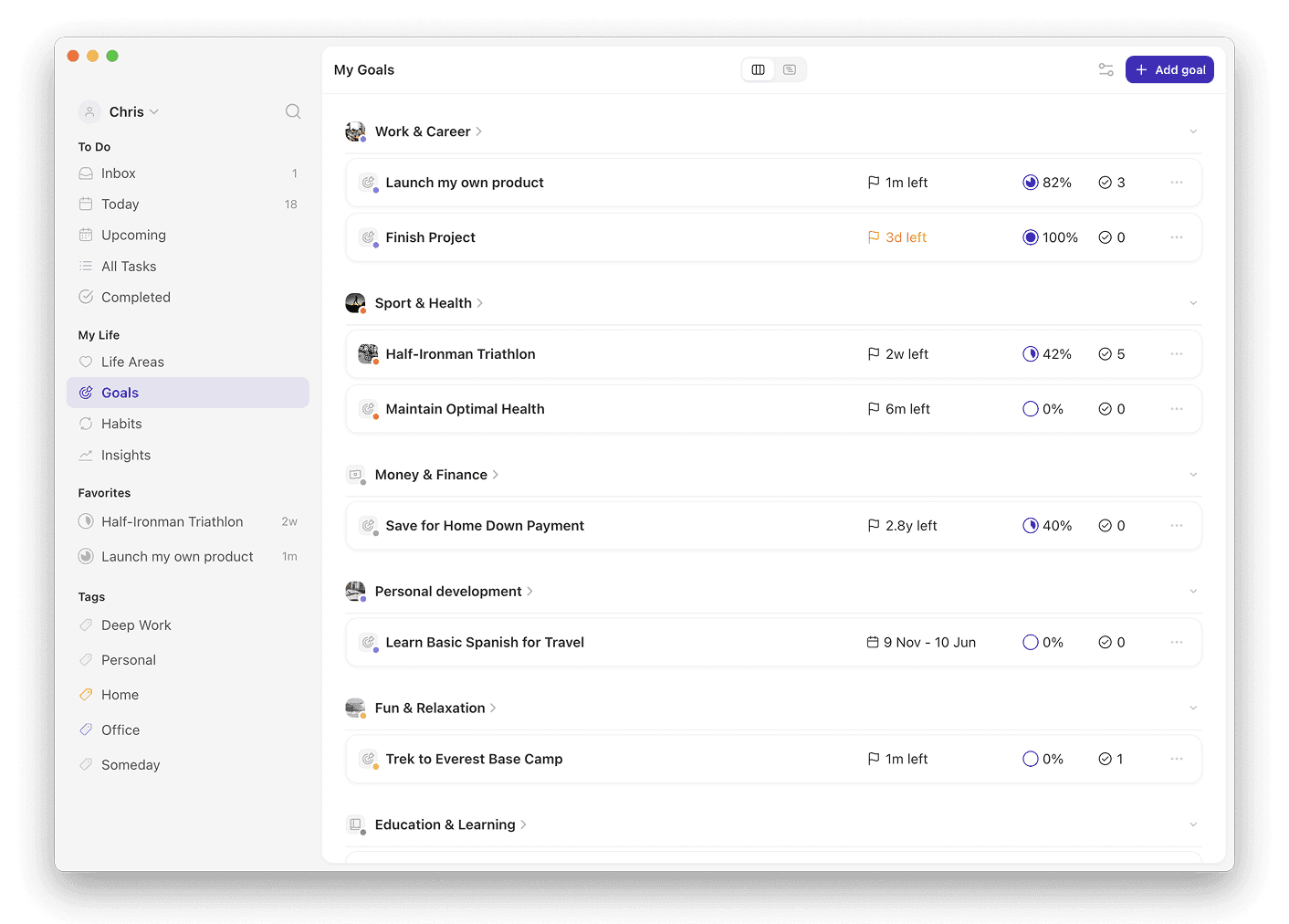
Griply, the goal app we make, shows you whether each work goal is on track months before the review. Each goal has a start value, a target and a deadline, and its chart draws the pace you need as a line. Every update you log appears as a point on that chart. If conversion is still at 2.2% in July, you see the gap in July.
Your work goals can sit in a Work & Career life area, next to the other areas of your life, with room to write a short vision of where you want your career to go. Your review goals and your own goals stay side by side. You can link tasks and habits to a goal, and the Today view shows which goals today's tasks are serving. A weekly review reminder prompts you to open Griply and plan the week. It comes on Sunday by default, and you can move it to Friday.
Griply is for your own goals. It doesn't run team reviews or manager dashboards, so you keep using your company's review tool for those. It suits big-picture thinkers who want one place to keep their plans organized. See how Griply's goal planner works.
Frequently asked questions
What are some good goals for work?
Good work goals have a number and a deadline, and they cover more than output. A balanced set might be one output goal, such as raising conversion from 2.1% to 2.6% by Q3, one skills goal, such as passing a certification by June, and one boundary goal, such as keeping 10 of the next 12 weekends free.
How many goals should you set for work?
Three to five work goals is a workable number for most people. That's enough to cover your results, your growth and how you work, and few enough that each goal gets time every week. If your company asks for more, keep the extra ones small and give your weekly attention to the three to five that matter most to you.
What goals should I set for my performance review?
Set goals your manager can check at the review: a number with a starting point, a target and a deadline. Include one or two goals for your main results and one for a skill. Agree in advance where the evidence will come from, such as a dashboard or a ticket tracker, so the review doesn't depend on anyone's memory.
What is the difference between work goals and career goals?
Work goals cover what you want to achieve in your current role, usually this year, such as hitting a target or learning a skill. Career goals cover where you want your working life to go over several years, such as the kind of role you want. Good work goals often move a career goal forward.
What are short-term and long-term goals for work?
Short-term work goals take a few weeks to three months, such as cutting recurring meetings from nine hours a week to five by March 31. Long-term work goals take a year or more, such as reaching a senior role or doubling your day rate. Break each long-term goal into short-term ones, one quarter at a time.
Work goals pay off when you check them every week
Any of the 40 goals above takes a few minutes to copy and adapt. The harder part comes in March, when this week's deadlines take the hours you meant to spend on the goal you wrote in January.
Choose three to five goals, write each one with a number and a deadline, and put a weekly check in your calendar. Every Friday, update the numbers and give next week's spare hours to the goal that's furthest behind. Keep that up for a quarter and your review becomes a summary of numbers you already know. You'll also have caught any goal that was slipping while there were still months left to fix it.
Related Guides
Mark, Gloria, Daniela Gudith, and Ulrich Klocke. "The Cost of Interrupted Work: More Speed and Stress." Proceedings of the SIGCHI Conference on Human Factors in Computing Systems (CHI '08), 2008. https://www.ics.uci.edu/~gmark/chi08-mark.pdf
Sonnentag, Sabine. "Psychological Detachment From Work During Leisure Time: The Benefits of Mentally Disengaging From Work." Current Directions in Psychological Science, 2012. https://madoc.bib.uni-mannheim.de/38114
Bauer, Talya N., Todd Bodner, Berrin Erdogan, Donald M. Truxillo, and Jennifer S. Tucker. "Newcomer Adjustment During Organizational Socialization: A Meta-Analytic Review of Antecedents, Outcomes, and Methods." Journal of Applied Psychology, 2007. https://pubmed.ncbi.nlm.nih.gov/17484552/
Wigert, Ben, and Annamarie Mann. "Give Performance Reviews That Actually Inspire Employees." Gallup, 2017. https://news.gallup.com/opinion/gallup/219863/give-performance-reviews-actually-inspire-employees.aspx
Harkin, Benjamin, Thomas L. Webb, Betty P. I. Chang, Andrew Prestwich, Mark Conner, Ian Kellar, Yael Benn, and Paschal Sheeran. "Does Monitoring Goal Progress Promote Goal Attainment? A Meta-Analysis of the Experimental Evidence." Psychological Bulletin, 2016. https://pubmed.ncbi.nlm.nih.gov/26479070/