
Table of Contents
Improving public speaking is the process of getting more comfortable and more effective in front of an audience by practising the skill in small, repeatable steps you can start today. If you freeze up, rush through your words, or read straight off your slides, the problem is rarely talent. Public speaking is a skill you build the same way you build any other: you practise the specific skills, get feedback, and do it again.
Most people try to fix it by reading tips the night before a big talk, then avoid speaking until the next one forces them. A practice plan works better. You give yourself concrete things to do each week, and you give a few low-stakes talks long before the high-stakes one. Speaking in front of people repeatedly is one of the most reliable ways to bring the fear down. The plan below turns "get better at public speaking" into steps you can start this week.
Key takeaways
Public speaking is a skill, so you improve it by practising and getting feedback.
The steps that work: record and review yourself, learn a simple structure, join a speaking group, and give low-stakes talks.
Regular practice out loud beats occasional cramming, because your nerves settle the more you speak.
In Griply you set public speaking as one goal, add the steps as tasks, and keep a habit of practising out loud.
The plan, step by step
Here is the whole plan before you start. Each step has one thing to get done, so you always know what to work on this week.
Step | What to have done | Rough time |
|---|---|---|
1. Set your baseline | A 2-minute talk recorded and watched back | Week 1 |
2. Learn a structure | One simple talk shape, your open scripted | Week 1-2 |
3. Join a speaking group | Signed up to Toastmasters or a local club | Week 2-3 |
4. Give a low-stakes talk | One short talk to a friendly group | Month 1-2 |
5. Get specific feedback | One clear thing to work on next | After each talk |
6. Give a real talk | One talk to your target audience | Month 2-3 |
Most people notice a real change in two to three months. The steps overlap, so you keep practising out loud the whole time and move on to the next step the week you finish the last one.
How to do each step
Each step builds a piece of the skill, and most of them are small enough to start this week. Here is how to do each one.
Set your baseline
Open your phone camera, pick any topic you know well, and record yourself talking for two minutes with no script. Watch it back once, looking for one thing only, like your pace, your filler words ("um", "like"), or where your eyes go. Skill only improves when you get feedback on an attempt and try again with a change, so a recording is the fastest feedback you have.
Learn one simple structure
A structure keeps you from getting lost mid-talk. Use a simple shape you can hang anything on, like point, story, point: state your one message, tell a short story that proves it, then land the message again. Script your first 30 seconds word for word so the shaky opening is on rails.
Join a speaking group
A speaking group gives you a regular, friendly audience and honest feedback, which is what practice needs most. Sign up to a Toastmasters club or a local meetup where people give short talks. You get to speak often, low-stakes, in front of people who want you to do well.
Give a low-stakes talk
A low-stakes talk is one where a stumble costs nothing: a two-minute update in a team meeting, a toast, a lightning talk at a meetup. Volunteer for one. Actually giving talks is the single strongest driver of speaking confidence, far more than reading tips, so the point is to rack up real reps in front of real people.
Get specific feedback
After a talk, ask one person one question: "what is one thing I could do better next time?" One clear note beats vague praise, because it gives you the exact thing to practise before your next talk. Write it down and work on it.
Give a real talk
Put your practice to work on a talk that matters to you: a conference session, a pitch, a wedding speech. Bring your structure, your scripted open, and the note you have been working on.
Give each step a number so you know when it is done, whether that is one recording watched back or three talks given. A clear, specific target beats a vague "get better" because you can see when you have earned the next step.
Why it feels hard
A great talk is the outcome you want. The practice you put in is the process, and keeping the two separate is what stops you quitting after one rough talk. The nerves themselves are rarely the real problem. The racing heart and dry mouth are your body getting ready, and reading that arousal as a sign you are primed improves how you perform under pressure. You cannot control whether every audience loves you. You can control how many reps of real practice you put in before you stand up.
Build the habit
Practice out loud is the engine, so a few short sessions across the week beat one long cram before a talk. Practising out loud means standing up and saying your talk at full speaking volume, as if the audience is there in the room. Three sessions a week of five to ten minutes is enough: run your open, work on your one feedback note, and time yourself. A repeatable cue, routine, and reward loop for that practice, like every Monday, Wednesday, and Friday morning, carries you between talks without relying on motivation. The same out-loud reps build any spoken skill, including when you learn a language.
Common mistakes
A few habits hold most speakers back:
Memorising a talk word for word. One forgotten line and you freeze. Learn the structure and the key points, then speak to them.
Only rehearsing in your head. It feels productive, but it skips the hard part. Stand up and say it out loud at full volume.
Speaking too fast. Nerves speed you up, so mark two or three spots to pause and breathe.
Reading straight off your slides. Your slides support you, so look at the audience and talk to them.
Avoiding practice until a big talk forces it. Give yourself low-stakes talks long before the high-stakes one.
Skipping feedback. Ask one person for one specific thing to improve after every talk.
Set it up in Griply
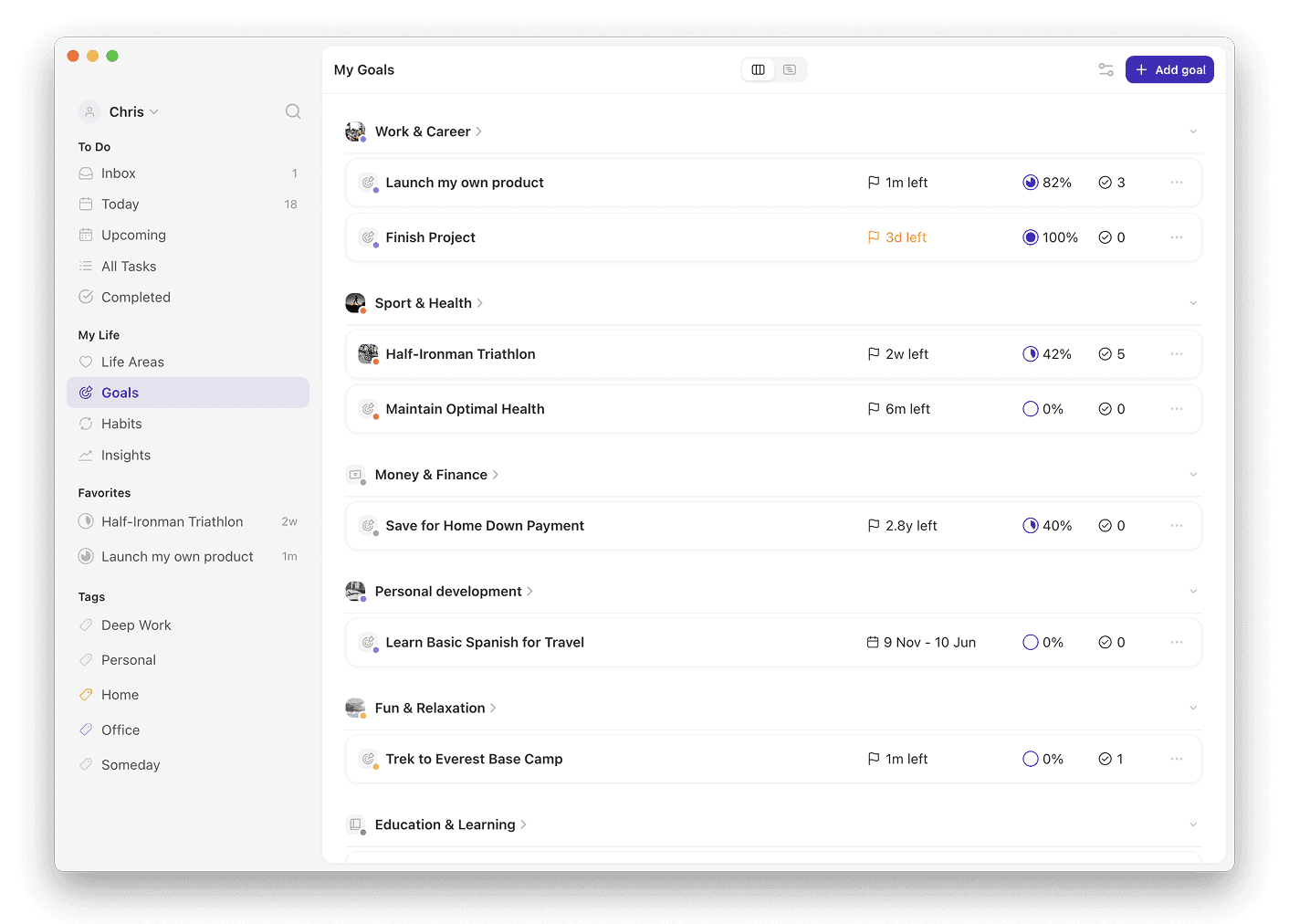
The hard part is rarely knowing the steps. It is keeping them in one place and seeing how much of the plan you have actually run. In Griply the whole plan becomes one template under your Personal Development life area:
Goal: Get better at public speaking (metric: Completed task count, 0 to 6 done)
Task: record a 2-minute talk on your phone and watch it back
Task: learn one simple structure and script your first 30 seconds
Task: join a speaking group like Toastmasters
Task: give one low-stakes talk to a friendly group
Task: ask a listener for one specific piece of feedback
Task: give a real talk to your target audience
Habit: Practise a talk out loud (schedule: 3 times a week)
You check off each step as you complete it, and the progress line climbs toward done and turns green when you have run the whole plan. The Task Manager keeps the goal, its steps, and the weekly practice in one view, so the plan you just read becomes a template you can reuse for the next skill. Habit targets and progress charts are part of Griply's paid plan; the free plan covers two goals and two habits.
Frequently asked questions
How can I improve my public speaking skills?
Practise the skill in small steps. Record a short talk and watch it back, learn one simple structure, and give low-stakes talks to friendly audiences. Ask for one specific piece of feedback each time, and practise out loud a few times a week.
How do I get better at public speaking if I get anxious?
Start small and build up. Give short talks to a friendly group before a big one, since speaking in front of people repeatedly brings the fear down. Reframe the nerves as your body getting ready, and slow your open with two planned pauses.
How long does it take to get better at public speaking?
Most people notice a change within two to three months of regular practice. You feel steadier after your first few low-stakes talks, and confidence builds each time you speak, so the more talks you give, the easier it gets.
Does joining Toastmasters help?
Yes. A speaking group gives you a regular, low-stakes audience and honest feedback, which is what practice needs. You speak often, get specific notes, and build confidence through real talks. Any local club or meetup works the same way.
How do I stop speaking too fast?
Nerves speed you up, so plan your pace. Mark two or three spots in your talk to pause and breathe, script your first 30 seconds, and practise out loud at the speed you want. Recording yourself shows you where you rush.
Get your reps in
Better public speaking comes from practice you can actually schedule: record yourself, learn a simple structure, join a group, and give real talks to real people. None of that depends on being a natural. It depends on reps you can start booking this week.
When you have watched yourself back, given a few low-stakes talks, and asked for feedback each time, standing up stops feeling like a test and starts feeling familiar. Each talk hands you one thing to work on for the next one, which keeps the plan moving even after a rough day at the lectern. The same steady practice carries your other personal-development goals. Give yourself the reps, track each one, and the confidence follows the practice.
Related Goal Plans


Related Guides
Reeves R, Curran D, Gleeson A, Hanna D. "A Meta-Analysis of the Efficacy of Virtual Reality and In Vivo Exposure Therapy as Psychological Interventions for Public Speaking Anxiety." Behavior Modification, 2022. https://pubmed.ncbi.nlm.nih.gov/33533265/
Ericsson KA, Harwell KW. "Deliberate Practice and Proposed Limits on the Effects of Practice on the Acquisition of Expert Performance: Why the Original Definition Matters and Recommendations for Future Research." Frontiers in Psychology, 2019. https://pmc.ncbi.nlm.nih.gov/articles/PMC6824411/
Jamieson JP, Nock MK, Mendes WB. "Mind Over Matter: Reappraising Arousal Improves Cardiovascular and Cognitive Responses to Stress." Journal of Experimental Psychology: General, 2012. https://pmc.ncbi.nlm.nih.gov/articles/PMC3410434/
Wang Y, Sun PP. "Development and validation of scales for speaking self-efficacy: Constructs, sources, and relations." PLoS One, 2024. https://pmc.ncbi.nlm.nih.gov/articles/PMC10824441/