

Table of Contents
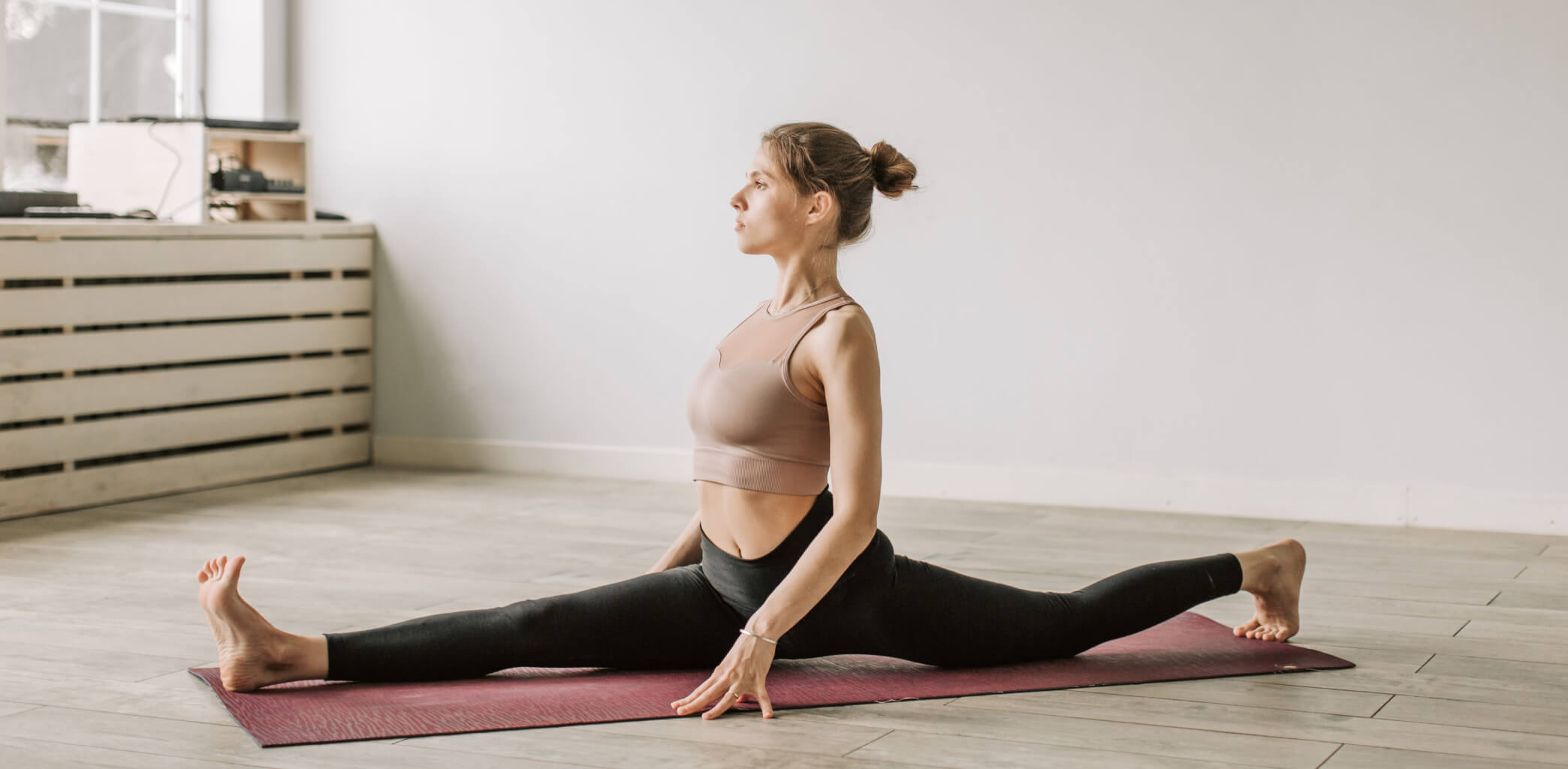
Doing the splits is a flexibility skill you build in stages, by stretching the same few muscles a little further each week until your hips reach the floor. Most people treat it as something you can either do or you cannot, so they yank into a deep stretch once, feel sore, and give up. A staged plan works better. You open the hamstrings, hip flexors, and inner thighs in short sessions most days, measure how close your hips get to the floor, and lower that gap over time. The stages below take you from your first floor stretches to a full front split, built the same patient way as a handstand.
Key takeaways
Doing the splits comes from stretching the same muscles a little further each week, over months of short sessions.
A front split has three areas to open: your hamstrings, your hip flexors, and your inner thighs.
Stretching five or six days a week builds flexibility faster than one long weekly session.
In Griply you set the split as one goal measured by depth, tick off each stage as a task, and attach a stretching habit.
The plan, stage by stage
Here is the whole plan before you start. Each stage has one target to hit before you move to the next, so you always know where you are and what to work on today.
Stage | Target to hit before moving on | Rough time |
|---|---|---|
1. Warm up and hold the base stretches | Flat-back forward fold to the floor, 30 seconds | 1-2 weeks |
2. Open the hips | Butterfly and frog with knees sinking toward the floor, 60 seconds | 2-3 weeks |
3. Elevated split | A split with your front heel on a block, back knee down, 30 seconds | 3-5 weeks |
4. 80% split | Hips within a few inches of the floor on a low cushion, 30 seconds | 4-8 weeks |
5. Full front split | Hips flat, front leg straight, hips square, 30 seconds | the milestone |
6. Both legs | A full front split on each leg, warmed up | ongoing |
Most people reach a front split in two to six months of near-daily stretching. The areas overlap, so you train hamstrings, hip flexors, and inner thighs in the same sessions from week one. Giving your depth a number is what tells you when you have earned each stage.
How to do each move
Warm up first, every session. A few minutes of light, moving stretches prepares the muscles without the performance drop that long cold holds cause, so save the deep holds for once you are warm.
1. Dynamic warm-up
Spend five to ten minutes getting warm: leg swings front to back and side to side, walking lunges, and hip circles. Never sink into a deep hold cold. Save the long stretches for a warm muscle.
2. Hamstring stretch (front leg)
Hinge at your hips with a straight back into a seated or standing forward fold, reaching for your shins or the floor. Feel it in the back of your thigh, breathe, and hold without rounding or bouncing. The hamstring is what limits your front leg.
3. Hip-flexor stretch (back leg)
From a half-kneeling lunge, tuck your pelvis under and press your hips forward until you feel the front of your back-leg hip. Hold each side. This opens the back-leg limiter of a front split.
4. Inner-thigh mobility
Sit in a butterfly, soles together, easing your knees down with your elbows, then a frog, knees wide and hips drifting back. Let your knees sink toward the floor. This opens the hips and is the main limiter of a side split.
5. Elevated split
Slide into a split with your front heel on a low block or cushion and your back knee down. Square your hips forward, ease down to a strong but tolerable stretch, and carry weight on your hands. Lower the prop a step at a time as each height becomes comfortable, from a block to a cushion and finally the floor.
6. Full front split
Warm up, drop into your deepest elevated position, then remove the prop. Keep your hips square and level, front foot flexed, and hold without bouncing. Train and re-test both legs, since they open at different rates.
Here is what one session looks like, done five or six days a week: five to ten minutes of dynamic warm-up, then the hamstring, hip-flexor, inner-thigh, and split stretches for your current stage, holding each for about 30 seconds, two to four times per side, for roughly 15 to 20 minutes in total. There is little extra gain from holding any single stretch longer than that. Deepen a stretch only once you can hold its current depth for 30 seconds comfortably, at a strong stretch with no sharp pain. Then lower your support a small step at a time: drop the block or cushion by a couple of centimetres, or step down from a block to a thick book to a cushion to the floor. Move on to the next stage when you can hold its target the same way.
Why it feels hard
A split asks for far more range than daily life ever trains, so the muscles around your hips resist it at first. That range builds with repetition. Consistent stretching over weeks raises how much range your body will allow, which is why a position that felt impossible in week one becomes a strong but manageable stretch by week six.
The full split is the result you want, and the daily stretching is how the range arrives. Trusting the slow gains keeps you going when the floor still looks far away. You cannot force the range faster than your body adapts. You can control whether you show up for the short sessions that build it.
Build the habit
Flexibility comes from frequent, short sessions. Your total weekly stretching time drives your range more than how long any single session lasts, so aim for a short stretch five or six days a week; one long weekly effort does far less.
Stretching most days also keeps the range you build, since flexibility fades when you stop. Ticking off each stretch on a weekly tracker shows the near-daily sessions adding up and carries you toward the floor.
Common mistakes
A few habits slow people down or cause strains:
Stretching cold. Always warm up for five to ten minutes first, since deep holds on cold muscles are how strains happen.
Bouncing into the stretch. Hold it still and let the muscle release.
Holding your breath. Breathe slowly and relax into each hold.
Forcing past a strong stretch into sharp pain. Ease back to a strong but tolerable stretch, since forcing risks a strain.
Letting your hips rotate open. Keep them square and level, especially in the elevated and full split.
Training only your dominant leg. Stretch and re-test both, since they open at different rates.
Judging progress day to day. Flexibility fluctuates, so compare week to week.
Set it up in Griply
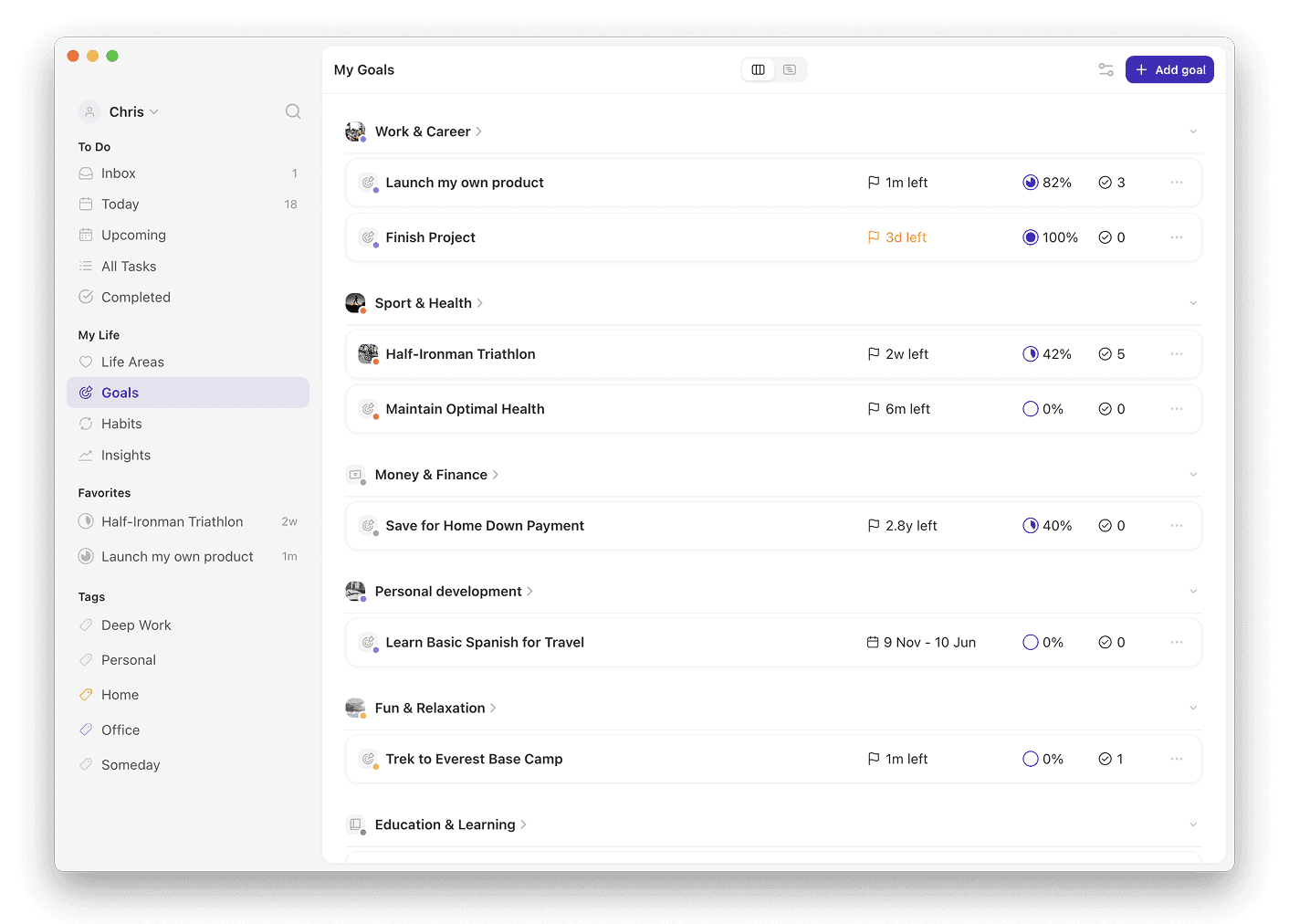
The hard part is rarely the plan. It is holding all the stretches in one place and seeing whether your hips are actually getting lower. In Griply the whole progression becomes one scannable template under your Sport & Health life area:
Goal: Do the splits (metric: Unit-based, gap to the floor, 30 cm to 0 cm)
Task: flat-back forward fold, hands to the floor
Task: kneeling hip-flexor stretch, hips square and easy
Task: elevated split, front heel on a block
Task: 80% split, hips a few inches off the floor
Task: full front split, hips flat
Task: full front split on both legs
Habit: Stretching session (schedule: 5 to 6 times a week)
You tick off each stage and log the gap to the floor, so the progress line falls toward zero and turns green when your hips reach the floor. The Goal Planner keeps the goal, its stages, and the stretching habit in one view, so the plan you just read becomes a template you can reuse for the next flexibility goal. Habit targets and progress charts are part of Griply's paid plan; the free plan covers two goals and two habits.
Frequently asked questions
How long does it take to learn the splits?
Most people reach a front split in two to six months of near-daily stretching, depending on how flexible they start. Stretching five or six days a week and measuring your depth keeps the timeline realistic.
Can you do the splits in one day?
Almost never, and trying to is how people get hurt. Flexibility builds as your body slowly allows more range over weeks. A "splits in one day" attempt tends to end in a pulled muscle, and the flexibility does not last.
How often should you stretch to get the splits?
Five or six days a week, for five to ten minutes, works better than one long session. Your total weekly stretching time drives your range more than the length of any single stretch.
Is it bad to force a split?
Yes. A split should feel like a strong stretch, never a sharp pain. Forcing past that risks a strain. Ease down, hold, and progress only by lowering your support once the current depth feels comfortable.
What muscles do you stretch for the splits?
For a front split, your hamstrings in the front leg and your hip flexors in the back leg. For a side split, your inner thighs. Most plans train all three from the start, since they open at different rates.
The floor gets closer
A front split comes from opening the same three areas a little further, most days, and measuring how close your hips get to the floor. You warm up, stretch the hamstrings, hip flexors, and inner thighs, and lower your support as the range builds.
When you can watch the gap to the floor shrink from week to week, the split stops being a party trick and becomes the next number to beat. Keep the sessions short and frequent, and hold without forcing. Once your hips touch down on one leg, the same routine takes you to the other, and then to a deeper hold you can drop into warm. The same patient method powers the rest of your mobility goals.
Related Goal Plans


Related Guides
Page P. "Current concepts in muscle stretching for exercise and rehabilitation." International Journal of Sports Physical Therapy, 2012. https://pmc.ncbi.nlm.nih.gov/articles/PMC3273886/
Thomas E, Bianco A, Paoli A, Palma A. "The Relation Between Stretching Typology and Stretching Duration: The Effects on Range of Motion." International Journal of Sports Medicine, 2018. https://pubmed.ncbi.nlm.nih.gov/29506306/
Ingram LA, Tomkinson GR, d'Unienville NMA, et al. "Mechanisms Underlying Range of Motion Improvements Following Acute and Chronic Static Stretching: A Systematic Review, Meta-analysis and Multivariate Meta-regression." Sports Medicine, 2025. https://pmc.ncbi.nlm.nih.gov/articles/PMC12152101/
Behm DG, Blazevich AJ, Kay AD, McHugh M. "Acute effects of muscle stretching on physical performance, range of motion, and injury incidence in healthy active individuals: a systematic review." Applied Physiology, Nutrition, and Metabolism, 2016. https://pubmed.ncbi.nlm.nih.gov/26642915/