
Table of Contents
Reading more books comes down to a simple routine: read a small amount every day, from a fixed time and place, until picking up a book is automatic. Most people who want to read more struggle to make it a habit. They wait for a free evening that rarely comes, start three books at once, and finish none.
A daily reading habit fixes that. You set a realistic yearly target, read a set number of pages each day, and let the books add up gradually over weeks. It is worth the effort: reading books is linked to a longer life, and the vocabulary and knowledge you build keep compounding for years. This plan shows you how to pick books you will finish, build the daily habit, and track every book you read.
Key takeaways
Reading more books comes from reading a small amount every day at a set time.
A realistic target like 24 books a year works out to about 20 pages a day.
Keep a book within reach and read at the same time each day, so reading does not depend on willpower.
In Griply you set the reading goal with a books-read target, run it on a daily reading habit, and log each book as you finish it.
The plan, stage by stage
Here is the whole plan before you start. Each stage builds the daily habit and raises how much you read, so the pages add up without a heroic effort.
Stage | Target to hit before moving on | Rough time |
|---|---|---|
1. Pick your books | A to-read list of 10 books you want | Day 1 |
2. Set your reading spot | A fixed time and place chosen | Day 1 |
3. Read 10 pages a day | 10 pages a day for a week | Week 1 |
4. Read 20 pages a day | 20 pages a day for two weeks | Weeks 2-3 |
5. Finish your first book | 1 book done | Weeks 2-4 |
6. Hold the habit | 20 pages a day on 5 or more days a week for a month | ongoing |
Most people finish their first book within three to four weeks and settle into a steady rhythm by the second month. Some stages overlap, so you can pick your books and set your reading spot on the same day and start reading that evening.
Why it feels hard
Reading more is simple in theory and hard in practice, because a book competes with your phone, your inbox, and a dozen quicker rewards. The gains are real but slow: the more you read, the more your vocabulary and background knowledge keep building, so early on it can feel like little is changing even when it is. That slow payoff is why a vague plan to read more rarely lasts.
The number of books is the outcome you want. The daily reading is the habit that gets you there, and seeing that the habit and the goal are not the same thing is what stops a slow week feeling like failure. You cannot control how fast you finish a book. You can control whether you read your pages today.
How to fit in more reading
You do not need a spare hour. Short, regular reading sessions stacked into your day get you through more books than an occasional long stretch. Giving your reading a number and holding it before you raise it keeps the ramp realistic.
Pick books you want to read
Choose books you are curious about and want to open. A book you look forward to gets picked up; a worthy but dull one sits on the shelf. Keep a running list of ten so you always have the next one ready.
Read at the same time every day
Attach reading to a slot you already keep, like the twenty minutes before sleep or your morning coffee. A fixed time removes the daily decision of whether and when to read.
Keep a book within reach
Leave your current book where you will see it: on your pillow, next to the kettle, in your bag. A visible book gets read; one on a shelf in another room does not.
Use small pockets of time
Read on the commute, in a waiting room, or in the ten minutes before a meeting. A few pages here and there add up to a chapter a day with no time carved out.
Try audiobooks and ebooks
Audiobooks turn a commute or a walk into reading time, and an ebook app puts your book on the phone you already carry. Both count, and both make it easier to read in more places.
Put down books you are not enjoying
If a book is a slog by page fifty, start another one. Forcing your way through a book you dislike is the fastest way to stop reading altogether.
Build the habit
A daily reading habit sticks when a cue triggers it automatically. Repeating the same action in the same context is how a behaviour becomes automatic, and on average that takes about 66 days of near-daily practice, so expect the first few weeks to need real attention before reading feels normal. Read at the same time and place every day, even if it is only five pages on a busy night, because a short session still counts and keeps the cue strong. A repeatable cue, routine, and reward loop, like reading the moment you get into bed, carries you on the days you would rather scroll. If you are also working to learn a language, reading in it turns your daily pages into extra practice.
Common mistakes
A few habits stall most readers:
Setting a vanity target like 52 books when you read two a year. Start where you are and raise the number once the habit holds.
Reading several books at once and finishing none. Keep one or two on the go, no more.
Only reading when you have a long free stretch. Those stretches rarely come, so read your pages daily instead.
Forcing through a book you dislike until you stop reading altogether. Abandon it and pick another.
Treating a missed day as a broken streak. Read the next day and hold your weekly average.
Set it up in Griply
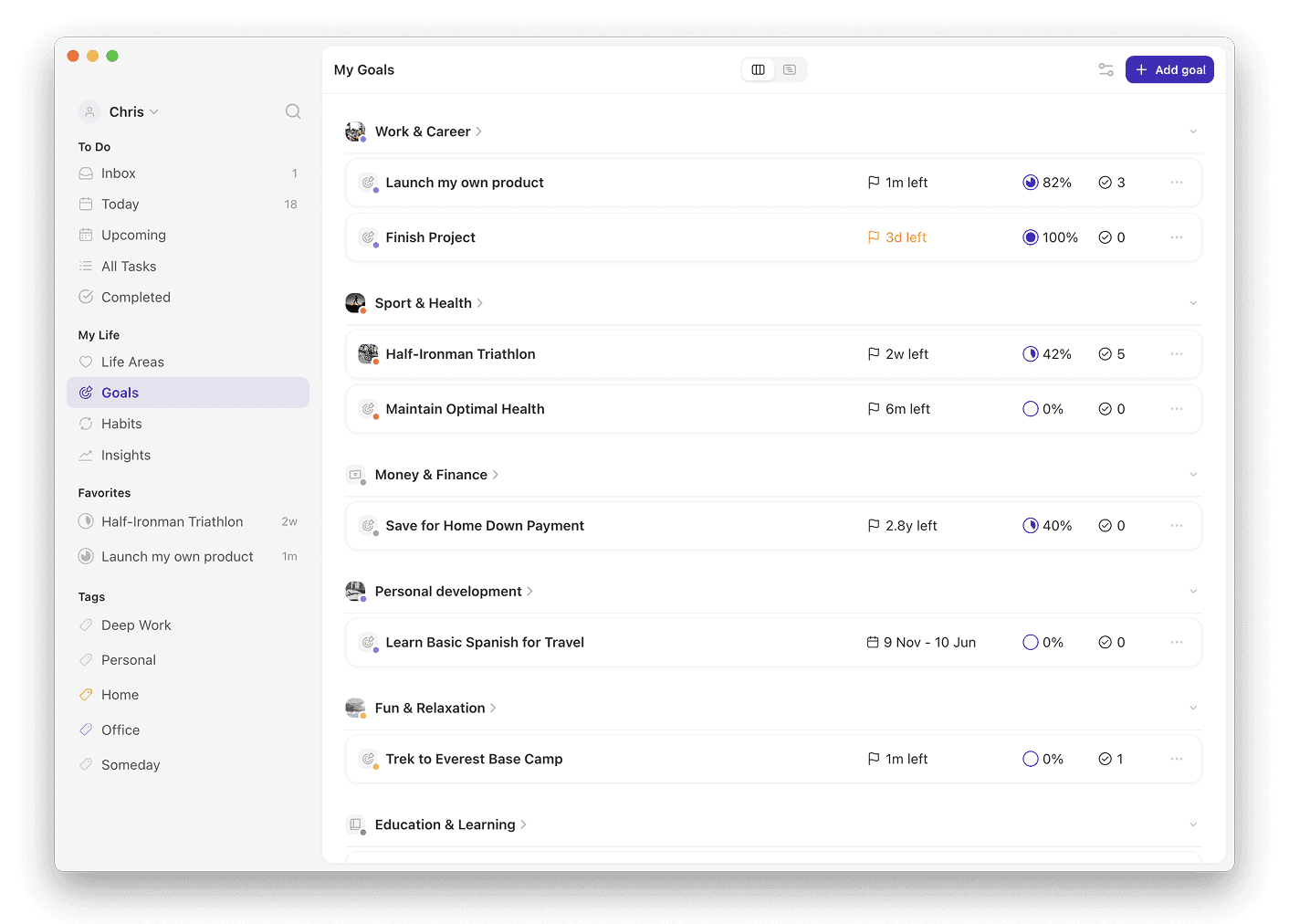
The hard part is rarely wanting to read more. It is keeping the plan in one place and seeing whether you are getting through books. In Griply it becomes one scannable template under your Personal Development life area:
Goal: Read more books (metric: Unit-based, books, 0 to 24)
Habit: Read 20 pages (schedule: every day)
Task: list 10 books you want to read
Task: pick a fixed reading time and place
Task: leave your current book where you will see it
You log each book as you finish it, so the progress line climbs from 0 toward 24 and turns green when you hit your target. The Habit Tracker keeps the goal, your daily reading, and your setup steps in one view, so the plan you just read becomes a template you can reuse for the next learning goal. Habit targets and progress charts are part of Griply's paid plan; the free plan covers two goals and two habits.
Frequently asked questions
How do I train myself to read more books?
Pick a fixed time and place, keep a book within reach, and read a small amount every day, such as 20 pages. Start with 10 pages if that feels like too much, and raise it once the daily habit holds.
How many books should I read in a year?
There is no right number. A common target is 24 books a year, about two a month or 20 pages a day. If you read little now, 12 books, one a month, is a realistic first goal you can raise later.
What is the 5 finger rule for books?
The five finger rule checks a book's reading level: open a page and raise a finger for each word you do not know. Five or more on one page means the book may be too hard for now.
How do I find time to read when I am busy?
Read in small pockets: on your commute, in waiting rooms, or for ten minutes before bed. Keep a book or an ebook app on your phone so any spare moment becomes reading time. A few pages a day adds up fast.
Do audiobooks count as reading?
Yes. Audiobooks let you get through books while commuting, walking, or doing chores, and they build the same vocabulary and knowledge. Use them alongside print or ebooks to read more in places where holding a book is hard.
A few pages a day
Reading more books is not about speed or a heroic reading weekend. It is about a small daily habit: a fixed time, a book within reach, and 20 pages you get through before the day ends. Do that most days and the books add up on their own.
Pick titles you want, hold the daily pages before you chase a bigger number, and log each book as you finish it so you can watch the count climb. Once reading feels automatic, the yearly target stops being a stretch and becomes the pace you keep without thinking about it. A daily reading habit feeds the rest of your personal-development goals. Start tonight with the first ten pages of a book you have wanted to read.
Related Goal Plans


Related Guides
Bavishi A, Slade MD, Levy BR. "A chapter a day: Association of book reading with longevity." Social Science & Medicine, 2016. https://pmc.ncbi.nlm.nih.gov/articles/PMC5105607/
Cunningham AE, Stanovich KE. "What Reading Does for the Mind." American Educator, 1998. https://www.aft.org/ae/springsummer1998/cunningham_stanovich
Gardner B, Lally P, Wardle J. "Making health habitual: the psychology of 'habit-formation' and general practice." British Journal of General Practice, 2012. https://bjgp.org/content/62/605/664