

Table of Contents
Growing your professional network is the practice of steadily building and keeping real working relationships with people in and around your field, so that help, advice, and opportunities move both ways. Most people only think about it when they need a job, then scramble to reach out to contacts who have not heard from them in years. A network built that way rarely delivers.
A better approach is to treat it as an ongoing habit with a clear plan behind it. You get clear on who is worth knowing, make yourself easy to find, reconnect with people you already know, and reach out to a few new faces every week. Because networking is one lever of your wider professional development, the circle you build quietly today is what opens doors later. The steps below take you from a cold list of contacts to a circle you actually keep up with.
Key takeaways
A professional network grows from steady contact over months, well before you need anything from it.
Start with people you already know, then widen out to looser connections a step removed from your usual crowd.
One outreach a week plus a regular follow-up beats a burst of activity when you are job hunting.
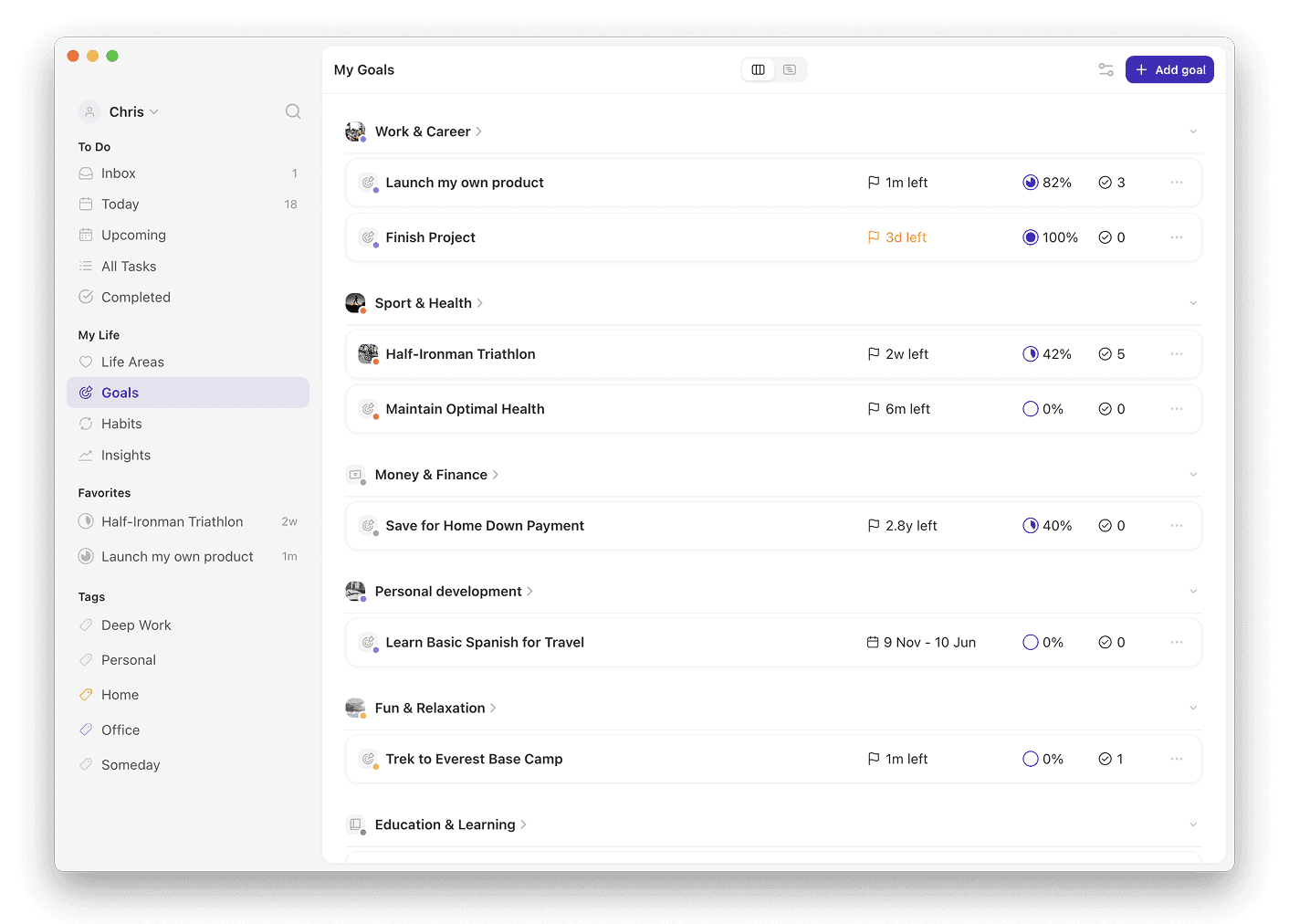
In Griply you set growing your network as one goal, add the setup steps as tasks, and keep a weekly outreach habit.
The plan, step by step
Here is the whole plan before you start. The first few steps are setup you do once, then steps five and six become an ongoing rhythm.
Step | What to have done | Rough time |
|---|---|---|
1. Get clear on who and why | A short list of the people and circles worth knowing | Week 1 |
2. Make yourself findable | An up-to-date profile with a clear headline | Week 1 |
3. Reconnect old contacts | 5 dormant contacts messaged | Week 1-2 |
4. Widen the circle | One community, group, or event joined | Month 1 |
5. Reach out every week | One new or dormant person contacted a week | Ongoing |
6. Follow up and stay in touch | A routine for circling back every few months | Ongoing |
Setup takes a week or two, and the outreach runs from there. The steps overlap, so you can reconnect with old contacts in the same week you tidy your profile. Giving each step a concrete action is what turns a vague plan to network into one you can run.
How to do each step
The first three steps get you ready and warm up the contacts you already have. The last three are the ongoing practice. Here is how to do each one.
1. Get clear on who and why
Write down what you want from your network, such as advice, referrals, clients, or peers who understand your work, and the kinds of people who fit. Name five categories, like people one role ahead of you, people in a field you want to move into, or peers at your level. A clear target stops networking from feeling like a chore with no point.
2. Make yourself findable
Update your LinkedIn or professional profile so someone who meets you can understand your work in ten seconds. Write a plain headline that says what you do, add a recent photo, and fill the About section with one short paragraph on what you work on and care about. People will look you up after they meet you, so make that first impression clear.
3. Reconnect old contacts
Start with people you already know but have lost touch with, called dormant contacts. Reaching back out to old contacts tends to bring high-trust, fresh help, because they know you and have moved into new circles since you last spoke. Message five of them with a warm, specific note: reference how you know each other and ask one genuine question. Skip the ask for now.
4. Widen the circle
To meet new people, join one place where your kind of work gathers: a professional group, an online community, a meetup, or a conference. Looser connections, the people outside your close circle, are the ones most likely to bring new opportunities, so aim to meet people a step removed from your usual crowd. Pick one community and show up regularly, so the same faces start to know you.
5. Reach out every week
Each week, contact one new or dormant person. Keep it short and specific: say why you are reaching out, mention something you have in common or admire about their work, and ask one clear question or offer something useful. A message you actually send is worth more than the perfect one you never write, so keep the bar low enough to do it every week.
6. Follow up and stay in touch
The follow-up is where a contact turns into a connection. After a good conversation, send a short thank-you and one concrete next step, like a link you mentioned or a suggestion to talk again. Then circle back every few months with no agenda: share an article, congratulate a move, or check in. A quick, regular touch keeps the relationship warm.
Why it feels slow
Networking can feel like effort with no reward, because you rarely see a payoff on the day you send a message. The returns arrive months or years later, through a contact you almost forgot. That gap is what makes people give up.
The effort does compound. Networking behavior predicts salary growth and promotions over the following years, with staying in touch mattering more than one-off introductions.
The opportunities are the outcome you want. The outreach you do each week is the process, and keeping the two separate is what stops you quitting before the payoff arrives. You cannot control who turns into a useful contact. You can control how many people you reach out to.
Build the habit
The plan works only if the weekly outreach becomes routine, so treat it as a standing habit. Once a week, at a set time, reach out to one person and follow up with anyone from the week before. Being generous with help, and doing it often, raises your standing more than one big favor, so lead with something useful whenever you can. Building that weekly reach-out into a routine you actually keep, like doing it every Friday morning with a coffee, carries you through the months before the payoff shows up.
Common mistakes
A few habits keep people stuck with a thin network:
Only reaching out when you need a job. Stay in touch when you want nothing.
Collecting contacts you never speak to. A name you never message is not a connection.
Leading with the ask. Offer interest or help first, every time.
Trying to be everywhere at once. Pick one or two circles and show up often.
Going silent after the first message. The follow-up is where the relationship forms.
Waiting until you feel ready. Start this week with someone you already know.
Set it up in Griply
The hard part is rarely deciding to network. It is keeping the outreach going for months and seeing whether your circle is actually growing. In Griply it becomes one scannable template under your Work & Career life area:
Goal: Grow your network (metric: Unit-based, new connections, 0 to 20)
Task: write down the 5 kinds of people you want to know
Task: update your LinkedIn headline, photo, and About
Task: list 20 people to reach out to
Task: join one community, group, or event in your field
Task: message 5 contacts you have lost touch with
Habit: Reach out to one new or dormant person (schedule: weekly)
Habit: Have one real conversation (schedule: monthly)
You log a new connection each time a conversation turns into a real, ongoing contact, and the line climbs toward 20 and turns green when you reach it. The Habit Tracker keeps the goal, the weekly outreach, and your monthly conversations in one view, so the plan you just read becomes a template you can reuse. Habit targets and progress charts are part of Griply's paid plan; the free plan covers two goals and two habits.
Frequently asked questions
How do you grow your professional network?
Start with the people you already know, then widen out. Clarify who is worth knowing, update your profile so people can find you, reconnect with old contacts, and reach out to one new person a week. Consistency over months is what builds a real network.
How do you network if you are an introvert?
Skip large events and work one to one. Send a short written message, ask a genuine question, and offer something useful. One thoughtful conversation a week suits introverts better than a crowded room, and it tends to build deeper contacts over time.
What is the golden rule of networking?
Give before you ask. Offer help, an introduction, or a useful idea before you need anything back. Research on favor exchange links being generous to higher standing, and frequent small favors build it faster than one big gesture.
How long does it take to build a strong network?
Expect it to take months. The setup takes a week or two, but a real network grows through steady contact over a year or more. The value compounds as relationships deepen, so the sooner you start the weekly habit, the sooner it pays off.
How often should you reach out to your network?
Aim for one new or dormant contact a week, and circle back to your closer contacts every few months. A short check-in with no agenda keeps relationships warm, so people are already there when you or they need help.
Start with who you know
A network grows from the people already around you more than from strangers at an event. You build it by staying in touch with them, then widening the circle a little each week. The first moves are the easiest ones: reconnect with a few old colleagues, tidy up your profile, and message one person this week.
From there it is a rhythm. One outreach a week, one real conversation a month, and a quick follow-up so the contact does not go cold. Log each new connection as it becomes real, watch the number climb, and let the habit carry you on the weeks you would rather stay quiet. In a year you will have a circle of people who know your work, are glad to hear from you, and quietly support the rest of your work and career goals.


Related Guides
Rajkumar K, Saint-Jacques G, Bojinov I, Brynjolfsson E, Aral S. "A causal test of the strength of weak ties." Science, 2022. https://pubmed.ncbi.nlm.nih.gov/36107999/
Wolff HG, Moser K. "Effects of networking on career success: a longitudinal study." Journal of Applied Psychology, 2009. https://pubmed.ncbi.nlm.nih.gov/19186904/
Levin DZ, Walter J, Murnighan JK. "Dormant Ties: The Value of Reconnecting." Organization Science, 2011. https://business.gwu.edu/sites/g/files/zaxdzs5326/files/15_FP.SP_Walter.J_15levin_2011a.pdf
Flynn FJ. "How Much Should I Help and How Often? The Effects of Generosity and Frequency of Favor Exchange on Social Status and Productivity." Academy of Management Journal, 2003. https://www.gsb.stanford.edu/faculty-research/publications/how-much-should-i-help-how-often-effects-generosity-frequency-favor