
Table of Contents
Learning an instrument is the process of building playing skill in small, ordered stages, from holding it correctly and making one clean note to playing a full song from memory. If you have ever picked up a guitar or sat at a piano, played nothing recognisable, and put it back down, the problem is rarely talent. An instrument is a physical skill, and you reach it by training the pieces in an order you can manage today. This plan works for any instrument: guitar, piano, ukulele, drums, or violin. It also gives you something to enjoy for life, since instrument training has been linked to gains in coordination and wellbeing. You pick one instrument, give each stage a target, and practise a little most days until the next stage is in reach. The stages below take you from your first note to your first full song.
Key takeaways
Any instrument is learnable in stages, starting well before it sounds like music.
Each stage has a target, from one clean note to a full song from memory.
Short daily practice beats long weekend sessions, and how you practise matters most.
In Griply you set the instrument as one goal, split it into milestone subgoals, and attach a practice habit.
The plan, stage by stage
Here is the whole plan before you start. Each stage has one target to hit before you move to the next, so you always know where you are and what to work on today.
Stage | Target to hit before moving on | Rough time |
|---|---|---|
1. Set up and hold | Sit in a relaxed playing position, instrument held correctly | Week 1 |
2. One clean note or chord | Play one clear, ringing note or chord 10 times | 1-2 weeks |
3. Change between three | Switch between three notes or chords without long pauses | 2-3 weeks |
4. A simple song, slowly | Play an easy 8-bar song start to finish, slowly | 2-4 weeks |
5. Play it in time | Play the song to a steady beat with no stops | 2-4 weeks |
6. A full song from memory | Play one full song from memory at its normal tempo | 3-6 weeks |
Most beginners play a simple song within two to three months, and a confident full song around four to six. Some stages overlap, so you can work on changing between notes and your first song in the same weeks, and move up the day you hit a target.
Why it feels hard
Early on, your fingers do not go where you want, and nothing sounds like the record. That gap is normal, and focused, repeated practice is what closes it. Across studies of violinists, the amount and quality of practice explains a large share of the difference in playing skill, which is the part you control.
The finished song is the outcome you want. Each stage in between works because it sets a clear, specific target you can hit, which is what stops you quitting in the weeks before it sounds good. You cannot control how fast it clicks. You can control whether you sit down and practise the stage in front of you.
How to practise each stage
Before each session, get the instrument ready: tune it, since a free tuner app works for most instruments, and sit or stand in a relaxed position. Here is how to work through each stage.
1. Set up and hold
Hold the instrument the way a beginner video for your instrument shows: a guitar resting on your leg with a loose fretting hand, a piano with curved fingers and relaxed wrists, a violin with a supported chin and a straight back. Spend the first few sessions getting comfortable, because bad posture early makes every later stage harder. Done means you can hold it for a few minutes without tension.
2. One clean note or chord
Play a single note or one beginner chord slowly and listen. On guitar, press just behind the fret and pick one string; on piano, drop one finger and let it ring; on a wind instrument, hold one steady note. Aim for a clear, ringing sound with no buzz. Repeat until you can produce it ten times in a row on demand.
3. Change between three
Pick three easy notes or chords and move between them slowly. Set them in a fixed order, play one, then move to the next only when it sounds clean. Speed comes later, so keep it slow enough that every change is clean. You are ready to move on when you can cycle through all three without long pauses.
4. A simple song, slowly
Choose a short, well-known beginner song for your instrument and learn it a few bars at a time. This is chunking: you work one small section until it is clean, then join it to the next, so you are not playing the whole thing from the top every time. How you practise matters more than how long you practise, so slow, accurate work on small sections beats rushing through the song once. Play it end to end slowly, with stops allowed.
5. Play it in time
Turn on a metronome or a slow backing track and play your song to the beat. Playing in time means every note lands with the click, which is what turns separate notes into music. Start well below full speed, at a tempo where you never stop, then raise it a few beats per minute once you can play it clean twice.
6. A full song from memory
Play the whole song without the sheet or tab in front of you, at its normal tempo. Build up to it by memorising one section at a time, the same way you learned it. Giving each stage a target keeps you honest about when you have earned the next one, so move up when you can hit the stage target cleanly twice on a fresh day.
Build the habit
Skill on an instrument comes from frequent, short practice, so 15 to 20 minutes most days beats one long weekend session. Spreading practice across several days builds more lasting skill than cramming it into one block, because each session reminds your hands of the last one. A session has a simple shape: tune up, warm up with a note or chord you know, spend most of the time on the one stage you are working on, then finish by playing something you enjoy.
Tie practice to a cue you already have, like sitting down right after dinner, so you are not relying on memory. Stacking it onto a routine you already keep keeps the practice happening on the days you would skip it. An instrument is one way to take up a new hobby, and the same weekly rhythm holds any of them.
Common mistakes
A few habits slow most beginners down:
Practising for two hours on Sunday and nothing midweek. Short daily sessions build skill faster, so spread the time out.
Playing whole songs from the top every time. Work the hard bars on their own first, then join them up.
Only playing what you already know. Spend most of each session on the stage in front of you, where the growth is.
Skipping tuning. An out-of-tune instrument teaches your ear the wrong sound, so tune before every session.
Rushing the tempo before the notes are clean. Speed up only once a section is clean twice in a row.
Set it up in Griply
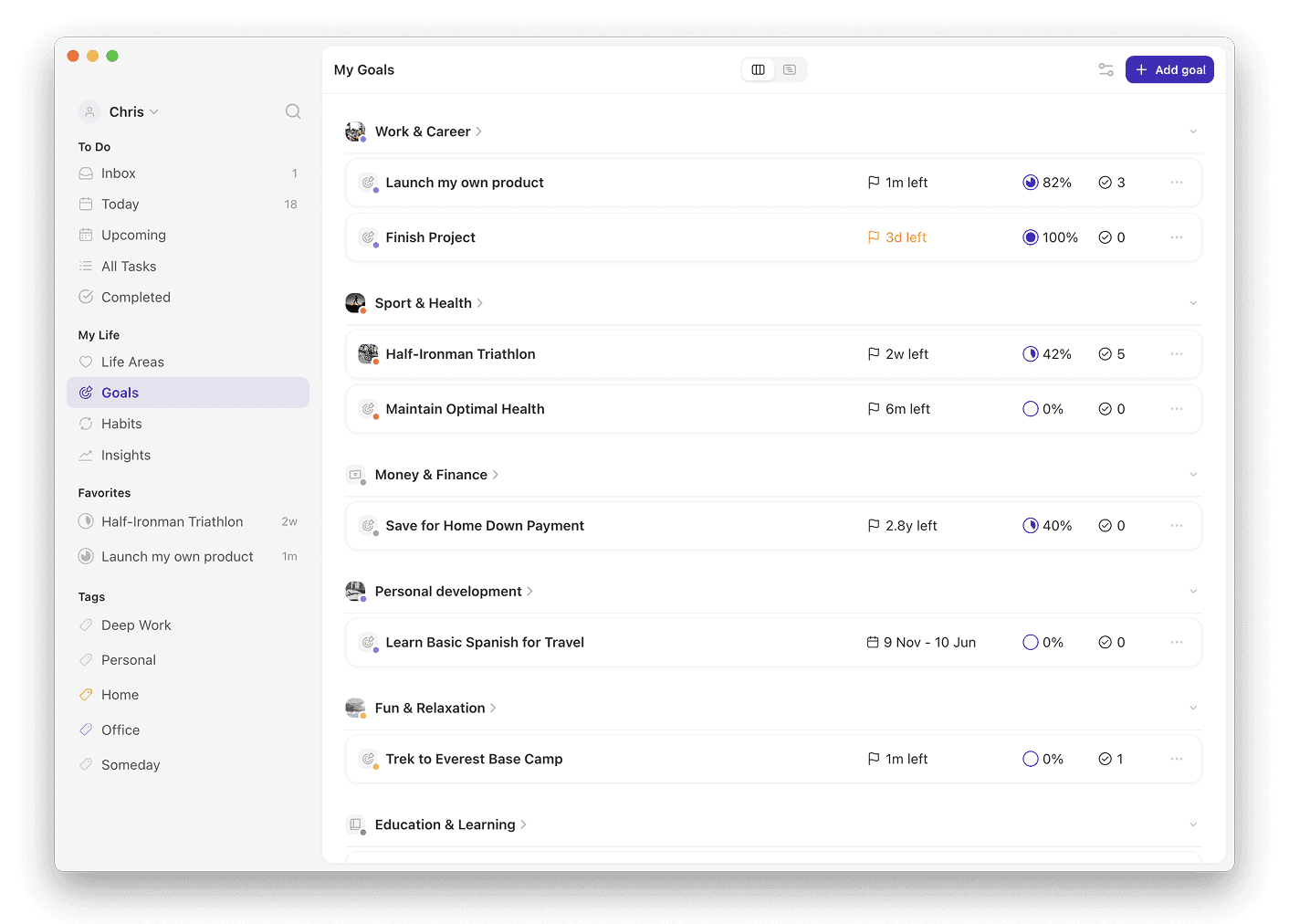
The hard part is rarely wanting to play. It is holding the whole path in one place and seeing whether you are moving, when the first song is still weeks away. In Griply it becomes one scannable template under your Fun & Relaxation life area:
Goal: Learn an instrument (metric: Subgoals, average)
Subgoal: hold the instrument correctly for a few minutes
Subgoal: play one clean note or chord ten times
Subgoal: change between three notes or chords cleanly
Subgoal: play a simple song slowly, start to finish
Subgoal: play the song in time with a metronome
Subgoal: play a full song from memory at tempo
Task: pick one instrument to start with
Task: buy or rent the instrument
Task: choose a method, app, or teacher
Habit: Practise, 15 to 20 minutes (schedule: most days)
You advance each stage as you build it, and the progress line averages your milestones, so it climbs from your first week of practice, well before the song sounds finished. The Goal Planner keeps the goal, its milestones, the setup tasks, and the practice habit in one view, so the plan you just read becomes a template you can reuse for the next skill. Subgoals, habit targets, and progress charts are part of Griply's paid plan; the free plan covers two goals and two habits.
Frequently asked questions
Can you teach yourself an instrument?
Yes. Most beginners learn without a teacher using free lessons, apps, and songbooks. A teacher speeds up feedback on your technique, but a clear plan, daily practice, and a way to check your own sound carry you a long way on any instrument.
What is the easiest instrument to learn?
Ukulele, piano, and keyboard are common first picks because they make a clean sound quickly and have plenty of simple beginner songs. The easiest instrument is usually the one you are most drawn to, since you will practise it more often.
What is the fastest way to learn an instrument?
Practise a little every day and spend most of each session on the specific thing you cannot do yet. Slow, accurate work on small sections builds skill faster than playing songs you already know. Consistency across the week does more than any single long session.
How long does it take to learn an instrument?
Most beginners play a simple song within two to three months of near-daily practice, and a confident full song around four to six months. Your pace depends on the instrument, your practice time, and how focused each session is.
How much should you practise a day?
Fifteen to twenty minutes most days is plenty for a beginner and easier to keep up than long, rare sessions. Short, regular practice gives your hands frequent repetition and keeps the habit going. Consistency matters more than the length of any one session.
The first song follows
A song you can play from memory comes from sitting down most days, working the stage in front of you, and letting the earlier ones settle before you move on. You build it one clean note, one clean change, one slow run-through at a time, in the order the stages come.
When you can hear your single notes ring clean and your changes stop stalling, the first song stops feeling out of reach and becomes the next target on the list. Every session gives you something small to get right, which keeps you going on the days you do not feel musical. An instrument is one of the rest of your fun and relaxation goals, and it rewards the same steady practice. Once you own that first full song, the same method takes you to the next one: learn it in sections, play it in time, then play it from memory.
Related Goal Plans


Related Guides
Macnamara BN, Maitra M. "The role of deliberate practice in expert performance: revisiting Ericsson, Krampe & Tesch-Römer (1993)." Royal Society Open Science, 2019. https://pmc.ncbi.nlm.nih.gov/articles/PMC6731745/
Duke RA, Simmons AL, Cash CD. "It's Not How Much; It's How: Characteristics of Practice Behavior and Retention of Performance Skills." Journal of Research in Music Education, 2009. https://journals.sagepub.com/doi/10.1177/0022429408328851
Benjamin AS, Tullis J. "What makes distributed practice effective?" Cognitive Psychology, 2010. https://pmc.ncbi.nlm.nih.gov/articles/PMC2930147/
MacRitchie J, Breaden M, Milne AJ, McIntyre S. "Cognitive, Motor and Social Factors of Music Instrument Training Programs for Older Adults' Improved Wellbeing." Frontiers in Psychology, 2020. https://pmc.ncbi.nlm.nih.gov/articles/PMC6968490/