Guide


Table of Contents
Personal goals examples are specific, time-bound targets you set for yourself across the main areas of your life: a savings amount you must hit by a fixed date, a fitness benchmark you must reach by a specific week, each written with enough detail that you can tell on any given day whether you are on track. Most people understand they should have goals but get stuck before they write a single one down. The difficulty is not motivation: it is specificity.
A vague intention like "get healthier" or "save more money" gives you nothing to act on, no way to know whether you are making progress, and no clear point at which you have succeeded. What follows are ready-to-use personal goals examples across five life areas (health, finances, relationships, personal growth, and career), each written in SMART format so you can copy or adapt them today. For a broader introduction to goal setting, that guide covers the full practice from the ground up.
Key takeaways
Organising your personal goals by life area (Health, Finances, Relationships, Personal Growth, and Career) stops important areas of your life from going unaddressed.
Specific and challenging goals consistently lead to better performance than vague or easy ones, across 35 years of goal-setting research.
Griply organises your personal goals inside life areas and links each one to a vision, so you can track progress on a line chart and always know where you stand.
Every personal goals example here is a starting point: adjust the numbers and deadlines to match your current situation before committing to any of them.
Why most personal goal lists fail before they start
Most people write personal goals as intentions rather than commitments. "Lose weight," "read more," and "spend less" appear on lists every January and disappear by February. The problem is not willpower: it is the absence of a measurable target.
The most replicated body of work in this field, 35 years of goal-setting research, found that specific, challenging goals produce significantly higher performance than vague "do your best" instructions. A goal without a number and a deadline is, by that standard, not really a goal. It is a preference.
People who wrote down their goals were 42% more likely to achieve them than those who did not, in a Dominican University of California study. Writing a goal forces specificity, and specificity is what makes a goal actionable. For a deeper look at what separates a strong goal from a weak one, see the guide on characteristics of a good goal.
Personal goals examples for health and fitness
Health goals are the category most people name first and abandon soonest. The pattern is familiar: a broad ambition with no measurable benchmark and no end date. Each example below is written with a number and a deadline so you know exactly when you have succeeded.
Run 5 km in under 30 minutes by June 30, starting from a baseline of walking 2 km, using a three-day-a-week training plan.
Lose 6 kg by September 1 by reducing daily calorie intake to 1,800 and walking 8,000 steps per day.
Sleep at least 7 hours per night on 5 out of 7 nights by tracking sleep with a wearable device for 90 consecutive days.
Drink 2 litres of water each day for 30 consecutive days, tracked using a daily log in a goal app.
Complete a 10-minute morning mobility routine at least 5 days per week for 8 weeks.
Each of these examples of personal goals is specific enough to track, which is what measurable goals research consistently shows separates goals that stick from those that fade.
Personal goals examples for finances
Financial goals fail for the same reason health goals do: the target is too vague. "Save more money" is not a goal. "Save $5,000 by December 31" is.
Save $5,000 in an emergency fund by December 31 by transferring $420 per month on the first day of each month.
Pay off $3,600 in credit card debt by March 31 next year by making $300 monthly payments and cutting one discretionary expense per month.
Invest $200 per month into an index fund for 12 consecutive months, reviewed quarterly against a target portfolio value.
Reduce monthly food spending from $800 to $550 by meal planning every Sunday for 8 weeks.
These targets are aggressive enough to require real effort but achievable given a specific income range, which aligns with self-efficacy research: goals perceived as achievable generate stronger commitment and sustained effort than goals that feel out of reach. That means a financial goal set at a stretch you genuinely believe is possible will hold your attention longer than one that feels arbitrary or impossible from the start.
Personal goals examples for relationships
Relationships are the life area most underrepresented in personal goal lists. People set financial targets and fitness benchmarks but rarely apply the same intention to the people they care about.
Call one family member every Sunday for 12 consecutive weeks.
Plan and complete one date night with your partner each month for 6 months, with the activity planned at least 3 days in advance.
Send a handwritten note to one friend per month for 6 months.
Attend one social event outside your usual circle per month for 4 months, and introduce yourself to at least one new person at each.
Self-concordance research found that goals aligned with your own values and relationships produce greater long-term wellbeing than goals set to meet external expectations. A goal to strengthen a relationship matters in a way that a goal set to impress others rarely does.
Personal goals examples for personal growth
Personal growth goals cover the skills and habits of mind you build for your own satisfaction, independent of what your job requires. Angela Duckworth's research on grit shows that consistent effort over time is a stronger predictor of long-term achievement than raw talent, which makes habit-based growth goals especially worth setting.
Read 12 non-fiction books in 12 months by reading 20 pages each morning before opening your phone.
Complete one online course in a topic outside your current professional skills by June 30, spending at least 3 hours per week on coursework.
Write 200 words in a daily journal every morning for 60 consecutive days.
Learn to cook 8 new recipes by the end of the quarter, trying one new recipe per week on a set day.
Meditate for 10 minutes per day for 30 consecutive days using a guided app, tracked on a habit log.
Each of these examples of personal development goals pairs a measurable target with a habit frequency, which is what separates a plan you can execute from a wish you revisit at year-end.
Personal goals examples for career development
Career goals are covered in detail in the professional development goal examples guide. For setting the longer-term direction those examples ladder up to, see the career goals guide. The personal goals for work examples below focus on the boundary between work and life: goals about how you work, beyond what you achieve at your job.
Complete one professional certification relevant to your role by the end of Q3, studying for 45 minutes each weekday.
Deliver a presentation to your team once per quarter for the next 12 months to build public-speaking confidence.
Reduce email response time to under 4 hours on 90% of working days for one month by batching email into two daily windows.
Ask for feedback from your manager after every major project for 6 months and document one specific improvement area from each conversation.
These personal work goal examples sit alongside life goals rather than replacing them: a full personal goal list covers work and life together rather than one at the expense of the other.
A goal without a home gets lost: Griply connects each one to a life area and a vision
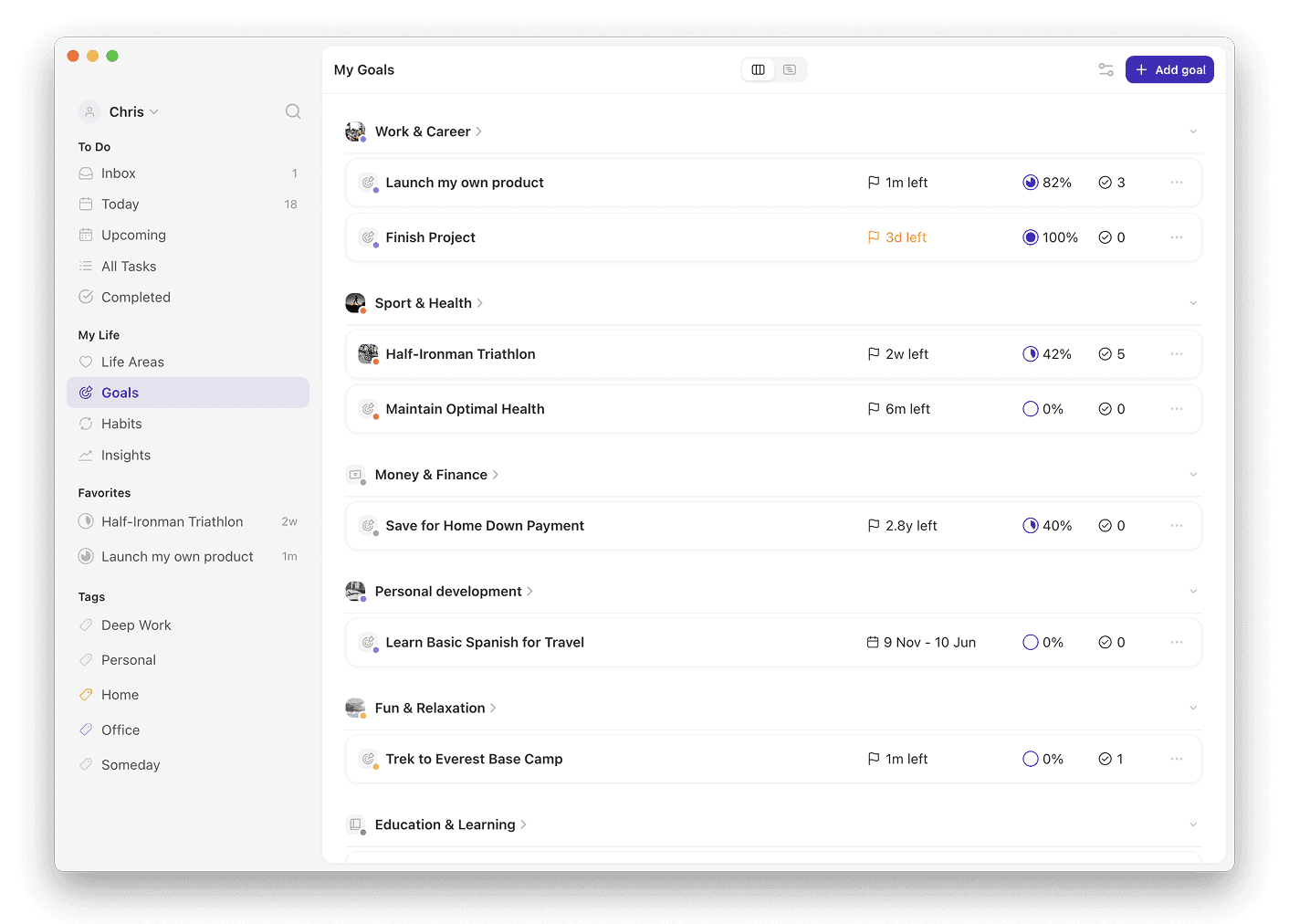
Once you have your personal goals written in SMART format, the next question is where to put them so they do not get lost. Griply is built around the same structure this article uses: life areas at the top with goals nested inside them, and daily tasks that can anchor to those goals. For a side-by-side look at how the leading apps handle this, see our best goal tracking apps roundup.
The hierarchy in Griply runs: Life Area, Vision, Goal, Subgoal, Task, and Habit. You set a life area (Sport & Health, Money & Finance, and so on) and write a vision statement for it, then add your SMART goals beneath. Each goal has a start value, a target value, and a deadline; you log progress manually on a line chart, and the life planner makes the connection between daily work and long-term direction visible at a glance.
Habits in Griply can be tied to goals in the hierarchy rather than floating in a separate tracker. A daily habit like "read 20 pages" is linked to the goal it serves, so the connection between the action and the outcome is always clear. The goal planner shows all your goals with their progress charts and attached tasks in one place, so nothing falls through the gap between intention and action.
Frequently asked questions
What are the best personal goals examples for beginners?
Start with one goal per life area and keep the timeframe short: 30 to 90 days. A beginner goal works best when the target is specific enough to track, achievable within your current routine, and connected to something you genuinely care about rather than something you feel you should care about.
How do I write a personal goal in SMART format?
A SMART personal goal names exactly what you want to achieve, includes a number that tells you when you have achieved it, has a realistic deadline, and connects to a life area that matters to you. For example: "Save $2,000 by August 31 by transferring $250 per month from my main account" hits every criterion.
How many personal goals should I set at once?
Research on goal striving suggests that pursuing too many goals simultaneously reduces the effort available for any single one. A practical ceiling for most people is three to five active goals at a time, spread across different life areas.
What is the difference between a personal goal and a professional goal?
A personal goal covers any area of your life: health, finances, relationships, learning, or creative interests. A professional goal relates specifically to your work performance, career advancement, or workplace skills. Many people benefit from setting both types, since professional goals alone leave the rest of life unaddressed.
Why do personal goals fail even when they are written down?
Writing a goal down increases the likelihood of achieving it, as the Dominican University research found, but a written goal still needs a regular review habit and a system for tracking progress. A goal written once and never revisited is only marginally better than one kept entirely in your head. Griply connects each goal to a life area, tracks progress on a line chart, and keeps the goal visible in your daily view so it does not drift into inactivity.
A personal goal needs a number, a deadline, and a life area you actually care about
Personal goals examples work best when they are specific enough to act on and connected to a life area you genuinely care about. The SMART format is the minimum structure needed to turn a wish into something you can measure and pursue daily.
Related Guides
Locke, Edwin A. and Gary P. Latham. "Building a Practically Useful Theory of Goal Setting and Task Motivation: A 35-Year Odyssey." American Psychologist, Vol. 57, No. 9, 2002. https://pubmed.ncbi.nlm.nih.gov/12237980/
Matthews, Gail. "Goals Research Summary." Dominican University of California, 2015. https://www.dominican.edu/sites/default/files/2020-02/gailmatthews-harvard-goals-researchsummary.pdf
Duckworth, Angela. Grit: The Power of Passion and Perseverance. Scribner, 2016. https://angeladuckworth.com/grit-book/
Bandura, Albert. "Self-efficacy: Toward a Unifying Theory of Behavioral Change." Psychological Review, Vol. 84, No. 2, 1977. https://pubmed.ncbi.nlm.nih.gov/847061/
Sheldon, Kennon M. and Andrew J. Elliot. "Goal Striving, Need Satisfaction, and Longitudinal Well-Being: The Self-Concordance Model." Journal of Personality and Social Psychology, Vol. 76, No. 3, 1999. https://pubmed.ncbi.nlm.nih.gov/10101878/