

Table of Contents
Learning to surf means building one skill in stages, from practising the pop-up on dry sand to riding foamy whitewater on your belly, then standing up, then paddling for unbroken green waves. Most beginners rush straight into the water, try to stand on the first wave, and fall for a month with no plan. A staged approach works better, because each stage has a clear target you can reach in today's session before you move to the next. Surfing is also one of the most rewarding skills to learn: regular surf sessions are linked to real gains in mood and wellbeing, which is what keeps people paddling out for years. The stages below take you from your first pop-up on the beach to riding along the face of a green wave, and each one is small enough to practise and track.
Key takeaways
You learn to surf in stages, each with a target you can hit before moving on.
Start on a big, stable soft-top board in small whitewater waves close to shore.
Most beginners stand on whitewater within a few sessions and reach green waves over a few months.
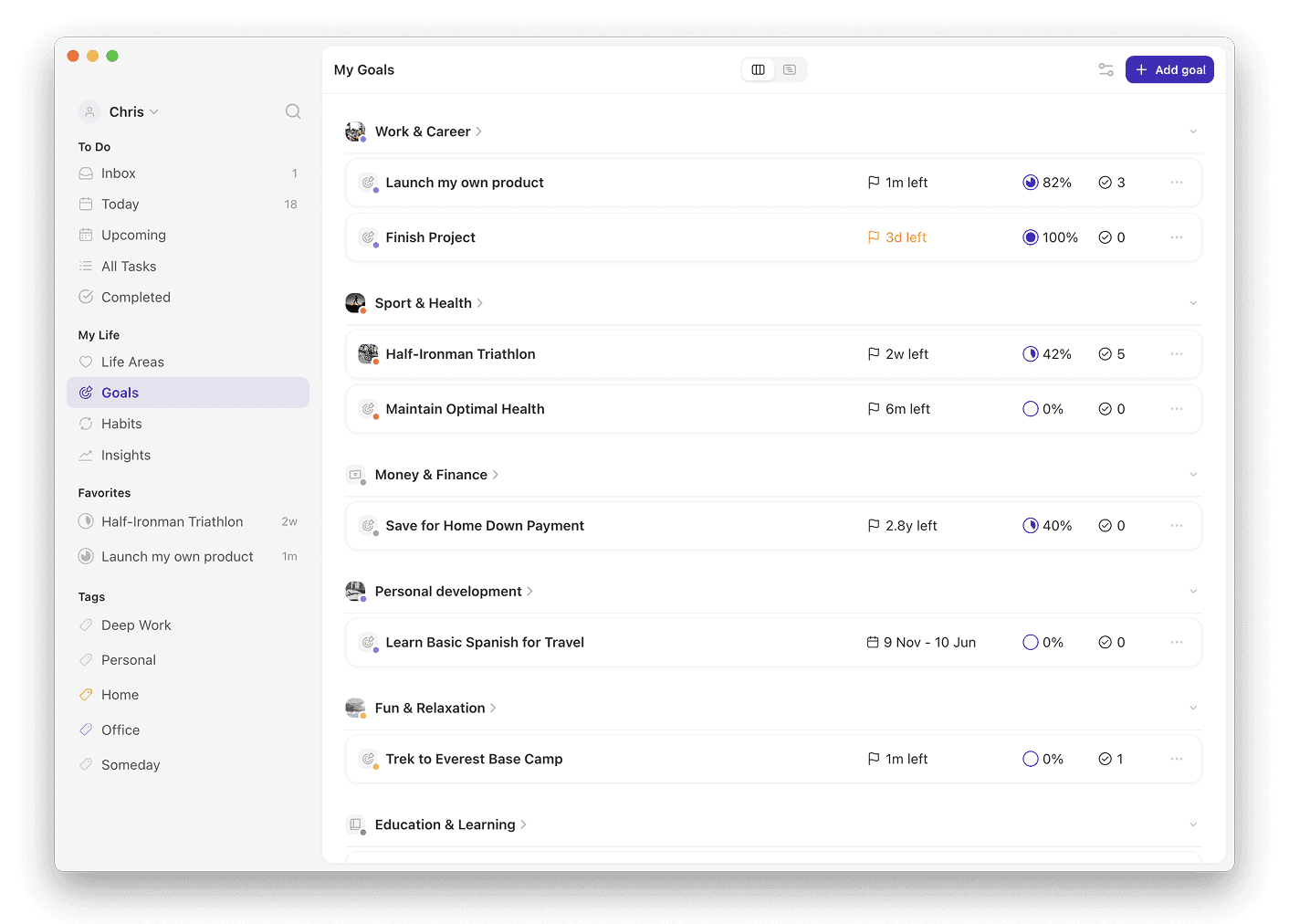
In Griply the plan is one goal, six milestone subgoals, and a surf habit under your Fun & Relaxation life area.
The plan, stage by stage
Here is the whole plan before you wax a board. Each stage has one target to hit before you move to the next, so you always know what to work on in today's session.
Stage | Target to hit before moving on | Rough time |
|---|---|---|
1. Pop-up on the sand | 10 smooth pop-ups in a row | 1-2 sessions |
2. Paddle and balance | Paddle out and lie centred without tipping | 1-2 sessions |
3. Whitewater on your belly | Catch and ride 5 broken waves prone | 1-2 sessions |
4. Pop up on whitewater | Stand and ride 5 whitewater waves | 2-4 weeks |
5. Catch a green wave | Catch and ride 3 unbroken waves straight | 1-3 months |
6. Turn along the wave | Ride along the face of a green wave | 3-6 months |
Most beginners stand up on whitewater within their first few sessions and reach clean green waves over three to six months of regular surfing. The stages overlap, so you will practise paddling and whitewater in the same session and move up the day you hit a target.
Before you paddle out
Three things set up before your first stage: the right board, the right wetsuit, and a read on the conditions.
Start on a soft-top, a big foam board around seven to nine feet with plenty of volume. It floats you, forgives mistakes, and catches waves easily. A short, thin board is far harder to paddle and balance, so save it for later.
Match your wetsuit thickness to the water temperature so you can stay in long enough to practise. Cold and shivering ends a session early.
Pick a beginner beach with small, mellow waves and a sandy bottom, ideally with lifeguards on duty. Check a surf forecast for wave height, wind, and tide, and learn to spot a rip current, a narrow channel of water flowing back out to sea. If you are ever caught in one, do not fight it: stay afloat and swim parallel to the shore until you are out of the pull, then angle back in.
A first lesson is the fastest way to get the pop-up and the safety basics right.
How to do each move
Warm up your shoulders, then work your current stage. Here is how to do each one.
1. Pop-up on the sand
Lie face down on the board on the beach, hands flat under your chest. In one motion, push up and swing your feet under you into a low sideways stance, front foot between your hands, knees bent, eyes forward. This move, called the pop-up, is the hardest part of standing, so grooving it on land pays off. Watching a clear demonstration and copying it is one of the fastest ways to learn a movement like this.
2. Paddle and balance
Lie centred on the board, chest up, and paddle with long, deep strokes, one arm at a time. Too far forward and the nose digs in; too far back and you plough water. Find the spot where the nose sits just above the surface, and practise lying balanced while small whitewater rolls under you.
3. Ride whitewater on your belly
Whitewater is the foamy, already-broken part of a wave. Point the board at the beach, and as a line of whitewater reaches you, paddle hard to match its speed. When it picks you up, keep paddling a stroke or two and ride it prone, lying flat, all the way in. Catching the wave is the skill here, before you add standing.
4. Pop up on whitewater
Now put the two together. Catch a whitewater wave lying down, feel it take you, then do your pop-up in one motion and ride it standing to the beach. Keep your knees bent, weight low, and eyes on the shore. Expect to fall often at first, and count each caught wave as a rep.
5. Catch a green wave
A green wave is an unbroken wave still forming a clean face. Paddle out past the breaking waves to the lineup, where surfers wait, and sit facing the horizon. As a swell approaches, turn to shore, paddle hard early, and pop up as the wave lifts your board. Ride it straight in at first.
6. Turn along the wave
Angle your take-off so you travel along the wave face as it peels, staying on the open wall ahead of the breaking part. Look where you want to go, lean gently onto your toes or heels, and let the board follow. This is the first real ride, and it is what surfing is about.
Inside each stage, make it a little harder each session: a longer ride, an earlier take-off, a cleaner stance. You are ready to move up when you can hit the stage target twice on separate sessions. Giving each stage a clear, specific target keeps you honest about when you have earned the next one.
Why it feels hard
Surfing is hard at first because you are balancing on a moving board on moving water, timing a wave you did not create, while your arms are tired from paddling. You get past that by building the pieces separately: the pop-up on land, the paddling and balance in whitewater, then the timing to catch a green wave.
The wave you ride is the outcome you want. The sessions you paddle out for are the process, and keeping the two separate is what stops you quitting when clean waves are slow to come. You cannot control the waves or the wind on any given day. You can control how often you paddle out and which stage you practise.
Build the habit
Surfing rewards frequency, so short, regular sessions beat one long day every few weeks. Practice spread across separate days builds a skill more effectively than the same hours crammed together, because your body consolidates the movement between sessions. Aim to surf two or three times a week when you can.
Surfing depends on conditions, so treat any surfable day as a session, and on flat days practise pop-ups at home and build paddling fitness with swimming. A repeatable cue, routine, and reward loop, like checking the forecast every evening and surfing before work, carries you between milestones without relying on motivation. Learning to surf is one way to take up a new hobby, and the same weekly rhythm keeps any of them going.
Common mistakes
A few habits keep beginners stuck in the shorebreak:
Starting on a short board. A big soft-top catches waves and forgives mistakes while you learn.
Trying to stand before you can catch whitewater lying down. Master catching the wave first.
Popping up in stages, knees first. Practise one smooth motion from lying to standing.
Nose-diving because your weight is too far forward. Slide back until the nose rides just clear.
Ignoring the conditions. Check the forecast, pick small waves and a lifeguarded beach, and avoid rips.
Paddling tired arms into big sets. Build paddling fitness before you chase bigger waves.
Set it up in Griply
The hard part is rarely the plan. It is holding six stages, your gear, and your sessions in one place and seeing whether you are improving. In Griply it becomes one scannable template under your Fun & Relaxation life area:
Goal: Learn to surf (metric: Subgoals, average)
Subgoal: 10 smooth pop-ups on the sand
Subgoal: paddle out and lie balanced in whitewater
Subgoal: ride 5 whitewater waves on your belly
Subgoal: pop up and ride 5 whitewater waves
Subgoal: catch and ride 3 green waves straight
Subgoal: ride along the face of a green wave
Task: buy a beginner soft-top board and wetsuit
Task: check the surf forecast and spot the rip currents
Task: book a first surf lesson
Habit: Surf or practise (schedule: 2 to 3 times a week)
You advance each stage as you reach it, and the progress line averages your milestones, so it climbs from your first pop-up on the sand, well before you catch a green wave. The Goal Planner keeps the goal, its milestones, the setup tasks, and your surf habit in one view, so the plan you just read becomes a template you can reuse. Subgoals, habit targets, and progress charts are part of Griply's paid plan; the free plan covers two goals and two habits.
Frequently asked questions
Can I teach myself to surf?
Yes, mostly. You can learn the pop-up, whitewater riding, and green waves on your own with a stable soft-top board and steady practice. A first lesson speeds up your technique and safety. Always start at a lifeguarded beginner beach with small waves.
How long does it take to learn to surf?
Most beginners stand up on whitewater in their first one to three sessions. Riding an unbroken green wave usually takes a few months of regular surfing, and turning along the wave face takes longer still. Frequent sessions shorten the timeline.
What is the 12 second rule in surfing?
It refers to swell period, the seconds between waves. A period around 12 seconds or more carries more energy and forms cleaner, more rideable faces than short-period wind swell. Beginners still want small waves, but a longer period usually means better shape.
Is 40 too old to learn to surf?
No. Surfing rewards regular practice more than youth, and beginners of any age can reach green waves with a big, stable board and consistent sessions. Build your paddling fitness gradually, pick small-wave days, and give each stage time.
How difficult is surfing for beginners?
Surfing is hard at first because you balance on a moving board while timing waves you cannot control. Most beginners stand on whitewater within a few sessions, then take a few months of regular surfing to catch and ride green waves.
Start in the whitewater
Learning to surf comes down to paddling out often in small whitewater and moving through stages you can measure: a clean pop-up on the sand, a caught wave on your belly, your first stand, then a green wave. You build the skill by showing up for those stages in order.
When you can watch your whitewater rides stack up and your pop-up get smooth, the green wave stops feeling far off and becomes the next number on the list. Every session gives you a target to beat, which keeps you paddling out on the days the surf looks small or the water feels cold. Surfing sits alongside the rest of your fun and relaxation goals. Once you ride along your first green wave, the same method carries you to steeper waves and longer rides.
Related Goal Plans


Related Guides
Han Y, Syed Ali SKB, Ji L. "Use of Observational Learning to Promote Motor Skill Learning in Physical Education: A Systematic Review." International Journal of Environmental Research and Public Health, 2022. https://pmc.ncbi.nlm.nih.gov/articles/PMC9407861/
Benjamin AS, Tullis J. "What makes distributed practice effective?" Cognitive Psychology, 2010. https://pmc.ncbi.nlm.nih.gov/articles/PMC2930147/
Carneiro L, Clemente FM, Claudino JG, Ferreira J, Ramirez-Campillo R, Afonso J. "Surf therapy for people with mental health disorders: a systematic review of randomized and non-randomized controlled trials." BMC Complementary Medicine and Therapies, 2024. https://pmc.ncbi.nlm.nih.gov/articles/PMC11514801/
National Oceanic and Atmospheric Administration. "How Do I Escape Rip Currents?" NOAA National Environmental Satellite, Data, and Information Service. https://www.nesdis.noaa.gov/about/k-12-education/oceans-coasts/how-do-i-escape-rip-currents