

Table of Contents
Passing a certification exam comes from a few weeks of spaced, active study built around the official syllabus: you book a date, work through every exam domain, quiz yourself from memory, and sit full practice exams until you clear the pass mark reliably. Most people study by rereading their notes and highlighting. That feels productive and rarely holds up under exam pressure. A booked date and a written plan work better, because they turn a vague wish to get certified into a schedule you actually follow. A certification is the outcome of a focused study effort, and this plan covers the concrete steps that earn the pass. If you want the wider career framework, see professional development goals. A certification is one of the work and career goals worth planning toward deliberately. Start by reading the exam like a map.
Key takeaways
Book your exam date first, so a real deadline drives the whole plan.
Study each syllabus domain by testing yourself, which beats rereading your notes.
Space your study across weeks and sit full timed mock exams before the real one.
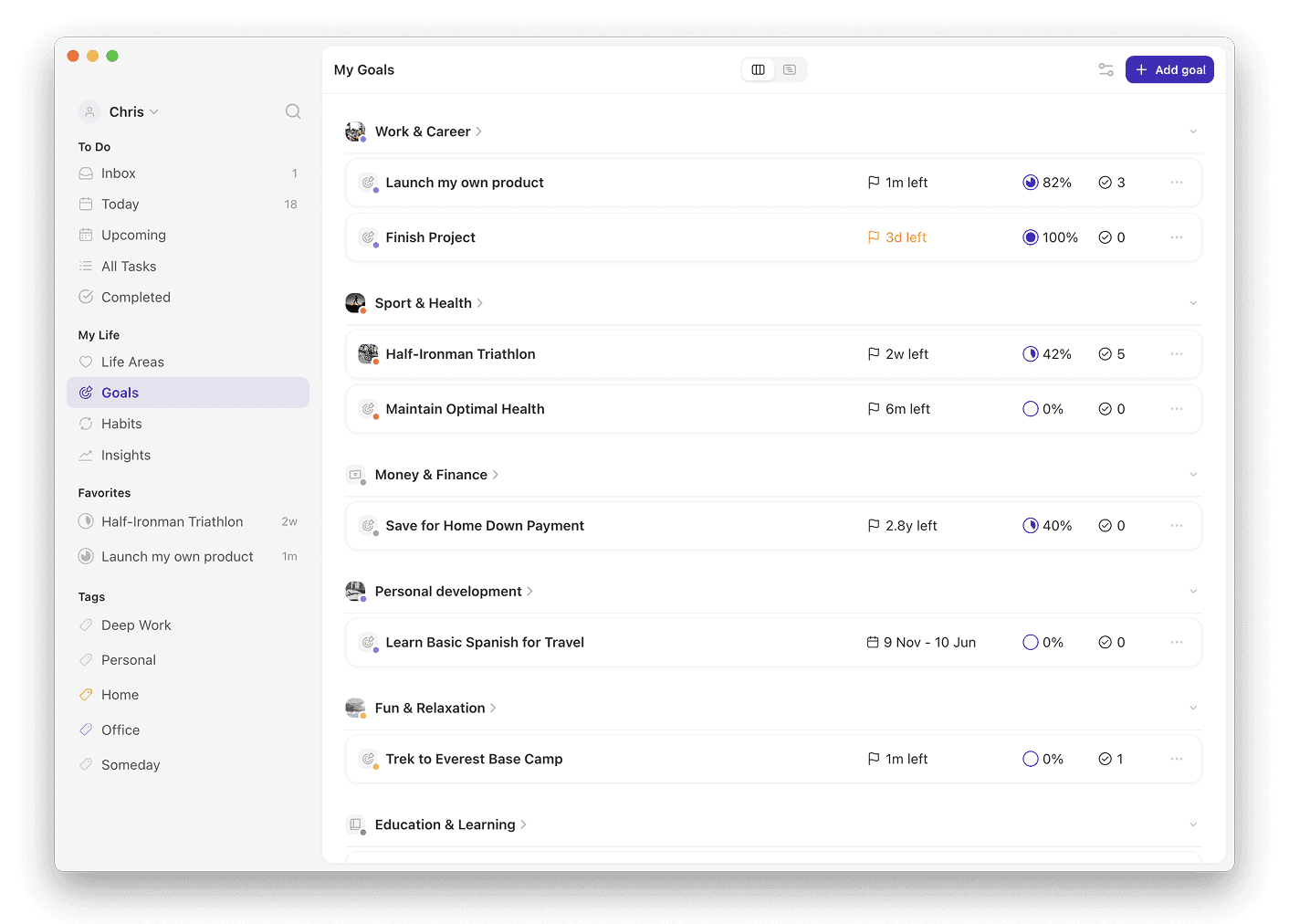
In Griply the certification is one goal with setup, learning, and drilling as subgoals, each holding its tasks, plus a study habit.
The plan, step by step
Here is the whole plan before you start. The stages run across one prep cycle, so you always know what to have done and roughly when.
Stage | Target to hit before moving on | Rough time |
|---|---|---|
1. Read the exam | Syllabus, format, and pass mark understood | Week 1 |
2. Book and gather | Exam date booked, study materials in hand | Week 1 |
3. Diagnostic test | One full practice exam taken cold | Week 1 |
4. Learn each domain | Every domain studied once, flashcards made | Weeks 2-6 |
5. Retrieval practice | Recall each domain from memory without notes | Weeks 3-7 |
6. Question drills | 80 percent on a question bank per domain | Weeks 6-8 |
7. Mock exams | 80 percent on two full timed practice exams | Weeks 8-10 |
8. Exam day | Pass the certification exam | the milestone |
Most certifications take eight to twelve weeks of part-time study, depending on the exam and your background. The stages overlap, so you drill questions on early domains while you are still learning later ones. Giving each domain a target is what turns "study more" into a plan you can run.
Why it feels hard
A certification exam covers a lot of material, and you forget most of what you read within days unless you do something about it. That is ordinary forgetting at work, and the plan below is the fix for it. Studying the same material in short sessions spread across weeks builds memory that survives to exam day, while a single long cram fades almost as fast as you build it.
The pass is the outcome you want, and the studying you show up for is the process. Once your exam date is set, treat the prep as a focused campaign over a fixed run of weeks, so a low practice score becomes a prompt to adjust your plan. You cannot control which questions the exam picks. You can control whether you have studied every domain and drilled it under timed conditions.
How to study for the exam
Set up before you study, then work each domain the same way. Here is how to do each part.
Read the exam like a map
Download the official syllabus and exam guide. Note the domains and their weighting, the number of questions, the time limit, and the pass mark. Study the heavily weighted domains hardest, since they carry the most marks. Knowing the format up front means no surprises on the day.
Take a diagnostic test first
Before you study anything, sit one full practice exam cold, meaning with no preparation. It shows which domains you already know and which need the most time, so you spend your weeks on the material that needs the most work.
Learn each domain, then test yourself
Read or watch the material for one domain, then close the book and write down what you remember, or make flashcards and quiz yourself. Recalling material from memory builds far stronger retention than reading it again. Rereading and highlighting feel productive and do little. Make the flashcards as you learn, one domain at a time.
Drill practice questions
Once you have learned a domain, answer a batch of practice questions on it, ideally 40 or more, then review every question you missed and re-study that point. Practice tests build the material better than going back to restudy it. Question banks also teach the exam's phrasing, so the wording stops throwing you.
Sit full mock exams
In the last two to three weeks, sit complete practice exams under real conditions: full length, timed, no notes, one sitting. Aim to clear the pass mark comfortably on two separate mocks before exam day. Review every wrong answer and re-study the domain it came from.
Handle exam-day logistics
Check the rules a week ahead: what ID you need, whether it is online-proctored or at a test centre, what you can bring, and how long it runs. Sleep properly the two nights before. A rested brain recalls more than a crammed and tired one.
Build the habit
The plan runs over weeks, so a study habit is the engine. Block the same slot most days, around 45 minutes, five times a week, and protect it. Short daily sessions beat one long weekend cram, because your memory holds material better when you meet it again and again across days. Among students preparing for a licensing exam, the ones who tested themselves with spaced flashcards and practice questions scored higher on the real thing. A repeatable cue, routine, and reward loop for sitting down to study carries you through the weeks when you would rather not.
Common mistakes
A few habits sink most exam candidates:
Passive rereading and highlighting. Testing yourself is what makes recall stick.
Cramming the week before. Spread study across weeks so it holds.
Skipping practice exams. Rehearse the real format under time pressure.
Studying every domain equally. Weight your time by the exam's domain split.
Ignoring the questions you miss. Those are your syllabus for tomorrow.
Booking no date. Without a deadline the prep drifts for months.
Studying late and tired. A rested brain recalls far more.
Set it up in Griply
The hard part is rarely knowing what to study. It is holding a whole syllabus in one place and seeing how much of it you have actually covered. In Griply the plan becomes one template under your Work & Career life area:
Goal: Get a certification (metric: Subgoals, average)
Subgoal: Setup
Task: download the official syllabus and note the pass mark
Task: book your exam date, eight to twelve weeks out
Task: buy the official guide and a practice question bank
Task: sit one full practice exam cold to find your gaps
Subgoal: Learn the syllabus
Task: study domain one, make recall flashcards as you read
Task: study each remaining domain the same way
Subgoal: Drill and test
Task: answer 40 practice questions per domain, review every miss
Task: sit a full timed mock exam, aim above the pass mark
Task: re-study any domain scoring under 80 percent
Habit: Study 45 minutes (schedule: five times a week)
Each phase progresses as you tick its tasks, and the goal averages the three, so you watch Setup, Learn the syllabus, and Drill and test fill up in turn and the line turns green when you are ready. The Goal Planner keeps the goal, its three phases, and the study habit in one view, so the plan you just read becomes a template you can reuse for the next certification. Subgoals, habit targets, and progress charts are part of Griply's paid plan; the free plan covers two goals and two habits.
Frequently asked questions
How do you pass a certification exam?
Study from the official syllabus over several weeks, quiz yourself from memory, drill practice questions by domain, and sit full timed mock exams until you clear the pass mark. Book the date first so a real deadline drives the schedule.
How long does it take to study for a certification exam?
Most people need eight to twelve weeks of part-time study, around five sessions a week. It depends on the exam's size and your background. Booking the date first sets the deadline and stops the prep drifting for months.
Is it better to cram or study over time?
Study over time. Spacing the same material across weeks builds memory that lasts to exam day, while a single cram fades within days. Short daily sessions with self-testing beat one long weekend before the exam.
How many practice exams should you take?
Take at least two or three full, timed mock exams in the final weeks, plus smaller question drills throughout. Aim to clear the pass mark comfortably on two separate mocks before you sit the real exam. Review every wrong answer.
What is the best way to study for a certification exam?
Test yourself from memory. Retrieval practice, flashcards, and practice questions build far stronger recall than rereading and highlighting. Space the sessions across weeks, weight your time by the exam's domain split, and finish with full mock exams.
Book the date first
A certification pass is built over weeks of spaced study. Read the syllabus, book the date, study each domain by testing yourself, and drill practice questions until the format feels routine. None of that depends on being a naturally gifted test-taker. It depends on a schedule you can start this week.
When you have covered every domain, cleared the pass mark on two mocks, and slept properly beforehand, exam day becomes a formality. Book the date first, because a real deadline is what turns "I should get certified" into a plan with weeks on it. Then run the plan, keep the study habit five days a week, and log each domain as you finish it. By the time the exam arrives, you already know you are ready, because your practice scores have told you so. The credential then becomes evidence you can point to when you change careers.


Related Guides
Cepeda NJ, Vul E, Rohrer D, Wixted JT, Pashler H. "Spacing Effects in Learning: A Temporal Ridgeline of Optimal Retention." Psychological Science, 2008. https://files.eric.ed.gov/fulltext/ED505660.pdf
Karpicke JD, Grimaldi PJ. "Retrieval-Based Learning: A Perspective for Enhancing Meaningful Learning." Educational Psychology Review, 2012. https://learninglab.psych.purdue.edu/downloads/2012/2012_Karpicke_Grimaldi_EDPR.pdf
Adesope OO, Trevisan DA, Sundararajan N. "Rethinking the Use of Tests: A Meta-Analysis of Practice Testing." Review of Educational Research, 2017. https://eric.ed.gov/?id=EJ1141817
Deng F, Gluckstein JA, Larsen DP. "Student-directed retrieval practice is a predictor of medical licensing examination performance." Perspectives on Medical Education, 2015. https://pmc.ncbi.nlm.nih.gov/articles/PMC4673073/