

Table of Contents
Building an emergency fund means setting aside three to six months of essential expenses (the bills you must pay even with no income) in a separate savings account you touch only for real emergencies. It is the buffer that covers a car repair, a medical bill, or a lost paycheck without borrowing. The stakes are real: nearly half of Americans could not readily come up with $2,000 for an unexpected expense within a month. A fund like this is built the same way every time. You set a target number, open an account you will not dip into, and automate a fixed transfer every payday so the balance grows on its own. This plan walks you through the whole thing, from your first dollar to a full buffer.
Key takeaways
Aim for three to six months of essential expenses, saved in a separate account.
Start with a small starter buffer, then build up in stages.
Automating a fixed transfer every payday is what makes the fund grow.
In Griply, the fund is one goal with an automatic saving habit and setup tasks.
The plan, step by step
Here is the whole plan before you start. The first three steps are one-time setup. The rest are savings targets you clear in order, each one a bigger buffer than the last.
Stage | Target to hit before moving on | Rough time |
|---|---|---|
1. Set your target | Know your monthly essentials and your 3-6 month number | a day |
2. Open a separate account | A high-yield savings account, apart from checking | a day |
3. Automate the transfer | A recurring transfer set for every payday | a day |
4. Starter buffer | $1,000 saved, or one month if that is lower | 1-3 months |
5. One month of essentials | One month of essential expenses saved | 2-4 months |
6. Three months saved | Three months of essential expenses saved | 4-8 months |
7. Full fund | Your target of three to six months saved | ongoing |
The setup is one afternoon. The saving stages then run continuously, so how fast you clear them depends on how much you can move each payday. The starter buffer comes first because a small cushion covers most everyday shocks while the full fund builds.
Why it feels hard
A three to six month fund is a large number, and it sits far in the future, so it is easy to never start or to raid the account when something comes up. That is why so many households stay exposed. In the Federal Reserve's 2024 survey, 37 percent of adults said they could not cover a $400 emergency expense with cash or savings.
The full fund is the outcome you want, and the transfer you make every payday is the process. Pinning the fund to a target number you can watch fill up is what stops a slow month feeling like failure. You cannot control when an emergency lands. You can control whether the transfer went out this payday.
How to build it
Set up the account and the transfer first, then let the stages take care of themselves. Here is how to do each part.
Set your target
Add up your essential expenses for one month: rent or mortgage, utilities, food, insurance, transport, and minimum debt payments. Multiply by three for a lean target and by six for a full one. That range is your goal. Start with the three-month number if the six-month figure feels out of reach.
Open a separate account
Open a high-yield savings account, which is a savings account that pays meaningfully more interest than a standard one. Keep it at a different bank from your checking account so the money is a few taps away, out of sight, and awkward to spend on a whim. This one move prevents most accidental dipping.
Automate the transfer
Set a recurring transfer from checking to your savings account for the day after each payday. Pick a fixed amount you can sustain, whether that is $50, $200, or 10 percent of your pay, and treat it as a bill. Automating deposits is one of the evidence-based strategies the CFPB found for building emergency savings, because the money moves before you can spend it.
Build the starter buffer
Your first target is a small cushion, around $1,000 or one month of essentials if that is lower. This covers the everyday shocks, a flat tyre or a vet bill, while the larger fund is still growing. Giving the fund a number and clearing one buffer before the next gives each stage a clear finish line.
Build to a full fund
Once the starter buffer is in place, keep the same transfer running toward one month of expenses, then three, then your full three to six month target. Every payday adds to the balance, and each stage you clear is a real level of security. When you can, add any windfall, such as a tax refund or a bonus, straight to the fund to jump a stage, and a no-spend month can free up a chunk to do the same.
Build the habit
The fund grows because the transfer keeps happening, so the saving habit is the engine. Anchor it to payday, the one day the money is there, so you are not relying on memory or leftover cash. A repeatable cue, routine, and reward loop, where payday triggers the transfer and you watch the balance tick up, carries the fund forward on the months you would rather spend. The payoff is more than the number: people with even a month of income saved report much higher financial well-being and far less trouble paying bills.
Common mistakes
A few habits keep people from ever reaching a full fund:
Keeping the money in checking, where it blends in and gets spent. Move it to a separate account.
Saving whatever is left at month-end. Move a set amount on payday first.
Setting a six-month target from day one and quitting. Clear the starter buffer first.
Dipping in for non-emergencies. Define what counts as an emergency before you need it.
Forgetting to replenish after using it. Restart the transfers until the fund is whole again.
Investing the fund for higher returns. Keep it liquid and stable so it is there when you need it.
Set it up in Griply
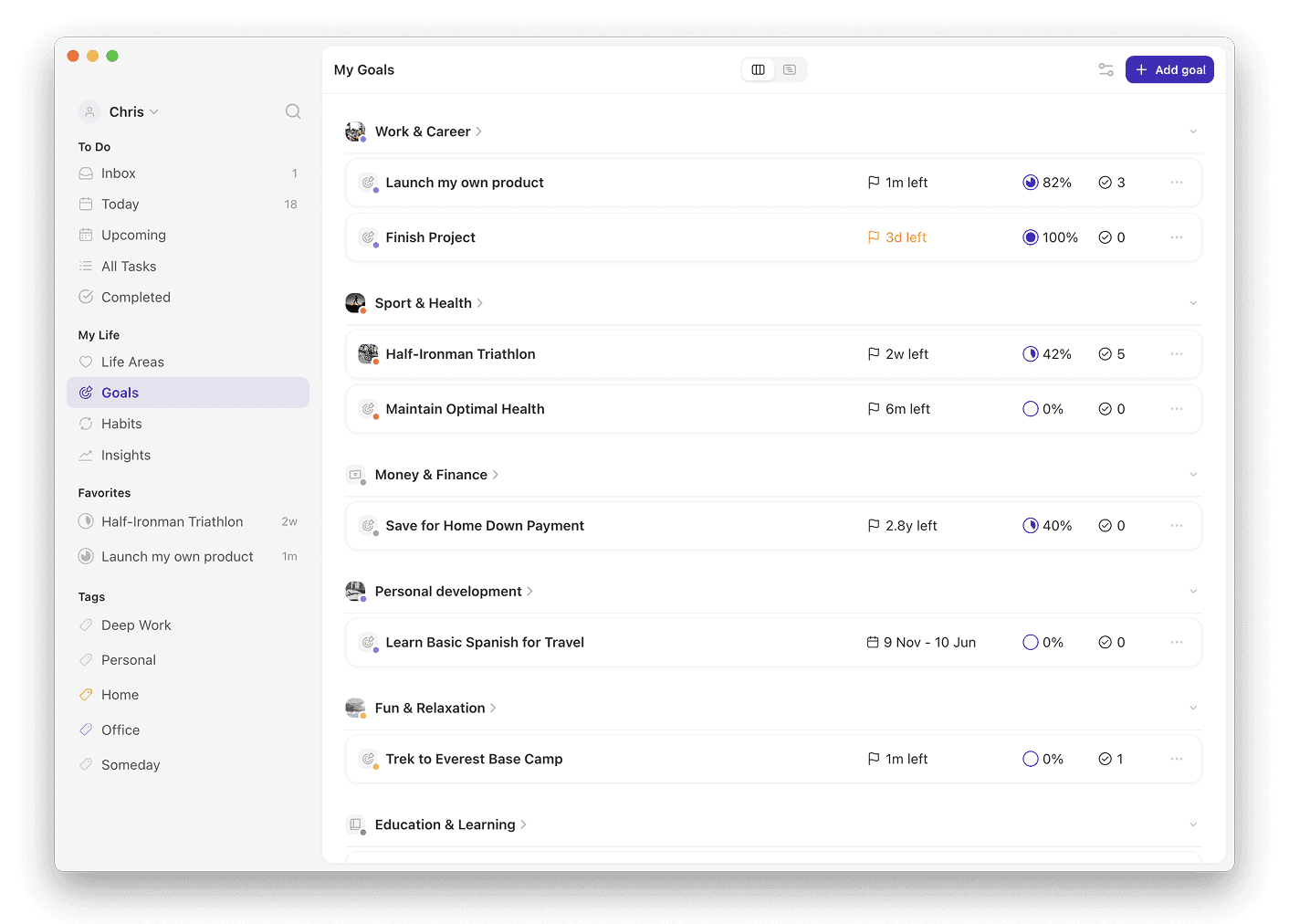
The hard part is rarely deciding to save. It is watching the balance actually grow and keeping the money somewhere you will not spend it. In Griply the whole plan becomes one scannable template under your Money & Finance life area:
Goal: Build an emergency fund (metric: Unit-based, currency, 0 to your target)
Task: calculate three to six months of essential expenses
Task: open a separate high-yield savings account
Task: set up an automatic transfer for payday
Habit: Move a set amount to savings (schedule: every payday)
You log your balance as it grows, so the progress line climbs from zero toward your target and turns green when you reach it. The Goal Planner keeps the target, the saving habit, and your setup steps in one view, so the plan you just read becomes a template you can reuse for the next money goal. Habit targets and progress charts are part of Griply's paid plan; the free plan covers two goals and two habits.
Frequently asked questions
How much should you have in an emergency fund?
Aim for three to six months of essential expenses, the bills you must pay even with no income. Three months suits a stable job with two incomes; six months suits variable income or a single earner. Start with a $1,000 buffer, then build toward the larger target.
Where should you keep an emergency fund?
Keep it in a high-yield savings account at a separate bank from your checking account. It stays liquid, earns interest, and sits far enough away that you will not spend it on impulse. Avoid investing it, since the balance needs to be stable and available on short notice.
How do you start an emergency fund with little money?
Start with any amount and automate it. A $25 or $50 transfer every payday builds the habit and a real balance over time. Aim for a small starter buffer of around $1,000 first, then raise the transfer whenever your budget allows.
How long does it take to build an emergency fund?
It depends on your target and how much you move each payday. A $1,000 starter buffer often takes one to three months. A full three to six month fund usually takes one to two years of steady, automated saving, faster if you add windfalls.
Should you invest your emergency fund?
No. An emergency fund needs to be stable and available on short notice, and investments can drop in value exactly when you need the cash. Keep it in a high-yield savings account. Invest only the money you are saving for longer-term goals beyond the fund.
Pay yourself first
An emergency fund is not built in one heroic month of saving. It is built by moving a set amount to a separate account every payday, before the money reaches your spending, and letting the balance climb through one buffer after another. You set the target, automate the transfer, and clear the starter cushion before the full fund.
When you can watch the balance grow from zero toward three or six months of expenses, the fund stops feeling out of reach and becomes the number you top up each payday. Automate the transfer, leave the account alone, and the buffer builds itself. It is the foundation your wider money and finance goals build on.
Related Goal Plans


Related Guides
Lusardi A, Schneider D, Tufano P. "Financially Fragile Households: Evidence and Implications." NBER Working Paper No. 17072, National Bureau of Economic Research, 2011. https://www.nber.org/papers/w17072
Board of Governors of the Federal Reserve System. "Report on the Economic Well-Being of U.S. Households in 2024." Federal Reserve, May 2025. https://www.federalreserve.gov/publications/2025-economic-well-being-of-us-households-in-2024-savings-and-investments.htm
Consumer Financial Protection Bureau. "Evidence-based strategies to build emergency savings." CFPB, 2020. https://www.consumerfinance.gov/data-research/research-reports/evidence-based-strategies-build-emergency-savings/
Consumer Financial Protection Bureau. "Emergency Savings and Financial Security: Insights from the Making Ends Meet Survey and Consumer Credit Panel." CFPB, March 2022. https://files.consumerfinance.gov/f/documents/cfpb_mem_emergency-savings-financial-security_report_2022-3.pdf