

Table of Contents
Finding a hobby is the process of trying a few low-commitment activities, keeping the one you look forward to, and doing it often enough that it becomes part of your week. If you have ever felt like you should have a hobby but had no idea where to start, the block is rarely a lack of options. Most people try to pick the perfect hobby in their head. The faster route is to test a few in real life and keep what you enjoy. A hobby you actually keep is linked to fewer depressive symptoms and higher life satisfaction, so it is worth the small effort to find one. This plan walks you through building a shortlist, sampling each option cheaply, committing to a single choice, and building the habit so it lasts past the first few awkward weeks.
Key takeaways
Test three or four hobbies cheaply, then keep the one you enjoy.
Pick the activity that makes time disappear while you do it.
Most hobbies feel awkward at first, so give your choice about six weeks before judging it.
In Griply, "take up a new hobby" is one goal with a twice-weekly practice habit.
The plan, stage by stage
Here is the whole plan before you start. Each stage has one thing to get done before the next, so you always know your next move.
Stage | Target to hit before moving on | Rough time |
|---|---|---|
1. Know what you want | List what you want from a hobby (calm, active, social, creative) | 1 day |
2. Build a shortlist | 3 to 5 hobbies that fit your time and budget | 2-3 days |
3. Try each one | One low-cost trial session per hobby | 1-2 weeks |
4. Pick one | Choose the hobby you looked forward to most | 1 day |
5. Get the starter kit | The minimum gear to do it once, borrowed or cheap | a few days |
6. Schedule it | A regular weekly slot blocked in your calendar | 1 day |
7. Make it stick | 12 sessions done over about six weeks | 6 weeks+ |
Most people land on a hobby within two to three weeks and know it has stuck after about six. Some stages overlap, so you can build your shortlist while you book your first trial.
How to do each step
The early stages narrow the field, and the later ones make your choice stick. Here is how to do each one.
1. Know what you want
Before you look at any activity, write down what you want a hobby to give you. Some people want to switch off after work, some want to move their body, and some want to make things or meet people. A hobby that matches what you actually want is the one you keep. Your answer also rules out whole categories fast, so you do not waste trials on the wrong kind of thing.
2. Build a shortlist
Turn that into three to five specific activities you could realistically start this month. Match them to your real constraints: how much time you have in a week, what you can spend, and whether you want something at home or out of the house. If you are stuck for ideas, think in categories, something creative, something active, something social, and pick one candidate from each.
3. Try each one
Give every shortlisted hobby one short trial before you commit to any of them. A trial is a single low-cost session: a library book and one afternoon, a rented instrument, a free class, a taster session, or a beginner video you follow along with. The activities worth keeping are usually the ones you lose yourself in, where an even match between the challenge and your skill pulls you into the moment. Notice which trial made time disappear and which one you had to force.
4. Pick one
Choose the single hobby you looked forward to and wanted to go back to. A simple test: which trial did you think about afterwards, and which one made an hour feel like ten minutes. Commit to that one for now. You can keep the others on a list for later, but starting four hobbies at once usually means you drop all four.
5. Get the starter kit
Get the smallest amount of gear you need to do the hobby once, and borrow or buy second-hand where you can. Buying a full professional setup before you know you will stick is the most common way people waste money and add pressure. You can upgrade your kit once the habit is real and you know what you actually need.
6. Schedule it
Book a regular weekly slot for your hobby and treat it like any other appointment. Attach it to something you already do, like a Sunday morning coffee or the hour after you get home on a Tuesday, so you do not rely on remembering. Giving the commitment a fixed number and time makes it far easier to protect than a vague plan to do it more.
Why it feels hard
Finding a hobby feels harder than it should because people treat it as a permanent decision, when it is really a set of small experiments. You do not have to marry the first thing you try. You just have to try it once and notice how it felt.
The hobby you imagine mastering is one of many things you want from life, and seeing where it fits among your other life goals helps you stick with it the week you are still clumsy at it. You cannot control whether you have a natural gift for something. You can control whether you book the next session.
Regular enjoyable activity is worth protecting for its own sake, too. People who make time for leisure they enjoy tend to have lower stress and better mood, so the time you give a hobby pays you back.
Build the habit
A hobby becomes real once the sessions happen without a decision each time. Aim for two sessions a week, which is enough to keep improving and light enough to protect on a busy week. Give your choice about six weeks, or twelve sessions, before you judge whether it is for you, because the first few always feel clumsy.
Sticking gets easier as you get a little better each time. We keep doing the activities we chose ourselves and feel ourselves improving at, so let yourself be a beginner and track small progress. A repeatable cue, routine, and reward loop, like playing right after dinner on set evenings, carries the hobby through the weeks your motivation dips. If music is on your shortlist, the plan to learn an instrument breaks it into the same kind of small steps.
Common mistakes
A few common mistakes stop a new hobby before it takes hold:
Buying all the gear up front, then quitting once the money is spent.
Choosing a hobby for how it looks to other people.
Skipping a set weekly time, so the hobby happens only by accident.
Starting four hobbies at once and finishing none of them.
Expecting to be good right away and quitting in the clumsy first weeks.
Judging a hobby on one bad session before giving it a fair run.
Set it up in Griply
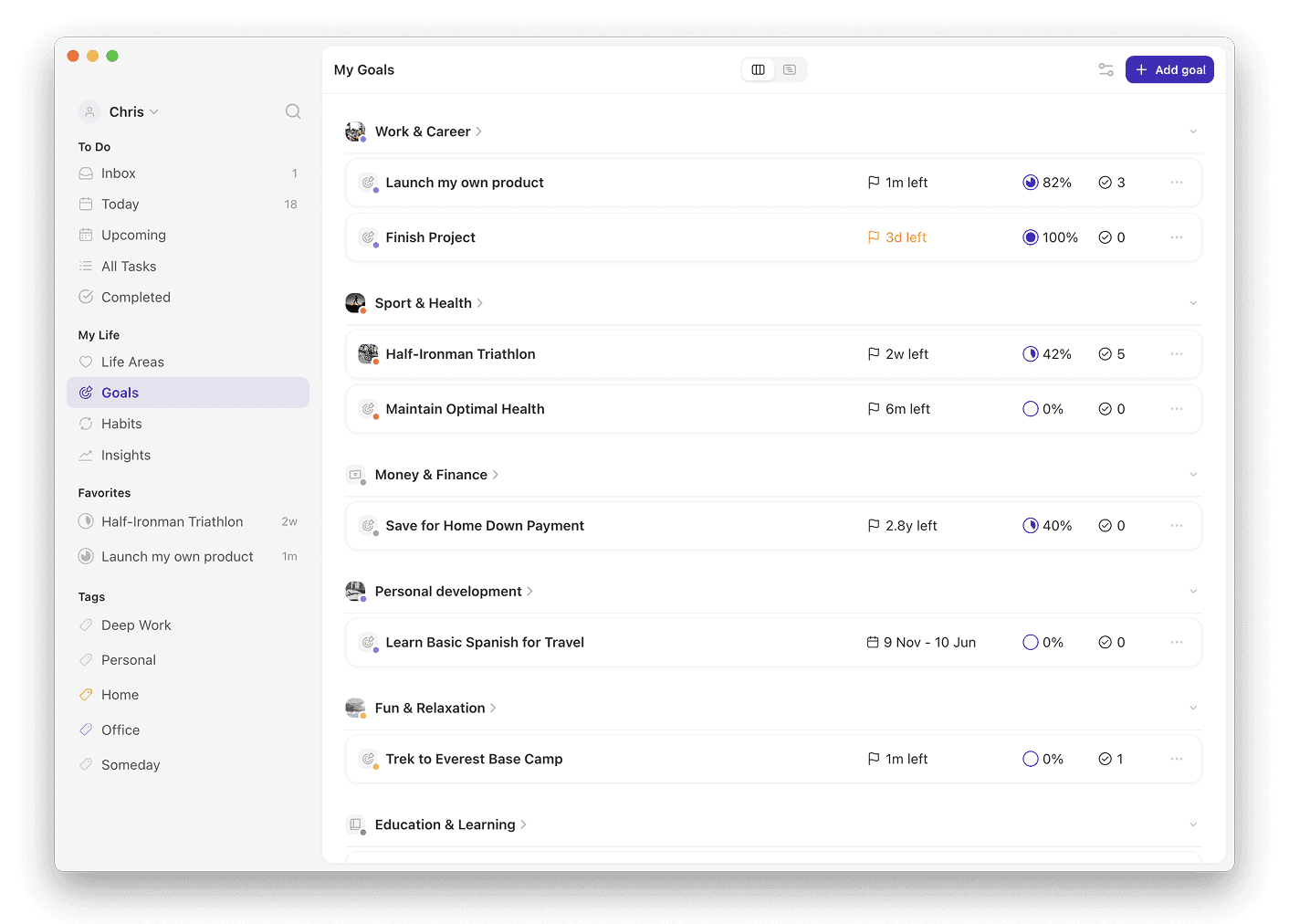
The hard part is rarely choosing a hobby. It is doing it enough times that it turns from a one-off into something you keep. In Griply the whole plan becomes one template under your Fun & Relaxation life area:
Goal: Take up a new hobby (metric: Unit-based, sessions, 0 to 12)
Task: shortlist 3 to 5 hobbies that fit your time and budget
Task: try each one with a low-cost trial session
Task: pick the hobby you looked forward to most
Task: get the minimum starter kit for it
Habit: Do your hobby (schedule: 2 times a week)
You log each session as you go, so the progress line climbs from 0 toward 12 and turns green once the hobby is part of your week. The Habit Tracker keeps the goal, the setup steps, and your twice-weekly practice in one view, so the plan you just read becomes a template you can reuse for the next one. Habit targets and progress charts are part of Griply's paid plan; the free plan covers two goals and two habits.
Frequently asked questions
What is the 3 hobby rule?
The 3 hobby rule is an informal idea that you keep three hobbies: one to keep you active, one to make you money, and one to keep you creative. It is a loose suggestion with no research behind it. One hobby you enjoy and keep is already a win.
How do I find the right hobby for me?
Start from what you want a hobby to give you, whether that is calm, movement, making something, or company. Shortlist three or four that fit your time and budget, try each once, and keep the one you looked forward to. The right hobby is the one you return to.
What are the 4 types of hobbies?
Hobbies are often grouped into four types: creative (making things), physical (moving your body), mental (learning or solving), and social (doing something with others). Most activities cross more than one. Picking one type you are drawn to is a fast way to narrow your options.
How long does it take to stick with a new hobby?
Give a new hobby about six weeks, or roughly twelve sessions at twice a week, before you decide whether it fits. The first sessions feel clumsy for almost everyone, so early awkwardness is a poor signal. If you still look forward to it after six weeks, it has stuck.
What if nothing interests me?
Lower the bar from passion to curiosity. Something mildly interesting to try once is enough, and a hobby does not need to be a calling. Pick any activity you were curious about as a child, try it cheaply, and let real experience guide you.
Try a few, keep one
Finding a hobby is not a personality quiz you have to get right. It is a short run of cheap experiments, followed by showing up for the one that stuck. You shortlist a few, try each once, and keep the activity that made time disappear.
The part that matters is what happens after you choose. Book the same weekly slot, let yourself be a beginner for a few weeks, and log each session so you can watch the habit forming. When you have twelve sessions behind you and still look forward to the next, the hobby is yours to keep. A hobby you enjoy makes room for the rest of your fun and relaxation goals. Start with one small trial this week, and let the sessions add up from there.
Related Goal Plans


Related Guides
Mak HW, Noguchi T, Bone JK, Wels J, Gao Q, Kondo K, Saito T, Fancourt D. "Hobby engagement and mental wellbeing among people aged 65 years and older in 16 countries." Nature Medicine, 2023. https://pmc.ncbi.nlm.nih.gov/articles/PMC10504079/
Pressman SD, Matthews KA, Cohen S, Martire LM, Scheier M, Baum A, Schulz R. "Association of Enjoyable Leisure Activities With Psychological and Physical Well-Being." Psychosomatic Medicine, 2009. https://pmc.ncbi.nlm.nih.gov/articles/PMC2863117/
Ryu J. "Leisure Engagement and Happiness in Later Life Based on a Level of Flow Experience." Innovation in Aging, 2024. https://pmc.ncbi.nlm.nih.gov/articles/PMC11692653/
Ryan RM, Deci EL. "Self-Determination Theory and the Facilitation of Intrinsic Motivation, Social Development, and Well-Being." American Psychologist, 2000. https://selfdeterminationtheory.org/SDT/documents/2000_RyanDeci_SDT.pdf