


Table of Contents
Couch to 5k is a nine-week plan that builds a total beginner up to running 5k, or 30 minutes without stopping, through walk-run intervals that get longer each week. You start by jogging for one minute at a time with generous walking breaks, and by week nine you run the whole way. The payoff shows up early, since even small amounts of running are linked to a lower risk of early death. Most people who quit do so because they run too fast or skip their rest days, well before fitness is the problem. This plan keeps the pace easy and the steps small, so you actually reach the finish.
Key takeaways
Couch to 5k builds a total beginner up to a 30-minute run through walk-run intervals over about nine weeks.
You run at an easy, conversational pace, and the early runs are meant to feel slow.
Three runs a week on non-consecutive days works best, because the rest days are when you adapt.
In Griply you set the 5k as one goal measured in distance, add each training as a task, and attach a running habit.
The plan, week by week
Here is the whole plan, ready to copy straight into your week. You start with one-minute jogs and generous walking breaks and build to a 30-minute run, about 5k, over roughly nine weeks. Do three runs a week on non-consecutive days, keep every jog easy enough to talk in full sentences, and top and tail each one with a five-minute brisk walk to warm up and cool down. "Same" means repeat run 1.
Week | Run 1 | Run 2 | Run 3 |
|---|---|---|---|
1 | Run 60 sec, walk 90 sec, 8 times | Same | Same |
2 | Run 90 sec, walk 2 min, 6 times | Same | Same |
3 | Twice: run 90 sec, walk 90 sec, run 3 min, walk 3 min | Same | Same |
4 | Run 3 min, walk 90 sec, run 5 min, walk 2.5 min, run 3 min, walk 90 sec, run 5 min | Same | Same |
5 | Run 5 min, walk 3 min, 3 times | Run 8 min, walk 5 min, twice | Run 20 min non-stop |
6 | Run 5, walk 3, run 8, walk 3, run 5 (minutes) | Run 10 min, walk 3 min, run 10 min | Run 25 min non-stop |
7 | Run 25 min non-stop | Same | Same |
8 | Run 28 min non-stop | Same | Same |
9 | Run 30 min non-stop, about 5k | Same | Same |
In most weeks the three runs are identical. Weeks five and six are the exception: their sessions grow across the week, which is how you bridge from five-minute runs to a twenty-minute run without a brutal jump. If the third run of any week feels beyond you, repeat that week before moving on; the week-five jump to a 20-minute run is where many beginners struggle, so there is no penalty for spending two weeks on a stage.
Why it feels hard
Running feels hard at first because your heart, lungs, and legs are being asked to do something new, all at once. The plan fixes that by starting tiny and adding a little each week. Starting with short, easy runs is what protects beginners from the injuries that end most attempts.
The 5k is the finish line, and the runs you show up for are how you reach it. Keeping your eyes on the next run stops a bad day from ending the whole plan. You cannot rush your fitness. You can control whether you keep the pace easy and take your rest days.
How to run it
Two things carry the whole plan: keep the pace easy, and move up only when the current week feels manageable.
Run at a conversational pace, slow enough to talk in full sentences. If you are gasping for air, slow down, because the early runs are meant to feel easy. Speed comes later. If you train with a heart-rate monitor, that easy effort is roughly zone 2, about 60 to 70 percent of your maximum heart rate, but the talk test does the same job with no kit.
Build gradually, since sudden jumps in how far or fast you run are what raise the injury risk. Giving each week a target tells you when you have earned the next one, so let the third run of the week be the test of whether you are ready to move on.
Build the habit
Three runs a week is the engine, and the rest days between them are part of the plan. Your body adapts while you recover, so running every day would slow you down. Building the run into a fixed weekly routine, like a standing Monday, Wednesday, and Friday, carries you through the weeks when you would rather stay on the couch.
Common mistakes
Most people who stall make one of these mistakes:
Running the intervals too fast. Keep every jog conversational, even when it feels almost too slow.
Treating the walk breaks as optional. Walk them at an easy pace so you recover for the next run interval.
Skipping the warm-up walk. Five easy minutes at each end loosens your legs and lowers the injury risk.
Running on back-to-back days. Keep a rest day between runs, since that is when your body adapts.
Jumping ahead when a week felt maxed out. Repeat the week; there is no penalty for spending two weeks on a stage.
Set it up in Griply
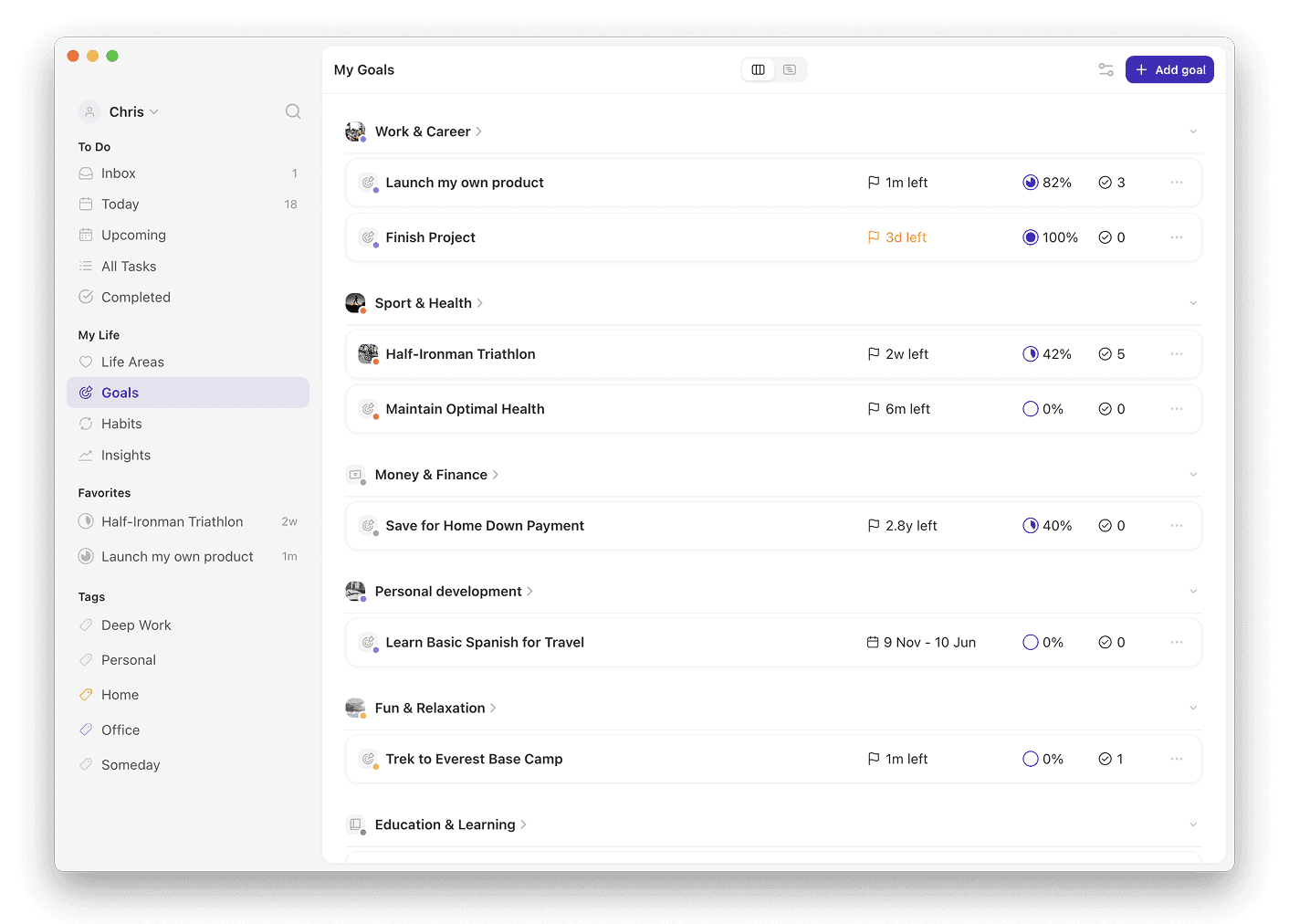
The hard part is rarely the plan. It is holding nine weeks of runs in one place and seeing your longest run grow. In Griply the whole plan becomes one template under your Sport & Health life area:
Goal: Run 5k (metric: Unit-based, distance, 0 to 5 km)
Task: each training as a task, grouped in a section per week
week 1, run 1: run 60 sec, walk 90 sec, 8 times
week 1, run 2: run 60 sec, walk 90 sec, 8 times
and so on, through week 9's 30-minute run
Habit: Go for a run (schedule: 3 times a week on non-consecutive days)
You tick off each run as you do it and log your longest continuous run, so the progress line climbs toward 5 km and turns green when you get there. The Goal Planner keeps the goal, its weekly runs, and the running habit in one view, so the plan you just read becomes a template you can reuse for your next distance. Habit targets and progress charts are part of Griply's paid plan; the free plan covers two goals and two habits.
Frequently asked questions
How long does couch to 5k take?
About nine weeks at three runs a week. It can take longer if you repeat a week, which is fine and common. Spending ten or twelve weeks on the plan still gets you to a 5k.
Can a complete beginner go from the couch to 5k?
Yes. The walk-run structure is built for people who have never run. You start with one-minute jogs and generous walking breaks, and the running builds gradually until you can run the whole way.
How many times a week should you run couch to 5k?
Three runs a week, on non-consecutive days. The rest days between runs are part of the plan, since that is when your body adapts and gets stronger. Running every day would slow your progress and raise your injury risk.
What if you cannot finish a run or a week?
Repeat the week before moving on, and slow your pace. There is no penalty for spending two weeks on a stage. Most people who struggle are running too fast, so easing off usually fixes it.
Is running 30 minutes the same as 5k?
For most beginners, 30 minutes of continuous running lands close to 5k. The graduation target is 30 minutes without stopping, and the exact distance depends on your pace. As you get faster, the same time covers more ground.
Keep the pace easy
Couch to 5k works because it starts where you are and adds a little each week: one-minute jogs become five-minute runs, then a twenty-minute run, then the full thirty. You keep the pace conversational, take your rest days, and repeat a week whenever you need to.
When you can watch your longest run climb from one minute to twenty to thirty, the 5k stops being a far-off idea and becomes the next number on the list, sitting alongside the rest of your fitness goals. Run easy, run three times a week, and let the weeks do the work.


Related Guides
Lee DC, Pate RR, Lavie CJ, Sui X, Church TS, Blair SN. "Leisure-Time Running Reduces All-Cause and Cardiovascular Mortality Risk." Journal of the American College of Cardiology, 2014. https://pmc.ncbi.nlm.nih.gov/articles/PMC4131752/
Relph N, Taylor SL, Christian DL, Dey P, Owen MB. "'Couch-to-5k or Couch to Ouch to Couch!?' Who Takes Part in Beginner Runner Programmes in the UK and Is Non-Completion Linked to Musculoskeletal Injury?" International Journal of Environmental Research and Public Health, 2023. https://pmc.ncbi.nlm.nih.gov/articles/PMC10487403/
Fredette A, Roy JS, Perreault K, Dupuis F, Napier C, Esculier JF. "The Association Between Running Injuries and Training Parameters: A Systematic Review." Journal of Athletic Training, 2021. https://pmc.ncbi.nlm.nih.gov/articles/PMC9528699/
Bertelsen ML, Hansen M, Rasmussen S, Nielsen RO. "The Start-to-Run Distance and Running-Related Injury Among Obese Novice Runners: A Randomized Trial." International Journal of Sports Physical Therapy, 2018. https://pmc.ncbi.nlm.nih.gov/articles/PMC6253747/