


Table of Contents
The push-up challenge is a 30-day plan where you test your starting max, do near-daily sets that scale to your level, and retest at the end to measure how far you have come. Most challenges online hand you the same fixed numbers whatever your level, so beginners burn out in week one and stronger people barely break a sweat. A plan anchored to your own max fixes both.
The version here scales every set to your baseline, builds over four weeks, and keeps two rest days, because that is when the strength is built. A specific if-then plan also beats a vague intention to do more push-ups, because tying your sets to a set time and place raises your odds of finishing all 30 days. For the pulling counterpart to this pressing challenge, a pull-up progression works the same staged way. Start by finding your number.
Key takeaways
A good push-up challenge scales to your own starting max, so it fits a beginner and a stronger lifter alike.
You test your max on day one, do near-daily sets anchored to it, and retest on day 30.
Two rest days a week are part of the plan, because muscle is built during recovery.
In Griply you set the challenge as one goal measured in reps, run it on a daily habit, and mark the max test and retest as tasks.
Start by testing your max
Before anything else, find your starting number. After a light warm-up, do as many clean push-ups as you can in one set, and stop when your form breaks. That number is your max, and every session in the plan scales off it. Setting a specific, measurable baseline you can test is what makes day 30 mean something, because you have a before to compare the after against.
The plan, week by week
The plan runs five training days a week with two rest days, and every set is a share of your max, so it fits any level. Spread the rest days across the week, for example train Monday and Tuesday, rest Wednesday, train Thursday and Friday, rest Saturday, and train Sunday, so the two rest days never fall back to back. Keep two or three reps in reserve on each set, which means you stop while you could still do two or three more clean reps, and rest 60 to 90 seconds between them. Adding reps week by week is a real way to get stronger, even without adding weight.
Week | Sets per session | Reps per set | Focus |
|---|---|---|---|
1 | 4 | about 40-50% of your max | Adapt: groove the movement |
2 | 5 | about 50-60% of your max | Build: add volume |
3 | 5 | about 60-70% of your max | Push: add a set when strong |
4 | 4, then retest | taper, then a max test | Peak and retest on day 30 |
If your max is 12, week one is about four sets of five, week two five sets of six or seven, week three five sets of eight, then week four tapers: two light sessions of three sets at about 40% of your max early in the week, an easy day, then the max retest on day 30. A taper simply means cutting the volume in the final days so you go into the retest fresh. For the 100 push-up version, aim for 100 total reps across your sets in one session, which is realistic within a month for most people. One hundred unbroken reps is an advanced feat that takes many months, so treat that as a separate goal.
How to do a push-up
A rep only counts if the form is clean, so build the challenge on a solid push-up.
Proper form
Set your hands about shoulder-width, slightly wider than your chest. Keep your body in one straight line from head to heels, with your core and glutes braced so your hips do not sag. Lower until your chest is about a fist's height off the floor, elbows tracking back at roughly 45 degrees, then press all the way up to straight arms.
If you cannot do a full rep yet
Start easier and work down to the floor. Wall push-ups come first, then incline push-ups with your hands on a bench or stair, then knee push-ups with a straight line from knees to head. Lower the surface every week until you are pressing from the floor.
If the standard reps feel easy
Raise the difficulty of the reps themselves. Decline push-ups with your feet on a step shift the load to your shoulders, diamond push-ups with your hands together hit your triceps, and a slow three-second lower adds time under tension. Swap one or two working sets to a harder version once the plan feels light.
Why it works
Push-ups have a reputation as a warm-up move, but they build genuine upper-body strength. In an eight-week trial, push-ups matched a light bench press for chest and triceps strength and size, which is why a focused month of them shows up as a higher max. The retest on day 30 is the outcome you want, and the daily sets are what move the number. Trusting the process keeps you training on the days the number has not budged yet.
Build the habit
A challenge comes down to showing up, so the daily set is the part that matters most. The strength itself is built afterwards. Muscle adapts in the 24 to 48 hours of recovery after training, which is why the two rest days are part of the plan.
If your reps stall for several sessions, take an extra rest day, then drop back to about 40% of your max for one session before building again. Marking each session off on a habit tracker, with your set landing right after your morning coffee, is what carries you to day 30.
Common mistakes
A few things quietly derail a push-up challenge:
Letting your hips sag or pike. Brace your core and glutes so your body stays in one straight line.
Doing half-range reps to hit a number. Lower until your chest is about a fist off the floor and press all the way up, or the rep does not count.
Going to failure every day. Keep two or three reps in reserve so you are fresh enough to train tomorrow.
Skipping rest days to catch up. The strength is built on those days, so protect them.
Flaring your elbows out to 90 degrees, which strains your shoulders. Keep them tracking back at about 45 degrees.
Jumping the reps up too fast. Follow the percentage scaling and let the number climb on its own.
Set it up in Griply
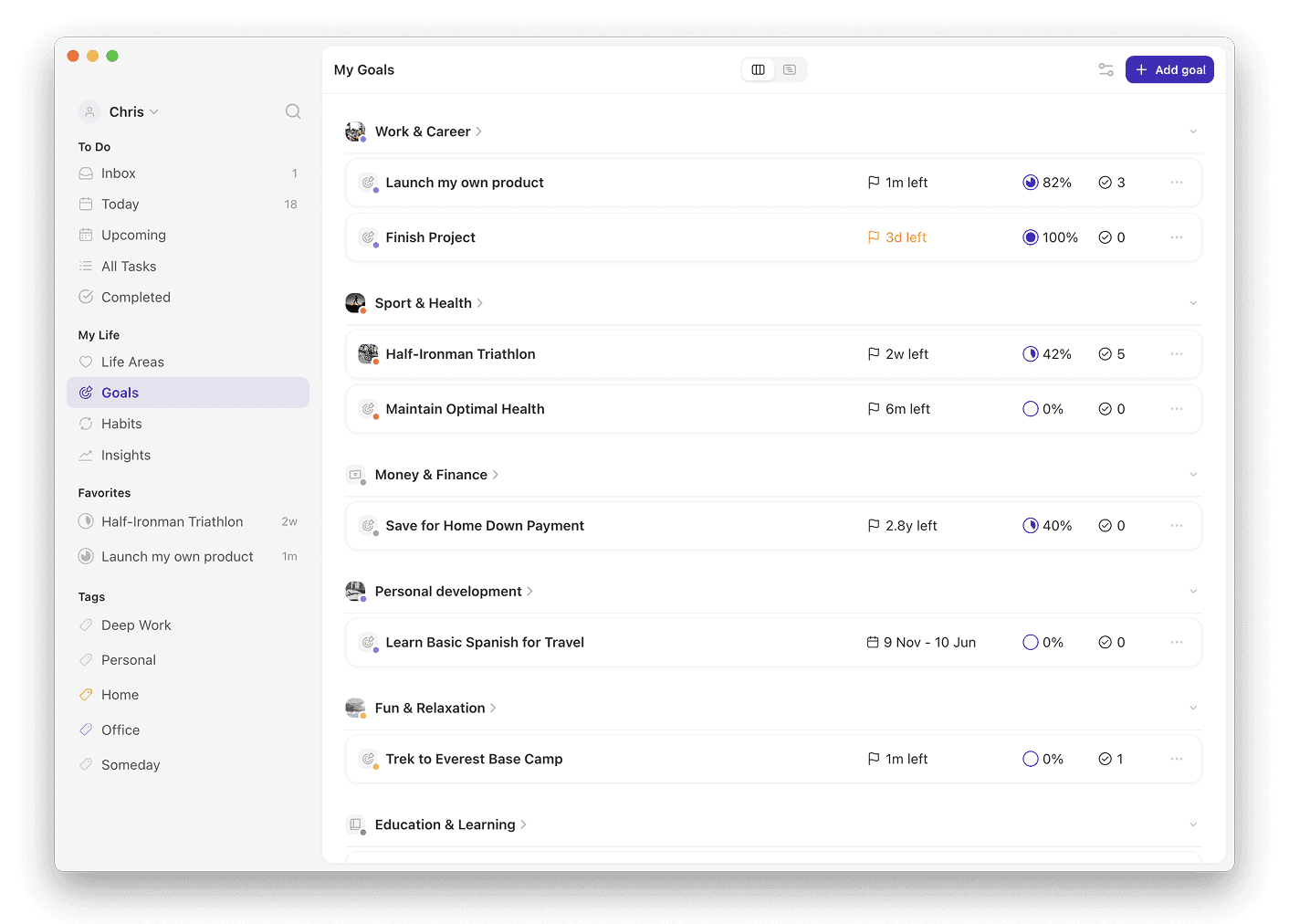
The hard part is rarely the plan. It is keeping 30 days of sets in one place and seeing your max climb. In Griply the whole challenge becomes one template under your Sport & Health life area:
Goal: Do a 30-day push-up challenge (metric: Unit-based, reps, your baseline to your target)
Habit: Push-up sets (schedule: 5 days a week)
Task: day 1, test your max
Task: note your reps at the end of weeks 1, 2, and 3
Task: day 30, retest your max
The daily habit does the work, and you log your max at the day-1 test and the day-30 retest, so the progress line climbs from your baseline to your new max. The Habit Tracker keeps the daily sets and the goal in one view, so the plan you just read becomes a template you can reuse for the next challenge. Habit targets and progress charts are part of Griply's paid plan; the free plan covers two goals and two habits.
Frequently asked questions
Is it OK to do push-ups every day?
Doing push-ups most days is fine if you keep the sets submaximal and take at least one or two rest days a week. The rest days let your muscles recover and adapt, which is where the strength gains come from.
How many push-ups a day should a beginner start with?
Start from your own max. If you can do 12 clean reps, four sets of five or six a session is plenty in week one. Building from your baseline keeps the challenge steady and doable.
Can you get stronger from a 30-day push-up challenge?
Yes. Push-ups build real upper-body strength, and progressing your reps over a month raises your max. The gain is bigger for beginners, and it lasts as long as you keep training after the 30 days.
What if you cannot do a single full push-up yet?
Start with an easier version. Do wall push-ups, then incline push-ups with your hands on a bench, then knee push-ups, and lower the surface each week. Most starting points reach the floor by the end.
How do you avoid a plateau during the challenge?
Keep two or three reps in reserve so you are not maxing out daily, and take your rest days. If your reps stall, add an extra rest day and drop back to a lighter session before building again.
Day 30 is the point
A push-up challenge works when it scales to you: test your max, train near-daily sets anchored to it, rest twice a week, and retest at the end. Each week asks for a little more than the last, and the two rest days turn that work into strength.
When you retest on day 30 and the number beats the one you wrote down on day one, that gap is your proof. Every session is one small deposit toward it, which is what keeps the daily set worth doing on the days you would rather skip. It also leaves you with a repeatable habit you can point at the next goal, whether that is more reps, a harder variation, or a different movement. The same test-train-retest loop powers the rest of your strength goals.
Related Goal Plans


Related Guides
Plotkin D, Coleman M, Van Every D, et al. "Progressive overload without progressing load? The effects of load or repetition progression on muscular adaptations." PeerJ, 2022. https://pmc.ncbi.nlm.nih.gov/articles/PMC9528903/
Kikuchi N, Nakazato K. "Low-load bench press and push-up induce similar muscle hypertrophy and strength gain." Journal of Exercise Science & Fitness, 2017. https://pmc.ncbi.nlm.nih.gov/articles/PMC5812864/
Keefe G, Wright C. "An intricate balance of muscle damage and protein synthesis: the key players in skeletal muscle hypertrophy following resistance training." The Journal of Physiology, 2016. https://pmc.ncbi.nlm.nih.gov/articles/PMC5157116/
Gollwitzer PM, Sheeran P. "Implementation Intentions." National Cancer Institute, Health Behavior Constructs, 2008. https://cancercontrol.cancer.gov/sites/default/files/2020-06/goal_intent_attain.pdf