

Table of Contents
Changing careers means moving into a different field or role, usually by mapping the skills you already have to a new target, closing the gaps that remain, and running a deliberate job search over several months. If you are asking how to change careers, the most useful shift is to treat it as a project you plan and track, one you break into concrete steps and work through week by week. Most people stall because the whole thing feels like one giant leap. It is really a sequence of smaller, doable steps: figure out where you are going, audit what transfers, talk to people who already do the job, close your biggest skill gap, and start applying. A specific plan with set times beats a vague wish to switch, because if-then plans that tie an action to a time and place raise your odds of following through. The steps below take you from where you are to your first offer.
Key takeaways
A career change is a project you can plan, break into steps, and track.
The core steps: define the target, audit your skills, network, close the gap, apply.
It usually takes three to nine months, so a weekly session keeps it moving.
In Griply you set the change as one goal, add the steps as tasks, and keep a weekly habit.
The plan, step by step
Here is the whole plan before you start. The steps run across one career change, so you always know what to have done and roughly when.
Step | What to have done | Rough time |
|---|---|---|
1. Define the target | Must-haves written down and 2 to 3 target roles named | Week 1-2 |
2. Audit your skills | Your transferable skills mapped to those roles | Week 2 |
3. Talk to people | 5 informational chats with people in the field | Weeks 2-5 |
4. Close the gap | Your biggest skill gap being closed with a course or project | Months 2-4 |
5. Rebuild your CV | CV and profile rewritten for the target role | Month 3 |
6. Apply | First applications sent, interviews underway | Months 3-6 |
A career change usually runs three to nine months, sometimes longer if you need to retrain. The steps overlap, so you can research target roles while you talk to people and close a skill gap. Giving each step a concrete action turns "switch careers" into a plan you can run.
Why it feels risky
A career change can feel risky because you are trading a role you know for one you have not done yet, and the outcome depends partly on employers you cannot control. The change is more common than it feels. The average American worker holds about 12.9 jobs between ages 18 and 58, and many of those shifts cross into new fields, so a change sits closer to normal than to reckless.
The new title is the outcome you want, and the steps you take are the process. It helps to map the path backwards from the role you want to the moves that get you there, so a month without an offer still counts as progress through the plan. You cannot control who says yes. You can control whether you have done the research, built the network, and sent the applications by the time the right role opens.
How to do each step
You do not need every answer before you start. Work the steps roughly in order, and let each one sharpen the next. Here is how to do each.
Define what you're moving toward
Before you audit anything, get specific about the destination. Write down your must-haves (a pay floor, remote or on-site, the kind of work you want to do more of) and your dealbreakers. Then name two or three target roles by their real job titles, the ones you would actually apply for. If you are unsure what exists, read job postings in fields that interest you and note the titles that keep coming up. Concrete titles like "junior data analyst" give you something to plan toward and research.
Audit your transferable skills
Transferable skills are the abilities you can carry into a new field without starting from zero, like project management, writing, data analysis, or client relationships. List the skills your current work has built, then compare them against the requirements in your target job postings. How realistic a change is depends on how much your existing skills overlap with the destination role, and how much retraining would bridge the gap. Mark each requirement as "have it", "partly have it", or "gap", so you can see exactly what stands between you and the role.
Talk to people who do the job
An informational chat is a short, low-pressure conversation with someone who already does the work you want, where you ask about the day-to-day, the path in, and the skills that actually matter. Aim for five of them. Find people through your existing network first, then looser acquaintances and second-degree connections on LinkedIn, since weaker ties tend to open more new-job doors than your closest contacts. Ask for twenty minutes, come with three or four specific questions, and end each chat by asking who else you should talk to. Building these relationships is a plan in itself, so it pays to grow your professional network well before you need it.
Close your biggest skill gap
Take the biggest "gap" from your skills audit and close it with one concrete step: a course, a certificate, or a small real project you can show. Pick the single gap that shows up most often in your target job postings, so your effort maps straight onto what employers screen for. Give it a deadline and a visible output, like a finished course certificate or a portfolio piece. One closed gap you can point to beats three half-started courses.
Rebuild your CV and profile
Rewrite your CV and LinkedIn around the target role, leading with the transferable skills and results that matter for the new field. Translate your old job into the new field's language: describe what you did in terms the target role recognises, and put numbers on your results. Mirror the words from the job postings you are targeting, since the first read is often a keyword scan. Have one person already in the field check it before you send.
Apply and start interviewing
Start applying once your CV is rewritten and one skill gap is visibly closing. Do not wait until you feel fully ready, because you sharpen your pitch through real applications and interviews. Send a first batch of five, track what you hear back, and adjust your CV and pitch based on the responses. Warm applications through someone you met in an informational chat tend to move faster than cold ones.
Build the habit
The research, outreach, and applications happen over months, so a weekly session is the engine that keeps the change moving. Once a week, block sixty to ninety minutes for your career change and split it across the active steps: research a target role, send one or two outreach messages, work on your skill gap, or send applications. A repeatable cue, routine, and reward loop for that session keeps momentum between the bigger milestones.
Here is what one session looks like: ten minutes reviewing where you are, thirty minutes on your current main step (outreach or the skill gap), and the rest on applications or CV tweaks. Keep it the same day and same time each week, so it becomes a fixed appointment you protect like any other.
Common mistakes
A few patterns stall most career changers:
Waiting to feel ready before you talk to anyone or apply. Start now.
Trying to switch on skills alone, with no network in the new field.
Chasing three courses at once. Close one clear gap you can show.
Sending the same generic CV everywhere. Rewrite it for each target role.
Keeping the search a secret, so no one can refer you.
Treating the whole thing as one leap, so you never take the first small step.
Set it up in Griply
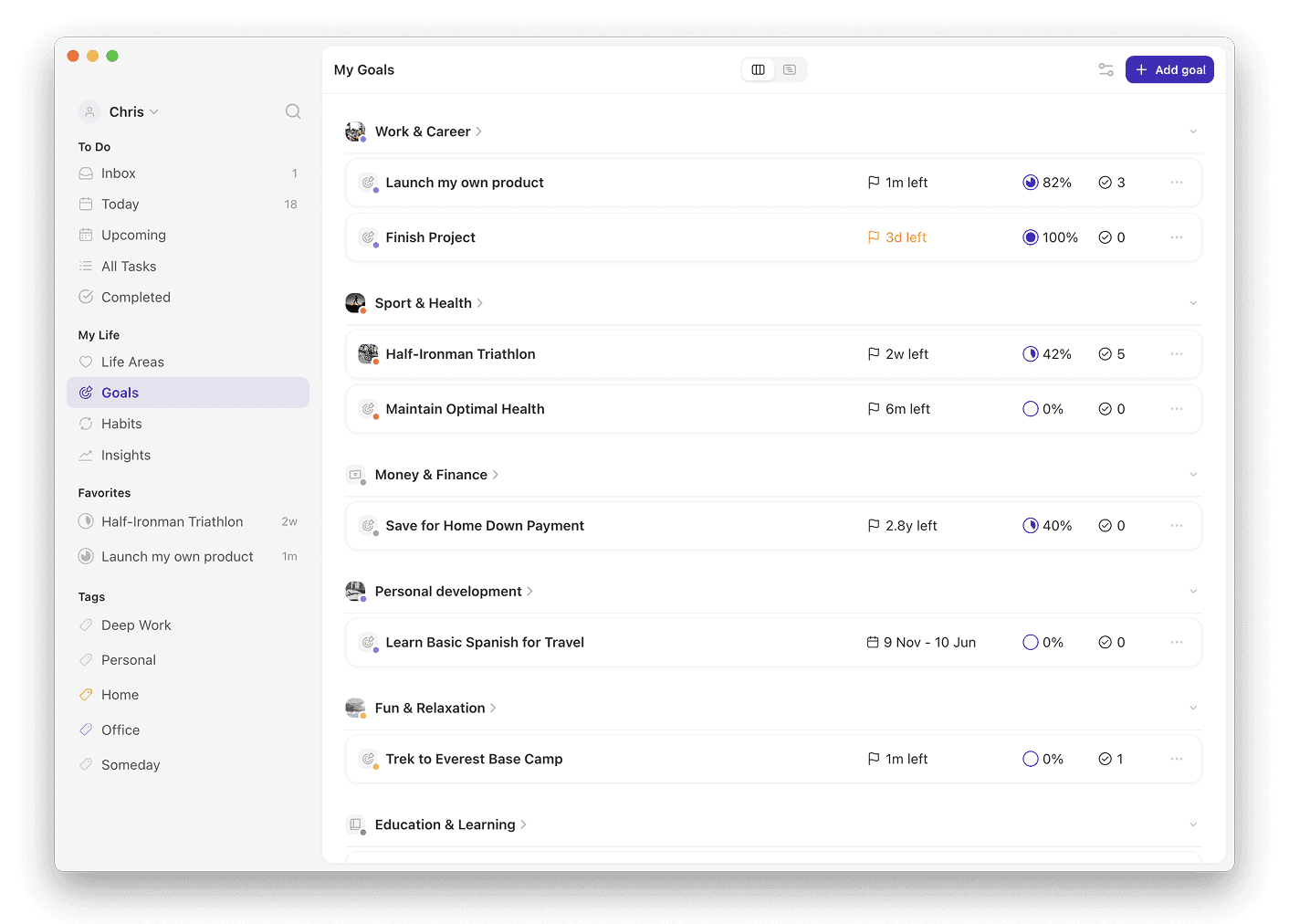
The hard part is rarely knowing the steps. It is holding them in one place and seeing how much of the change you have actually built. In Griply the whole plan becomes one scannable template under your Work & Career life area:
Goal: Change careers (metric: Subgoals, average)
Subgoal: target field and roles defined
Subgoal: transferable skills audited against those roles
Subgoal: informational chats (0 to 5)
Subgoal: biggest skill gap closed with a course or project
Subgoal: CV and profile rewritten for the target role
Subgoal: applications sent (0 to 5)
Habit: Career-change session (schedule: once a week)
You advance each milestone as you build it, so the progress line averages your six milestones and climbs from your first chats and prep, well before you send an application. The Goal Planner keeps the goal, its milestones, and the weekly session in one view, so the plan you just read becomes a template you can reuse. Subgoals, habit targets, and progress charts are part of Griply's paid plan; the free plan covers two goals and two habits.
Frequently asked questions
How long does it take to change careers?
Usually three to nine months from first research to a new offer, though it varies with the field and how much retraining you need. A weekly session keeps it moving. If the new role needs a formal qualification, plan for longer.
Is it too late to change careers at 40 or 50?
No. People change careers well into their forties and fifties, and the average worker holds around a dozen jobs across their working life. Your experience is an asset: lead with the transferable skills and judgement your years have built.
How do you change careers with no experience in the new field?
Lead with your transferable skills, then close the most common gap with one course or a small project you can show. Informational chats with people in the field tell you which skills actually matter, so you spend effort where it counts.
What is the first step to changing careers?
Get specific about the destination. Write your must-haves and dealbreakers, then name two or three target roles by their real job titles. A concrete target turns a vague wish to switch into something you can research, plan, and act on.
How do you change careers without a big pay cut?
Target roles that reuse your existing skills, since a smaller skill gap usually means a smaller pay drop. Negotiate using the value your experience brings, and treat any dip as short term while you rebuild seniority in the new field.
Start with the first step
A career change is a sequence of steps you can start this week: get specific about the target, audit what transfers, and book your first informational chat. None of those need permission or perfect timing to begin. A change like this sits within your wider work and career plans.
When your target roles are named, your skills are mapped, and a few people in the field know you are looking, the change stops feeling like a gamble and becomes a plan you are working through. Keep the weekly session, close one gap at a time, and apply when your CV is ready. If one attempt does not land, you have a clear list of what to strengthen for the next, with no mystery about why.
Related Goal Plans


Related Guides
Gollwitzer PM, Sheeran P. "Implementation Intentions." National Cancer Institute, Health Behavior Constructs, 2008. https://cancercontrol.cancer.gov/sites/default/files/2020-06/goal_intent_attain.pdf
U.S. Bureau of Labor Statistics. "Number of Jobs, Labor Market Experience, Marital Status, and Health: Results from a National Longitudinal Survey." 2023. https://www.bls.gov/news.release/nlsoy.htm
Bechichi N, Grundke R, Jamet S, Squicciarini M. "Occupational Mobility, Skills and Training Needs." OECD Science, Technology and Industry Policy Papers No. 70, 2019. https://www.oecd.org/content/dam/oecd/en/publications/reports/2019/04/occupational-mobility-skills-and-training-needs_baa97008/30a12738-en.pdf
Rajkumar K, Saint-Jacques G, Bojinov I, Brynjolfsson E, Aral S. "A Causal Test of the Strength of Weak Ties." Science, 2022. https://news.stanford.edu/stories/2022/09/real-strength-weak-ties