

Table of Contents
Improving your work-life balance means setting a few repeatable boundaries around work, a fixed stop time, protected time off, and real breaks, so your job stops crowding out the rest of your life. If your evenings keep filling with email and your weekends never feel off, the problem is rarely a lack of willpower. It is that nothing marks where work ends.
Most people try to fix this by resolving to work less, then slide back the first busy week. A few concrete boundaries work better. You pick a time work stops, protect one block that is off-limits, and hold those most days until they become normal. This plan lays out the levers that matter and how to start each one. Better balance is one of your work and career goals worth planning deliberately. It is for ordinary overwork. If you are facing burnout or a mental-health crisis, speak to a doctor, since these habits are not a treatment for a medical condition.
Key takeaways
Better work-life balance comes from a few daily boundaries held most days, above all a firm stop time.
A shutdown ritual, protected time off, ruthless priorities, and real breaks all move the needle.
If work keeps following you home, turn off after-hours notifications and agree your hours with your manager.
In Griply you set better work-life balance as one goal, attach a shutdown habit and a breaks habit, and rate it weekly.
The levers at a glance
These are the levers that shape your work-life balance. You do not need all of them at once, so start with a firm stop time and a shutdown ritual, then layer on the rest. Giving your balance a number to track, like a weekly rating or the evenings you kept work-free, makes progress visible.
Lever | What to aim for | How to start |
|---|---|---|
Set clear work hours | A fixed start and stop time you keep most days | Pick a stop time and block it in your calendar |
Run a shutdown ritual | A 10-minute end-of-day routine every workday | Write tomorrow's top three, tidy up, close the laptop |
Turn off after-hours notifications | No work pings after your stop time | Mute work email and chat apps on your phone after hours |
Protect time off | One evening or day each week fully off work | Block it, and tell people you are offline then |
Prioritise ruthlessly | Three important tasks a day, finished first | Each morning pick the three that matter, do those first |
Take real breaks | A proper lunch and short breaks away from the screen | Leave your desk for lunch, step away once an hour |
Why it feels hard
You cannot shrink your workload by force, and pushing harder tends to make the imbalance worse. What you can change are the boundaries around work. Working 55 or more hours a week measurably raises your risk of heart disease and stroke, which is why a firm stop time is the first lever to fix.
The balanced life is the outcome you want. The daily boundaries are the process, and keeping the two separate is what stops one busy week from undoing the plan. You cannot control how much work lands on your desk. You can control when the workday stops.
The levers, one by one
Start with the first two levers, then add the rest over a couple of weeks. A simple order: week one, set a stop time and a shutdown ritual; week two, turn off after-hours notifications and protect one evening; week three, tighten your daily priorities and fix your breaks. They reinforce each other, so each one you hold makes the next easier.
Set clear work hours
Pick a time work starts and a time it stops, and treat the stop time as fixed as a meeting. Block it in your calendar so the last hour is not swallowed by one more task. If your hours are unpredictable, agree a default with your manager: the times you are reachable and the times you are not.
Run a shutdown ritual
A shutdown ritual is a short, repeatable sequence that marks the end of the workday, so your brain gets a clear signal to stop. For about ten minutes before you log off, write down tomorrow's top three tasks, clear your inbox to a rough zero, tidy your desk, and close the laptop. Mentally switching off from work in the evening lowers emotional exhaustion, and the ritual is what makes that switch happen at the same time each day.
Turn off after-hours notifications
The single change that protects your evenings most is silencing work. Mute work email and chat on your phone after your stop time, or set a downtime schedule so those apps go quiet on their own. Checking work on your phone in the evening measurably harms your ability to detach, so reaching work after hours takes a deliberate action, a tap you have to mean.
Protect time off
Pick one evening or one weekend day each week that is fully off-limits to work, and defend it like an appointment. Block it, tell the people who might message you, and put your laptop out of sight. A single reliably protected block does more for recovery than a vague plan to relax more, because you know it is coming and can rest into it.
Prioritise ruthlessly
A long day usually means a long list, so cut the list before you cut your evening. Each morning, pick the three tasks that genuinely matter and do those first, before meetings and email. When the important work is done by mid-afternoon, stopping on time stops feeling like falling behind. Say no, or "not this week," to work that does not fit the three.
Take real breaks
Working through lunch and skipping breaks feels productive and quietly drains you. Short breaks away from a task reliably restore energy and reduce fatigue, so leave your desk for lunch and step away for a few minutes each hour. A break means changing what your eyes and mind are doing, so a walk or a coffee away from the screen counts, and scrolling a work channel does not.
Build the habits
Boundaries only work when they repeat, so the two habits worth locking in first are your stop time and your shutdown ritual. Once those hold, protecting an evening and taking real breaks get easier. A repeatable cue, routine, and reward loop for your shutdown, like the same three steps at the same time each day, is what turns a good intention into a routine your body expects. Anchor it to something already fixed, like your commute or the end of your last meeting, so it fires without a decision.
Common mistakes
A few habits quietly undo the rest:
Keeping email on your phone after hours. If the pings still arrive, the boundary is only a hope, so mute the apps after your stop time.
Waiting for a quiet week to start. The quiet week rarely comes, so set the stop time now and hold it through a busy one.
Protecting time off in your head only. Block it in your calendar and tell people, or work will fill it.
Confusing a full day with a productive one. Cut the list to three real priorities so finishing on time is possible.
Skipping lunch to get ahead. Working through breaks lowers your energy for the afternoon, so the desk hours cost you more than they save.
Trying to fix every lever at once. Start with the stop time and the shutdown, then add the rest over a couple of weeks.
Set it up in Griply
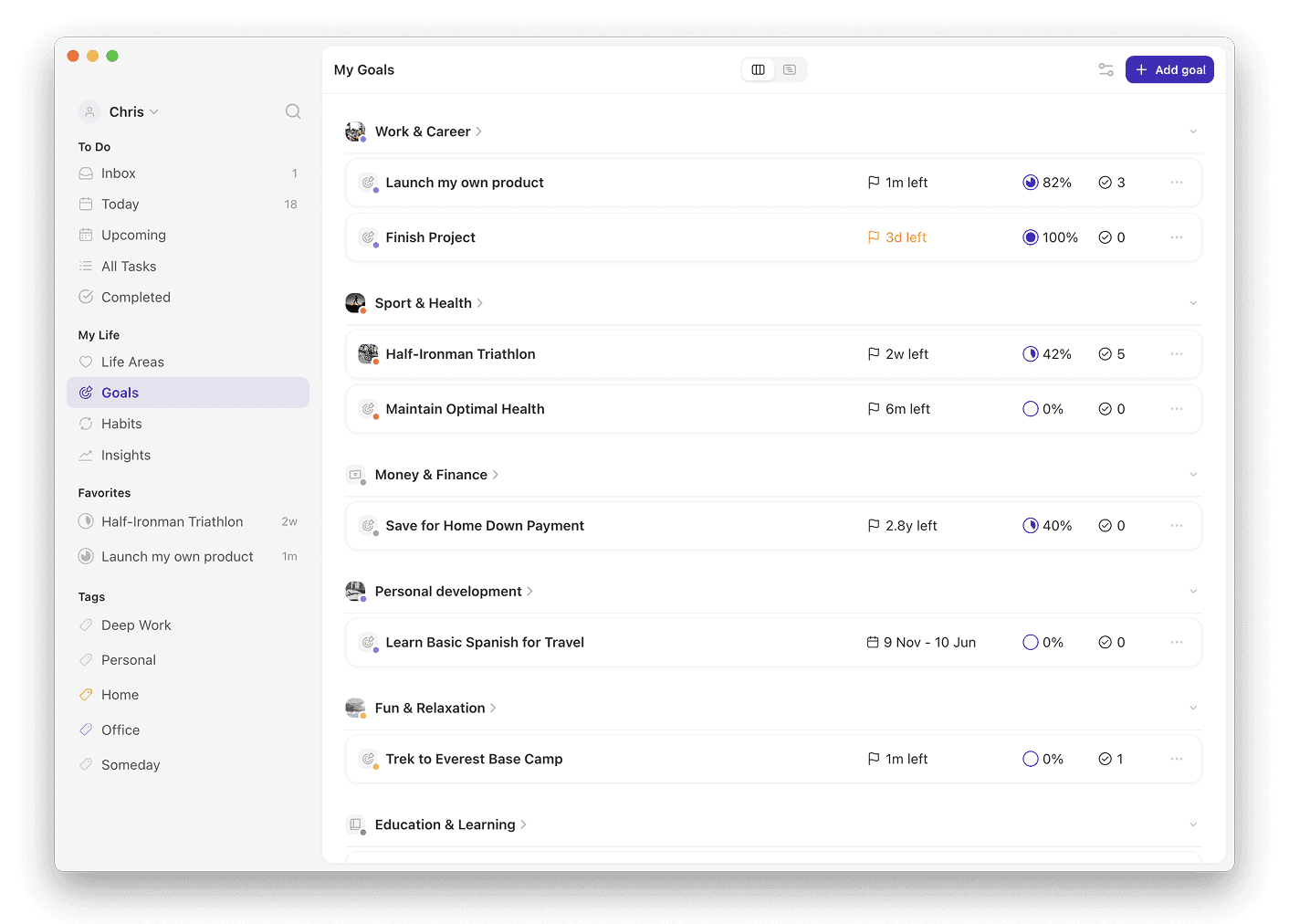
The hard part is rarely knowing what to change. It is holding the boundaries in place week after week and seeing whether your balance is actually improving. In Griply the whole plan becomes one template under your Work & Career life area:
Goal: Better work-life balance (metric: Unit-based, self-rated score 4 to 8)
Habit: Stop work and run a 10-minute shutdown ritual (schedule: every workday)
Habit: Take a real lunch break away from your desk (schedule: every workday)
Habit: Plan tomorrow's top three before you log off (schedule: every workday)
Habit: Keep one evening or day fully off work (schedule: weekly)
Task: turn off work notifications after your stop time
Task: agree your working hours and reply times with your manager
You rate your balance once a week, and the progress line climbs toward your target and turns green when you hold it. The Habit Tracker keeps the goal, its habits, and your setup tasks in one view, so the plan you just read becomes a template you can keep. Habit targets and progress charts are part of Griply's paid plan; the free plan covers two goals and two habits.
Frequently asked questions
What is a healthy work-life balance?
A healthy work-life balance is one where work fits inside boundaries you set, so it does not routinely spill into your evenings, weekends, and rest. It looks different for everyone. The practical test is whether you can stop work most days and recover before the next one.
How do I set boundaries with work?
Pick a fixed stop time and treat it like a meeting, mute work notifications on your phone after it, and protect one evening or day each week. Agree your default hours and reply times with your manager, so people know when you are reachable and when you are not.
What are signs of poor work-life balance?
Common signs are checking email late into the evening, never feeling off on weekends, skipping lunch and breaks, and struggling to switch off from work in your head. Constant fatigue and a sense that work has crowded out everything else are the clearest ones.
Can you have work-life balance in a demanding job?
Yes, though it takes firmer boundaries. Agree your reachable hours with your manager, protect at least one block each week, and be ruthless about your daily priorities. You may not control your workload, but you can control your stop time and whether work follows you onto your phone.
How long does it take to improve work-life balance?
Give it a few weeks. A stop time and a shutdown ritual can change your evenings within days, while the fuller picture, protected time off and steady breaks, settles over about a month of holding the boundaries most days. Tracking a weekly rating keeps the progress visible.
Start with one boundary
Better work-life balance is not about one grand change. It is about a few boundaries held most days: a firm stop time, a shutdown ritual, protected time off, tighter priorities, and real breaks. Each one you hold makes the next easier, so you do not have to fix everything at once. The same steadiness helps when you are working toward a promotion, because a rested week is a sharper one.
When work stops at a set time and your phone goes quiet after it, your evenings stop belonging to your job. Start with the stop time this week, add the shutdown ritual, and rate your balance every Sunday. Watch that number climb as the boundaries become normal, and add the next lever once the first one holds.


Related Guides
Pega F, Náfrádi B, Momen NC, et al. "Global, regional, and national burdens of ischemic heart disease and stroke attributable to exposure to long working hours for 194 countries, 2000-2016: A systematic analysis from the WHO/ILO Joint Estimates of the Work-related Burden of Disease and Injury." Environment International, 2021. https://pmc.ncbi.nlm.nih.gov/articles/PMC8204267/
Wu Q, Qi T, Wei J, Shaw A. "Relationship between psychological detachment from work and depressive symptoms: indirect role of emotional exhaustion and moderating role of self-compassion." BMC Psychology, 2023. https://pmc.ncbi.nlm.nih.gov/articles/PMC10585803/
Van Laethem M, van Vianen AEM, Derks D. "Daily Fluctuations in Smartphone Use, Psychological Detachment, and Work Engagement: The Role of Workplace Telepressure." Frontiers in Psychology, 2018. https://pmc.ncbi.nlm.nih.gov/articles/PMC6166396/
Albulescu P, Macsinga I, Rusu A, Sulea C, Bodnaru A, Tulbure BT. "'Give me a break!' A systematic review and meta-analysis on the efficacy of micro-breaks for increasing well-being and performance." PLOS ONE, 2022. https://journals.plos.org/plosone/article?id=10.1371/journal.pone.0272460