

Table of Contents
Journaling is the practice of writing down your thoughts, feelings, and reflections on a regular basis, usually for a few minutes at a time. To start journaling, you pick a fixed time and place, choose one simple method like freewriting or a daily prompt, and keep each entry short enough that you come back to it tomorrow. The blank page is what stops most people, so the plan below removes the guesswork: a set time, a method to follow, and a length you can hit on a busy day. Writing regularly about what is on your mind has measurable benefits for your mental and physical health, which is why a five-minute habit is worth protecting. This plan gives you a starting method, a handful of prompts, and a way to track the days you show up, so journaling turns into a daily habit you keep.
Key takeaways
Journaling sticks when you keep entries short and tie them to a fixed daily time.
Pick one method to begin: freewriting, a daily prompt, gratitude, or a short reflection.
A few starter prompts remove the blank-page problem on the days you feel stuck.
In Griply you run journaling as a daily habit toward a 30-day goal.
The plan at a glance
Here is the whole plan before you start. Pick a time, pick a method, keep it short, and track the days you write.
Step | What to aim for | How to start |
|---|---|---|
Pick a time | A fixed five-minute slot each day | Tie it to a routine you already have |
Pick a tool | One notebook or app you open daily | Keep it where you will see it |
Choose a method | One style to begin with | Freewriting, a prompt, gratitude, or reflection |
Keep it short | Five minutes or three lines | Set a timer and stop when it rings |
Track it | A mark for every day you write | Check off the habit and count the day |
Give it about two weeks to feel automatic. You can switch methods any day, so treat the table as a starting point and adjust the order to suit you.
Why it feels hard
Journaling feels hard because the payoff is small at first and the blank page asks you to perform. There is no score at the end, so it is easy to skip on a busy night. Naming the real obstacle helps: most people quit because they aim to write pages, judge the first sentence, or treat one missed day as failure.
Feeling clearer is the outcome you want. Sitting down to write is the daily habit that gets you there, and knowing how a habit differs from the goal it serves is what turns a vague intention into a routine you can keep. Giving the habit a set length and a number you track makes a missed day obvious early, which keeps you honest on the nights you would rather skip.
How to journal
Start with one method and stick with it for a week before you try another. Each one below takes about five minutes, so pick the one that gets you writing today.
Freewriting
Freewriting means writing whatever is in your head without stopping to edit or judge it. Set a timer for five minutes and keep your pen moving, even if you write "I don't know what to write" until something surfaces. Spelling and grammar do not matter here. The point is to get thoughts out of your head and onto the page.
Prompt journaling
A prompt is a question or sentence starter that gives you something to answer, so you never face a blank page. Keep a short list and pick one each day. Good starters: what is on my mind right now, what went well today, what am I avoiding and why, and what would make tomorrow feel like a good day.
Gratitude journaling
Gratitude journaling means writing down a few specific things you are grateful for. People who keep a weekly gratitude list report better mood and fewer physical complaints than those who track hassles. Write three things and make them specific: a kind message from a friend beats "my friends" every time.
Reflection journaling
Reflection means looking back on what happened and drawing a lesson from it. Spending a few minutes writing about what you learned measurably improves how you perform next time, because putting the lesson into words fixes it. Ask what happened, how you handled it, and what you would do differently.
Build the habit
A daily entry sticks when writing becomes automatic. A repeatable cue, routine, and reward loop, like writing the moment you get into bed, carries the habit without willpower. Attaching journaling to something you already do every day, such as your evening tea or brushing your teeth, removes the effort of remembering. If you already sit for a few minutes of meditation, write your entry right after it while your mind is still settled. Keep the bar low: five minutes or three lines counts as a win, and a short entry beats a skipped day. If you miss a day, write the next one and move on, since one gap does not undo the streak.
Common mistakes
A few habits stall most beginners:
Trying to write pages on day one, which makes journaling feel like a chore. Keep it to five minutes.
Editing as you go, which stops the flow. Let the first draft be messy.
Waiting for the perfect notebook or app before you start. Any paper works today.
Treating one missed day as a failure and quitting. Just write the next day.
Only writing when you feel inspired. The daily habit is what makes the insight show up.
Set it up in Griply
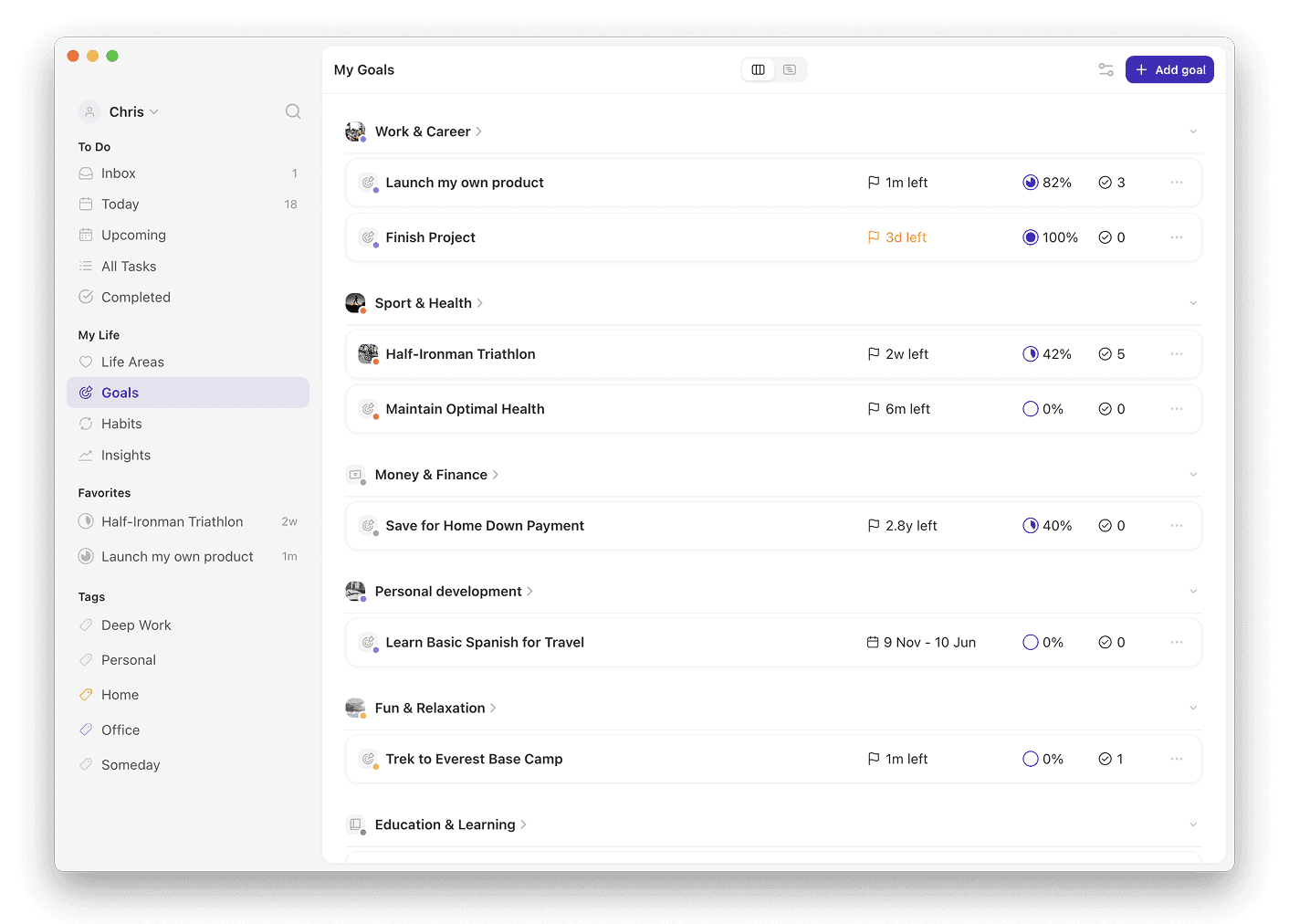
The hard part is rarely deciding to journal. It is remembering to write night after night and seeing whether it is becoming a habit. In Griply the plan becomes one simple template under your Personal Development life area:
Goal: Start journaling (metric: Unit-based, days on target, 0 to 30)
Task: pick your time and a notebook or app
Task: write three starter prompts on the first page
Habit: Write for five minutes (schedule: every evening)
The two setup tasks get you going, and the daily habit is the engine. You check off the habit each evening and count a day toward 30 every time you write, so the goal fills up as the habit sticks. The Habit Tracker keeps your daily entries and your run of on-target days in one view, so the plan you just read becomes a template you can reuse. Habit targets and progress charts are part of Griply's paid plan; the free plan covers two goals and two habits.
Frequently asked questions
How do you start journaling as a beginner?
Pick a fixed time, one notebook or app, and one method like freewriting or a daily prompt. Keep the first entries to five minutes or three lines. Starting small and at the same time each day is what makes the habit stick.
What should you write about in a journal?
Anything on your mind. If the page feels blank, use a prompt: what went well today, what you are avoiding, or three things you are grateful for. Freewriting, gratitude, and short reflections all work, so pick whichever gets you writing.
How often should you journal?
Daily is ideal for building the habit, and the entries stay short. A few minutes every evening beats a long session once a week. If daily feels like too much, start with three or four set days and grow from there.
Is journaling good for your mental health?
Yes. Writing regularly about your thoughts and feelings is linked to better mood and lower stress, and gratitude and reflection carry their own benefits. It is a simple daily support and works well alongside therapy or other help.
How long should you journal each day?
Five minutes is plenty to start. A short entry you write every day builds the habit faster than a long one you dread. As journaling becomes automatic, some days will run longer on their own.
Keep the entries short
Starting a journal comes down to three things: a fixed time, a method you can follow, and an entry short enough that you show up again tomorrow. You pick a slot, choose a prompt, and write for five minutes.
When writing the moment you get into bed becomes automatic, journaling stops taking any thought. Some evenings you will spill a page, and others you will manage three lines, and both count. Keep the notebook where you will see it, protect the five minutes, and let the daily habit carry the rest. A steadier mind supports the rest of your personal-development goals. The clearer head is what you get for showing up, and it arrives faster when the entries are small enough to repeat every day.
Related Goal Plans


Related Guides
Baikie KA, Wilhelm K. "Emotional and physical health benefits of expressive writing." Advances in Psychiatric Treatment, 2005. https://sparq.stanford.edu/sites/g/files/sbiybj19021/files/media/file/baikie_wilhelm_2005_-_emotional_and_physical_health_benefits_of_expressive_writing.pdf
Emmons RA, McCullough ME. "Counting blessings versus burdens: An experimental investigation of gratitude and subjective well-being in daily life." Journal of Personality and Social Psychology, 2003. https://greatergood.berkeley.edu/pdfs/GratitudePDFs/6Emmons-BlessingsBurdens.pdf
Di Stefano G, Gino F, Pisano GP, Staats BR. "Learning by Thinking: How Reflection Aids Performance." Harvard Business School Working Paper 14-093, 2014. https://papers.ssrn.com/sol3/papers.cfm?abstract_id=2414478