


Table of Contents
A Hyrox training plan works in phases: build your running base, learn the eight stations, then train the two together so you can run on tired legs. Hyrox is eight kilometres of running broken up by eight functional workout stations, so preparing for it means training endurance and strength side by side over eight to twelve weeks. Most people pick the part they enjoy and neglect the rest, then fall apart on race day. This plan structures the whole build, from your first base runs to a taper, so you arrive ready. If your running base is not there yet, a 10k training plan builds it first. Start by testing where your running and your stations are now.
Key takeaways
Hyrox is endurance-first, so your running fitness matters more than any single station.
The plan builds in phases: a running base, the eight stations, then compromised running that trains both at once.
Train three to four times a week for eight to twelve weeks, with one session that combines running and strength.
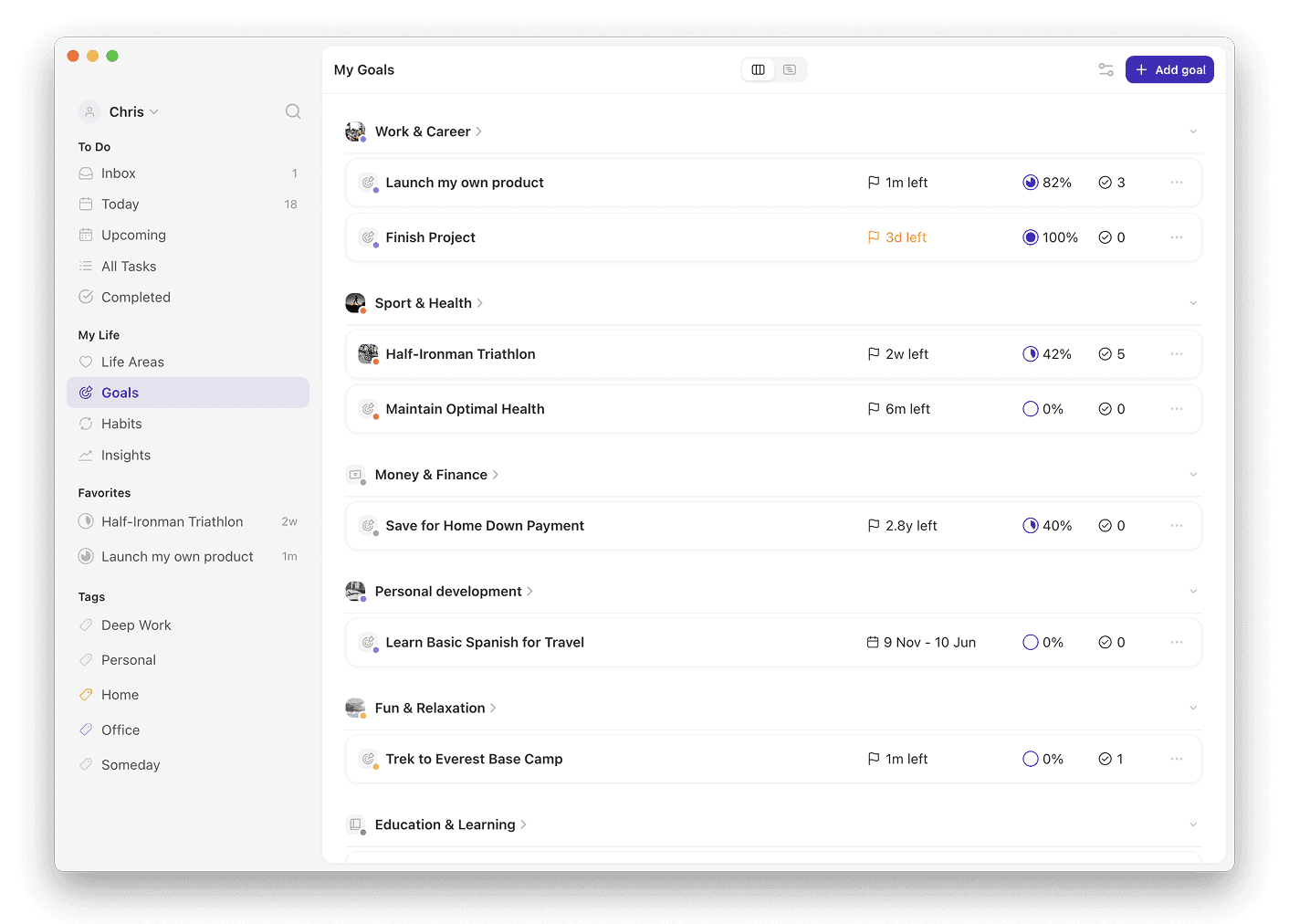
In Griply you set the race as one goal, add each session and setup step as a task, and attach a hybrid training habit.
The 12-week schedule
Here is the whole plan, ready to follow week by week. Before week 1, test your starting point: your longest continuous run, your 5k time, and a light try of a few stations. The build moves through five phases, base (weeks 1 to 3), build (4 to 6), sharpen (7 to 8), peak (9 to 11), and a taper (12), though you simply follow the weeks in order. The early weeks blend easy runs with light station practice, so your running base and your station skills grow together. Most beginners need the full twelve weeks; if you already run 5k and lift regularly, compress it to eight by shortening the base block to one week. In the final stretch, cutting your volume for the last 8 to 14 days while you keep the intensity is what leaves you fresh on race day.
First, what each session means, so there is no guesswork:
Easy run: the minutes shown at a conversational pace, one you can talk in full sentences at. With a heart-rate monitor, that is roughly zone 2, about 60 to 70 percent of your maximum heart rate.
Long run: the distance shown, also at that easy pace.
Strength: 3 to 4 rounds of 8 to 10 reps covering a squat, a lunge, a hip hinge, and a 40 m loaded carry. "Try stations light" means add the named Hyrox stations at an easy weight to learn the movement.
Compromised run: alternate a 1 km run with one Hyrox station, for the number of rounds shown. This trains running on tired legs, which is the whole point of Hyrox.
Race-pace intervals: the number of 1 km reps shown at your goal race pace, with 90 seconds of easy jogging between them.
Simulation: the rounds shown done in race order, so run, then station, then run, then station.
Then the week-by-week build. Do the four sessions in any order that fits your week (for example Monday, Tuesday, Thursday, and Saturday), keeping a rest day after the hardest ones.
Week | Session 1 | Session 2 | Session 3 | Session 4 |
|---|---|---|---|---|
1 | Easy run 30 min | Strength, then try the SkiErg and sled light | Long run 6 km | Easy run 30 min, then try 2 more stations light |
2 | Easy run 30 min | Strength, then try the rower and farmers carry light | Long run 7 km | Easy run 35 min, then try 2 more stations light |
3 | Easy run 35 min | Strength, then run all 8 stations once at a light weight | Long run 8 km | Easy run 35 min |
4 | Easy run 35 min | Strength, heavier | Long run 8 km | Compromised run: 3 rounds of 1 km + 1 station |
5 | Easy run 40 min | Strength, heavier | Long run 8 km | Compromised run: 4 rounds of 1 km + 1 station |
6 | Easy run 40 min | Strength, add sled push and sled pull | Long run 8 km | Compromised run: 4 rounds of 1 km + 1 station |
7 | Race-pace intervals: 4 x 1 km | Strength | Long run 8 km | Compromised run: 5 rounds of 1 km + 1 station |
8 | Race-pace intervals: 5 x 1 km | Strength | Long run 8 km | Compromised run: 5 rounds of 1 km + 1 station |
9 | Easy run 30 min | Strength, light | Half-Hyrox: 4 rounds of 1 km + 2 stations, race order | Easy run 30 min |
10 | Easy run 30 min | Strength, light | Full or half simulation in race order | Easy run 30 min |
11 | Race-pace intervals: 4 x 1 km, your last hard session | Easy run 30 min | Easy run 30 min | Rest |
12 | Easy run 20 min | Easy run 20 min with 4 x 20 sec strides | Rest | Race day |
Move on a week early if it feels easy, and repeat a week if it does not. The long run and the weekly compromised run are the two sessions you protect first.
Why it feels hard
A Hyrox is eight kilometres of running broken up by eight heavy functional stations, so it punishes anyone who trains only one side. The race is endurance-dominant, and your running fitness is the single biggest predictor of your finish time, yet every station leaves your legs and lungs compromised for the run that follows.
Finishing is the outcome you want. The training blocks are the process, and holding the outcome and the daily work apart is what stops you panicking when one workout goes badly. You cannot control how you feel on race day. You can control whether you have trained the runs, the stations, and the two together.
How to train each station
Drill each station at a light load before you push it, and advance only when your form holds. Strength work also makes your running more efficient, so the squats and carries below pay off twice. Giving each station a benchmark tells you when it is race-ready.
SkiErg, 1000m
Hinge at the hips and pull with your whole body, so your legs and lats share the load with your arms. Settle into a pace you can repeat, since this comes early and sets up the run after it.
Sled push, 50m
Keep a low body angle with your arms long, and drive through your legs with short, quick steps. Grind it out; the sled rewards steady effort.
Sled pull, 50m
Pull hand over hand with your hips back, leaning your weight away from the sled. Reset your feet if you stall, and let your back and legs do the pulling.
Burpee broad jumps, 80m
Chest to the floor, then jump forward to cover ground while staying low. Control your breathing, because this station spikes your heart rate fast.
Rowing, 1000m
Drive legs, then core, then arms, with a strong leg push and a steady stroke rate. Keep it smooth; a frantic row costs you the next run.
Farmers carry, 200m
Brace your core and move with a fast turnover. Grip is the limiter here, so train heavy carries in your strength sessions.
Sandbag lunges, 100m
Rest the bag on your upper back and lunge to full depth so your back knee taps down. Stay upright and take small breaks before your form breaks.
Wall balls, 100 reps
Squat to depth and hit the target height every rep, catching and going. Plan your rep breaks before you start, since 100 unbroken is rare.
Build the habit
The plan runs on a hybrid habit: you run and lift across the same week, three to four sessions, with one that combines them. When you train both in a single session, do the strength work before the endurance work for better strength gains. Finishing is the goal and the hybrid sessions are the habit beneath it, so treating the two as a pair, on a fixed Tuesday, Thursday, and Saturday, carries you through the twelve weeks when motivation dips.
Common mistakes
A few habits trip up most first-timers:
Running every session hard. It leaves you too tired to progress, so keep the easy runs genuinely easy and protect your rest days.
Drilling the stations while neglecting the runs. Your running decides your finish, so protect the weekly long run and the compromised run first.
Adding load or distance in big jumps. Grow the long run and the station weights a little at a time, so nothing spikes at once.
Skipping the compromised-running sessions. Running on tired legs is the specific skill Hyrox tests, and it is the one most people avoid.
Set it up in Griply
The hard part is rarely the plan. It is holding a running build, eight stations, and a taper in one place and seeing whether you are on track. In Griply the whole build becomes one template under your Sport & Health life area:
Goal: Finish a Hyrox (metric: Completed task count)
Task: each session and setup step as a task, grouped in a section per week
before week 1: sort out gym or kit access, register, and test your baseline
week 1, session 1: easy run 30 min
week 1, session 2: strength, then try the SkiErg and sled light
and so on, through the week 12 taper and race day
Habit: Hybrid training, runs plus strength and a compromised run (schedule: 3 to 4 times a week)
You tick off each session as you complete it, so the progress line climbs across the twelve weeks and turns green when you have done the training and finished the race. The Goal Planner keeps the goal, its weekly sessions, and the training habit in one view, so the plan you just read becomes a template you can reuse for your next race. Habit targets and progress charts are part of Griply's paid plan; the free plan covers two goals and two habits.
Frequently asked questions
How long does it take to train for Hyrox?
Most beginners need eight to twelve weeks, depending on your starting running fitness and strength. If you can already run 5k and lift regularly, the shorter end is realistic. If you are new to either, give yourself the full twelve weeks.
Can a beginner do Hyrox?
Yes. Hyrox scales to your level, and there are divisions from first-timers to pros. A beginner who builds a running base, learns the eight stations, and practises the two together over a couple of months can finish comfortably.
How many days a week should you train for Hyrox?
Three to four sessions a week works for most people: two or three runs, one strength session, and one compromised run that trains running and stations together. Space them with a rest day or two between the hardest ones.
Do you need a gym for Hyrox?
A gym helps, since the sled, wall balls, and heavy carries need equipment. You can build the running base and some strength anywhere, but book gym access to practise the actual stations before race day.
How hard is Hyrox?
It is demanding but achievable with a plan. The challenge is running well on tired legs, since every station leaves you compromised for the next kilometre. Training compromised running is what makes race day manageable.
Train all three
A Hyrox finish comes from building in order: a running base first, then the eight stations, then the compromised running that ties them together. You cannot fake the endurance, and you cannot muscle through the runs without it, so the plan gives both their own blocks and then combines them.
When your base runs feel easy, your stations are clean, and you have finished a simulation, race day becomes a matter of steady pacing, and the distance takes care of itself. Run the first kilometre controlled, manage each transition, break the wall balls into sets you can hold, and let the training carry you home. The same block-by-block build works across the rest of your training goals.
Related Goal Plans


Related Guides
Brandt T, Ebel C, Lebahn C, Schmidt A. "Acute physiological responses and performance determinants in Hyrox, a new running-focused high intensity functional fitness trend." Frontiers in Physiology, 2025. https://pmc.ncbi.nlm.nih.gov/articles/PMC11994925/
Wang Z, Wang YT, Gao W, Zhong Y. "Effects of tapering on performance in endurance athletes: A systematic review and meta-analysis." PLoS ONE, 2023. https://pmc.ncbi.nlm.nih.gov/articles/PMC10171681/
Llanos-Lagos C, Ramirez-Campillo R, Moran J, Sáez de Villarreal E. "Effect of Strength Training Programs in Middle- and Long-Distance Runners' Economy at Different Running Speeds: A Systematic Review with Meta-analysis." Sports Medicine, 2024. https://pmc.ncbi.nlm.nih.gov/articles/PMC11052887/
Eddens L, van Someren K, Howatson G. "The Role of Intra-Session Exercise Sequence in the Interference Effect: A Systematic Review with Meta-Analysis." Sports Medicine, 2018. https://pmc.ncbi.nlm.nih.gov/articles/PMC5752732/