Guide


Table of Contents
To plan your goals for 2027, look back at 2026, choose two to four goals, make each one measurable, plan the first three months in detail and review the plan every week. The seven steps below take you through it in that order.
Setting goals for the new year works better than its reputation suggests. One study followed people for six months after New Year’s Day: 46% of those who made a resolution were still succeeding, compared with 4% of people with similar goals who made no resolution. The people who succeeded tended to feel ready and confident when they started. A written plan helps with both, whether you plan in December or in January.
Set aside one to two hours somewhere quiet, or spread the steps over a few evenings. Two example goals run through the whole guide: running a half marathon and growing a freelance income from $3,000 to $5,000 a month. Each step also shows where to set it up in Griply, our goal app, so by the end your 2027 plan is ready to track.
The 7 steps at a glance
Look back at 2026. Carry over, change or drop each unfinished goal.
Pick your top life areas. Rank them and write a short vision for each.
Choose two to four goals. For now, only write down what they are.
Make your goals measurable. Pick what to measure, then set a target and deadline.
Plan your first quarter. Add a milestone, habits, projects and tasks.
Check the plan fits your week. Compare the hours needed with your free hours.
Plan your first week. Then put weekly, monthly and quarterly reviews in your calendar.
Step 1: Look back at 2026 before you plan 2027
The best guide to next year is what happened this year. Before you write a single goal, spend 30 to 60 minutes on three questions:
What went well in 2026, and why?
What didn’t work, and what got in the way?
What do you want more of in 2027, and what do you want less of?
For a fuller review of 2026, work through our 📘 End of year reflection: a guide to reviewing 2026, which covers every life area. If you only want prompts, pick a few from our 📘 101 end-of-year reflection questions, grouped by life area.
Then come back to this guide with your notes.
Next, list the goals you set for 2026 that you haven’t finished. For each one, decide: carry it into 2027, change it, or drop it. If you carry a goal over, give it a new plan in the steps below. A goal you carry over unchanged usually fails again for the same reason.
Step 2: Pick the life areas that matter most in 2027

Life areas are the main parts of your life: work and career, health, money, relationships, family and friends, personal growth, and fun. Write down the ones that apply to you, then rank them for 2027. Your top two or three are where most of your goals will come from.
For each of those, write a short vision: two or three sentences about where you want that part of your life to go. A vision has no number or deadline. It gives you a direction to check your goals against. In Griply, each life area has its own vision page, and our help article explains how to write a life vision.
Two examples. For work: “I choose the clients I work with, and my freelance business pays me a steady income.” For health: “I look after my body in a way I can keep up, so I stay fit and active for years.”
If you wrote a vision last year, reread it and check whether it still describes where you want to go.
Step 3: Choose two to four goals for 2027

Start with your top life area and ask where you want to be by the end of 2027. Then do the same for the next one. Aim for two to four goals in total. Every goal needs time each week, and Step 6 will show you how much time you actually have.
In this step you only decide what your goals are. Write each one down in a single line and leave it there for now. You’ll add the numbers in Step 4 and plan the work in Step 5.
A few guidelines:
If you’re new to goal setting, start with one goal you’re confident about.
Spread your goals over at least two life areas.
Write each goal as something to start doing.
The last one matters more than it looks. In a study of more than 1,000 people’s New Year’s resolutions, goals phrased as something to do succeeded more often than goals phrased as something to stop: 58.9% compared with 47.1% after a year. So “cook dinner at home four nights a week” is a better goal than “stop ordering takeout”.
The two examples become “run a half marathon” and “grow my freelance income”.
Stuck for ideas? Our list of personal goal examples for every life area has more than 25 to start from. For 68 more, each with a first step for January, see our new year goal ideas by life area.
Step 4: Make your goals for 2027 measurable

A goal you can measure tells you during the year whether you’re on track. For each goal, write down four things:
What you’ll measure, such as miles, clients, dollars or pages
Where you are today
Where you want to be
The deadline
For the half marathon, you measure your longest run: from 3 miles today to 13.1 miles by October 10, 2027. For the freelance goal, you measure monthly income: from $3,000 to $5,000 by December 31, 2027. Those four answers are the measurable and time-bound parts of SMART goals, and they’re what vague New Year’s resolutions leave out. In Griply they make up the goal’s success metric. Our help article on goals lists every kind of metric you can pick, from distance to money.
Choose a number that changes during the year, like your longest run or your monthly income. A goal you can only mark as done or not done in December gives you nothing to check in March. For areas like relationships or wellbeing, count what you do: “have dinner with a close friend twice a month” gives you a number to check. If a goal has nothing to measure, such as redecorating the bedroom, treat it as a project: a list of tasks you work through until it’s done.
Decide when each goal starts

Not every goal has to begin in January. Both example goals start right away, but a project like the bedroom could wait until spring. Spreading start dates across the year keeps January from getting overloaded. In Griply, the Timeline shows each goal and project as a bar from its start date to its deadline, so you can see when too many start in the same month.
Step 5: Break your first-quarter goals into milestones, habits, projects and tasks
Plan the first quarter, January to March, in detail and keep the rest of the year rough. You’ll know more in March than you do now, and you’ll repeat this step at each quarterly review.
Set a milestone for the end of March
A milestone is a smaller goal on the way to the big one, with its own number and date. In Griply that’s a subgoal, with its own progress chart inside the goal. For the half marathon: run 6 miles without stopping by March 31. For the freelance goal: sign two new monthly clients by March 31.
Add one or two habits
Ask what you need to do every week to make progress. For the half marathon, that’s running three times a week. For the freelance goal, it’s sending five pitches a week. Keep it to one or two new habits at a time, because starting five at once usually means keeping none. If you want an app to track them, see our comparison of the best habit tracker apps.
Group the bigger tasks into projects
Write down the one-off tasks each goal needs this quarter: choose a training plan, sign up for a spring 10K, update your portfolio, write a new rate card. Give each one a rough time estimate (30 minutes, 1 hour, 2 hours) and a deadline where one matters. Leave the small steps for now. You’ll add those when you plan each week.
When several tasks belong together, put them in a project. For example, a project called “Refresh my portfolio”, linked to the freelance goal, can hold the portfolio update, the new rate card and a new case study. Use a subgoal when the step has a result worth measuring, like 6 miles or two new clients. Use a project when it’s simply work to get through: it’s done when its tasks are done, and it doesn’t change the goal’s number. Our help article explains when to use a project.
Step 6: Check that the plan fits your week
Now that you have habits and tasks, estimate how many hours a week each goal needs. Running three times a week takes about four hours once you count getting changed and showering. Five pitches plus follow-ups might take two. Add up the hours for all your goals.
Compare that total with the time you actually have. Start from the 168 hours in a week and subtract sleep, work, commuting, meals, chores, family time and rest. Most people have fewer free hours than they expect, and new tasks usually take longer than planned. Leave room for weeks that go wrong. If you connect your Google or Outlook calendar to Griply, your meetings show up next to your tasks, which makes the free hours easier to spot.
If the plan doesn’t fit, change it now: move a goal to a later quarter, push a deadline back or drop a goal. Pushing a deadline back in January is easier than giving up on a goal in April.
Step 7: Plan your first week and schedule your reviews

Progress on a yearly goal happens one week at a time. Before you start, plan your first week: put each task on a specific day, block time for your habits, and split bigger tasks into steps you can finish in one sitting. In Griply, a focus block on the calendar reserves time for a goal, a project or a life area. Expect the week to change. If a task doesn’t get done, move it to another day.
Planning the week this way also clears your head. In experiments, people who made a concrete plan for an unfinished goal were no longer distracted by it while doing other work. Once you know when you’ll work on a goal, you stop thinking about it at random moments.
Put your reviews in the calendar
Put three kinds of review in your calendar:
Weekly, 15 to 30 minutes: check progress and plan next week’s most important tasks.
Monthly, 30 minutes: what moved forward, what fell behind, and why.
Quarterly, one to two hours: repeat Steps 5 and 6 for the next quarter.
The weekly review does most of the work. It catches a goal that’s falling behind in week three, while there’s still time to fix it.
If a goal slips, you don’t need to wait for 2028 to restart it. People are more likely to work on their goals right after a fresh start such as a new week, month or year, so pick it up again on the first of next month.
A yearly planning template for your 2027 goals
Use these ten parts as a checklist while you plan. Most of them have their own place in Griply, from the vision on each life area to the success metric on each goal, so you can fill in the template there as you go.
2026 in three lines: what went well, what didn’t, what you want more of.
Unfinished 2026 goals, each marked carry over, change or drop.
Your top two or three life areas for 2027.
A short vision for each of those life areas.
Two to four goals, each written as something to start doing.
For each goal, its success metric: what you measure, start value, target, deadline.
The start date of each goal.
For first-quarter goals: a March subgoal, one or two habits, projects and tasks.
Hours per week each goal needs, compared with your free hours.
A weekly review habit, plus dates for the monthly and quarterly reviews.
Track your 2027 plan in Griply
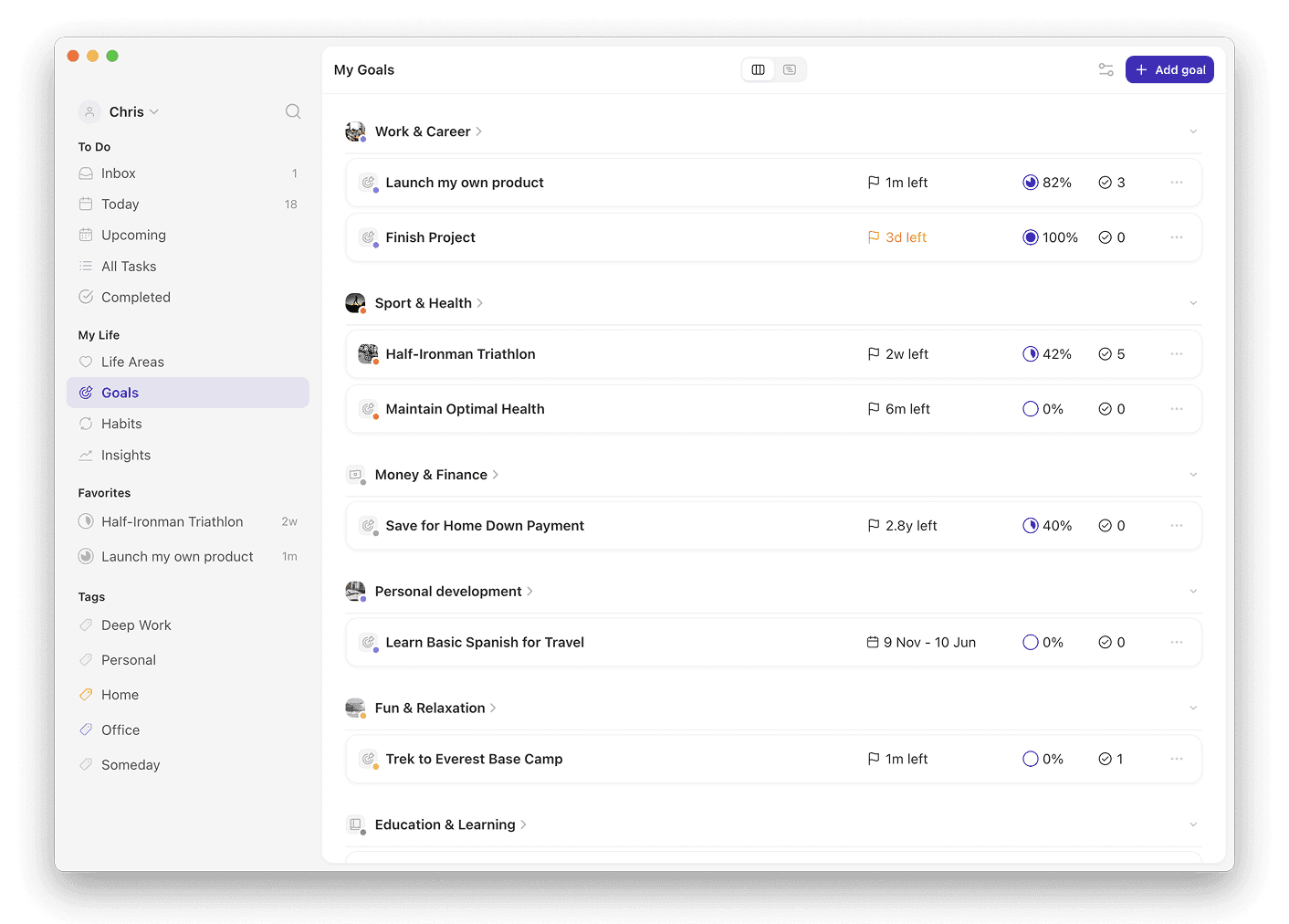
Griply, the goal app we make, shows at a glance whether each of your 2027 goals is on track. You give each goal a start value, a target and a deadline, and its chart draws the pace you need as a line. Each update you log appears as a point, so if your half marathon training falls behind in February, you see it in February and can adjust at your next weekly review.
You can also keep the plan from this guide in one place, on iPhone, Android, Mac, Windows or the web. Your goals sit under the life areas from Step 2, and each life area has room for the vision you wrote. You can link the habits, projects and tasks from Step 5 to their goal, and the Today view shows which goals today’s tasks are serving. The bedroom from Step 4 can be a project of its own. A weekly review reminder, on Sundays by default, prompts you to plan the coming week.
The free plan includes two goals, two habits and five projects, enough to try this with your top priority. Premium adds subgoals for your quarterly milestones, the Timeline, which lays out your goals and projects across the year, and Insights for your reviews. See how Griply’s goal planner works.
Frequently asked questions
When should you start setting goals for the new year?
Any time. Many people plan in late December so they can start on January 1, but the start of any new week or month works too. If it’s already January, plan this week and start next Monday, or use February 1 as a fresh start.
How many goals should you set for a year?
Two to four is enough for most people, spread over your most important life areas. Each goal needs a few hours a week, so with more than four, some usually get no time at all. If you’re new to goal setting, start with one goal and add another once you’re working on the first one every week.
What’s the difference between a New Year’s resolution and a goal?
A resolution is an intention, such as “get fit”. A goal adds a starting point, a target and a deadline, such as “go from running 3 miles to 13.1 miles by October 10”. The goal tells you during the year whether you’re on track. The resolution only tells you in December whether you kept it.
Is there a free app to plan and track your 2027 goals?
Yes. Griply, the goal app we make, has a free plan with two goals, two habits and five projects. Each goal gets a progress chart that shows whether you’re on pace to hit your target by the deadline, which most task and habit apps don’t have. We compared other free options in our guide to free goal tracker apps.
What if you fall behind on your goals in February?
Adjust the plan at your next weekly review. Push the deadline back, lower the target, or cut a habit down to something you can keep up. Falling behind early is normal. The goals that fail are usually the ones you stop looking at after January.
Plan 2027 one quarter at a time
A plan for a whole year can’t predict what happens in May. It can give you a direction, a number to aim for and a clear plan for the first three months. Plan January to March in detail, look at the plan every week, and rebuild the next quarter at the end of March with what you’ve learned.
That gives you four planning sessions a year. Each one after January starts from your actual progress, so the plan gets more accurate as the year goes on. By December 2027 you’ll have a year of weekly check-ins behind you, and next year’s plan will be much easier to write.
Works cited
Norcross, John C., Marci S. Mrykalo, and Matthew D. Blagys. “Auld Lang Syne: Success Predictors, Change Processes, and Self-Reported Outcomes of New Year’s Resolvers and Nonresolvers.” Journal of Clinical Psychology, 2002. https://pubmed.ncbi.nlm.nih.gov/11920693/
Oscarsson, Martin, Per Carlbring, Gerhard Andersson, and Alexander Rozental. “A Large-Scale Experiment on New Year’s Resolutions: Approach-Oriented Goals Are More Successful than Avoidance-Oriented Goals.” PLOS ONE, 2020. https://journals.plos.org/plosone/article?id=10.1371/journal.pone.0234097
Masicampo, E. J., and Roy F. Baumeister. “Consider It Done! Plan Making Can Eliminate the Cognitive Effects of Unfulfilled Goals.” Journal of Personality and Social Psychology, 2011. https://users.wfu.edu/masicaej/MasicampoBaumeister2011JPSP.pdf
Dai, Hengchen, Katherine L. Milkman, and Jason Riis. “The Fresh Start Effect: Temporal Landmarks Motivate Aspirational Behavior.” Management Science, 2014. https://faculty.wharton.upenn.edu/wp-content/uploads/2014/06/Dai_Fresh_Start_2014_Mgmt_Sci.pdf