Guide


Table of Contents
A 5 year plan is a written description of where you want to be in five years across the parts of life you care about, broken into annual goals and shorter subgoals you can act on now. Most people write one once, save it in a journal or a Notion doc, and never open it again. You find it three years later and wince at how far you drifted, and the plan wasn't wrong: nothing connected it to the work you did each week.
That is the real problem with a five-year horizon. Five years is far enough away that today's choices feel like they barely move it, so the plan stops influencing your decisions almost immediately. The version that keeps working is the one where the long-horizon direction sits above your annual goals, which sit above your quarterly subgoals, so reviewing your goals each week is the same act as checking progress toward the five-year picture. If planning my future has always felt like a once-and-forget exercise, that structure is the part you were missing.
Key takeaways
A 5 year plan written in a static document loses influence within weeks because nothing ties it to the work you do each week.
A goal five years out exerts almost no pull on today unless you add nearer deadlines between now and then.
Picturing your future self in concrete detail leads to better long-term choices, which is exactly what a specific five-year description gives you.
In Griply a subgoal requires a parent-goal link, so a quarterly target cannot exist without tracing up to the annual goal and the five-year vision above it.
Why a 5 year plan stops working after you write it
The distance is the whole issue. A goal set five years out has so little immediate consequence that your brain discounts it almost to zero when deciding what to do today. This is described by Temporal Motivation Theory: motivation to act on a goal drops as the deadline moves further away, which means a five-year deadline produces close to no pull on a random Tuesday.
A plan saved in a document makes this worse. There is no deadline between today and year five, no point where missing progress becomes visible, so you can drift for a year before anything tells you. By the time you reread the file, the gap is large enough to feel like failure, and a plan that only ever delivers bad news is a plan you stop opening.
The fix is to add structure between the five-year point and today, which is where a five-year plan stops being a journal entry and becomes part of your life planning. When the long horizon breaks into annual goals, and those break into quarterly targets, each level has a near deadline that your motivation can respond to.
How to create a life plan with a five-year horizon
Start at the top with the destination, then work down to what you can do this quarter. Picture yourself five years out in concrete terms rather than as a vague better version of now. Future self-continuity research shows that people who see their future self in vivid, specific detail make choices that serve that self, while a fuzzy future self gets treated almost like a stranger you owe nothing to.
Write the five-year description per area of life rather than as one blurry paragraph. Career, health, money, relationships, and learning each progress at a different pace, and a single statement hides which one is drifting. If you need help turning a broad intention into something concrete, the vision planner guide covers writing a clear vision for each area.
The honest answer to how can I plan my future without losing track of it is to work backward from the five-year endpoint to the checkpoints between here and there. Define where each area needs to be in roughly one year, then what this quarter has to produce to stay on that line. The planning for the future guide walks through reasoning backward from a defined endpoint if you want the method in full.
Why the five-year vision has to sit above your annual goals
A 5 year plan only earns its place when the layers connect. The five-year description is the direction, your annual goals are the measurable outcomes for this year, and your quarterly subgoals are the targets you review now. Each layer answers to the one above it, so progress at the bottom is progress toward the top.
When a quarterly target traces up to an annual goal that traces up to the five-year direction, finishing the quarter's work is visible movement on the whole horizon. When those layers live in separate places, you can complete a busy quarter and have no idea whether you moved closer to the five-year picture or just stayed occupied.
The bottom layer is where most plans break. Quarterly targets work as the subgoal layer beneath a yearly goal, and a short-term goal that connects to a longer outcome is the thing you actually act on, while one floating on its own is a preference you will drop. Keeping each quarter tied to the year, and each year tied to the five-year direction, is what keeps the plan current.
How a regular review turns the plan into a checkpoint
A five-year horizon needs a recurring point where the plan and your real progress meet. Without one, the document and your life run on separate tracks until they are far apart. Temporal landmarks like the start of a quarter or a new month naturally prompt people to step back and act on bigger aspirations, which is exactly what a scheduled review should capture.
Use two cadences. A weekly review asks whether this week's work moved the current quarter's targets, and a quarterly review asks whether the quarter moved the year's goals and whether the year is still on the five-year line. Because the layers connect, the weekly review of your goals is automatically a check against the long horizon, with no separate session to dig out the five-year file, and the quarterly review guide covers running the deeper version.
The point of both is to catch drift while it is small. A quarter off course is a quick correction. Three years off course, found when you reopen an old document, means starting over.
How Griply keeps a 5 year plan connected to daily work
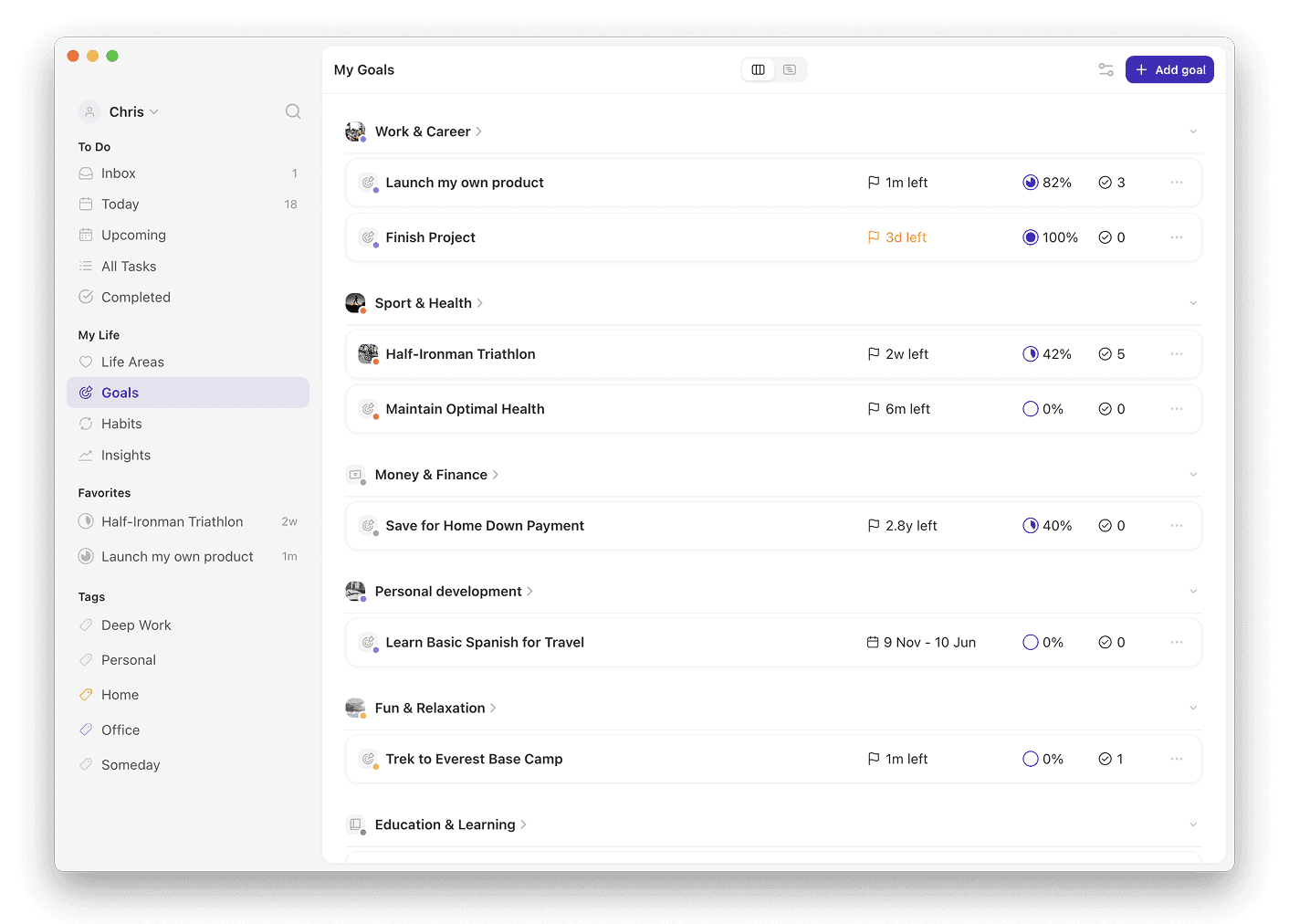
A 5 year plan fails in a journal or a Notion doc for a structural reason: there is no link between the five-year description and the tasks you do this week, so the plan and the work never meet. Griply keeps the long horizon, the annual goals, and the quarterly targets in one connected hierarchy rather than separate documents.
The five-year description goes in the Vision field on each life area, the place that holds what a domain looks like when it is going well. Your annual goals become measurable goals beneath it with a start value, target value, and deadline. Each quarterly target is a subgoal, and because a subgoal requires a parent-goal link, a quarter's target cannot exist without tracing up to the annual goal and the five-year vision above it.
The Goal Roadmap lays goals and subgoals across time as a Gantt chart, so the multi-year plan is visible across time instead of buried in a file. When you review your goals each week, you are reading progress against the five-year direction, because that is what the layers above each subgoal point to.
Frequently asked questions
What should a 5 year plan include?
A 5 year plan should include a concrete description of where you want to be in five years across each area of life, the annual goals that move you there, and the quarterly subgoals you can act on now. The layers must connect so progress on the small targets is progress on the big direction.
How do I write a 5 year plan that I will actually use?
Write the five-year direction per life area, break it into one-year goals with deadlines, then quarterly subgoals, and schedule a weekly and quarterly review. Keep all the layers in one place, like Griply, so reviewing your goals doubles as checking the five-year plan.
Why do most 5 year plans fail?
Most fail because a five-year deadline is too distant to influence daily choices, and a plan stored in a document has no nearer checkpoints to make drift visible. Adding annual goals and quarterly subgoals gives the plan deadlines your motivation can respond to.
How often should I review a 5 year plan?
Review the quarterly subgoals weekly and the annual goals every quarter. If each layer connects to the one above it, these reviews check progress toward the five-year direction automatically, so you rarely need a separate session to revisit the long-horizon plan.
Is a 5 year plan the same as a life plan?
A 5 year plan is one horizon within a life plan. A life plan covers your vision across every area of life at any timescale, while a 5 year plan sets a specific five-year target that your annual goals and quarterly subgoals work toward.
A 5 year plan works only when annual goals and quarterly subgoals sit beneath it
The reason a five-year plan in a document fails is not weak ambition or poor discipline. It is that five years is too far away to guide today, and a static file has no checkpoints to surface drift before it becomes a rewrite. The plan that keeps working is the one where the five-year direction sits above annual goals, those sit above quarterly subgoals, and a regular review of the small targets is the same act as checking the long horizon. Build the layers and connect them, and the five-year picture stays in front of you instead of waiting three years to disappoint you.
Related Guides
Hal Hershfield. "Future Self-Continuity: How Conceptions of the Future Self Transform Intertemporal Choice." Annals of the New York Academy of Sciences, 2011. https://pmc.ncbi.nlm.nih.gov/articles/PMC3764505/
Piers Steel and Cornelius König. "Integrating Theories of Motivation." Academy of Management Review, 2006. https://doi.org/10.5465/amr.2006.22527462
Hengchen Dai, Katherine Milkman, and Jason Riis. "The Fresh Start Effect: Temporal Landmarks Motivate Aspirational Behavior." Management Science, 2014. https://papers.ssrn.com/sol3/papers.cfm?abstract_id=2204126