

A weekly review is a scheduled session, usually 30 to 60 minutes, where you look back at the week's progress, clear anything that slipped, and decide what the next week is actually for. Most people who try one give up inside a month, and the reason is rarely discipline. The review feels like busywork because it checks tasks against tasks: you tidy the inbox, reschedule what you missed, and close the laptop no wiser about whether any of it moved a goal.
A weekly review earns its place only when there is something structural to review against, so the three questions that matter can actually be answered: what made real progress, what stalled, and whether next week's work still points at the right goal. A flat task list can tell you what you finished, never whether it added up. This guide, part of the wider productivity guide, covers what to review each week, how long it should take, and why the artifact you review against decides whether the session is strategy or tidying.
Key takeaways
A weekly review answers three questions: what made real progress, what stalled, and whether next week's work still points at the right goal.
Feedback only helps when it points somewhere; a review that checks task completion without a goal above it can leave performance flat or worse.
The GTD weekly review clears your head and lists well, but its own structure never makes a goal measurable, so it can run for years without telling you if you are winning.
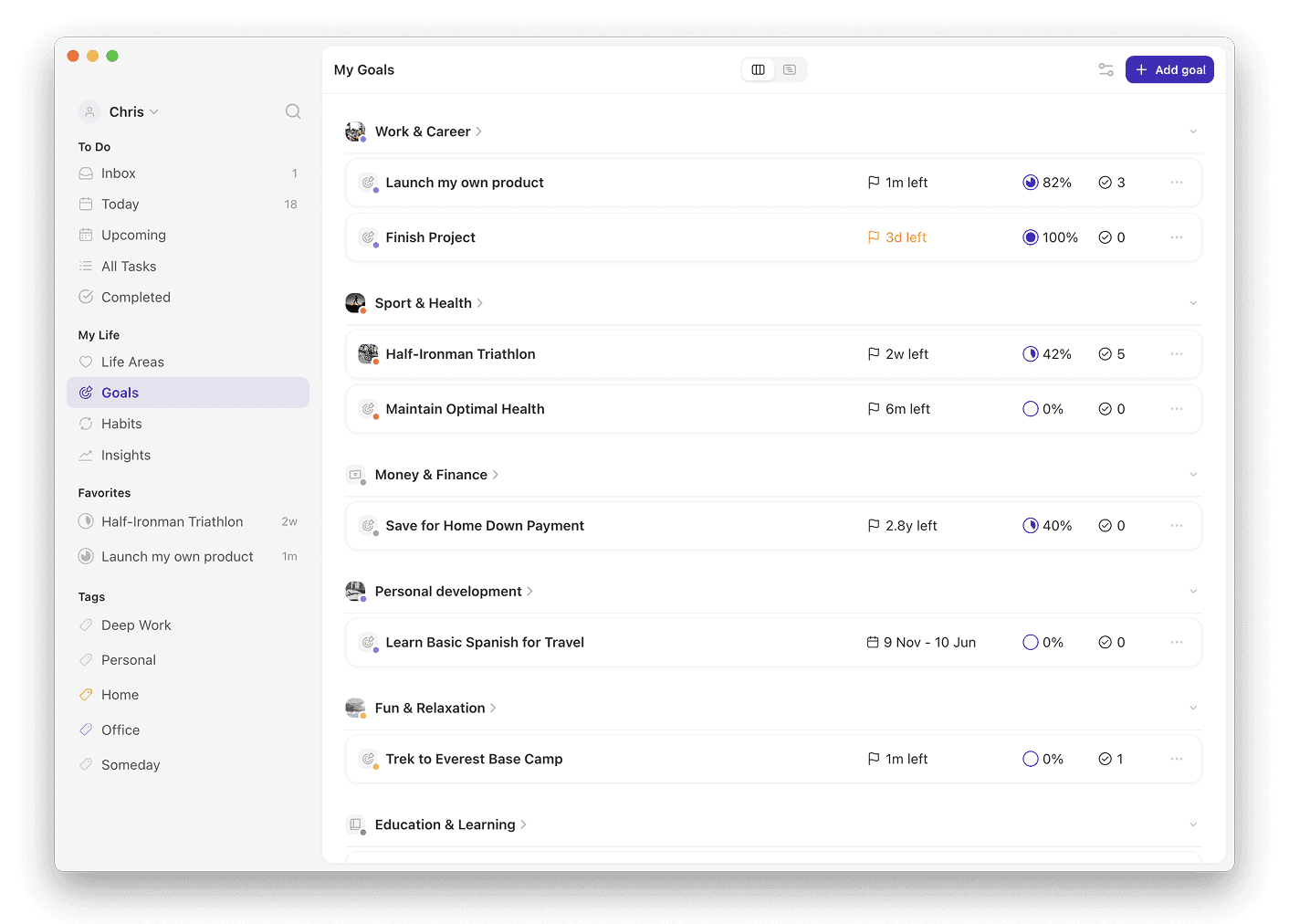
In Griply, the review has a fixed artifact to interrogate: the goal progress chart and the Today view, where every task shows the goal it serves.
What a weekly review is, and what it is not
A weekly review is a recurring appointment with your own plan. You sit down once a week, read what happened, and reset the coming week against your goals rather than against whatever landed in your inbox on Friday afternoon. The practice became widely known through David Allen's Getting Things Done, where the weekly review is the step that keeps the whole system trustworthy, and Griply's own GTD walkthrough covers where the review sits in Allen's five steps.
The confusion worth clearing up early is the difference between a weekly review and a weekly plan. A weekly plan looks forward and schedules the next seven days, while a weekly review looks backward first, reads the evidence, and only then plans, so the plan responds to what actually happened.
Skip the backward-looking half and you are rewriting the same optimistic list you wrote last Sunday. The backward read is the step that makes every other planning tactic land.
Why most weekly reviews quietly fail
The common failure is running a review that inspects the wrong layer. You open your task manager, see forty items, complete the ritual of dragging overdue tasks forward, and feel vaguely productive without learning anything. The session checked whether tasks got done, never whether the tasks were the right ones.
This is where the research on feedback gets uncomfortable. A weekly review is a feedback intervention, and feedback is not reliably good for performance: across more than 600 studies, feedback improved results on average but made things worse in over a third of cases, usually when it pulled attention toward the self or trivial detail rather than the task and its goal. A review that fixates on how many boxes you ticked is exactly that kind of feedback, which is why a busy review week can leave you feeling worse rather than clearer.
The fix is to aim the review at the goal rather than the checklist. A review is only useful when it can answer whether the gap between where you are and where you said you would be got smaller this week.
The three questions a real weekly review answers
A weekly review that changes your week comes down to three questions, asked in order. Everything else is administration around them.
What made real progress? Look past what you finished to which finished work moved a goal's number closer to its target.
What stalled, and why? Name the goal that did not move, and the reason: no time blocked, wrong priority, or a task that turned out not to matter.
Is next week's work still aimed at the right goal? Look at what you are about to schedule and confirm each block traces back to a goal you chose on purpose.
The first two questions are impossible to answer honestly if your system only stores tasks. "Did I make progress?" needs a progress metric, and a flat task list does not have one. This is the structural reason weekly reviews drift into tidying: the tool can show you what got done, but not whether it added up, so you review the only data you have.
How long a weekly review should take, and when to run it
A weekly review should take 30 to 60 minutes once the habit settles, and the first few will run longer because you are also building the system you are reviewing. If yours regularly stretches past an hour, it usually means the review is absorbing planning decisions that should live in your daily routine, or your goals are too vague to check quickly.
The strongest cue for when to run it is a temporal boundary, the natural line between one week and the next. Friday afternoon suits people who want to close the week cleanly and start Monday with a set plan; Sunday suits people who think better with a night's distance from the work. Pick one and keep it fixed, because a review that floats to "whenever I have time" is the first thing a busy week deletes.
What to review each week
The content of a good weekly review follows the three questions, made concrete. Work through a short, fixed list so the session runs on a routine and you are not deciding what to check each time.
Read the week's goal progress: for each active goal, has the number moved, and is it on pace for the deadline?
Clear the loose ends: inbox items with no home, tasks with no date, anything half-captured during the week.
Mark what is on track, at risk, or drifted, and name the reason for anything at risk.
Plan the coming week from the goals down: pick the two or three goals that need movement, then block time for the specific work that moves them.
The order matters. Reading progress before planning is what stops the review from becoming a weekly re-run of the same wishlist. When you plan from the goals that are behind, the next week's calendar is a response to the data you just read.
Where the weekly review meets self-regulation
The weekly review is not a productivity gimmick; it is the visible version of a well-studied cycle. Barry Zimmerman's model of self-regulation runs in three phases: forethought (planning), performance (doing), and self-reflection (judging the result against the goal). The weekly review is the self-reflection phase given a slot on the calendar, which is what turns a vague intention to "check in on my goals" into something that reliably happens.
Reflection built into a routine measurably improves what follows. In one field study, employees who spent the last minutes of the day reflecting on what they had learned went on to perform 22.8% better than a control group who spent that time on more practice. Scaled up to a week, that is the case for the review: the time you spend judging last week against your goals is not time taken from the work, it is what makes the next week's work count.
How Griply gives the weekly review something to review against
A weekly review is only as good as the artifact you interrogate, and most tools hand you a task list, which is exactly the layer that makes reviews drift into tidying. Griply's Goal-First hierarchy gives the review a different starting point. Because every task and habit can link up through Subgoal to Goal to Vision to Life area, the review starts with the goal and its evidence, not with a pile of undated tasks.
The Goal Planner is the artifact for the first question. Each goal has a start value, target value, deadline, and a progress line chart with a target line, so "did this make progress?" becomes a number you read rather than a feeling you guess at. The Insights screen scopes those goal metrics and habit completion rates to any past week, which is the raw material for deciding what is on track and what drifted.
For the third question, the Today view surfaces each task with its parent goal attached, so when you plan the coming week you can see at a glance whether the work still points where you meant it to. A Smart List that filters for high-priority tasks with no planned date catches the important work that slipped through the week in a single tap. Setting the review up as a recurring weekly habit, with each step saved as a subtask, keeps the session inside the same system it reviews, which is what makes it survive a busy week.
Frequently asked questions
What is a weekly review?
A weekly review is a scheduled session, usually 30 to 60 minutes, where you look back at the week's progress on your goals, clear anything that slipped, and plan the coming week. It is the review step that keeps a planning system honest by checking whether your work is actually moving your goals.
How do you do a weekly review?
Run it in three steps: read your goal progress to see what moved, clear loose ends like undated tasks and inbox items, then plan the next week starting from the goals that need attention. Reviewing progress before planning is what stops it becoming a weekly rewrite of the same list.
What is the GTD weekly review?
The GTD weekly review is the step in David Allen's Getting Things Done where you get clear, get current, and get creative: empty your inboxes, update your task and project lists, and review what is next. It keeps the system trustworthy, though it tracks next actions rather than measurable goal progress.
How long should a weekly review take?
Between 30 and 60 minutes once the habit is established. Your first few will run longer because you are also setting up the goals and lists you review. If it regularly exceeds an hour, your goals are probably too vague to check quickly, or the review is doing planning that belongs in your daily routine.
What is the difference between a weekly review and a weekly plan?
A weekly plan looks forward and schedules the coming seven days. A weekly review looks backward first, reads what actually happened against your goals, and only then plans. The review turns the plan into a response to real evidence.
The artifact is what makes the review strategic
A weekly review is only strategy when it has a goal to measure against; without one, the same 45 minutes become tidying with a calendar reminder attached. What separates the two is whether your system can show progress alongside the task list, and that is a design question more than a discipline one. Point the review at your goals, ask what moved, what stalled, and where next week is aimed, and the session starts changing the week rather than only closing it.
Related Guides
Allen, David. "Getting Things Done: The Art of Stress-Free Productivity." Viking, 2001. https://gettingthingsdone.com/what-is-gtd/
Kluger, A. N., and DeNisi, A. "The Effects of Feedback Interventions on Performance: A Historical Review, a Meta-Analysis, and a Preliminary Feedback Intervention Theory." Psychological Bulletin, Vol. 119, No. 2, 1996. https://mrbartonmaths.com/resourcesnew/8.%20Research/Marking%20and%20Feedback/The%20effects%20of%20feedback%20interventions.pdf
Zimmerman, Barry J. "Becoming a Self-Regulated Learner: An Overview." Theory Into Practice, Vol. 41, No. 2, 2002. https://eric.ed.gov/?id=EJ656632
Di Stefano, Giada, Gino, Francesca, Pisano, Gary P., and Staats, Bradley R. "Learning by Thinking: How Reflection Aids Performance." Harvard Business School Working Paper, 2014. https://www.library.hbs.edu/working-knowledge/reflecting-on-work-improves-job-performance