Guide


Table of Contents
A SMART goal is an outcome written so it is Specific, Measurable, Achievable, Relevant, and Time-bound, which turns a vague intention into something you can check against a number. This page hands you ready-to-use smart goals examples for work, each shown vague first, then rewritten with all five criteria made concrete. You copy the structure, swap in your own numbers, and you have a goal you can act on.
Every example below does the same three things the vague version cannot. It names a starting point, so you know whether the target is a stretch. It sets a check-in cadence, so you catch a miss while you can still fix it. It puts the number somewhere you actually look, so you still have the number weeks later.
The framework theory takes one short section, because the value is in the examples. Read the rewrites first, then come back for the why.
Key takeaways
A usable work goal names a target, a starting number, a deadline, and a check-in rhythm.
The baseline is what tells you whether your target is ambitious or already met.
A weekly or monthly check-in catches a miss while you still have months to act.
Griply stores each goal as a start value, a target value, and a deadline.
What SMART means, in one short section
SMART is a goal-setting acronym standing for Specific, Measurable, Achievable, Relevant, and Time-bound. George T. Doran invented it in a November 1981 Management Review article for managers who needed objectives they could actually evaluate. The structure is what stuck, because it forces every goal to carry a number and a date.
Here is what each letter asks of a work goal:
Specific means the goal names one concrete outcome.
Measurable means the goal carries a number you can read off.
Achievable means the target is reachable with the resources you have, push it past comfortable reach and it becomes a stretch goal.
Relevant means the goal traces up to a purpose beyond this quarter.
Time-bound means the goal has a fixed deadline on the calendar.
The criterion people fake is the M, so every example below makes the M concrete.
Six smart goals examples for work, vague then rewritten
Here are six examples of goals for work, one per role, each shown weak first and then rewritten with all five criteria pinned down. After each rewrite you get the part most templates skip: the baseline to start from, the cadence to check on, and where the number should live.
Sales rep. From "close more deals this quarter" to "grow monthly closed-won revenue from $48k to $75k by Q4 close."
Baseline: $48k
Cadence: check your standing every Monday
Where the number lives: the pipeline dashboard your team already opens daily
Team lead. From "keep the team happy" to "cut voluntary team turnover from 18% to under 10% over the next four quarters," a clean smart leadership goals example.
Baseline: the current rate from the last twelve months
Cadence: review each month against pulse-survey scores
Where the number lives: the same review doc you bring to one-on-ones
Developer. From "fix the bugs" to "reduce the open bug backlog from 140 issues to 50 by end of Q3."
Baseline: 140 issues, set on the day you start
Cadence: check the count every sprint review
Where the number lives: the board everyone already triages from, so it stays visible without extra reporting
Support agent. From "answer tickets faster" to "drop median first-response time from 9 hours to under 3 hours by August 31."
Baseline: the current median first-response time
Cadence: watch it weekly in the helpdesk report
Where the number lives: pinned to the channel where the team reviews queue health
Marketer. From "get more leads" to "raise marketing-qualified leads from 60 to 110 per month by September 30." The baseline of 60 is what makes 110 a target you can measure against.
Baseline: 60 marketing-qualified leads per month
Cadence: check it weekly in your attribution view
Where the number lives: the same dashboard you report from
Manager running the weekly planning meeting. From "make meetings better" to "raise the post-meeting usefulness score from 3.1 to 4.2 out of 5 over the next eight weeks."
Baseline: a one-question survey after the next meeting
Cadence: track the score each week
Where the number lives: posted where attendees can see it move
When you want to create your own goal rather than copy one of these, build your own SMART goal from scratch with the six-step generator that walks a raw idea through each letter. For goals aimed squarely at career growth and promotions, the career-focused SMART goals framework covers professional development letter by letter.
Why the baseline, the cadence, and the visible home make the example work
A target number on its own is not measurable. It becomes measurable when you attach three things: a starting point to measure against, a cadence to track on, and a place the number stays visible.
The baseline is what most goals leave out. "Reach 110 leads a month" means nothing until you know you are at 60 now, because the gap is what tells you the work ahead. Specific and challenging targets produce higher performance than vague ones, and a baseline is what makes a target specific.
The cadence is what turns a number into a feedback loop. A figure checked once at the deadline only reports the result after you can no longer change it. Pick weekly or monthly and log the current value on that rhythm.
In work-related training, the level you set your target at is the strongest predictor of how much you actually achieve, which is the case for naming a real number and watching it.
How Griply tracks your smart goals examples for work
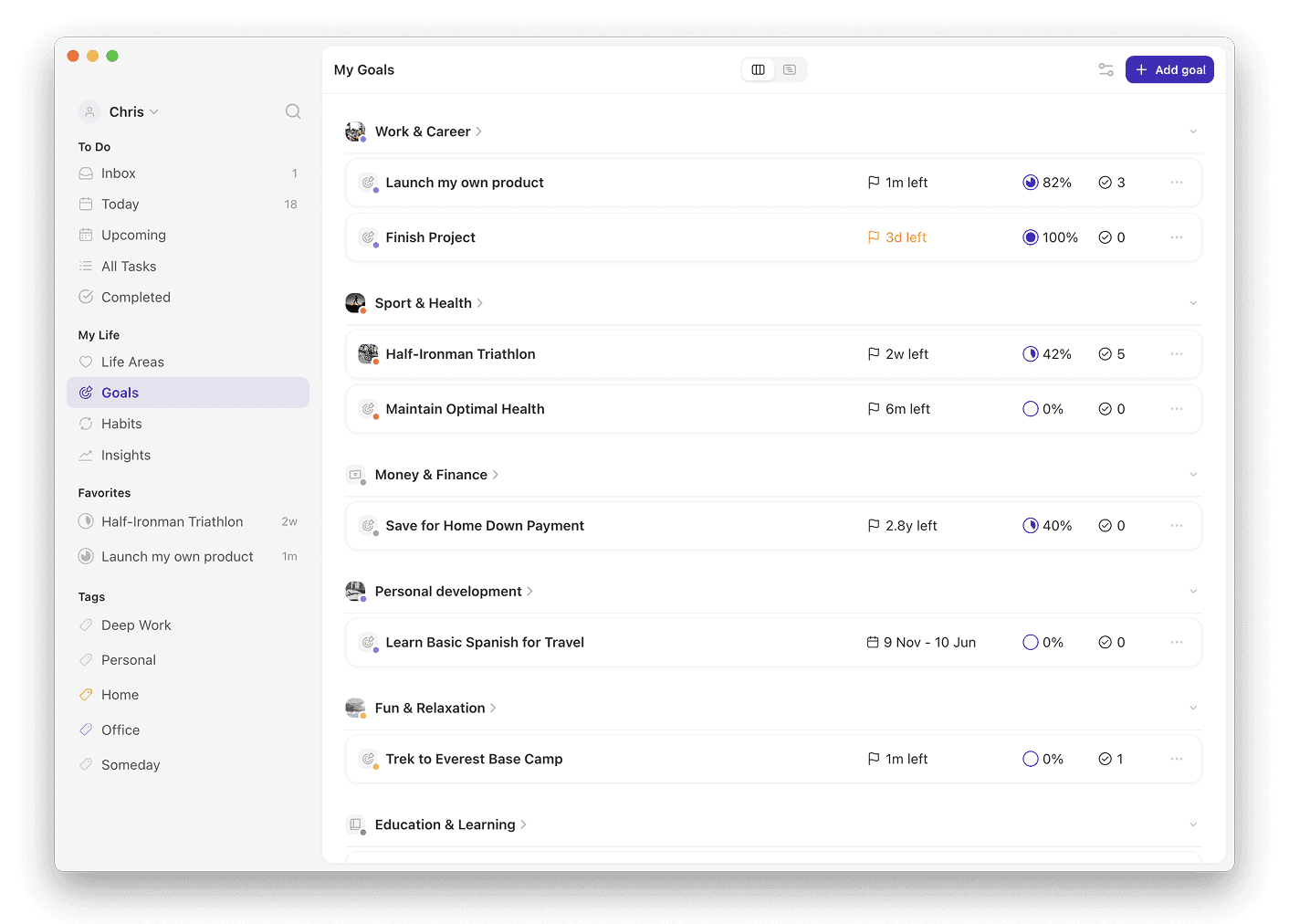
Take the marketer's goal above and put it in Griply. You set the goal with a start value of 60, a target value of 110, and a deadline of September 30 on the goal planner. Each time you log the month's number, it plots onto a line chart with a target line from your start date to the deadline, and the chart turns green when you hit 110. That line chart is the M and the T made visible: the baseline, the tracked progress, and the deadline in one view.
Relevance is structural. Every goal sits inside a Life area with a Vision field, so the leads target traces up to the Work and Career domain you actually care about. The hierarchy runs Life area, Vision, Goal, Subgoal, then Task or Habit, so the yearly target breaks into shorter measurable subgoals, and a habit like a weekly outreach push ties back to the outcome it feeds. Progress is logged by you, on your cadence, by design. For more ways to set targets like these, browse the goal setting guides.
Frequently asked questions
Who invented SMART goals?
George T. Doran invented SMART goals in a November 1981 Management Review article. He was Director of Corporate Planning at Washington Water Power Company and wrote the framework for managers who needed objectives they could measure and evaluate.
What does the SMART acronym stand for?
SMART stands for Specific, Measurable, Achievable, Relevant, and Time-bound. The exact words behind each letter vary slightly across sources, but the structure forces every goal to carry a clear number and a deadline.
What makes a work goal measurable?
A measurable goal answers three questions: what is the starting number, how often you check it, and where the number stays visible. The starting number is the one most goals skip, and it is what tells you how far you have to go.
What is a good SMART goal example for a manager?
Cut voluntary team turnover from 18% to under 10% over the next four quarters. Baseline the current rate from the last twelve months, review it monthly against team-survey scores, and keep the number in the doc you use for one-on-ones.
How do you track a SMART goal at work?
Record the starting value, then log the current value on a set rhythm, weekly or monthly. Keep that running number on a dashboard or board your team already opens, so the goal stays visible.
A work example is only useful once you can see the number
A rewritten SMART goal needs three things to back it up: a baseline, a check-in rhythm, and a place you see the number. It needs a baseline, so you can read the gap. It needs a check-in rhythm, so a February miss reaches you in February. It needs a place you actually see the number, so you still have the number later.
Each of the six examples above names a baseline, a check-in, and where the number lives, which is exactly what makes it copyable into your own week. Give your next work target those three supports, and the rest of the SMART framework has something real to act on. For the evidence on why measured targets outperform vague ones, read how measurable goals drive real results.
Related Guides
Doran, George T. "There's a S.M.A.R.T. way to write management's goals and objectives." Management Review, vol. 70, no. 11, 1981, pp. 35-36.
Locke, Edwin A., and Gary P. Latham. "Building a practically useful theory of goal setting and task motivation: a 35-year odyssey." American Psychologist, vol. 57, no. 9, 2002, pp. 705-717. https://pubmed.ncbi.nlm.nih.gov/12237980/
Sitzmann, Traci, and Katherine Ely. "A meta-analysis of self-regulated learning in work-related training and educational attainment: what we know and where we need to go." Psychological Bulletin, vol. 137, no. 3, 2011, pp. 421-442. https://pubmed.ncbi.nlm.nih.gov/21401218/