

The 12 Week Year is a planning system that treats every 12 weeks as a full year, compressing the horizon to create urgency and force the kind of weekly commitment that annual plans almost never produce. Brian Moran and Michael Lennington introduced it in their 2013 book The 12 Week Year, and the core logic is simple: when your deadline is 12 months away, you have 11 months to procrastinate. When it is 12 weeks away, you have this week.
Most people who try the 12 Week Year run into the same wall after two or three cycles. The first week goes well, then a busy Tuesday blows the weekly plan, and by week four the 12-week goal feels as abstract as the annual one did before. The compression effect disappears.
The reason is structural: the 12-week goal, the weekly milestones, and the daily tasks live in separate tools or separate documents, so missing a weekly plan carries no visible cost against the 12-week target. When the connection is invisible, abandoning the weekly plan feels cheap.
Key takeaways
The 12 Week Year works by compressing the planning horizon from 12 months to 12 weeks, which reduces the delay-discount factor that erodes motivation on long timelines.
Brian Moran and Michael Lennington's central claim in The 12 Week Year is that consistent weekly execution determines the final result: execution rate matters more than goal size.
Specifying the when, where, and how of an action reliably bridges the gap between goal intention and follow-through. The weekly plan in the 12 Week Year is only as strong as its connection to specific tasks.
In Griply, the Goal hierarchy connects weekly milestones to the 12-week target, so a missed milestone shows up on the goal's progress chart.
Why the 12-month year stops working
The standard annual planning cycle produces a predictable failure pattern. You set goals in January with genuine intention, carry a full slate of ambitious targets into Q1, and by March the daily task list has quietly disconnected from the plan. The time horizon is too long to create real pressure on any given week.
Temporal Motivation Theory formalises this: motivation is a function of the expected value of the outcome, discounted by time and by your confidence that you will succeed. The further away the deadline, the steeper the discount. A goal with a December deadline carries almost no motivational weight in February: the delay-discount factor is so high that the task competing for your attention this Tuesday will win almost every time, even if the Tuesday task matters less.
Annual goals also produce what Moran calls false urgency: a plan document with no mechanism for weekly commitment. The review never comes until December, and by then the gap between intention and output is a year wide.
How the 12 Week Year fixes the time horizon
The 12 Week Year's central move is to reset the deadline. Instead of treating January to December as the operating cycle, you run three 13-week cycles per year (12 weeks of execution plus one week of transition). Each cycle has its own goals, its own execution plan, and its own weekly review.
A deadline 12 weeks out is close enough that skipping a week of work has an immediate, calculable cost against the target.
Moran and Lennington's framework runs on three elements. The 12-week goal is specific and measurable: what you will achieve, by when, and what number defines success. The weekly plan is the list of tactics for this specific week that move the goal forward.
The weekly review is where you score your own execution against the plan. The execution score matters more to the framework than the goal metric: if you complete 85% or more of your planned tactics in a given week, the goal outcome tends to follow. If you consistently score below 65%, the goal is in trouble whether you realise it yet or not.
Self-imposed deadlines apply here directly: when people voluntarily commit to earlier, intermediate deadlines rather than a single distant end-date, performance improves. The 12 Week Year turns an annual goal into a specific, close-deadline goal, and adds a weekly feedback loop as the monitoring mechanism.
Where most 12 Week Year attempts break down
The framework is sound. The implementation fails in a specific, predictable place: the hierarchy between the 12-week goal, the weekly plan, and the daily task list is not structural.
Most people run the 12 Week Year across multiple tools. The 12-week goal lives in a notes app or a planning template. The weekly tactics live in a separate to-do app.
The daily calendar is a third tool. Each layer works fine in isolation. What they cannot do is show you, when you are deciding what to do at 9am on Tuesday, that skipping a task will leave a gap in this week's plan that will register on the 12-week target you set on Monday of week one.
Research on the intention-behaviour gap makes the mechanism clear: committing to a specific action ("I will do X on day Y at time Z") reliably bridges the gap between goal intention and follow-through. The weekly plan in the 12 Week Year is supposed to be the implementation intention layer: it specifies what you will do, this week, to advance the goal. But a weekly plan that lives in a separate tool, disconnected from the goal metric, cannot carry that weight.
When Tuesday gets busy and you skip the tactic, you do not feel the consequence on the 12-week target. The cost is invisible, so abandoning the plan feels cheap.
This is the same structural problem behind the projects that never get finished and the productivity systems that get rebuilt every Sunday. Disconnected layers produce disconnected motivation.
What a connected 12-week hierarchy looks like
The fix is to run the 12 Week Year inside a single hierarchy where each layer is a child of the one above it. The structure:
12-week goal: a measurable outcome with a start value, target value, and 12-week deadline
Weekly milestones: subgoals of the 12-week goal, each with its own metric and a one-week deadline
Daily tactics: tasks and habits linked to the weekly milestone or directly to the 12-week goal
When the weekly milestone is a subgoal of the 12-week goal, missing a week shows up on the goal's progress chart. The cost becomes visible. The compression effect Moran and Lennington describe (the urgency a 12-week horizon creates) only materialises when that connection exists at the structural level.
The weekly review in this setup has something real to interrogate: you are looking at your 12-week progress line and your week's execution score together. If the line is flat and the execution score is low, the problem is clear. If the execution score is high but the line is not moving, you are working on the wrong tactics: a different problem, but visible early enough to correct.
Progress monitoring amplifies this effect. Self-monitoring of progress is the self-regulation strategy most strongly linked to goal attainment, and the effect is strongest when the monitoring produces a concrete, visible record. A progress chart that updates as weekly milestones are completed is exactly that record.
How to set up a 12-week cycle that holds
Three questions determine whether the goal is usable:
What is the specific number or milestone I am trying to reach?
What is my current number or position?
What is the exact date 12 weeks from today?
With those three answers, you have a measurable goal with a start value, a target value, and a deadline. The second setup question is the weekly pace: divide the total gap between start and target by 12, and you have the per-week milestone the goal requires. That becomes your first set of subgoals.
The weekly tactics are the actions (tasks and habits) that will produce each milestone. Moran and Lennington call these lead indicators: the controllable inputs that drive the lag result. A useful test: if you do this specific action consistently for 12 weeks, will it produce the milestone?
If the answer is yes, the tactic is a lead indicator. If you are not sure, the tactic is probably activity rather than strategy.
For the weekly review, set aside 20–30 minutes at the same time each week. The monitoring research confirms what Moran found in practice: the review has to be scheduled at a fixed time each week. Score your execution percentage (completed tactics divided by planned tactics), update your progress metric, and decide whether the next week's tactics need adjustment.
For a complete guide to structuring the weekly time block that makes the review happen, see the time blocking method guide.
How Griply supports the 12 week year
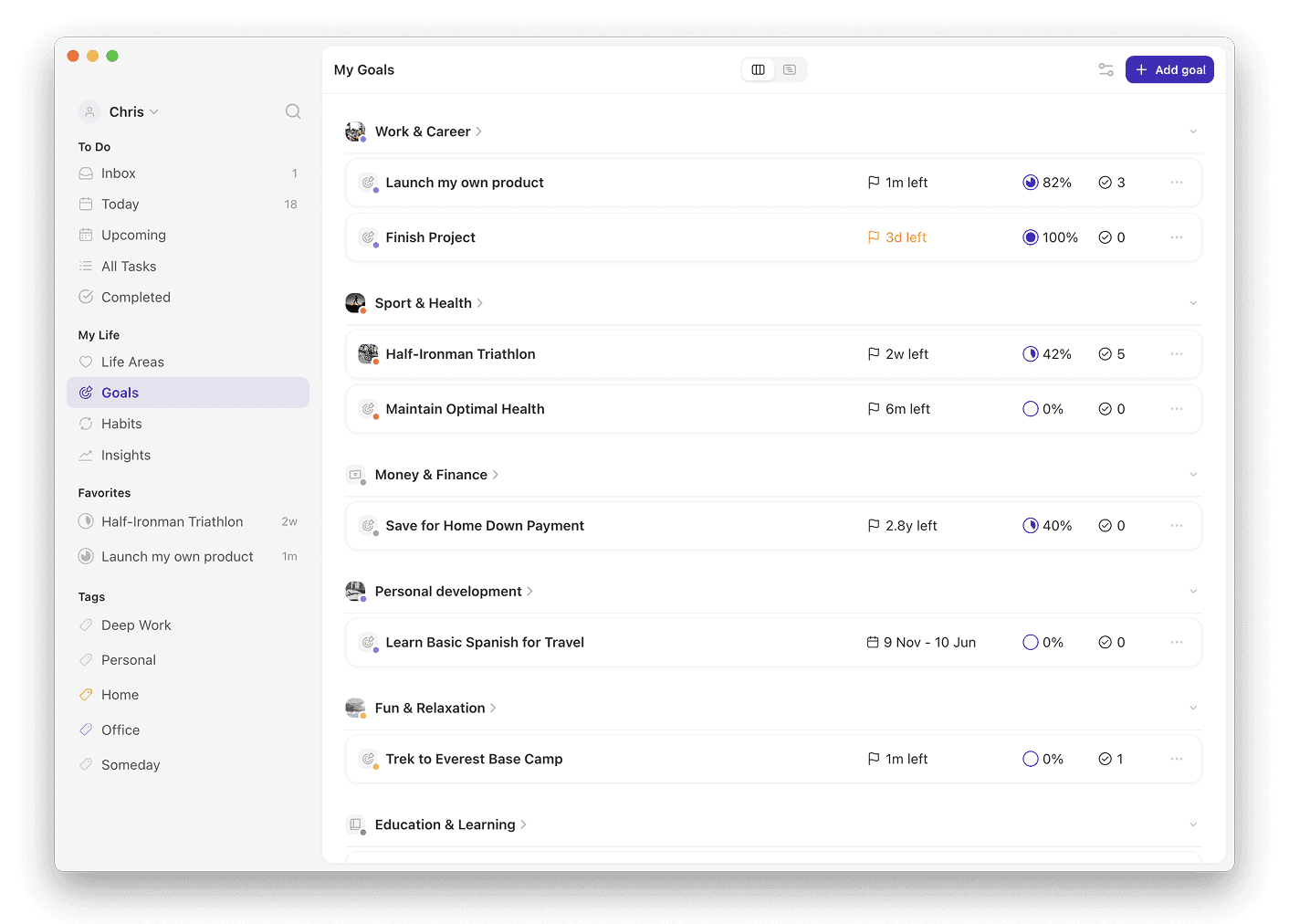
Griply's Goal-First hierarchy runs Life Area to Vision to Goal to Subgoal to Project to Task and Habit, so every tactical action you plan can trace back to the 12-week goal it is supposed to move.
The Goal Planner is where you set the 12-week goal: name the outcome, add a start value and target value, and set the deadline 12 weeks out. The progress chart updates as you log progress, so you see the distance between current and target every time you open the goal. Subgoals represent the weekly milestones: each one has its own metric and a one-week deadline, visibly connected to the parent 12-week goal.
When a milestone slips, the impact on the 12-week progress line is immediate.
Tasks and habits linked to the goal or its subgoals are the weekly tactics. The Today view surfaces which tasks are planned for today and shows the goal each one belongs to. The connection between this morning's task and the 12-week target is visible at a glance, which is what gives missing a tactic real weight.
Frequently asked questions
What is the 12 Week Year?
The 12 Week Year is a planning system by Brian Moran and Michael Lennington that replaces the annual planning cycle with a 12-week cycle. Each cycle has 2–4 specific goals, a weekly execution plan, and a weekly review where you score your own execution rate. The underlying argument is that a 12-week deadline creates the urgency that a 12-month deadline cannot.
How many goals should you set in a 12 Week Year?
Moran and Lennington recommend 2–4 goals per 12-week cycle, and fewer if your goals require heavy weekly effort. The purpose of the limit is to keep weekly tactics achievable: too many goals spread the weekly plan thin, and execution rates drop below the 85% threshold where the system produces results.
Why does the 12 Week Year fail for most people?
The most common failure is a disconnected hierarchy: the 12-week goal lives in one place, the weekly plan in another, and daily tasks in a third tool. When the connection between layers is invisible, missing a weekly tactic carries no visible cost against the 12-week target. The compression effect disappears, and the system reverts to a renamed version of the annual planning problem it was supposed to solve.
What is an execution score in the 12 Week Year?
An execution score is the percentage of your planned weekly tactics you actually completed that week. Moran recommends treating 85% as the threshold for a productive week. The argument is that execution consistency, sustained over 12 weeks, predicts goal attainment more reliably than goal ambition does.
How is the 12 Week Year different from quarterly planning?
Quarterly planning is a goal-setting interval: you set targets for Q1, Q2, etc. The 12 Week Year is a full operating system: it specifies the goal, the weekly plan, the execution score, and the review ritual. Quarterly planning still allows 12 weeks of low-accountability drift before you review; the 12 Week Year reviews execution every week.
What is the best app for running the 12 Week Year?
The best app for the 12 Week Year is one where the 12-week goal, the weekly milestones, and the daily tasks are structurally connected rather than split across separate tools. Griply's Goal Planner lets you set a 12-week goal with a progress chart, break it into weekly subgoals, and link every task directly to the goal it is supposed to move. When you open the Today view, you see each task alongside the goal it belongs to, which is what makes missing a tactic feel like a real cost against the 12-week target. For a side-by-side look at how Griply, the official Achieve app, Notion, and Todoist handle the method, see the best goal tracker for the 12 Week Year.
The compression effect requires a connected hierarchy
The urgency the 12 Week Year promises is real. The 12-week deadline is close enough to matter on a Tuesday morning, which is when most goals succeed or fail one task at a time. What the framework cannot supply on its own is the connection between that morning's task and the 12-week target: that connection has to be built into the system you use.
When the hierarchy is intact, the weekly plan connects directly to the 12-week goal. Abandoning a milestone shows up on the progress chart, and that visibility is the mechanism. Without it, the 12 Week Year is a better-framed version of the same annual planning cycle: ambitious at the start, invisible by week five.
Related Guides
Moran, Brian, and Michael Lennington. "The 12 Week Year: Get More Done in 12 Weeks Than Others Do in 12 Months." Wiley, 2013. https://www.wiley.com/en-us/The+12+Week+Year-p-9781118509234
Steel, Piers, and Cornelius König. "Integrating Theories of Motivation." Academy of Management Review, Vol. 31, No. 4, 2006. https://doi.org/10.5465/amr.2006.22527462
Ariely, Dan, and Klaus Wertenbroch. "Procrastination, Deadlines, and Performance: Self-Control by Precommitment." Psychological Science, Vol. 13, No. 3, 2002. https://pubmed.ncbi.nlm.nih.gov/12009041/
Sitzmann, Traci, and Katherine Ely. "A Meta-Analysis of Self-Regulated Learning in Work-Related Training and Educational Attainment: What We Know and Where We Need to Go." Psychological Bulletin, Vol. 137, No. 3, 2011. https://pubmed.ncbi.nlm.nih.gov/21401218/
Sheeran, Paschal, and Thomas L. Webb. "The Intention–Behavior Gap." Social and Personality Psychology Compass, Vol. 10, No. 9, 2016. https://eprints.whiterose.ac.uk/id/eprint/107519/