Guide


Table of Contents
A daily goal is a specific, outcome-focused commitment you make for a single day that connects directly to a longer-term goal you are actively working toward. It is different from a task: a task describes an action, while a daily goal names the result that action should produce.
Most productivity systems jump straight from a yearly goal to a task list, skipping the daily goal layer entirely. That gap is structural, not motivational. You can have a perfectly organised task list, complete everything on it, and still end the week with no visible progress on the goals that actually matter, because completing tasks and advancing goals are two different measures.
The daily goal is the bridge. It answers one question each morning before the day starts: what outcome would make today count toward the goal that matters most right now? The pages below explain how to set that commitment, why the timing matters, and how to connect it to the rest of your planning so it holds through the week rather than disappearing by Tuesday afternoon.
Key takeaways
A daily goal names the outcome you want from the day, not the actions you plan to take. An analysis of 12,000 diary entries found that making daily progress on a meaningful goal is the single strongest predictor of a positive and motivated inner work life.
Without a daily goal anchoring your task list, completing any goal-adjacent task creates a false sense of completion, and engagement with the actual outcome drops.
Self-monitoring is the strongest predictor of goal attainment in training and educational settings, and daily goal-setting is the lightest-weight monitoring practice available.
Griply's Today view shows each task alongside its parent goal, so you can see at a glance whether the day is pointed at the goal that currently matters most.
Why most daily planning systems skip the most important layer
When you open a task manager in the morning, the default question is "what do I need to do today?" That question produces a list. It does not produce an answer to "will today's work move any of my actual goals forward?"
The planning layer between a long-term goal and a daily task is a daily goal: one sentence that names the outcome you want the day to produce toward a specific goal. Without it, the day is a sequence of actions with no test for whether they matter. You finish, mark things complete, and still feel vaguely behind, because crossed-off tasks and real progress are two different measurements.
This is not a discipline problem. Completing a task that feels relevant to a goal reduces motivation to work on the goal itself, a licensing effect where the brain treats the sense of progress as a real signal. A specific daily goal is the structural fix: it names the outcome, which means any task that does not move the needle on that outcome is visible as peripheral rather than meaningful.
What makes a daily goal different from a task
A task is an action: write the draft, send the email, finish the report. A daily goal is a result: have a first draft that covers all three sections, get a response from at least two of the five leads, finish the report in time to review it before the presentation.
The difference in structure produces a different question at the end of the day. A task asks "did I do it?" A daily goal asks "did the day move the goal?"
This also changes how you plan. If your daily goal is "make visible progress on the Q3 proposal," the tasks that belong on today's list are the ones that produce progress on that specific goal. Tasks that don't connect to the daily goal still have their place, but the daily goal makes the ordering visible before you start.
How daily goals connect to your longer goals
A daily goal is not a standalone commitment. It is the execution layer of a longer goal, specifically the slice of that goal that is reachable within a single day.
The translation step is where most plans unravel: a monthly milestone like "complete the client research phase" is too large to drive a single day. A daily goal like "conduct three client interviews and draft raw notes for each" is specific enough to test and small enough to complete. The same logic applies to monthly goals for self improvement: the monthly goal only holds if the weeks inside it have something concrete to execute against.
The size question is worth applying to any daily goal you set: can you picture yourself succeeding or failing at this by the time you close your laptop?
Setting daily goals in this way also gives your goal-setting practice a natural review structure. If the daily goal was missed, you learn something about the milestone it belongs to: it was too big, the wrong priority, or blocked by something that needs to be resolved before you continue.
Set one daily goal before you open email
Deciding what matters is expensive, and it gets more expensive as the day fills up. Each task you start without a set priority is a fresh prioritisation call, competing with whatever just landed in your inbox. Make the call once, early, and you pay that cost a single time instead of re-deciding after every task.
One primary daily goal per day is enough, tied to the goal that is currently highest priority in your active plan. If you finish it early, a secondary goal gives you direction. The risk of setting five is that prioritisation decisions multiply: you are back to the same morning question you started with.
Opening email first hands the day's direction to whoever needed something from you overnight. Set the goal first, then open the inbox.
A 2011 meta-analysis on self-regulated learning identified self-monitoring as the strongest predictor of goal attainment across 22,000 participants. Daily goals create a lightweight review cycle: set the target in the morning, check the result at the end of the day, adjust for tomorrow.
The connection between daily goals and daily habits
A daily goal and a daily habit are related but different. A habit is a recurring behavior scheduled on a fixed cadence. A daily goal is a non-recurring outcome commitment.
Your morning run is a habit. "Complete the first mile without stopping" might be a daily goal for someone building toward a fitness target. The habit creates the condition; the daily goal tests whether the condition is producing the right result.
The confusion between the two is worth resolving early. If you find that your "daily goals" are the same every day, they are habits, not goals. The habits vs goals guide covers this distinction in full, including when to choose each structure and what each one does that the other cannot.
For daily planning, the clearest version uses both: habits for the recurring behaviors that move the background goals, and one specific daily goal that names the outcome you want from the focused work that sits outside the habit schedule.
How to use daily goals inside a time-blocked day
A daily goal without a time budget is a wish. The most reliable version of daily goal-setting assigns the goal a specific time block so the commitment has a structural home in the day.
The logic: you set a daily goal ("draft the executive summary"), then plan the block that gives it room ("9am to 11am, protected from meetings"). This is the core of time blocking method: connecting the goal to the calendar so "I planned to do it" becomes "I blocked time to do it," which is a categorically different level of commitment.
It also solves the mid-day drift problem. Without a block, the daily goal competes with everything else that arrives during the day. With a block, the commitment exists in the schedule before the distractions arrive.
A 2010 randomised controlled study found that structured daily and weekly goal-setting improved academic performance even in a brief intervention. The structure, not the ambition of the goal, was the variable that drove the effect.
How Griply supports daily goal-setting
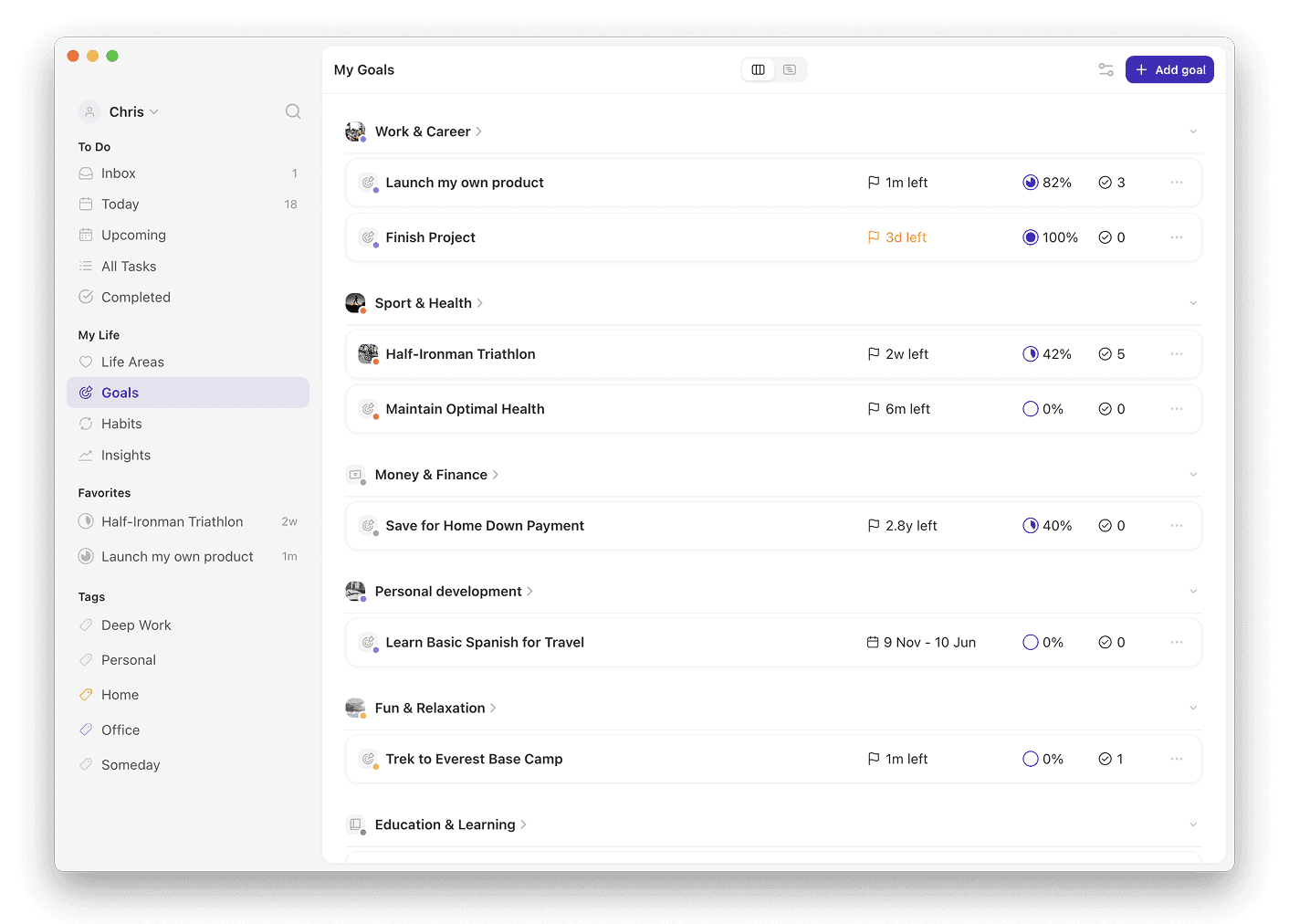
Most task managers, like Todoist, treat a goal as a label you apply to tasks. Griply's structure is different: the hierarchy connects your life areas and vision down to the tasks and habits you act on today, so every task you plan can be traced back to a specific goal in one step.
The Today view shows tasks alongside their parent goal. When you open the app in the morning you can see at a glance whether the day is pointed at the goal that currently matters most, and reprioritize before you start rather than after you finish. The Goal Planner gives each active goal a progress line chart and a deadline, so the daily question "did I move the goal today?" has a concrete answer.
For task management, every task can be linked to a goal or subgoal at capture. That means the raw material for your morning daily goal decision is already organized when you arrive. The daily goal becomes the selection step: of the tasks already linked to your top goal, which one produces the most progress today?
Frequently asked questions
What is a daily goal?
A daily goal is a specific outcome you commit to achieving within a single day, linked to a longer-term goal you are actively working toward. It is more precise than a task (which names an action) because it names the result the action should produce. A well-formed daily goal is testable: at the end of the day, you can answer yes or no to whether you achieved it.
How many daily goals should I set?
One primary daily goal is enough for most people, with a secondary for when you finish early. Setting five or more produces the same problem as setting none: all of them feel equally important, and you end up optimising for completion rate rather than progress on what matters most.
How do daily goals differ from tasks?
A task names an action; a daily goal names a result. "Send the proposal email" is a task. "Get the proposal out by noon with all three sections complete" is a daily goal. The distinction matters because a task can be completed without moving the goal forward, while a daily goal measures progress on an outcome.
When should I set my daily goal?
Set it before you open email or messages. Once the inbox is open, the day's priorities get set by whoever needed something from you overnight rather than by you. Setting the goal first fixes the day's direction while the decision is still yours to make.
How do I connect a daily goal to a longer-term goal?
Start from your longest active goal and work down: what would visible progress on this goal look like by end of this week? Ask what single outcome tomorrow could produce toward that milestone. That outcome is your daily goal for tomorrow, and the cascade repeats week by week.
Daily goals work when they answer a question tasks cannot
A crossed-off task list is a record of what you did. A completed daily goal is evidence that the day moved something forward. The difference sounds small and it isn't: one measures activity, the other measures progress.
Most planning systems are task systems: excellent at capturing what to do, silent on whether the doing produced the outcome. The daily goal layer closes that gap. Set it in the morning before the day decides itself, connect it to the goal it belongs to, and review the result before you plan tomorrow.
Related Guides
Amabile, T. M., & Kramer, S. J. "The Progress Principle: Using Small Wins to Ignite Joy, Engagement, and Creativity at Work." Harvard Business Review Press, 2011. https://www.hbs.edu/faculty/Pages/item.aspx?num=40692
Fishbach, A., & Dhar, R. "Goals as Excuses or Guides: The Liberating Effect of Perceived Goal Progress on Choice." Journal of Consumer Research, Vol. 32, No. 3, 2005. https://doi.org/10.1086/497548
Morisano, D., Hirsh, J. B., Peterson, J. B., Pihl, R. O., & Shore, B. M. "Setting, Elaborating, and Reflecting on Personal Goals Improves Academic Performance." Journal of Applied Psychology, 2010. https://pubmed.ncbi.nlm.nih.gov/20230067/
Sitzmann, T., & Ely, K. "A Meta-Analysis of Self-Regulated Learning in Work-Related Training and Educational Attainment: What We Know and Where We Need to Go." Psychological Bulletin, 2011. https://pubmed.ncbi.nlm.nih.gov/21401218/