Guide


Table of Contents
Habit stacking examples are concrete pairs that attach a new behaviour to something you already do every day, in the form "after I [current action], I will [new habit]". Habit stacking is the technique of using a stable existing routine as the trigger for a new one, so you stop relying on memory or motivation. The examples below are grouped by time of day and by life area, so you can copy a stack today and skip the work of building each pairing from scratch.
This guide assumes you already know the formula, so it skips the how-to and gives you stacks to use. If you want the fill-in template and the mechanics of why specificity makes a stack fire, start with the habit stacking template guide, then come back here for the examples. You can also see the wider habit tracking guide for where stacking fits alongside everything else you track.
What this guide covers:
How to audit your routine for true anchors before you stack anything
Morning habit stacking examples
Health and movement habit stacking examples
Work and focus habit stacking examples
Evening habit stacking examples
How to sequence each stack by friction, lowest first
Key takeaways
Most actions you assume are automatic anchors are not, so test each candidate against where and when it actually happens.
The strongest stacks place the new habit immediately after an action that already recurs in a stable location.
Where you put the new habit matters: placing it right after the anchor builds a stronger habit than placing it before.
In Griply a habit is a task with a
habitflag, which you can place under a goal or life area for visibility without changing the goal's progress.
Audit your routine for true anchors first
A good anchor is something you already do at the same time and in the same place, without deciding to. Around 45% of everyday behaviour is repeated in the same location almost daily, which means your real anchors are tied to a stable context, so pick from that pool of repeated actions, and skip anything you only wish you did consistently.
Here is the trap most people fall into. You assume the trigger for your habit is a goal or an intention, when the actual trigger is a context cue you barely notice. People misperceive what sets their habits off, so an anchor that feels reliable in your head can be the one that lets you down.
Audit before you stack. List the actions you genuinely repeat every day at the same time and place, then test each candidate anchor against that list.
Run each candidate anchor through three checks:
It happens at roughly the same time every day.
It happens in the same place every day.
It happens without you planning it the night before.
If an anchor passes all three, it is safe to build on. If it only happens "most days" or only when you remember, it is not an anchor yet, and a stack built on it will break.
Morning habit stacking examples
Mornings hold the most reliable anchors for most people, because the first hour follows a fixed order. Use the actions you already do on autopilot as triggers, and keep each new habit small enough to finish in under two minutes at first.
After I pour my morning coffee, I will write my top three tasks for the day.
After I brush my teeth, I will take my vitamins.
After I sit down at my desk, I will drink a full glass of water.
After I put my phone on the charger at night, I will lay out tomorrow's clothes.
After I close my laptop for lunch, I will step outside for five minutes.
If you want to chain several of these into one block, the morning is also where sequencing several stacks pays off. The morning routine guide covers how to order a full block of several stacks in sequence.
Health and movement habit stacking examples
Health habits fail most often because the trigger people pick is a wish they have not yet made automatic. A new behaviour anchored to a cue inside an existing daily routine gives you a stable starting point, and repetition in that consistent context is what builds automaticity.
Borrow an anchor that already happens every day, like a meal or your commute, and attach the habit to that.
After I sit down for breakfast, I will take a two-minute stretch first.
After I finish my lunch, I will walk one lap around the block.
After I change out of work clothes, I will do ten squats.
After I start the kettle, I will do a set of push-ups while it boils.
After I get in the car, I will set my water bottle in the cup holder.
If you are not sure which health habit to add in the first place, the habit tracker ideas guide lists options by life area. Pick one, then attach it to an anchor here.
Work and focus habit stacking examples
Work anchors are reliable because your environment cues them: opening an app, sitting at a desk, joining a call. That makes them strong triggers for focus habits, as long as you place the new habit at the exact moment the anchor fires.
After I open my email, I will write down the one task I must finish today.
After I join a video call, I will close every other browser tab.
After I finish a meeting, I will spend two minutes noting next actions.
After I sit down from a break, I will start a 25-minute focus timer.
After I open my laptop in the morning, I will silence notifications until 11am.
These work habits cue cleanly for most people, including anyone managing focus with ADHD. External anchors replace the unreliable internal "I'll remember later", which is why stacking is a practical answer to how to build habits with ADHD. The template guide linked above covers that argument in more depth.
Evening habit stacking examples
Evenings are anchor-rich but lower in energy, so keep these stacks light and tie them to actions you already finish without thinking.
After I load the dishwasher, I will write one line in a journal.
After I set my alarm, I will read one page of a book.
After I turn off the TV, I will fill my water glass for the morning.
After I plug in my phone, I will do two minutes of stretching.
After I lock the front door, I will check tomorrow's first appointment.
If a stacked habit is not linked to a goal, Griply still runs it, but it will not show progress toward anything you care about. If you want the new habit to move something you care about, link it to a goal, which is the difference habits and goals explores in full.
Sequence each stack by friction, lowest first
When you add several stacks at once, order them by how easy each new habit is, easiest first. The placement of the new habit relative to its anchor also changes how well it sticks. People who flossed right after brushing formed a stronger habit at the eight-month follow-up than those who flossed before, because the new habit followed an action they already did every day.
Put the new habit immediately after the anchor, never before it, and never wedge a hard habit into a window that is already full.
Start with the stack whose new habit takes under a minute.
Add the next stack only after the first one runs for a week without effort.
Never load two new habits onto the same anchor in the same week.
Keep the new habit just after the anchor so it follows an action you already do.
One window can carry one new habit at a time.
How Griply helps you run and keep stacks visible
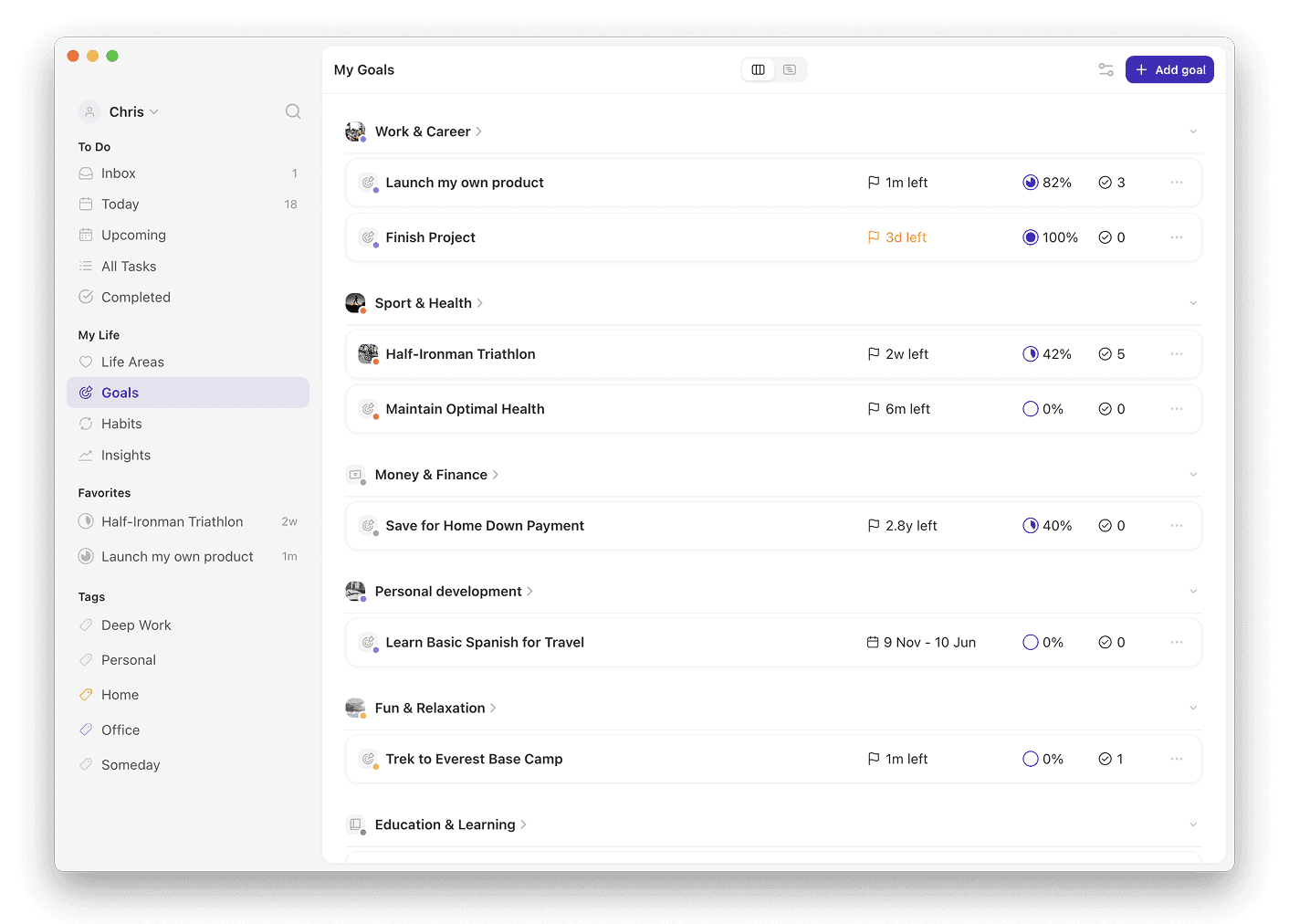
Griply does not have a "stack" object, because a stack is a technique you set up yourself. What Griply gives you is the parts to run the result: a scheduled habit with a reminder you can time to your anchor. Griply's hierarchy runs Life Area to Goal to Subgoal to Task or Habit.
A habit in Griply is a task with the habit flag set, so it carries a reminder, a schedule, and an optional link to a goal. Set the habit's reminder to the exact moment your anchor happens, like 7am coffee, so the stack fires without you remembering it. That solves the audit problem from earlier: you stop relying on an internal cue, because the reminder fires at the anchor time for you.
When you want a stacked habit to support a goal, link it to the goal it supports. The link is optional and keeps the habit visible against its goal; it does not auto-advance the goal's progress, which you still log yourself. The habit statistics, including completion rate, skips, and fails, show you when a stack is breaking down.
Frequently asked questions
What is the difference between a habit and a habit stack?
A habit is a single recurring action. A habit stack is that action attached to an existing one as its trigger, in the form "after I do X, I will do Y". The stack is what makes the habit fire reliably without you deciding each time.
How many habits can I stack at once?
Add one stack at a time and let it run for about a week before adding the next. Loading several new habits onto the same anchor in the same week is the fastest way to break all of them. Friction adds up, so sequence the easiest first.
Is there an app for habit stacking?
Griply works well for stacking because a habit is a task you can schedule, set a reminder for at the anchor's exact time, and link to a goal for visibility. It has no dedicated "stack" button. Its statistics show you when a stack starts to fail.
How do I build habits with ADHD using stacking?
Anchor each new habit to something your environment already cues, like sitting at your desk or starting the kettle, so you do not have to remember it. The external anchor triggers the habit, so you do not depend on motivation. Keep the new habit under two minutes until it is automatic.
What makes a good anchor habit?
A good anchor happens at the same time, in the same place, every day, without you planning it. Test any candidate against those three checks first. Actions you do "most days" are not anchors yet, and a stack built on them will not hold.
Why the anchor audit comes first
The examples on this page work only as well as the anchors you attach them to. Most stacks that fail do not fail because the new habit was wrong; they fail because the anchor was never as automatic as you assumed. That is why the audit comes before the copy-paste list.
Pick one anchor that passes all three checks, attach the easiest new habit to it, and place that habit immediately after the anchor. Run it for a week before you add a second.
Related Guides
Wood, Wendy; Quinn, Jeffrey M.; Kashy, Deborah A. "Habits in everyday life: Thought, emotion, and action." Journal of Personality and Social Psychology, 2002. https://dornsife.usc.edu/wendy-wood/wp-content/uploads/sites/183/2023/10/Wood.Quinn_.Kashy_.2002_Habits_in_everyday_life.pdf
Neal, David T.; Wood, Wendy; Labrecque, Jennifer S.; Lally, Phillippa. "How do habits guide behavior? Perceived and actual triggers of habits in daily life." Journal of Experimental Social Psychology, 2012. https://dornsife.usc.edu/wendy-wood/wp-content/uploads/sites/183/2024/01/neal.wood_.labrecque.lally_.2012.pdf
Gardner, Benjamin; Lally, Phillippa; Wardle, Jane. "Making health habitual: the psychology of 'habit-formation' and general practice." British Journal of General Practice, 2012. https://pmc.ncbi.nlm.nih.gov/articles/PMC3505409/
Judah, Gaby; Gardner, Benjamin; Aunger, Robert. "Forming a flossing habit: an exploratory study of the psychological determinants of habit formation." British Journal of Health Psychology, 2013. https://pubmed.ncbi.nlm.nih.gov/22989272/