Guide


Table of Contents
A habit stacking template is a tool that pairs a new habit with one you already perform automatically, so the existing habit becomes the trigger that fires the new one. No new reminders to set up, no willpower to summon at the right moment. The existing routine carries the new habit along with it.
James Clear's Atomic Habits gave this a name in 2018, but the logic is older than the term: if you want a new behaviour to stick, anchor it to something that already sticks. The formula is: "After I [CURRENT HABIT], I will [NEW HABIT]." Two habits, linked by one sentence.
Most articles explain the concept and leave you to figure out the rest. This one goes further: the examples section maps stacks to five life areas so you can see the formula applied, and the template section gives you something you can fill in and start today.
Key takeaways
Habit stacking works because it borrows the cue from an established habit rather than creating a new one from scratch, which removes the need for willpower at the moment of action.
The strongest habit stacks use an anchor that happens at the same time and place every day: making coffee, brushing your teeth, sitting down at your desk.
People with ADHD often find habit stacking more reliable than traditional habit-building approaches because the external anchor replaces the internal cue that ADHD makes unreliable.
Griply's Habit Tracker connects each stacked habit directly to a goal in your hierarchy, so you can see whether the habits you're building are actually moving you forward.
Habit stacking works by borrowing a trigger you already have
Habit stacking is the practice of attaching a new habit to an existing one so that the existing habit acts as a trigger. The existing habit is called the anchor. The new habit follows it automatically.
The trigger requires no reminder because the anchor already happens on its own. You brush your teeth every morning without deciding to. If you attach "two minutes of journalling" to that moment, the brush fires the journal.
BJ Fogg described this as "anchoring" in Tiny Habits before Clear popularised the habit stacking label. Both frameworks share the same core insight: new habits need borrowed cues.
The formula is one sentence, but specificity is what makes it fire reliably
The formula is one sentence: "After I [CURRENT HABIT], I will [NEW HABIT]."
Your anchor habit goes in the first slot. It should be automatic: something you do at the same time and place every day without thinking about it. Common anchors include making coffee, brushing your teeth, sitting down at your desk, getting into your car, or locking the front door at night.
Your new habit goes in the second slot. It should be small enough that friction is near zero. If the stack feels like an effort, the new habit is either too large or the anchor is wrong.
Specificity matters here. "After I pour my morning coffee, I will write one sentence in my notebook" works. "After I wake up, I will journal" doesn't. Waking up is not a discrete physical action, so it never fires a reliable trigger.
One habit stacking example per life area to make the formula concrete
These five habit stacking examples are mapped to common life areas. Each uses the formula exactly.
For health: after you turn off your alarm, do five minutes of stretching. This anchors movement to one of the first automatic actions of the day, before your phone gets involved.
For learning: after you sit down at your desk each morning, read one page of a non-fiction book. The transition to your workspace happens regardless. The reading attaches to it.
For finances: after you pay a bill online, log one expense in your budget tracker. The payment triggers the logging, rather than leaving logging as a separate task you'll forget later.
For relationships: after you pour your evening tea, send one message to a friend or family member you haven't spoken to recently. A simple anchor for a habit that otherwise slips through the week.
For career: after you close your laptop at the end of the workday, write down your three priorities for tomorrow. This turns shutdown into a transition rather than just stopping.
Your habit stacking template
Here is a habit stacking template you can fill in and start using today. Copy it and start with one stack before adding more.
Fill it in for each major transition in your day. Morning and evening are the most reliable anchors to start with; a midday one can be added once those two are running. A spread of stacks prevents any single window from becoming overloaded.
Once your stacks are on paper, the next step is making sure they actually happen. The Griply section below covers how to schedule and track them.
Why habit stacking fails
Most habit stacking attempts collapse for one of three reasons.
The anchor isn't consistent. If your anchor is "after I finish work" but your finish time shifts by two hours from day to day, the trigger never fires reliably. Pick an anchor that happens at the same clock time regardless of what else the day brings.
The new habit is too large. A 45-minute workout attached to "after I brush my teeth" is just a new routine: too big to survive friction in the early days. Keep the new habit under five minutes and expand it once the pattern is automatic.
The stack doesn't connect to anything you care about. Habits built for their own sake tend to collapse once novelty fades. A stack lasts longer when it's tied to a goal you've already committed to.
Habit stacking is more reliable for ADHD because it replaces internal cues with external ones
Traditional habit-building advice often fails people with ADHD. It assumes you can remember to do something when the right moment arrives, or that you'll feel motivated when it's time to start. These are exactly the kinds of internal cues ADHD disrupts.
Habit stacking works differently. It replaces internal cues with external ones: the anchor fires the new habit, so you don't need to remember it or feel motivated to start. The environment does the triggering.
This is why habit stacking tends to work better for ADHD users than generic habit advice. It builds a routine that works with your brain rather than against it.
How Griply makes habit stacking stick
The template gets you to the starting line. What kills a habit stack is not usually a bad anchor. It's that the new habit has no stake in anything. Once novelty fades and motivation dips, a stack with no goal connection gives you no reason to return after you miss a day.
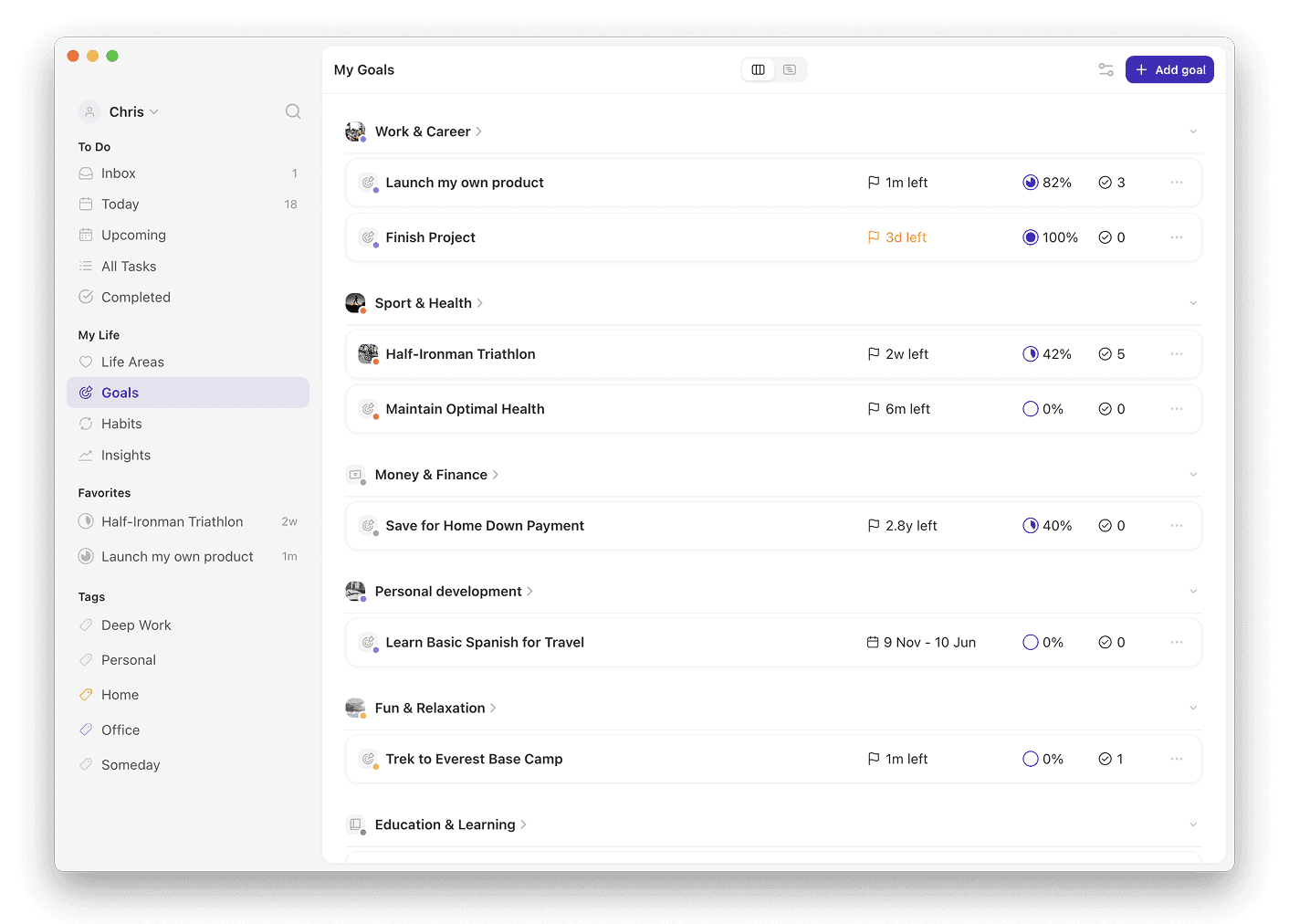
Griply's Habit Tracker solves the stake problem first. Every habit in Griply sits inside the hierarchy Life Area → Goal → Habit, so you can see, at any point, whether the habits you're stacking are moving your goals forward or just filling your calendar. When the new habit connects to a goal you've already committed to, missing a stack has a visible cost rather than a vague sense of failure.
The reminder feature solves the timing problem: set it for the exact moment your anchor habit happens. If you make coffee at 7am, set the reminder for 7am; if you lock the door at 9pm, set it for 9pm. The push notification then fires at the right moment without you having to remember.
Completion, skip, and fail statistics surface early breakdowns before they become permanent gaps, giving you the data to adjust the stack rather than abandon it. You can see exactly where the sequence is breaking down and correct the anchor before the habit disappears entirely.
If you're building a morning routine around several stacked habits, the morning routine guide covers how to sequence them into a structured block.
Frequently asked questions
How many habits can I stack at once?
Start with one stack and run it for at least two weeks before adding another. Phillippa Lally's 2010 study found habit formation takes an average of 66 days, so stacking too quickly means adding habits before earlier ones are automatic. One solid stack is worth more than five fragile ones.
Does the new habit have to come immediately after the anchor?
Yes, immediately. A gap of even a few minutes lets another stimulus break the chain. The transition from anchor to new habit should be one continuous move, not two separate events with a pause in between.
What is the difference between habit stacking and habit chaining?
Habit stacking links one new habit to one established anchor; habit chaining links multiple new habits in sequence. Chains are more fragile because if one link fails, the habits that follow tend to go with it. Start with individual stacks before you attempt chains.
Can I use Griply to track habit stacks?
Yes. Create the new habit in Griply, set the reminder for your anchor habit's time, and connect it to the goal it supports. Griply's Habit Tracker shows completion, skip, and fail statistics per habit, so you can see quickly whether a stack is holding or needs adjusting.
What if I can't find a good anchor habit?
List everything you do at a fixed time without thinking: make coffee, check your phone, sit in the car, lock the front door, brush teeth, sit down for lunch. Pick the one that happens closest to when you'd ideally do the new habit. Proximity to the right time matters more than finding the perfect anchor.
Habit stacking breaks down when the new habit has nothing to move forward
Habit stacking works because it doesn't ask you to generate motivation from scratch. It borrows the trigger from a habit you've already built and attaches a new action to it. The formula is simple: after the anchor, the new habit follows.
Use the habit stacking template above to write your first stack. Keep the new habit small and anchor it to something that runs at the same time every day. Tying that habit to a goal is what separates a stack that lasts from one that fades after two weeks.
Related Guides
Clear, James. Atomic Habits: An Easy & Proven Way to Build Good Habits & Break Bad Ones. Penguin Random House, 2018. https://jamesclear.com/atomic-habits
Fogg, BJ. Tiny Habits: The Small Changes That Change Everything. Houghton Mifflin Harcourt, 2020. https://tinyhabits.com/
Lally, Phillippa, et al. "How are habits formed: Modelling habit formation in the real world." European Journal of Social Psychology, 2010. https://onlinelibrary.wiley.com/doi/abs/10.1002/ejsp.674