Guide

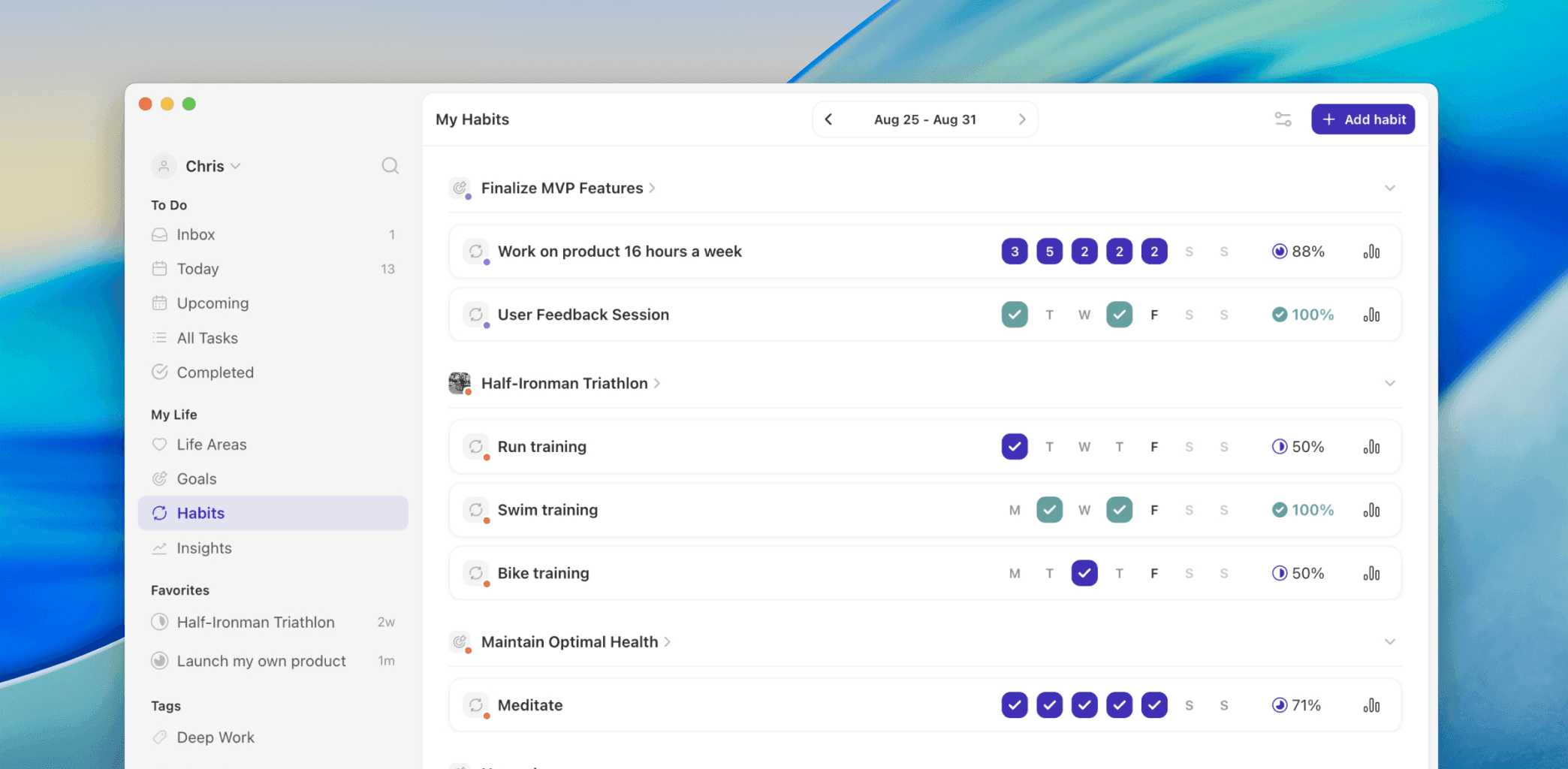
Table of Contents
Habit tracker ideas are the daily actions you choose to log, each tied to a specific goal rather than a generic wellness checklist. Most lists hand you the same 30 items: drink water, meditate, exercise, journal. Those habits aren't bad choices, but they're disconnected from what you're actually trying to achieve.
The right habit tracker ideas are the ones tied to a goal you've already committed to. Pick habits from a generic list and you end up with a tracker that feels like a wellness report card: something to feel guilty about rather than something that moves your life forward.
Good habits to track across five life areas are covered below, with each idea mapped to the kind of goal it supports. There's also a framework for deciding what to track in a habit tracker before you open any app, so every habit you add has a clear reason to be there.
Whether you're setting up a tracker for the first time or rebuilding one that stopped sticking, the framework is the same: start with the goal, then choose the habit.
Key takeaways
Before adding anything to your tracker, place it in a life area (health, career, finances, learning, or relationships) and name the goal it serves. The life area structure is the filter that stops the list from ballooning.
The goal generates the habit, not the other way around: a target like "run a half marathon by October" points directly to the specific daily actions worth tracking.
Habit tracking works best when each habit has a visible connection to a goal: Griply's Habit Tracker lets you link every habit to a goal in its hierarchy, so checking off a habit advances something you've already decided to pursue.
Beginners should start with two to three habits per life area rather than building an exhaustive tracker that becomes hard to maintain within the first month.
Habit tracker ideas at a glance (by life area)
Health & fitness: daily movement, sleep consistency, daily water target, food constraint
Career & work: deep work block, skill practice, weekly review, weekly outreach
Money & finances: daily spending log, weekly budget check, scheduled savings transfer
Learning & development: daily reading, language practice, daily writing or creation
Relationships: weekly call with a distant contact, daily check-in with a close person, weekly social activity
Each habit is covered in full below, with the goal it serves and how to track it.
Why most habit tracker idea lists don't work
The average "habit tracker ideas" article lists 50 or 100 habits. Some are useful, but many are vague.
The logic is backwards. You pick habits first, then hope they lead somewhere.
A habit has a job to do. That job is to push a specific goal forward, in a specific area of your life. Without that connection, a habit is just a routine with no destination.
How to decide what to track in a habit tracker
Start with your goals, not the habits. For each goal, ask: what daily or weekly action makes the biggest difference to whether I reach this?
That answer is the habit worth tracking. A goal like "lose 10 kg by September" points directly to a handful of daily habits: workout completion, calorie tracking, or a daily step count.
You don't need a list to find those. The goal generates them.
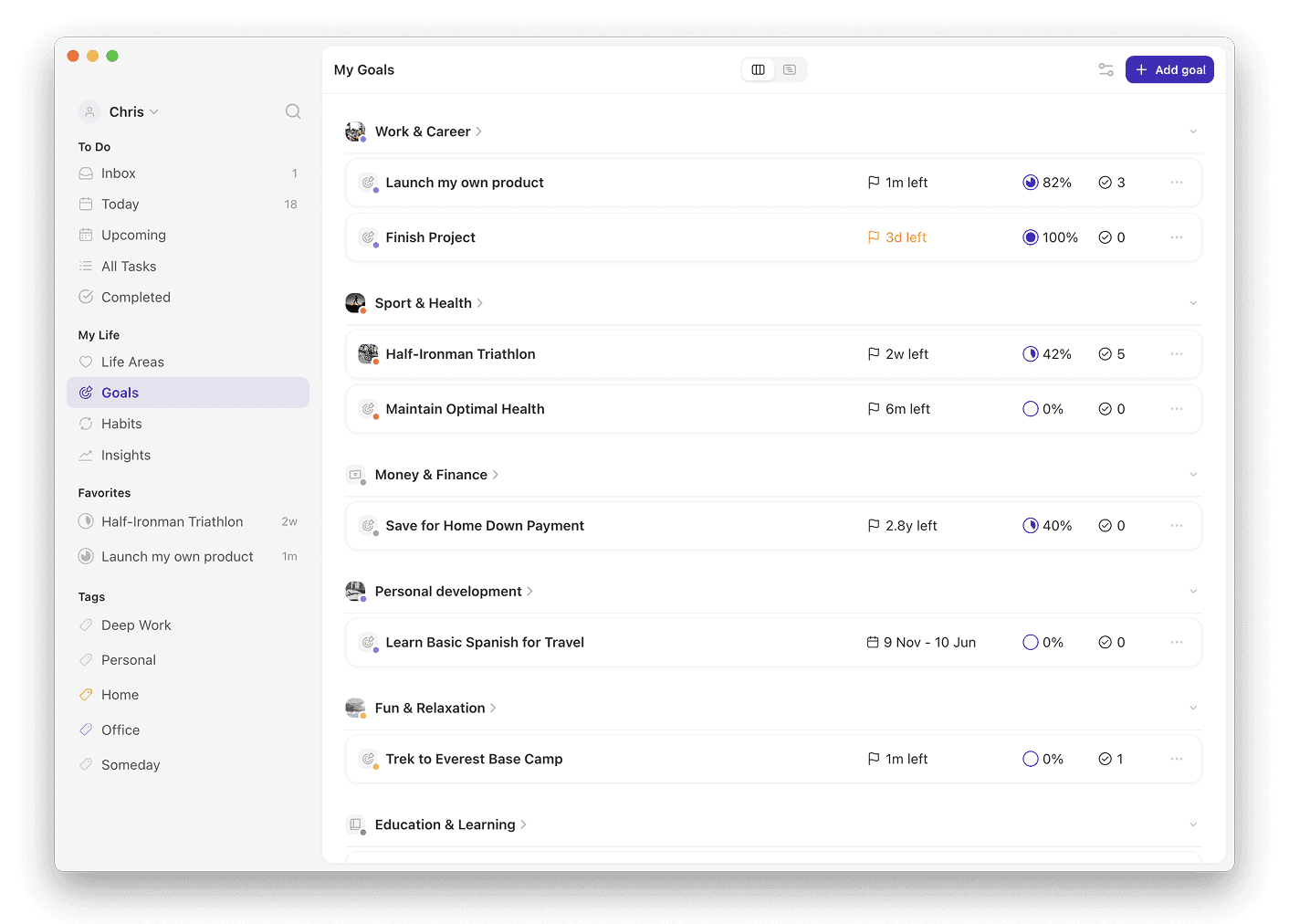
Once you have a habit in mind, map it to a life area. This is the structure behind Griply's Goal Planner: Life Area → Vision → Goal → Habit. When a habit sits inside that chain, checking it off each day tells you something concrete about your progress toward the thing that actually matters.
Health and fitness habits work best when tied to a specific target
Running a half marathon or building consistent fitness
Daily movement: log it as a daily binary. Did you complete a run, walk, or workout? A 20-minute session tracked consistently builds the kind of compound progress that sporadic longer efforts don't.
If you're building a morning exercise routine, the guide to productive morning routines covers how to anchor health habits at the start of the day where they're hardest to skip.
Losing weight or improving nutrition
Food constraint: track a simple restriction (no processed food at lunch, or no alcohol on weekdays) as a daily yes/no check. This is often easier to maintain than a positive habit because the check-in is binary.
Daily water target: hydration affects concentration and physical performance in ways that accumulate over weeks. A daily minimum is a low-resistance habit with a direct line to how you feel each morning.
Improving sleep quality or raising your daily energy
Sleep consistency: Matthew Walker's research in Why We Sleep shows that a consistent bedtime and wake time matters as much as total hours slept. If your goal is better energy or weight management, sleep regularity is the lever you can act on.
Career habits that move goals forward require daily consistency, not intensity
Earning a promotion or advancing in your role
Deep work block: Cal Newport defines deep work as distraction-free, cognitively demanding work that produces real output rather than the appearance of busyness. Track a 90-minute daily session and your output on complex tasks will shift within a few weeks.
Weekly review: a 30-minute end-of-week check on what moved your goals forward is one of the most effective habits for anyone with professional goals. Stephen Covey's framework in The 7 Habits of Highly Effective People calls this sharpening the saw: the habit that keeps all other habits running effectively.
Landing new clients or growing your network
Weekly outreach: one message a week creates forward motion that passive effort doesn't, and that pace adds 52 new contacts a year. Track whether you sent one message this week, not how many.
Launching a side project or building a portfolio
Skill practice: for coding, writing, or design goals, 20 minutes of daily practice builds more progress than a two-hour session once a week. Track whether you showed up to practice, not how it felt or what you produced.
Financial habits only stick when tied to a specific number
Financial habits work best when they're tied to a specific number. Before setting any up, name the goal exactly: not "save more money" but "save £10,000 by December."
Building an emergency fund or paying off debt
Daily spending log: a two-minute log keeps small leaks visible before they compound and creates the data you need to make better decisions.
Weekly budget check: a 10-minute review covering income, spending, and savings progress keeps you oriented before the next week's decisions pile up. Set a consistent day so the habit has a fixed cue.
Hitting a savings or investment target
Savings transfer: track it as a monthly binary. Did the transfer happen on the 1st? Name it specifically (£X to savings each month) so the habit connects to a number you've already committed to.
Learning habits are the most underused category in most trackers
Learning goals are where habit trackers are most underused. Most people track exercise but not the habits that build their knowledge.
Reading more books
Daily reading: James Clear argues in Atomic Habits that even 20 pages a day produces 12 to 15 books a year. Track it as a daily minimum, not a target to maximise.
Learning a language or completing a course
Language practice: a daily 15-minute session outperforms a two-hour session once a week. Distributed practice is one of the highest-utility learning strategies: more frequent, shorter retrievals build retention more reliably than massed study. For language learners, this means a daily habit is not just more convenient than a weekly session, it is measurably more effective at building recall.
Starting a newsletter or building a writing practice
Daily writing: the output matters less than showing up. A journal entry, a short draft, or a paragraph posted somewhere creates the consistency that irregular bursts don't.
Relationship habits are measurable: most trackers don't include them
Relationship goals are the most commonly neglected in habit trackers, often because the habits feel less measurable. They aren't.
Strengthening a long-distance friendship or family relationship
Weekly call: specific enough to check off, and one call a week creates 52 touchpoints a year that wouldn't otherwise happen. Track it as a single binary for each person you want to stay close to.
Being more present with family or a partner
Daily check-in: a real question to a partner or close family member rather than a logistics update. Track it as done or not done. Over months, this habit builds the relational consistency that good intentions rarely create on their own.
Building a new social circle
Weekly social event: block one planned activity per week and track whether it happened. One event a week adds up to 52 opportunities to deepen existing friendships or build new ones.
How Griply connects your habit tracker ideas to the goals behind them
The problem with generic habit lists is that every item looks equally valid. "Drink water" and "run 5k" sit side by side with nothing to explain which matters more, or why you added them. Without a goal structure, the tracker becomes a guilt log: a record of what you failed to do rather than a measure of how far you've come.
Griply's Habit Tracker closes that gap by letting you anchor each habit inside the hierarchy that gives it meaning: Life Area → Vision → Goal → Habit. When you define a Sport & Health life area, set a goal (Run a half marathon by October), and attach a habit (Morning run, 5x per week) inside that goal, checking off the habit is no longer a box-tick. It's a visible contribution to something you've already committed to.
Completion, skip, and fail statistics show you which habits are holding and which need adjusting, before the pattern hardens into a streak you're maintaining out of obligation. For habits tied to a measurable target, the Goal Planner lets you log progress against the goal metric and see it charted over time, so the connection between the daily action and the outcome stays concrete rather than abstract.
Frequently asked questions about habit tracker ideas
How many habits should I track at once?
Three to five habits per life area is a practical starting point. Habit automation takes an average of 66 days, so start with fewer and add more once the first ones are automatic, rather than tracking 20 from day one.
What are good habits to track for beginners?
For beginners, the most reliable habit tracker ideas are the ones connected to a goal you genuinely care about, with a daily check-in that takes under two minutes. A morning exercise habit tied to a fitness goal, or a daily reading habit tied to a learning goal, are good starting points because the feedback loop is immediate and the connection to the goal is obvious.
How do I decide what to track in a habit tracker?
Write down one goal per life area you care about most. For each goal, ask: what is the single daily action most likely to move me toward it? Start with one habit per goal, then add more once the first feels close to automatic.
Do habit tracker apps work?
The tracker itself doesn't make habits form. Consistency does. Apps that connect habits to a visible goal give you a stronger reason to return daily than apps that only show a streak counter. The goal context is what turns a tracker from a guilt log into a progress tool. Griply's Habit Tracker lets you link every habit to a goal in its hierarchy, so each completion registers as progress toward something you have already committed to.
Should every habit in my tracker be connected to a goal?
Some habits, like sleep timing or hydration, are worth tracking as standalone health practices. But for habits you struggle to maintain, the goal connection is often the missing piece. Seeing that a habit feeds a goal you care about gives you a reason to return after you break the streak.
Start with the goal and the habit list writes itself
The question "what should I put in my habit tracker?" is really two questions: what do you want to achieve, and what daily action moves you closest to it? Answer those in order and your habit list writes itself.
Start with one life area: health, work, or finances, wherever the goal pressure is highest right now. Define the goal, then choose one or two habits that serve it. Get those consistent before you expand.
Related Guides
Lally, Phillippa, et al. "How are habits formed: Modelling habit formation in the real world." European Journal of Social Psychology, 2010, https://onlinelibrary.wiley.com/doi/abs/10.1002/ejsp.674.
Clear, James. Atomic Habits. Avery, 2018, https://jamesclear.com/atomic-habits.
Newport, Cal. Deep Work: Rules for Focused Success in a Distracted World. Grand Central Publishing, 2016, https://calnewport.com/books/deep-work/.
Walker, Matthew. Why We Sleep. Scribner, 2017, https://www.simonandschuster.com/books/Why-We-Sleep/Matthew-Walker/9781501144325.
Dunlosky, John, et al. "Improving Students' Learning With Effective Learning Techniques: Promising Directions From Cognitive and Educational Psychology." Psychological Science in the Public Interest, 2013, https://pubmed.ncbi.nlm.nih.gov/26173288/.
Covey, Stephen R. The 7 Habits of Highly Effective People. Simon & Schuster, 1989, https://www.simonandschuster.com/books/The-7-Habits-of-Highly-Effective-People/Stephen-R-Covey/9781982137274.