Guide


Table of Contents
You open your eyes and immediately check your phone. Notifications, emails, a message from a colleague. Before you've had coffee, someone else's priorities are already shaping your day.
A productive morning routine is a fixed sequence of habits you run before your first task of the day, designed to put your goals ahead of external demands. It doesn't have to take two hours or involve ice baths. It has to happen before the reactive part of your day begins.
Most people have a morning routine in the same way they have a plan to get fit: loosely formed, easily disrupted, and abandoned at the first difficult week. What actually works is different. The science behind habit formation, what a morning routine checklist should include, and how to build a routine that lasts are all covered below.
Key takeaways
A productive morning routine is a fixed set of habits that runs before your first external demand (email, meeting, or notification) and consistently takes under 60 minutes to complete.
Habit formation takes an average of 66 days, not 21, so expecting your morning routine to feel automatic in three weeks sets you up for unnecessary frustration.
A morning routine checklist works best when it is short, sequenced, and connected to a specific goal you're actively pursuing.
Griply's Habit Tracker ties each morning habit directly to a goal in your hierarchy, so completing your routine advances something you've already committed to.
A productive morning routine doesn't need to be two hours: it needs to happen before the reactive day starts
A productive morning routine shouldn't have to be a productivity ritual borrowed from a CEO's bio. It's any set of intentional actions you take before your first obligation of the day, arranged in a fixed sequence, done consistently.
The word "productive" doesn't mean packed. A 20-minute routine that includes movement, a few minutes of planning, and a habit linked to a goal is more productive than a 90-minute sequence you abandon by Thursday.
Its defining characteristic is consistency: it runs on schedule regardless of how the rest of the day unfolds.
Why morning is the right time to build a routine
Your morning is the one window in the day you can claim before external demands arrive. Once your phone fills with notifications, your schedule partly belongs to other people. The habits you build into that window have a structural advantage that evening habits don't.
Morning habits also run before the day's decisions accumulate. By evening, you've made dozens of choices: what to prioritise, what to say in meetings, what to eat.
Adding another demanding habit at the end of that chain creates more friction. Running your morning routine before those decisions begin reduces it.
Where you put a habit determines whether it holds.
The 66-day rule: what habit science actually says
You've probably heard that it takes 21 days to form a habit. That figure traces to a misreading of informal observations by a plastic surgeon writing about patient adaptation times, not a controlled study on behaviour change.
A 2010 study at University College London tracked 96 participants over 12 weeks as they worked to form new habits. The average time to reach automaticity was 66 days, with individual results ranging from 18 to 254 days.
If your routine doesn't feel effortless after three weeks, that is normal, not a sign of failure. Missing a single day also had no meaningful impact on long-term habit formation in the study. Missing many consecutive days did.
How to build a morning routine that connects to your goals
Most morning routines fail because they're collections of habits with no shared purpose. You might have meditation, cold showers, journaling, and a workout, each backed by good reasoning but none of them connected to what you're actually trying to accomplish this year.
James Clear's four-step habit loop from Atomic Habits (cue, craving, response, reward) gives a framework for habits that hold. The cue triggers the habit; the craving provides the motivation to act; the response is the behaviour itself; the reward closes the loop. For a morning habit to stick, all four steps need to be present.
Start by picking one or two habits directly tied to a current goal. If your goal is completing a half-marathon, a 20-minute morning run is the habit. If your goal is writing a book, 30 minutes of writing before email is the habit.
For a complementary perspective rooted in character and principle rather than behavioural psychology, see the guide to Stephen Covey's 7 Habits of Highly Effective People.
Morning routine checklist: what to include (and what to cut)
A morning routine checklist should be short enough to complete on a bad day. If you can only do it when conditions are perfect, it is an aspiration, not a routine.
A structure that works across goals and schedules:
One physical movement habit: a walk, run, stretching sequence, or workout. Ten minutes of movement changes your cognitive state for the hours that follow. This doesn't need to be long.
One planning habit: review your goals for the day or confirm your most important task. Five minutes of intention prevents the reactive spiral.
One goal-linked habit: whatever moves your main goal forward. Writing, studying, practising, building. This is the item that earns your morning routine its purpose.
A morning routine planner, whether a physical notebook or a digital tool like Griply, makes this concrete. The difference between a list in your head and a written sequence is the difference between an intention and a commitment.
What to cut: anything you included because someone else does it. Cold showers, journaling, and elaborate preparation rituals belong in your routine only if they connect to a goal you're working on.
Morning routine mistakes that quietly kill the habit
The most common morning routine mistake is designing for your best day. You plan a 90-minute sequence on a Sunday when you have time. By Wednesday, with an early meeting and a poor night's sleep, the whole thing collapses.
Design for your worst day instead. Your baseline routine should run in 20 minutes or fewer. On good days, you can extend it. On hard days, the shorter version preserves the habit.
The second mistake is copying someone else's routine wholesale. There is no evidence that waking at 5am or cold showers produce results independent of the surrounding habits. Build from the goal outward: what do you need to do every morning to make progress on what matters most?
The third: treating a missed morning as a failed routine. The research shows missing one day doesn't break a habit. The only thing that breaks a routine is deciding one missed day means the routine is over.
How Griply helps you build a productive morning routine
The reason most morning routines collapse by week two is not lack of discipline. It's lack of visibility. Each habit sits in a list with no explanation of what it's for. Skipping a habit feels like nothing because nothing visibly changes.
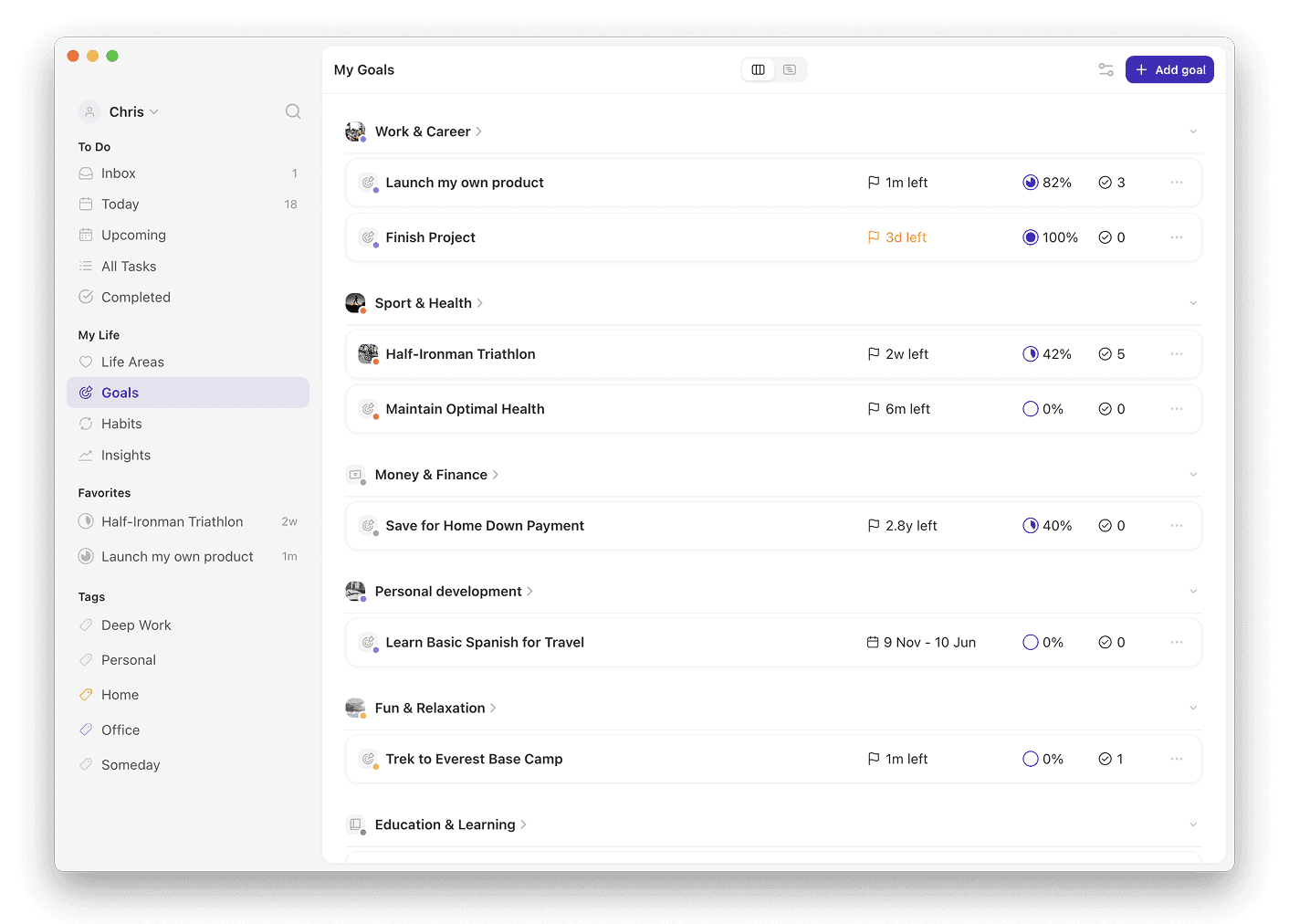
Griply's Habit Tracker ties every morning habit to a goal in your personal hierarchy: Life Area → Vision → Goal → Habit. When your morning run is linked to your fitness goal, and that goal traces back to a life area and a vision you've written down, skipping the habit has a visible cost, not just a vague sense of guilt. The goal connection is what gives the routine its reason to exist beyond day one.
The Today view surfaces your morning routine items alongside your calendar, showing which goal each habit serves and what else is planned. The daily push notification gives you an overview of habits scheduled for the day before the reactive part of your morning begins, so the routine is visible before anything else claims your attention.
Completion, skip, and fail statistics show you, over time, which morning habits are genuinely holding and which are stalling, so you can adjust the routine before it collapses entirely rather than after.
Frequently asked questions
What is a productive morning routine?
A productive morning routine is a fixed sequence of habits completed before your first obligation of the day, designed to put your goals ahead of external demands. It typically includes physical movement, a planning step, and at least one habit tied to a goal you're actively pursuing.
How long does it take to form a morning routine?
Habit formation takes an average of 66 days, with a range of 18 to 254 days depending on the individual and the habit. Expecting automaticity in 21 days is a common misconception. Missing a single day during the formation period has no significant impact on long-term habit strength.
What should I include in a morning routine checklist?
A morning routine checklist should include one physical movement habit (10 to 30 minutes), one planning step (review your goals or confirm your most important task for the day), and one habit directly tied to your main current goal. Keep the total under 60 minutes so the routine survives difficult mornings. Add items only when the core sequence feels stable.
What's the best morning routine app?
The best morning routine app connects your habits to the goals they're meant to support. Generic habit trackers record whether you completed a habit but not why it matters. Griply's Habit Tracker lets you tie each habit to a goal in your personal hierarchy, so your morning routine is part of a system rather than a separate list. It is available on iOS, Android, and desktop with full feature parity across all of them.
How do I stick to a morning routine?
Design your baseline routine for your worst day, short enough to complete when you're tired, pressed for time, or not motivated. Use a consistent cue (the same alarm time, the same first action) to anchor the sequence. And when you miss a day, start again the next morning without treating the gap as failure.
A morning routine collapses without a goal for each habit to serve
Your morning is the one part of the day you can claim before external demands arrive. What you do with that window, whether it's reactive or intentional, shapes the quality of what follows.
The science is clear: habit formation takes longer than 21 days, consistency matters more than perfection, and the habits most likely to stick are the ones connected to something you already care about.
If you want to build a productive morning routine that doesn't collapse by mid-week, start small, connect each habit to a goal, and give the sequence time to become automatic.
Related Guides
Lally, Phillippa, Cornelia H. M. Van Jaarsveld, Henry W. W. Potts, and Jane Wardle. "How Are Habits Formed: Modelling Habit Formation in the Real World." European Journal of Social Psychology 40, no. 6 (2010): 998–1009. https://onlinelibrary.wiley.com/doi/abs/10.1002/ejsp.674
Clear, James. Atomic Habits: An Easy & Proven Way to Build Good Habits & Break Bad Ones. Avery/Penguin Random House, 2018. https://jamesclear.com/atomic-habits