Habit tracking is the practice of logging whether a recurring action happened on a given day so you can see the pattern over time. On its own, a tracker tells you what you did. It does not tell you why any of it mattered.
You write the same habit on a sticky note in January. You bought a planner with habit tracker grids last year, filled it for three weeks, and stopped. You have a yearly habit tracker bookmarked on your phone that you have not opened since February. The behaviour is familiar because the tool is the wrong shape for the problem.
The rest of this guide covers what a habit tracker actually is, how habits form in the brain, which frameworks hold up under research, and how to connect daily habits to long-term outcomes so the streak is worth keeping. You will see where generic habit tracking breaks down and why a goal-first approach closes the gap.
Key Takeaways
Habit tracking means logging whether a recurring action happened each day, so you can see the real pattern instead of guessing at it.
A new habit takes far longer to feel automatic than the popular 21-day rule suggests, closer to 66 days on average.
Around 40% of what you do each day runs on habit rather than a fresh decision, which is why the cue matters more than willpower.
Frameworks like James Clear's Four Laws of Behavior Change and B. J. Fogg's Behavior Model give you repeatable rules for building habits that stick past week three.
A monthly habit tracker beats a one-off daily checklist because 30 days of data shows where you slipped and a single day cannot.
Habits tied to a measurable goal last longer than habits tracked on their own.
What is a habit tracker and what habit tracking does
A habit tracker is a simple logging surface where you mark, for each day, whether a recurring action happened. The surface can be a paper grid, a spreadsheet, a planner with a habit tracker page, or a dedicated app. The job is the same across every form: turn an invisible pattern into a visible one so you can tell the difference between "I meant to" and "I did."
Habit tracking does three concrete things. First, it creates a feedback loop the brain can use, because progress that is measured tends to continue. Second, it reduces decision load, since the question shifts from "should I do this today" to "did I do this today." Third, it creates a record you can review weekly or monthly to see whether the habit is actually moving the outcome you care about. The third point is where most tools quietly stop working, because a completion rate on its own cannot tell you whether the habit was worth tracking at all.
A monthly habit tracker works better than a daily checklist for this reason. Thirty days of data shows you drift and recovery, where a single day of checkboxes shows you only today.
For a full breakdown, see 📘 How to build a productive morning routine connected to goals.
Building daily habits to improve life: what works
You do not build a habit by trying harder. You build one by making the cue obvious, the action small, and the completion visible. Fogg's Behavior Model states that behaviour happens when motivation, ability, and a prompt meet at the same moment, summarised as B = MAP.
Most failed habits fail on ability rather than motivation. The action was too big for a tired Wednesday.
The practical move is to shrink the habit until it fits the worst day of the week. A two-minute version still counts, and it is the one you can keep doing on a bad day. Clear's 1% compounding frame argues that small daily gains accumulate to roughly 37 times improvement over a year. The maths is less the point than the disposition: a tiny habit done every day outperforms a large habit done in bursts.
Daily habits to improve life tend to group into five domains: sleep, movement, attention, nutrition, and relationships. Pick one habit per domain rather than five habits in one domain. A planner with a habit tracker grid makes this visible at a glance.
For a full breakdown, see 📘 Habit tracker ideas organised by life area and goal.
Building daily habits to improve life: what works
You do not build a habit by trying harder. You build one by making the cue obvious, the action small, and the completion visible. Fogg's Behavior Model states that behaviour happens when motivation, ability, and a prompt meet at the same moment, summarised as B = MAP.
Most failed habits fail on ability rather than motivation. The action was too big for a tired Wednesday.
The practical move is to shrink the habit until it fits the worst day of the week. A two-minute version still counts, and it is the one you can keep doing on a bad day. Clear's 1% compounding frame argues that small daily gains accumulate to roughly 37 times improvement over a year. The maths is less the point than the disposition: a tiny habit done every day outperforms a large habit done in bursts.
Daily habits to improve life tend to group into five domains: sleep, movement, attention, nutrition, and relationships. Pick one habit per domain rather than five habits in one domain. A planner with a habit tracker grid makes this visible at a glance.
For a full breakdown, see 📘 Habit tracker ideas organised by life area and goal.
Morning routines and habit stacking: chaining habits to existing anchors
The fastest way to install a new habit is to attach it to one you already have. Fogg calls this an anchor: an existing routine that reliably fires in a specific context. Clear calls the same pattern habit stacking: after I do X, I will do Y. The anchor provides the cue you would otherwise have to manufacture.
A productive morning routine is the cleanest place to apply this. You already wake up, and you already drink water or coffee. Each of those is an anchor you can stack onto without relying on willpower at 6:47 a.m. 📘 Robin Sharma's 20/20/20 formula from The 5AM Club proposes a specific stack: 20 minutes of movement, 20 minutes of reflection, 20 minutes of learning, anchored to the wake-up cue.
The point is not the exact hour or the exact split. The point is that you chain new habits onto anchors that already exist, and you track the chain so you see which links hold. A habit streak of 14 days on a stacked routine tells you the anchor is strong. A habit streak of three days tells you to move the habit to a different anchor.
The 66-day myth and what the research shows
The The 21-day rule comes from Maxwell Maltz's 1960 book Psycho-Cybernetics, based on observations of plastic-surgery patients adjusting to new faces, not a study of habit formation. Lally and colleagues at University College London ran the first rigorous test in 2010 and found a median of 66 days to automaticity, with a range from 18 to 254 days across 96 participants.
The implication for habit tracking is direct. A three-week plan is set up to fail on week four, because the brain has not yet automated the response. The tracker that shows a 21-day streak and then an empty week is the tracker doing its job: it is telling you the habit was not yet automatic when you stopped paying attention.
Range matters more than median. A new water-drinking habit might automate in three weeks; a 45-minute workout might take eight months. A monthly habit tracker is the minimum to reveal this, and a yearly one spans the full range.
One nuance most guides skip: tracking is not free. Deci and Ryan's self-determination theory shows that for behaviours you already enjoy, measurement can corrode the intrinsic motivation that was doing the work — the overjustification effect. The practical rule: track the habits you would otherwise skip, do not track the habits you already love, and anchor any tracked habit to a goal rather than to the streak itself.
For a full breakdown, see 📘 Habit stacking template: build new habits that stick.
The 66-day myth and what the research shows
The The 21-day rule comes from Maxwell Maltz's 1960 book Psycho-Cybernetics, based on observations of plastic-surgery patients adjusting to new faces, not a study of habit formation. Lally and colleagues at University College London ran the first rigorous test in 2010 and found a median of 66 days to automaticity, with a range from 18 to 254 days across 96 participants.
The implication for habit tracking is direct. A three-week plan is set up to fail on week four, because the brain has not yet automated the response. The tracker that shows a 21-day streak and then an empty week is the tracker doing its job: it is telling you the habit was not yet automatic when you stopped paying attention.
Range matters more than median. A new water-drinking habit might automate in three weeks; a 45-minute workout might take eight months. A monthly habit tracker is the minimum to reveal this, and a yearly one spans the full range.
One nuance most guides skip: tracking is not free. Deci and Ryan's self-determination theory shows that for behaviours you already enjoy, measurement can corrode the intrinsic motivation that was doing the work — the overjustification effect. The practical rule: track the habits you would otherwise skip, do not track the habits you already love, and anchor any tracked habit to a goal rather than to the streak itself.
For a full breakdown, see 📘 Habit stacking template: build new habits that stick.
Why a planner with habit tracker fails without a shared goal layer
Most people run their daily planner and their habit tracker as two separate systems, and the gap between them is where progress gets lost. Your tracker says you meditated six times this week; your planner says the project milestone is overdue. Neither tool knows whether the habits you are completing are connected to the outcomes you are trying to reach.
Tracking progress reliably helps you reach a goal, but only when the tracking points at a specific goal, a finding from a 2016 meta-analysis of 138 studies. A habit completion rate with no goal above it records effort rather than progress. The fix is to link every habit to the goal it is supposed to serve, visible in the same daily view where you schedule your day.
For a complete guide, see 📘 Planner with habit tracker: why most combinations fail.
Why a planner with habit tracker fails without a shared goal layer
Most people run their daily planner and their habit tracker as two separate systems, and the gap between them is where progress gets lost. Your tracker says you meditated six times this week; your planner says the project milestone is overdue. Neither tool knows whether the habits you are completing are connected to the outcomes you are trying to reach.
Tracking progress reliably helps you reach a goal, but only when the tracking points at a specific goal, a finding from a 2016 meta-analysis of 138 studies. A habit completion rate with no goal above it records effort rather than progress. The fix is to link every habit to the goal it is supposed to serve, visible in the same daily view where you schedule your day.
For a complete guide, see 📘 Planner with habit tracker: why most combinations fail.
Where a paper bullet journal habit tracker leaves you stranded
A bullet journal habit tracker is the analog version of everything above: a hand-drawn grid where you mark each habit by hand, from Ryder Carroll's Bullet Journal Method. The handwritten ritual is worth respecting, since writing by hand makes you process the choice more deliberately than tapping a box. The trouble is what the paper cannot do.
A paper grid has no field for the goal a habit serves, so the row is measured only against itself. It has no reminder, so it works only on the days you remember to open the notebook. And it never does the arithmetic, so your completion rate and your slipped weeks stay buried until you count them by hand. Those are limits of paper, and they are exactly the gaps a goal-linked digital tracker closes while keeping the reflective act.
For a complete guide, see 📘 The bullet journal habit tracker, and where paper leaves you stranded.
Where a paper bullet journal habit tracker leaves you stranded
A bullet journal habit tracker is the analog version of everything above: a hand-drawn grid where you mark each habit by hand, from Ryder Carroll's Bullet Journal Method. The handwritten ritual is worth respecting, since writing by hand makes you process the choice more deliberately than tapping a box. The trouble is what the paper cannot do.
A paper grid has no field for the goal a habit serves, so the row is measured only against itself. It has no reminder, so it works only on the days you remember to open the notebook. And it never does the arithmetic, so your completion rate and your slipped weeks stay buried until you count them by hand. Those are limits of paper, and they are exactly the gaps a goal-linked digital tracker closes while keeping the reflective act.
For a complete guide, see 📘 The bullet journal habit tracker, and where paper leaves you stranded.
Why tracking character habits matters as much as outcome habits
Most habit tracking focuses on behaviour, while Stephen Covey's framework focuses on character. The 7 Habits of Highly Effective People argues that durable change starts with the Private Victory (habits 1 to 3: be proactive, begin with the end in mind, put first things first), which moves you from dependence to independence, before the Public Victory (habits 4 to 6: think win-win, seek first to understand then to be understood, synergise) takes you from independence to interdependence. Habit 7, sharpen the saw, is the renewal layer that keeps the other six working. The order matters because behaviour without character reverts the moment pressure returns.
This is relevant to habit tracking because a tracker shaped only around outcomes tends to miss the character habits entirely. A "be proactive" habit is harder to check off than a "run 5 km" habit, but it is the one that produces the next five years of 5 km runs. The practical response is to track both kinds side by side, so the character layer stays visible even when the numbers on the outcome layer are quiet.
Covey's second habit, begin with the end in mind, is also the argument for connecting every tracked habit to a goal and a vision, which is the territory the life planning guide covers in depth.
For a full breakdown, see 📘 Apply the 7 Habits of Highly Effective People in your daily life.
Why tracking character habits matters as much as outcome habits
Most habit tracking focuses on behaviour, while Stephen Covey's framework focuses on character. The 7 Habits of Highly Effective People argues that durable change starts with the Private Victory (habits 1 to 3: be proactive, begin with the end in mind, put first things first), which moves you from dependence to independence, before the Public Victory (habits 4 to 6: think win-win, seek first to understand then to be understood, synergise) takes you from independence to interdependence. Habit 7, sharpen the saw, is the renewal layer that keeps the other six working. The order matters because behaviour without character reverts the moment pressure returns.
This is relevant to habit tracking because a tracker shaped only around outcomes tends to miss the character habits entirely. A "be proactive" habit is harder to check off than a "run 5 km" habit, but it is the one that produces the next five years of 5 km runs. The practical response is to track both kinds side by side, so the character layer stays visible even when the numbers on the outcome layer are quiet.
Covey's second habit, begin with the end in mind, is also the argument for connecting every tracked habit to a goal and a vision, which is the territory the life planning guide covers in depth.
For a full breakdown, see 📘 Apply the 7 Habits of Highly Effective People in your daily life.
Morning routine checklists: why most miss the one item that matters
Most published morning routine checklists give you ten to twenty items and skip the structural piece that determines whether any of them matter: a deliberate decision about which goal today is in service of.
Without that anchor, the routine is a set of healthy activities with no strategic outcome. Making daily progress on work that matters is the single biggest driver of your engagement and creative output, a pattern found across 12,000 work diary entries. The word "meaningful" is what separates a productive morning routine from a productive-looking one.
A practical morning routine checklist includes one movement habit, one goal declaration, one habit tied to a current goal, and one planning step. Keep it short enough to complete on a difficult day. For a complete guide, see 📘 Morning routine checklist: the goal anchor most people skip.
Morning routine checklists: why most miss the one item that matters
Most published morning routine checklists give you ten to twenty items and skip the structural piece that determines whether any of them matter: a deliberate decision about which goal today is in service of.
Without that anchor, the routine is a set of healthy activities with no strategic outcome. Making daily progress on work that matters is the single biggest driver of your engagement and creative output, a pattern found across 12,000 work diary entries. The word "meaningful" is what separates a productive morning routine from a productive-looking one.
A practical morning routine checklist includes one movement habit, one goal declaration, one habit tied to a current goal, and one planning step. Keep it short enough to complete on a difficult day. For a complete guide, see 📘 Morning routine checklist: the goal anchor most people skip.
How to read a monthly habit tracker
A row shows one habit across the month; a column shows one day across all your habits. Reading by row tells you whether a habit is holding, and reading by column tells you which days tend to break.
The unit of review shifts from the streak to the completion rate. You stop asking whether you kept an unbroken chain and start asking what a normal month looks like for you. A month with four missed days and an 87% completion rate is a strong month, even though a streak counter would have read zero after the first miss.
This is why a monthly view suits habits you measure by accumulation rather than a daily chain. For a complete guide, see 📘 How a monthly habit tracker turns 30 days into real progress.
How to read a monthly habit tracker
A row shows one habit across the month; a column shows one day across all your habits. Reading by row tells you whether a habit is holding, and reading by column tells you which days tend to break.
The unit of review shifts from the streak to the completion rate. You stop asking whether you kept an unbroken chain and start asking what a normal month looks like for you. A month with four missed days and an 87% completion rate is a strong month, even though a streak counter would have read zero after the first miss.
This is why a monthly view suits habits you measure by accumulation rather than a daily chain. For a complete guide, see 📘 How a monthly habit tracker turns 30 days into real progress.
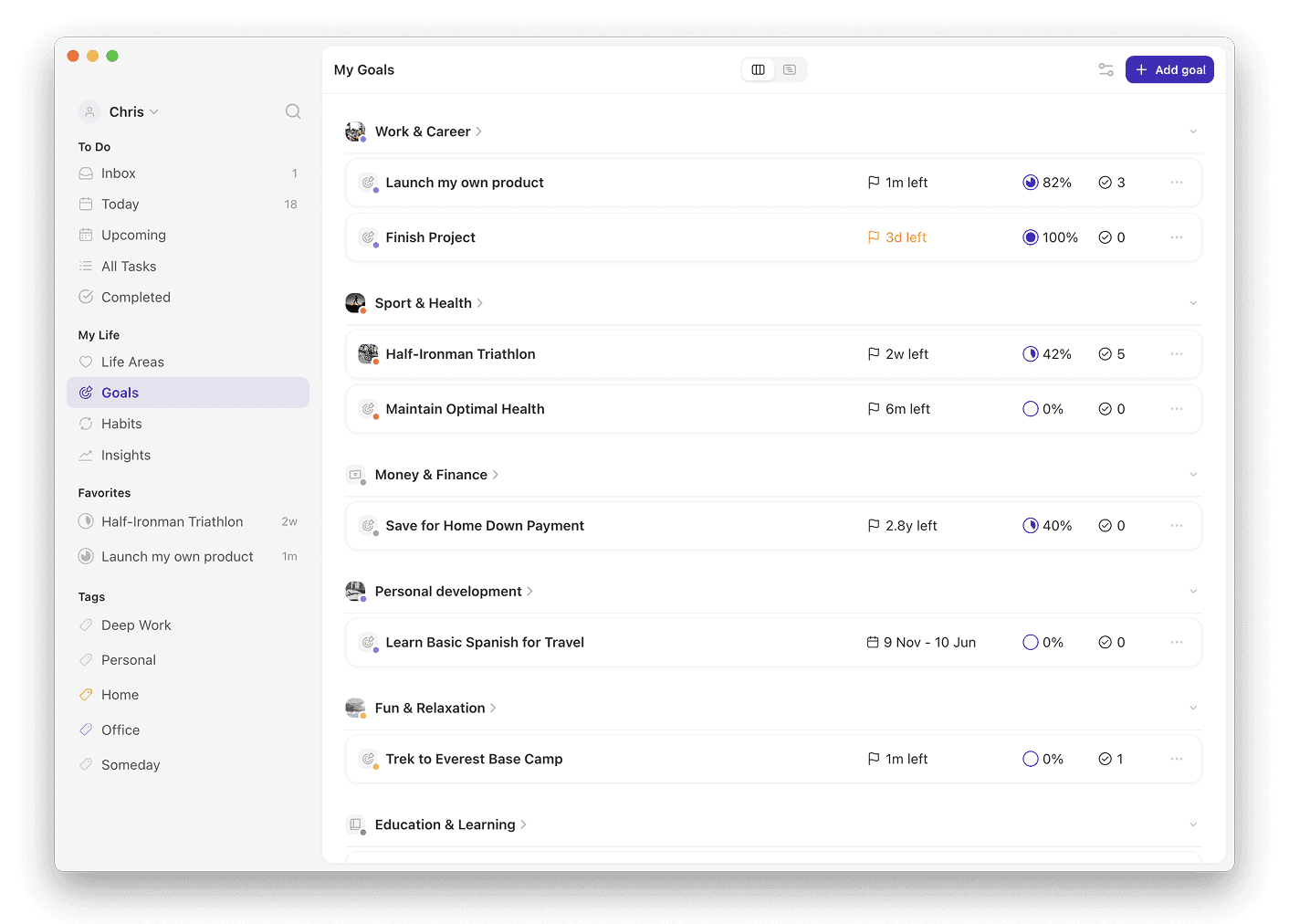
Goal-first habit tracking: how Griply connects habits to goals
Most habit trackers log behaviour in isolation, and apps like Streaks and Habitica do this well if a streak on its own is enough for you. Griply takes a different shape: it treats a habit as the bottom of a deliberate chain. The Goal-First hierarchy runs Life area → Vision → Goal → Subgoal → Project → Task/Habit, so every habit you track traces back to a measurable outcome and a wider vision for that life area. Habits without goals are streaks without purpose, which is the structural problem Griply is built to fix (the 📘 goal setting guide covers the outcome layer this rolls up to).
The structural decision that follows from that hierarchy is to model a habit as a recurring task rather than a separate object type. Habits inherit the full task surface instead of living in a parallel data model, and a habit completion can count directly toward a goal defined in "completed task count" units. The streak isn't a parallel metric you protect; it's an input to an outcome you chose.
The practical payoff is that habit completion and goal progress share one source of truth. A week of skipped workouts shows up as flat progress on your fitness goal, not as a green tick on a habit app that has no idea your goal exists. See how Griply's habit tracker works for the full walkthrough.
Frequently Asked Questions (FAQ)
Habit tracker vs goal tracker: which do I need?
You need both, and they should be the same system. A habit tracker logs whether you did the daily action, while a goal tracker logs whether that action is moving the outcome. Run them in separate apps and the habit becomes a streak without a destination, while the goal becomes a wish without execution.
How long does it take to form a habit?
Far longer than the widely repeated 21-day figure, which has no research basis in habit formation. Lally et al.'s 2010 University College London study found that simple habits like drinking a glass of water automated quickly while demanding habits like a structured workout took much longer. Plan for at least two to three months of consistent effort before a new behaviour feels automatic.
Habit tracker planner vs habit tracker app: which is better?
A paper planner wins under five habits where the act of writing is the reward; a habit tracker app wins above five habits or when each habit needs to roll up to a goal. Paper gives you the tactile reinforcement and forces a short daily pause. An app gives you automatic streak calculation, calendar-aligned statistics, and a path from habit to goal to outcome, which paper cannot do once the grid gets dense.
What should a monthly habit tracker include?
A monthly habit tracker should have a row per habit and a column per day, with room to mark Completed, Skipped, or Failed rather than just a blank-or-check binary. It should also include a short weekly review prompt so you are not only collecting data but reading it. A yearly habit tracker layered on top gives you the 66-day and 254-day view the science tells you to expect.
Does tracking a habit streak help?
Yes, because the streak itself is a reward that reinforces the cue, which is the loop Duhigg and Clear describe. The risk is that a streak can become the goal, and protecting a streak can turn into dishonest logging. The fix is to tie the streak to an outcome metric so the streak is a means, not the end.
Do I need a separate tool for habits, or can my task manager handle it?
A task manager can handle habits if it models recurring tasks with per-day status and calendar-aligned statistics. Most do not, which is why people end up running a separate habit app next to their task list. Griply combines both by treating a habit as a task with the habit flag set, so habits and tasks share one surface.
Make habit tracking worth the streak
Habit tracking works when each tracked habit answers a larger question about what you are trying to build. The research is clear on how habits form, the frameworks agree on how to design them, and the tools exist to log them cleanly. The missing layer is usually the connection to a goal and a vision for the life area the habit belongs to, and that is the layer generic trackers leave out.
A Griply habit sits inside a hierarchy that runs from life area to vision to goal to subgoal to project to the habit itself. Every completion contributes to a goal you defined, not just to a streak you are protecting.
Track habits that move your goals
Griply connects every habit to a goal and a life area, so your streaks point at outcomes. Start free on iOS, Android, web, and desktop.
Track habits that move your goals
Griply connects every habit to a goal and a life area, so your streaks point at outcomes. Start free on iOS, Android, web, and desktop.
More guides on habit tracking
📘 How to build a productive morning routine connected to goals: a three-tier morning routine (15, 45, 90 minutes) built on goal-anchored habits rather than aesthetic routines.
📘 Habit tracker ideas organised by life area and goal: concrete habit examples grouped by life area, each tied to a measurable goal.
📘 Habit stacking template: build new habits that stick: Clear's habit stacking formula with a morning, afternoon, and evening anchor template.
📘 Habit stacking examples you can copy today: ready-to-use stacks by time of day and life area, with an anchor audit to run first and a friction-based way to sequence them.
📘 5 AM Club summary: Robin Sharma's 20/20/20 formula: Sharma's early-morning 20/20/20 routine mapped to the Griply habit and goal hierarchy.
📘 Apply the 7 Habits of Highly Effective People in your daily life: Covey's seven habits translated into Griply habits, goals, and life areas.
📘 The habit loop: how cues, cravings, and rewards build behaviour: the three-step cue, routine, reward model and Clear's four-stage extension explained for daily use.
📘 Planner with habit tracker: why most combinations fail: why planners and habit trackers fail without a shared goal layer, and what the architecture needs to look like to fix it.
📘 Morning routine checklist: the goal anchor most people skip: what to include, what to cut, and why a goal declaration is the one item most checklists leave out.
📘 The bullet journal habit tracker, and where paper leaves you stranded: where the analog bullet journal tracker works, where it leaves you stranded, and what a goal-linked version adds.
📘 How a monthly habit tracker turns 30 days into real progress: why a 30-day calendar view beats a streak counter, and how a month of completions becomes progress once each habit links to a goal.
Works Cited
Amabile, Teresa, and Steven Kramer. "The Progress Principle: Using Small Wins to Ignite Joy, Engagement, and Creativity at Work." Harvard Business Review Press, 2011. https://progressprinciple.com/progress-principle/
Clear, James. "Atomic Habits: An Easy & Proven Way to Build Good Habits & Break Bad Ones." Avery / Penguin Random House, 2018. https://jamesclear.com/atomic-habits
Duhigg, Charles. "The Power of Habit: Why We Do What We Do in Life and Business." Random House, 2012. https://charlesduhigg.com/the-power-of-habit/
Fogg, B. J. "Tiny Habits: The Small Changes That Change Everything." Houghton Mifflin Harcourt, 2020. https://tinyhabits.com/book/
Harkin, Benjamin, Thomas L. Webb, Betty P. I. Chang, Andrew Prestwich, Mark Conner, Ian Kellar, Yael Benn, and Paschal Sheeran. "Does Monitoring Goal Progress Promote Goal Attainment? A Meta-Analysis of the Experimental Evidence." Psychological Bulletin, Vol. 142, No. 2, 2016. https://pubmed.ncbi.nlm.nih.gov/26479070/
Lally, Phillippa, Cornelia H. M. van Jaarsveld, Henry W. W. Potts, and Jane Wardle. "How are habits formed: Modelling habit formation in the real world." European Journal of Social Psychology, Vol. 40, Issue 6, 2010. https://onlinelibrary.wiley.com/doi/abs/10.1002/ejsp.674
Sharma, Robin. "The 5AM Club: Own Your Morning. Elevate Your Life." HarperCollins, 2018. https://www.robinsharma.com/books
Wood, Wendy, and David T. Neal. "A new look at habits and the habit-goal interface." Psychological Review, Vol. 114, Issue 4, 2007. American Psychological Association. https://dornsife.usc.edu/wendy-wood/wp-content/uploads/sites/183/2023/10/wood.neal_.2007psychrev_a_new_look_at_habits_and_the_interface_between_habits_and_goals.pdf