Guide



Table of Contents
The 7 habits of highly effective people are a framework of seven behavior patterns described by Stephen Covey in his 1989 book that move a person through a sequence: private victory first (taking responsibility, setting direction, prioritizing what matters), then public victory (seeking mutual benefit, listening to understand, creating through collaboration), and finally a renewal habit that sustains the capacity to practice all the others. Covey's core argument is that lasting effectiveness comes from character: from who you are and what you've internalized, rather than the communication tactics or productivity shortcuts most people reach for instead.
The book has sold more than 40 million copies, and yet most people who read it return to the same patterns the following Monday. Building these habits requires the same systematic installation as any behavior change: a clear trigger, a daily practice, a record of completion, and a connection to something you genuinely care about, which is precisely what the habit-tracking discipline exists to provide.
Key takeaways
Covey's "inside-out" paradigm means change starts with yourself: the person who wants a better team should examine their leadership before looking at the team.
Each habit can be practiced as a daily behavior rather than filed away as a principle; the gap between reading the book and changing your life is a practice gap.
Habits form when they are obvious, attractive, easy, and satisfying; Covey's habits need the same installation process as any other behavior change.
Griply lets you connect each habit you track directly to a goal and life area, so your streak data reflects real progress toward something that matters, not just a row of checkmarks.
Covey's framework argues that technique without character produces short-term results at best
Covey opens with a distinction he calls the "personality ethic vs the character ethic." Success literature after World War II, he argues, shifted toward personality: communication skills, positive attitudes, techniques for appearing competent.
Before that, success literature focused on character: on integrity and on humility as the foundations of genuine effectiveness. Covey's position is that the personality ethic produces short-term results at best; the character ethic produces lasting change.
The organizing structure of the book follows three stages: Habits 1 through 3 constitute the "private victory," moving from dependence on others to genuine independence; Habits 4 through 6 constitute the "public victory," moving from independence to effective interdependence with others. Habit 7 is the renewal habit that sustains the other six, and Covey calls this entire progression the "maturity continuum." The sequence matters because each stage builds the foundation the next requires.
The framework is also built on what Covey calls the "inside-out" paradigm: change starts with yourself, not with your circumstances or with other people. The person who wants a better marriage should become a better partner. The person who wants a more motivated team should examine their own leadership before looking at the team.
The 7 daily habits of highly effective people practiced as a daily rhythm
Covey's habits are principles, but principles only change your life when they become daily behaviors. Below is how all seven translate into a daily rhythm: what you actually do in the morning, during the day, and in the evening.
In the morning, the most important thing is orienting yourself before the day orients you. A 10-minute review prevents you from spending the day in Covey's Quadrant 3 (urgent but unimportant) by deciding what matters before distractions arrive:
Habit 2 (Begin with the End in Mind): review your goals and life areas
Habit 3 (Put First Things First): identify your highest-priority task for the day
During the day, the active habits are conversation- and project-level:
Habit 1 (Be Proactive): pause before reacting when something goes wrong
Habit 4 (Think Win-Win) and Habit 5 (Seek First to Understand): activate the moment you're in an interaction with another person
Habit 6 (Synergize): look for this when planning work that involves others
In the evening, the renewal habit gets its time. These activities don't feel urgent, which is exactly why most people skip them:
Habit 7 (Sharpen the Saw): exercise, read, reflect, or connect with people you care about
Scheduling renewal as fixed commitments rather than "if I have time" activities is what separates the people who practice the 7 daily habits from those who only know them.
How to build these habits (what the science says)
James Clear's framework in Atomic Habits offers the most practical installation guide for Covey's habits. Clear identifies four laws of behavior change (make it obvious, make it attractive, make it easy, make it satisfying) that determine whether a new behavior becomes automatic or fades within weeks. For a full breakdown of the cue-craving-response-reward model, the habit loop guide covers Clear's four-step model in depth.
The most common mistake people make with Covey's habits is trying to install all seven at once. Clear recommends building one habit at a time, with a version small enough that you can't reasonably fail on day one. A five-minute morning review is more sustainable than a 45-minute planning session you'll skip within days; once the five minutes is automatic, you extend it.
Habit stacking, attaching a new habit to an existing one, works particularly well with Covey's habits because several of them are review or reflection habits rather than physical actions. "After I make my morning coffee, I will open my goals and review today's priorities" is a habit stacking formula that requires no new willpower, only a new trigger. The more precisely you define when and where the habit occurs, the more reliably it fires.
The 7 habits: individual practice guide
Habit 1: Be Proactive
Covey's first habit is the foundational one: you are responsible for your own life. Your behavior is a product of your decisions, not your circumstances. "Between stimulus and response, man has the freedom to choose," Covey writes, and exercising that freedom consistently is what proactivity looks like in practice.
Practically, this means catching yourself when you're about to blame a person or situation, and asking instead: what's in my control here, and what's my next step? When a problem arises, you look for the first action you can take. When you're setting a goal, you identify the obstacles you can anticipate and address them before they become crises.
Add "Be Proactive" as a daily habit in Griply, linked to a relevant goal in your hierarchy (for example, a "Personal Effectiveness" goal under a Work & Career life area). Set a morning reminder so you're prompted before the day starts. Your completion rate and streak appear in Griply's habit completion statistics, giving you a concrete record of how consistently you're following through rather than a vague sense of whether you are.
Habit 2: Begin with the End in Mind
This habit is about knowing what you're building before you start building it. Covey asks you to write a personal mission statement, a clear description of what you want to be and do, and to use it as the reference point for every decision. Without that clarity, you can spend years being busy and productive while moving in the wrong direction.
The implementation starts with defining the life areas that matter to you (work, health, relationships, finances, personal growth) and writing a vision statement for each. From those visions, you set goals. The clarity this habit creates is structural as well as motivational: it gives you a basis for saying no to things that don't fit, which is where most people struggle.
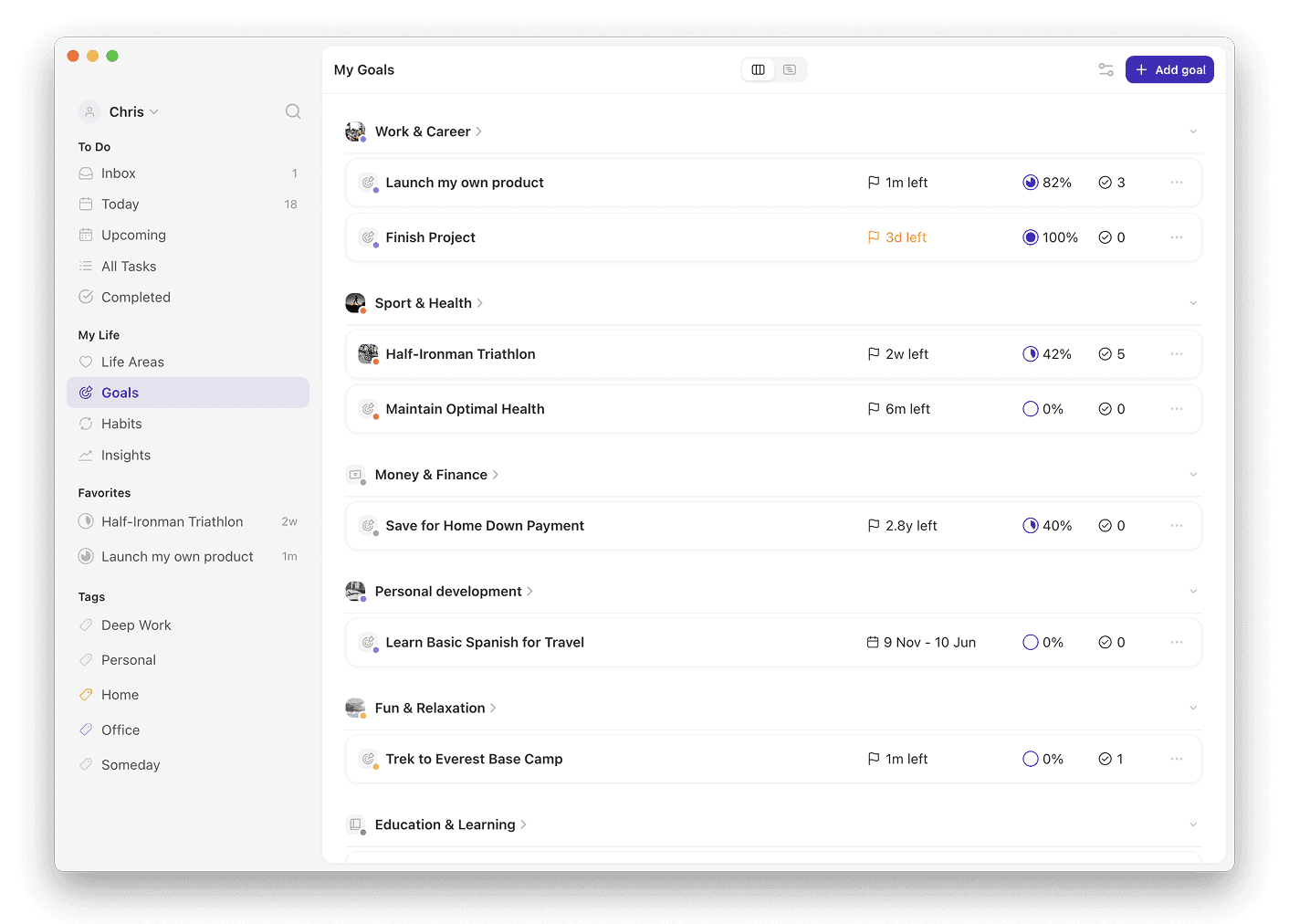
Griply's hierarchy is built around this exact sequence: Life Area, Vision, Goal, Subgoal, Habit. When you open Griply's Goal Roadmap, you see a Gantt chart of your goals and subgoals laid out in time, a visual representation of the future you're working toward. Use the goal planner to set measurable goals with deadlines and progress tracking; each habit you build in Griply sits inside this structure rather than floating as a disconnected to-do item.
Habit 3: Put First Things First
Habit 3 is where Covey's framework becomes operational, and its central tool is the Time Management Matrix from First Things First: four quadrants defined by urgency and importance.
Quadrant 1 — urgent and important: crises, deadlines
Quadrant 2 — not urgent but important: goal-setting, relationship-building, exercise, planning
Quadrant 3 — urgent but not important: most interruptions, many meetings
Quadrant 4 — neither urgent nor important
Effective people live primarily in Quadrant 2, investing time in what matters before it becomes urgent, which is why fewer things become crises. The practical discipline is a weekly planning session where you identify your Quadrant 2 priorities and block time for them before anything else fills the calendar.
Griply's goal planner shows your active goals with progress charts so you can see at a glance which goals are advancing and which are stalling. You can link every task and habit to a specific goal, so your Today view shows you what each item is for, not only what it is. Set a weekly review reminder in Griply so you're prompted every Sunday or Monday to plan the week ahead.
Habit 4: Think Win-Win
Covey's fourth habit challenges the zero-sum assumption that most people operate from without noticing it. Win-Win is not a negotiating technique; it's a belief that there is usually enough for everyone, and that the best outcomes come from looking for solutions that genuinely work for both parties.
In practice, this means entering difficult conversations with the question "what does a good outcome look like for both of us?" rather than "how do I win this?" It means listening to understand what the other person actually needs beneath what they're expressing. It means being willing to walk away from a deal that only works for you.
Track "Think Win-Win" as a daily habit in Griply, connected to a Relationships or Work & Career goal in your hierarchy. Set a morning reminder so you start the day with the intention. Your completion/skip/fail statistics give you an honest record of how consistently this mindset is showing up in your day, with data behind the aspiration.
Habit 5: Seek First to Understand, Then to Be Understood
"Most people do not listen with the intent to understand; they listen with the intent to reply," Covey writes. Habit 5 is the correction for this: you make genuine understanding your first objective in every conversation before you try to be understood yourself.
Empathic listening means giving the other person your full attention, resisting the urge to formulate your response while they're talking, and asking clarifying questions until you can accurately summarize their perspective. Only then do you communicate your own view. The habit produces better outcomes in almost every kind of interaction: negotiations, feedback conversations, relationships, problem-solving.
Add "Seek First to Understand" as a habit in Griply, link it to a Communications or Relationships goal, and use the daily reminder to set your intention before conversations begin. The habit heat map widget on iOS shows you a month-view grid of your completion, skips, and fails: a quick visual check on whether this habit is actually landing or just being added and ignored.
Habit 6: Synergize
Synergy, in Covey's definition, means that the whole is greater than the sum of its parts: two people collaborating creatively can produce an outcome neither could produce alone. The habit is about valuing difference (different perspectives, different experiences, different ways of thinking) rather than tolerating it or working around it.
Practically, synergy happens when you actively bring in people who see things differently from you, when you create conditions where everyone feels safe to contribute what they actually think, and when you treat disagreement as raw material for a better solution rather than a problem to resolve. Scan your current work for places where you're trying to solve something alone that would benefit from a different perspective.
Track "Synergize" as a daily habit in Griply linked to a Work & Career or relevant project goal. The daily check-in keeps collaboration as a conscious choice rather than something that happens only when it's convenient. Use Griply's completion statistics weekly to review whether you're actually seeking out collaboration or defaulting to working alone.
Habit 7: Sharpen the Saw
Habit 7 is the maintenance habit. Covey's woodcutter analogy is direct: the person who stops to sharpen the saw produces more wood than the person who saws without stopping. Sustained effectiveness requires renewing yourself across four dimensions:
Physical: sleep, exercise, nutrition
Mental: reading, learning, planning, journaling
Social/emotional: relationships, service, connection
Spiritual: purpose, reflection, time in nature or prayer
These activities share one property: they're not urgent and they never have a deadline, which means they get squeezed out by everything that does feel urgent. Without deliberate scheduling, renewal disappears from the week entirely. Covey's prescription is to treat Habit 7 activities as Quadrant 2 investments, recurring commitments rather than optional extras.
For the physical dimension, set habits in Griply for exercise frequency and sleep targets, linked to a Sport & Health goal; for the mental dimension, a daily 20-minute reading habit linked to a Personal Development goal tracks whether you're actually doing it. Griply's push messages send you a daily overview each morning so you see exactly which renewal habits are scheduled before the day starts, which makes the renewal dimension harder to ignore.
Generic habit trackers miss the structural point of Covey's framework
A habit tracker that records whether you completed "Be Proactive" without connecting that habit to a goal, a life area, or a vision is missing the entire structural point of Covey's framework. Habit 2 tells you to begin with the end in mind; Habit 3 tells you to prioritize tasks that serve your most important goals. The goal behind the streak carries the meaning. the streak is just the evidence.
Griply's hierarchy mirrors Covey's structure directly: Life Area → Vision → Goal → Habit. You define what you're building before you track whether you're doing it. Every habit in Griply has a goal connection, so the completion/skip/fail statistics tell you something real about progress rather than recording activity for its own sake.
The Habit Tracker lets you set frequency, add a reminder, and see completion, skip, and fail statistics over time. Your habits appear in the Today view alongside your tasks, in a split view on desktop with your calendar, so you process habits and work in one place. On iOS, the habit heat map widget shows a month-view grid of completions on your home screen.
Covey's framework is goal-first. Griply is built that way too.
Frequently asked questions
What are the 7 daily habits of highly effective people?
Be Proactive, Begin with the End in Mind, Put First Things First, Think Win-Win, Seek First to Understand Then to Be Understood, Synergize, and Sharpen the Saw. Covey organized them as a sequence: private victory (habits 1–3), public victory (habits 4–6), and renewal (habit 7). Each is a daily practice, not a one-time decision.
What are some practical ways to apply the 'Be Proactive' habit in daily life?
When something goes wrong, pause before reacting and ask: what's within my control, and what's my first concrete step? Start your day with a written intention about what you're going to initiate rather than wait for. Track "Be Proactive" as a daily habit in Griply linked to a personal effectiveness goal, the completion data shows whether this is a daily discipline or an occasional good day.
What is the best app for the 7 habits of highly effective people?
Covey's framework is explicitly goal-first, so a habit tracker that doesn't connect habits to goals misses the structural foundation of the system. Griply's hierarchy (Life Area, Vision, Goal, Subgoal, Habit) maps directly to Covey's maturity continuum. The free plan lets you start with 2 habits and 2 goals at no cost.
What are the key ideas in the 7 habits of highly effective people?
Covey's central argument is that lasting effectiveness comes from character, not personality: you can't technique your way to a meaningful life. The framework follows a maturity continuum, private victory (habits 1–3), public victory (habits 4–6), renewal (habit 7), and the "inside-out" paradigm runs throughout: change begins with yourself, not your circumstances.
How long does it take to build the 7 habits?
Average habit formation takes 66 days, though the range is 18 to 254 days depending on the person and habit. For Covey's framework, you install one at a time, not all seven at once. Most people find habits 1–3 (the private victory habits) need to be reasonably solid before habits 4–6 feel natural, because effective interdependence requires a clear sense of your own values first.
Character is what the habits are building
Covey's book has sold more than 40 million copies because the ideas are right: character matters more than technique, and daily habits are the mechanism that translates principles into outcomes. The people who get lasting value from the framework are not the ones who understood it best; they're the ones who practiced it daily and connected each habit to a goal they actually cared about, and that connection is what makes the difference.
Related Guides
Covey, Stephen R. "The 7 Habits of Highly Effective People: Powerful Lessons in Personal Change." Simon & Schuster, 1989. https://www.simonandschuster.com/books/The-7-Habits-of-Highly-Effective-People/Stephen-R-Covey/9781982137274
Covey, Stephen R. "First Things First." Simon & Schuster, 1994. https://www.simonandschuster.com/books/First-Things-First/Stephen-R-Covey/9780684802039
Clear, James. "Atomic Habits: An Easy & Proven Way to Build Good Habits & Break Bad Ones." Avery/Penguin Random House, 2018. https://jamesclear.com/atomic-habits
Clear, James. "How to Build a New Habit: This Is Your Strategy Guide." James Clear (blog). https://jamesclear.com/habit-guide