Guide


Table of Contents
The 5AM Club by Robin Sharma centres on one framework: the 20/20/20 formula, where the first 60 minutes of your day splits into 20 minutes of exercise, 20 minutes of reflection, and 20 minutes of learning. That is the 5AM Club summary in a sentence.
Most readers understand the formula within the first chapter. Converting it into a consistent daily practice is the harder challenge. You wake with conviction once or twice, then drift back to your old schedule before the habit has time to take hold.
Every layer of Sharma's framework is covered below: the 20/20/20 formula, the 66-day installation protocol, the reasoning behind the early hour, and the structural failure mode that ends most attempts before day 30. The final section shows how to connect each segment of the formula to a specific goal in Griply, so the 5AM Club becomes a system you operate rather than a book you remember fondly.
Key takeaways
The sequence matters: exercise first triggers a release of dopamine, serotonin, and norepinephrine that makes the reflection and learning segments significantly more effective.
Sharma recommends a 66-day installation period to make the routine automatic, aligned with research showing that real-world habits take far longer than 21 days to form.
The most common failure mode is retaining the aspiration (wake up early, do something good) while losing the structure (exactly these three segments, in this order, for exactly 20 minutes each).
The reflection segment only delivers its full value when there is a goal to reflect toward, without one, journaling at 5AM is purposeful-feeling but directionless.
What the 5AM Club actually contains beyond the formula most readers remember
The 5 AM Club (HarperCollins, 2018) presents the 5AM wakeup as the most reliable way to protect the first hour of your day from email, other people's demands, and the ambient noise of modern life. The book is written as a parable (three characters learning from an eccentric billionaire mentor), but the framework at its centre is practical and specific.
The central argument: the way you start your morning sets the cognitive and emotional trajectory for everything that follows. Sharma calls the first 60 minutes "the Victory Hour" and argues that it belongs entirely to you, before the world begins placing claims on your attention. Most professionals, he observes, hand this hour over to their phone within minutes of waking.
The book delivers four core frameworks:
the 20/20/20 formula (how to spend the Victory Hour)
the 66-day installation protocol (how to make the habit automatic)
the Twin Cycles of Elite Performance (how to structure work and recovery through the day)
the Four Focuses of History-Makers (the mental disciplines that separate high performers from everyone else)
The 20/20/20 formula is the one most readers take away because it is the most immediately executable.
The 20/20/20 formula works because each segment prepares your brain for the next
The 20/20/20 formula divides the Victory Hour into three equal "pockets," each with a distinct purpose and a specific neurological reason for its position in the sequence.
The first pocket (5:00–5:20) is Move: twenty minutes of vigorous physical exercise, intense enough to produce a sweat. Sharma is explicit about the intensity because the purpose is biological: to trigger a release of dopamine, serotonin, norepinephrine, and brain-derived neurotrophic factor (BDNF). These neurochemicals prime the prefrontal cortex for focus and creative thinking in the hours that follow.
The second pocket (5:20–5:40) is Reflect: twenty minutes of journaling, meditation, or both. This is where you examine your intentions for the day, connect your planned actions to your longer-term goals, and clear whatever is occupying your thinking. Sharma frames this segment as the interior work that makes the exterior work coherent.
The third pocket (5:40–6:00) is Grow: twenty minutes of reading, studying, or engaging with material that advances your capabilities. Sharma's compounding argument: 20 minutes a day equals over 120 hours of deliberate learning per year, a meaningful edge across a decade.
The sequencing is intentional. Exercise first creates the neurochemical conditions that make reflection and learning work at their best. Running the segments in a different order is not the same protocol.
The early hour works because cortisol peaks before the world sends you anything to react to
Andrew Huberman's work on the cortisol awakening response offers a biological explanation for why early morning functions differently from other parts of the day. Cortisol peaks within the first 30–60 minutes after waking. This peak is your brain's primary alertness signal, and morning sunlight exposure strengthens it, stabilises your circadian rhythm, and supports sustained energy into the afternoon.
For the 5AM Club specifically, this means the exercise segment lands at the biological moment your body is most primed for movement. Sharma's protocol, developed from decades of observing peak performers, aligns with circadian chemistry even though it was built from practice rather than research.
There is also a structural argument independent of neuroscience: 5AM is before the world sends you anything to react to. Your inbox is empty and no one is waiting on you. The two hours from 5 to 7 are qualitatively different from every other two-hour window in your day because you are the only one deciding what happens in them.
The 66-day installation protocol is why most people quit before the habit takes hold
Sharma is direct in the book about how long the habit takes to form: 66 days, not 21. The 21-day figure originates from a misreading of Maxwell Maltz's 1960 book Psycho-Cybernetics, which described surgery patients needing "a minimum of about 21 days" to adjust to a physical change. That floor was treated as a ceiling and repeated until it became received wisdom.
The 66-day figure aligns with a 2010 University College London study, which followed 96 participants forming new habits in real-world conditions. The median time to automaticity was 66 days, with a range of 18 to 254 depending on the habit's complexity and the individual. For anyone attempting the 5AM routine, this means the discomfort of the first three weeks is not evidence that the habit isn't working. It's the expected starting condition.
Sharma divides the 66 days into three phases. Days 1–22 he calls Destruction: the discomfort of breaking your existing pattern, where early alarms feel brutal and you regularly question whether the protocol is worth it. Days 23–44 are Installation: the new routine starts to require less willpower, and it no longer feels like a fight.
Days 45–66 are Integration. The habit becomes part of your identity, and the early hour starts to feel like who you are rather than what you are forcing yourself to do.
What Most 5AM Club Summaries Miss: The Structural Failure Mode
The most common failure mode is structural, not motivational. You carry the idea of the 5AM routine without retaining the precision that makes it work: these three segments, in this sequence, for exactly 20 minutes each.
You wake at 5AM with good intentions, pour coffee, and stall. You debate whether to run or stretch, wonder if this could be a journaling-only morning, and fifteen minutes pass before the session has started. The structure collapsed at the moment you were least equipped to rebuild it.
Sharma's formula works precisely because it removes morning decision-making. The protocol tells you what to do in each block. But when people absorb the idea without the structure, the formula becomes a vague intention rather than an executable plan.
The second failure mode is that the habits float free of any goal. You track your exercise streak and your meditation streak, but they connect to nothing you are building. The reflection segment loses its purpose when there is nothing to reflect toward.
Habit stacking addresses the sequencing problem, anchoring each pocket to the one before it so the sequence runs automatically. But even a well-stacked habit loses momentum when it is disconnected from a purpose you care about.
How to Use Griply to Make the 5AM Club Structural
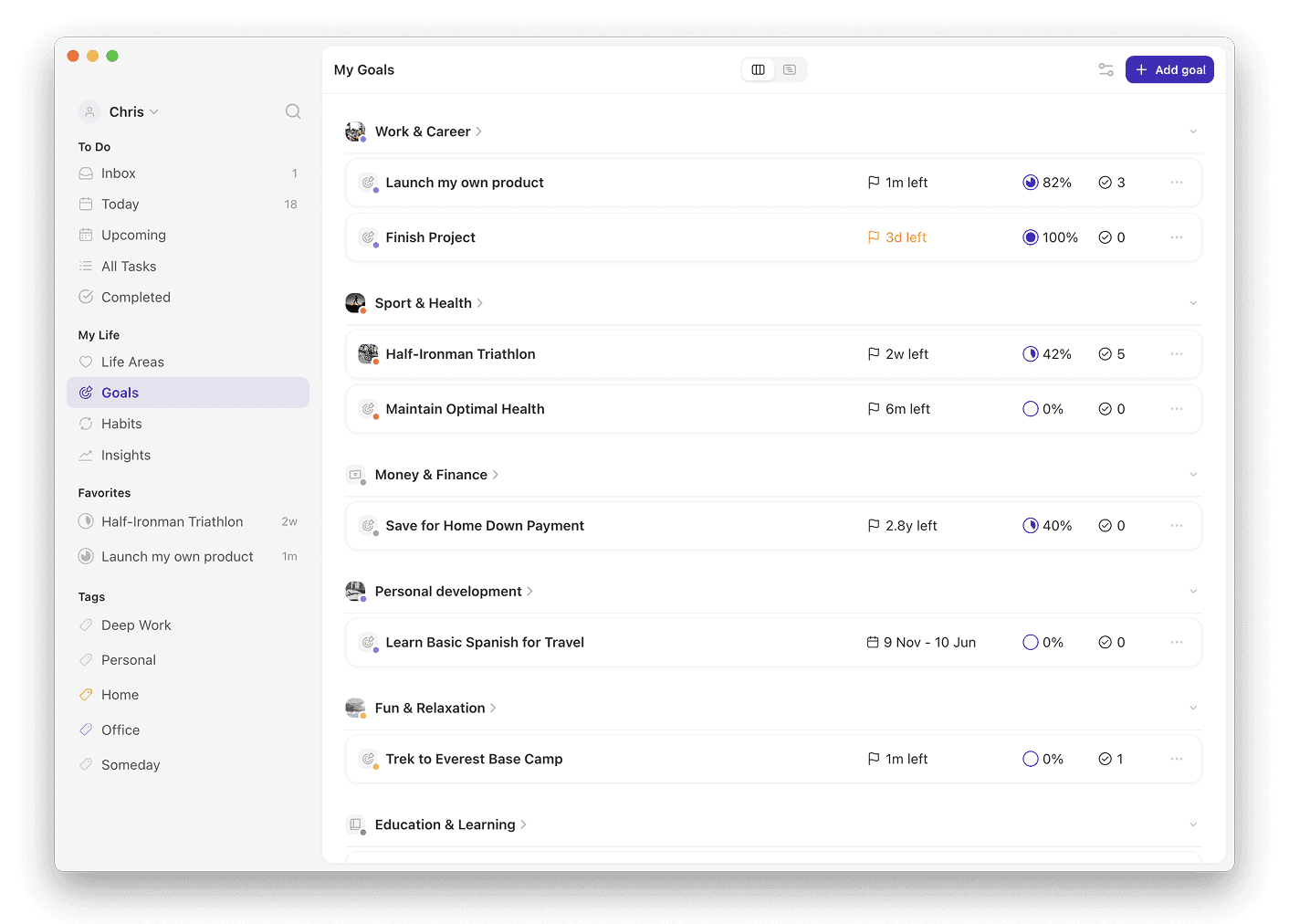
Griply's hierarchy runs Life Area → Vision → Goal → Subgoal → Habit. Each segment of the 20/20/20 formula maps directly into it.
The exercise habit belongs under a Health life area. You create a goal with a specific target value and deadline, then attach a daily habit directly to that goal. When you mark it complete each morning in Griply's Habit Tracker, the completion logs against the goal it serves, and the goal chart shows your progress over time.
The reflection segment is where you open Griply's Today view and check which goals today's habits and tasks are serving. Each life area stores the Vision you've written for it, so reflection becomes purposeful: you are not journaling in isolation, you are reviewing whether your planned day connects to what you said you wanted.
The learning habit connects to a Personal Growth life area. You set a measurable goal (read 24 books this year, log 120 hours of deliberate study), attach a 20-minute daily learning habit directly to that goal, and use Griply's Goal Planner to track the progress metric. The habit appears in your daily plan; the outcome appears in your goal chart.
Running the 5AM Club without a system means making decisions at the moment you are least equipped to make them. Griply removes those decisions by connecting each segment to a goal that is already defined. The formula stays the same; the outcome changes.
For a focused approach to designing your morning specifically, see the guide to productive morning routines.
Frequently asked questions
What is the main idea of the 5AM Club?
The 5AM Club argues that waking at 5AM and spending the first hour on yourself, rather than reacting to external demands, is the highest-leverage habit available to ambitious people. The book's central framework is the 20/20/20 formula: 20 minutes of exercise, 20 minutes of reflection, and 20 minutes of learning, in that order, every day.
What is the 20/20/20 rule in the 5AM Club?
The 20/20/20 rule divides the first 60 minutes after waking into three equal blocks: 5:00–5:20 for vigorous exercise, 5:20–5:40 for journaling or meditation, and 5:40–6:00 for reading or learning. The sequence is fixed, not interchangeable. Exercise first creates the neurochemical environment that makes the reflection and learning segments more effective.
How long does it take to build the 5AM routine?
Sharma recommends 66 days, aligned with research on real-world habit formation. He breaks this into three phases: Destruction (days 1–22, breaking the old pattern), Installation (days 23–44, the routine starts to feel natural), and Integration (days 45–66, the habit becomes automatic).
Does the 5AM Club method work?
The 20/20/20 formula works when you run it as a structured system with each segment tied to a goal, not as a loose intention to wake up early and do something productive. Each segment has independent evidence behind it: exercise for neurochemical priming, reflection for intentional planning, learning for compounding growth. The failure mode is almost always structural, not motivational.
What is the best app for tracking the 5AM Club routine?
An app that connects your morning habits to the goals they serve makes the 5AM Club significantly more durable than one that counts streaks in isolation. Griply lets you link each habit to the specific goal it is building: your exercise habit connects to a Health goal, your learning habit connects to a Personal Growth goal. In Griply's Today view, you see which goal each morning habit serves.
The victory hour only pays off when each segment has a goal to serve
The 5AM Club summary comes down to this: own the first hour of your day and invest it in three things, in a fixed sequence, every day. The 20/20/20 formula is simple enough to memorize. The problem is that memory is not a system.
Without structure connecting each segment to a goal you are working toward, the routine drifts. You track streaks that feel increasingly disconnected from anything meaningful. The early alarm starts to feel like discipline for its own sake, and eventually you stop setting it.
Griply converts each pocket of the formula into a tracked habit linked to a specific goal. The morning routine stops being a ritual you maintain and becomes the daily input to outcomes you can see changing. That is when the 5AM Club stops being aspirational and starts being structural.
Related Guides
Sharma, Robin. "The 5 AM Club." HarperCollins, 2018. https://www.robinsharma.com/books/the-5am-club
Lally, Phillippa, Cornelia H. M. van Jaarsveld, Henry W. W. Potts, and Jane Wardle. "How are habits formed: Modelling habit formation in the real world." European Journal of Social Psychology 40, no. 6 (2010): 998–1009. https://onlinelibrary.wiley.com/doi/10.1002/ejsp.674
Huberman, Andrew. "Using Cortisol & Adrenaline to Boost Our Energy & Immune System." Huberman Lab. https://www.hubermanlab.com/episode/using-cortisol-and-adrenaline-to-boost-our-energy-and-immune-system
Maltz, Maxwell. "Psycho-Cybernetics." Prentice Hall, 1960. https://www.penguinrandomhouse.com/books/318795/psycho-cybernetics-by-maxwell-maltz-md-fics/