Guide


Table of Contents
The habit loop is the neurological cycle your brain runs every time it performs a habitual behaviour: a cue triggers the behaviour, the behaviour produces a reward, and the reward reinforces the cue-behaviour link until the sequence becomes automatic. Charles Duhigg documented this three-step process in The Power of Habit (2012), and James Clear expanded it to four steps in Atomic Habits (2018) by inserting "craving" between the cue and the response.
Understanding the structure matters because most habit-building advice treats willpower as the primary variable. Habits are context-dependent automatic responses, largely independent of goal-directed motivation once the loop is formed. The loop is the mechanism; willpower is a poor substitute for it.
Duhigg's original model, Clear's expanded version, the Four Laws of Behavior Change, and how to apply all three in practice are all covered below.
Key takeaways
Clear's Four Laws of Behavior Change map directly onto the four steps of the habit loop: make it obvious (cue), make it attractive (craving), make it easy (response), make it satisfying (reward).
You can use the Four Laws to design new habits from scratch or to diagnose why an existing habit keeps collapsing.
Griply's Habit Tracker implements the Four Laws structurally: reminders make the cue obvious, goal connections make the habit attractive, flexible scheduling makes the response easy, and completion statistics make the reward satisfying.
A habit in Griply can sit inside the hierarchy Life Area → Vision → Goal → Subgoal → Habit, so each repetition connects to something you have already decided matters.
Duhigg's original model explains why habits become automatic without conscious effort
Charles Duhigg's The Power of Habit (Random House, 2012) drew on neuroscience research from MIT to describe how habits are stored in the basal ganglia as three-part sequences. A cue is any signal that starts the behaviour: a time of day, a location, an emotional state, another person, or an immediately preceding action. The routine is the behaviour itself.
The reward is whatever the brain receives at the end of the sequence that makes it worth repeating.
The loop runs in the background precisely because the brain has learned to hand off control. Once a behaviour has been performed in the same context enough times, the brain stops deliberating and runs the stored sequence instead. This is automaticity: the behaviour fires from context, not from conscious intention.
Duhigg's model also identified the craving as a background force, but he folded it into the cue-routine-reward framework rather than treating it as a discrete step. That was the gap Clear addressed six years later.
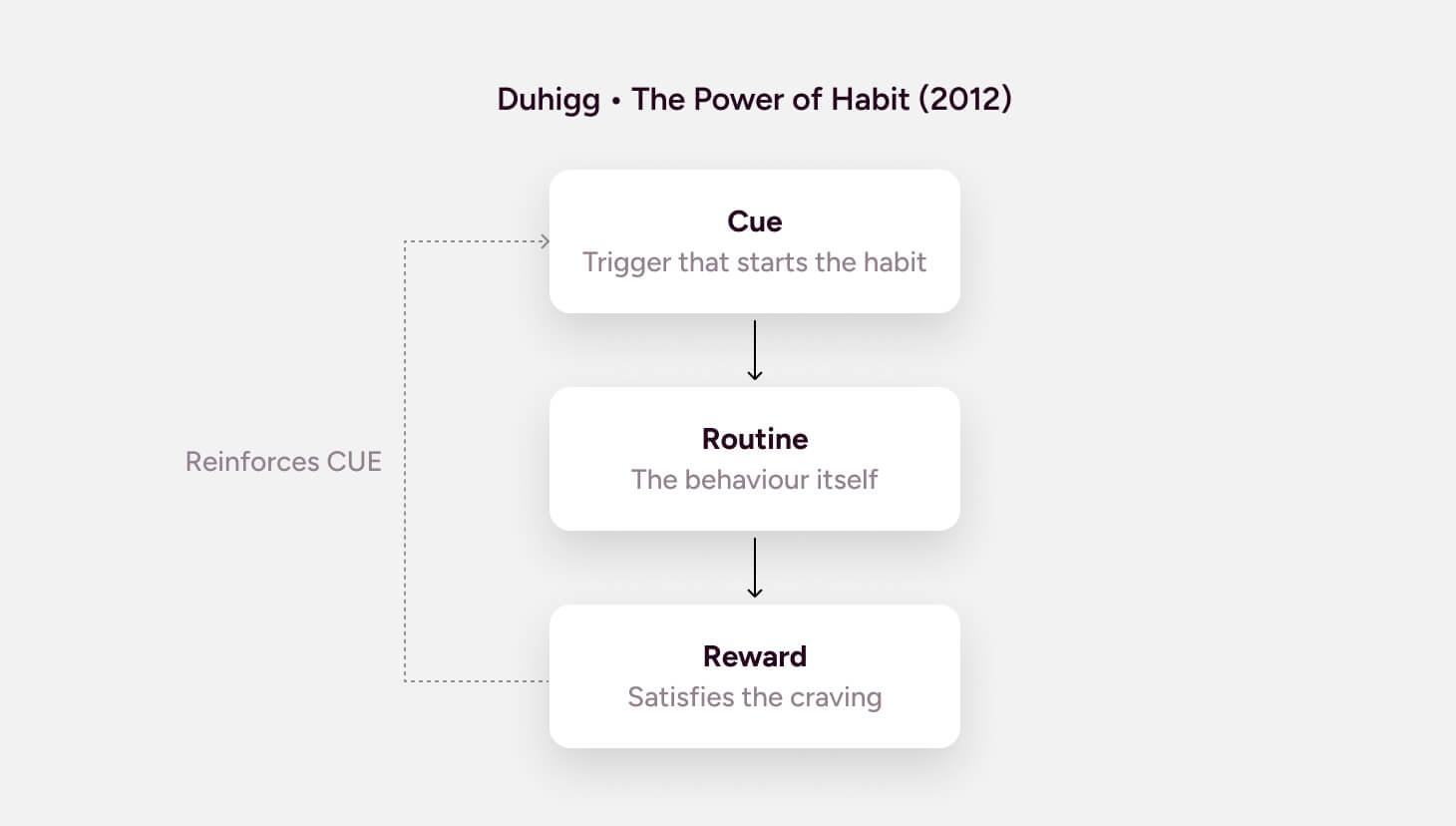
The loop begins with a cue, a trigger in your environment. The cue fires a routine, the habitual behaviour. The routine produces a reward , a positive signal the brain wants to repeat. The reward then feeds back to reinforce the original cue, making the whole sequence more likely to fire next time.
Clear's expanded model adds craving as the step most people miss when building habits
James Clear's Atomic Habits (Avery/Penguin Random House, 2018) added "craving" as a distinct fourth step between the cue and the response. Clear's argument is that the cue alone does not produce behaviour. The cue has to generate a craving first: a motivation, an anticipation of the reward, a felt desire.
Without the craving, the cue is just a signal that gets ignored.
This distinction matters for habit design. If you want to change a behaviour, you can target the cue, the craving, the response, or the reward.
Duhigg's three-step model implies three levers. Clear's four-step model identifies four, with the craving being the one most people overlook when they try and fail to build a new habit.
Clear also renamed "routine" to "response," which is more precise. A routine is a sequence of behaviours; a response is a single action. The habit loop operates at the level of a single response, not a full sequence.
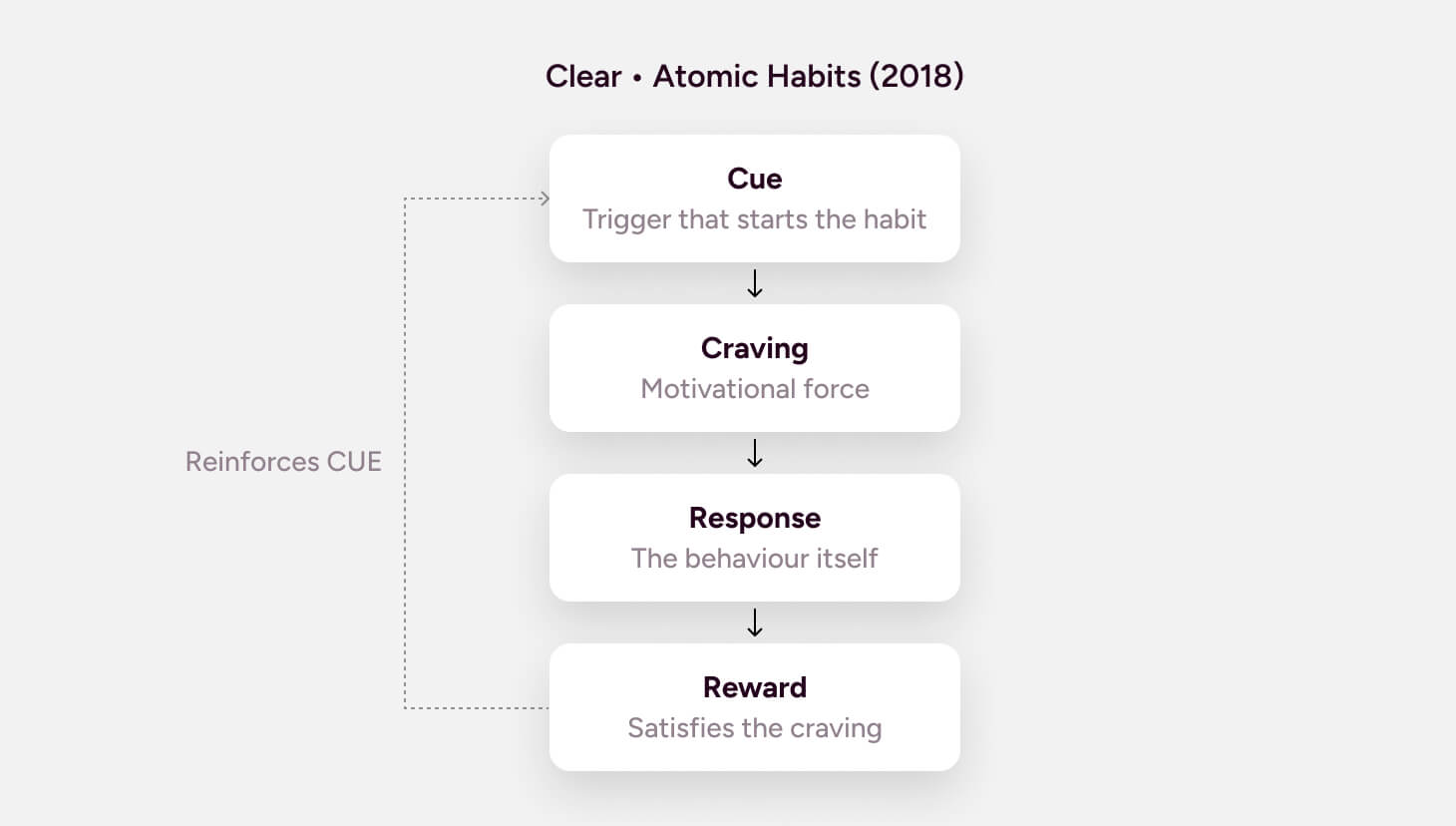
The loop begins with a cue, the same environmental trigger as in Duhigg's model. The cue generates a craving, an anticipation of the reward, the motivational force that actually moves you to act. The craving produces a response , the behaviour itself. The response delivers a reward, which travels back through the loop and strengthens the cue-craving link, making the whole sequence more automatic over time.
The habit loop diagram: how the two models compare
The two models are not competing frameworks. Duhigg's three-step loop is the foundational description of how habits are stored and retrieved. Clear's four-step version is a more granular map that adds the craving as a distinct, designable element.
For most practical purposes, Duhigg's model is enough to explain why a habit exists. Clear's model is more useful when you're designing a habit from scratch and need to engineer each step intentionally. The cue routine reward diagram below shows Duhigg's structure; the second shows where craving fits in Clear's expanded version.
Both models share the same insight: the reward does not just feel good in the moment. It travels backward through the loop and strengthens the association between the cue and the behaviour. That feedback is what converts a repeated action into an automatic one.
The Four Laws of Behavior Change give you a design question for each step of the loop
Clear's Four Laws of Behavior Change are the actionable form of the habit loop. Each law maps onto one step, giving you a concrete design question for each part of the cycle.
The first law, make it obvious, addresses the cue. An obvious cue is visible, specific, and timed. Implementation intentions ("I will do X at time Y in location Z") are the most researched form of cue design.
Habit stacking is one application of cue engineering: it borrows the cue from an existing habit and fires the new one immediately after.
The second law, make it attractive, addresses the craving. A habit is attractive when the anticipation of the reward is strong enough to generate action before the reward is received. Connecting a habit to a goal makes it attractive because the goal gives the habit a visible stake: completing it moves something that matters to you.
Griply's Goal Planner makes this connection explicit by displaying each goal's progress alongside the habits linked to it.
The third law, make it easy, addresses the response. Friction determines whether a behaviour actually happens when the cue fires, so reducing steps and cutting setup time are the primary levers. Clear's two-minute rule (start any new habit by doing a version that takes under two minutes) is one application of this law.
The fourth law, make it satisfying, addresses the reward. A behaviour that produces an immediate reward will be repeated. A behaviour that produces only a delayed reward is harder to sustain because the brain's reward system operates on a short time horizon.
Habit trackers exploit this by creating an immediate, visible reward (the completion mark) that bridges the gap before the long-term outcome arrives.
How to use the habit loop to build a new habit
Using the habit loop as a design framework means working through each law in sequence before you start. Most habit-building attempts fail because they skip two or three of the four steps and rely on willpower to fill the gaps.
Start with the cue. Write an implementation intention: "After I [existing behaviour], I will [new habit]." Specificity is what makes the cue reliable.
A vague intention like "I'll exercise in the morning" is not a cue; "I will put on my running shoes immediately after making coffee" is. For a practical walkthrough of cue design through habit stacking, see the Habit Stacking guide.
Work on the craving next by connecting the habit to a goal you are actively pursuing. If the habit has no visible connection to something you want, the craving will stay weak and the habit will collapse when motivation dips. A useful practice here is to build your morning routine around the habits that directly serve your most important current goal, so the sequence has internal logic rather than being a list of arbitrary self-improvement items.
Then reduce friction on the response: prepare the environment in advance and start with a smaller version of the habit than you think is necessary. Close the loop with an immediate reward each time you complete the habit. Logging a streak or reporting to someone creates a satisfying signal that arrives before the habit's longer-term benefit does.
How Griply implements the Four Laws
Griply's Habit Tracker is built on the premise that habits without a goal are decoration: they feel productive but don't move anything forward. A habit in Griply can live inside the hierarchy Life Area → Vision → Goal → Subgoal → Habit, connecting each repetition to a goal the user has already committed to.
For the first law, making it obvious, Griply lets you set a reminder time on any habit so the push notification arrives at the exact moment you've designated for the cue to fire. The Today view surfaces your habits alongside tasks before you have to remember them.
The second law, making it attractive, is addressed by connecting every habit to a goal. The goal planner displays that goal's progress as a line chart, so you can see the stake before you decide whether to complete the habit.
The third law, making it easy, is handled through flexible scheduling: set frequency and plan individual habit repetitions on different times and days, with no rigid streak requirement that punishes a single missed day.
The fourth law, making it satisfying, is met through completion, skip, and fail statistics on each habit. The iOS habit heat map widget shows a month grid of completions; marking a habit complete closes the reward loop immediately, before any long-term benefit arrives. For a side-by-side look at how the leading habit trackers compare, see our best habit tracker apps roundup.

Frequently asked questions
What is the habit loop?
The habit loop is the repeating cycle your brain runs whenever it performs a habitual behaviour. Duhigg's original three steps are cue, routine, and reward. Clear expanded it to four steps in Atomic Habits (2018) by adding "craving" between cue and response, making the motivational link a distinct, designable element rather than a background assumption.
What are the Four Laws of Behavior Change?
The Four Laws of Behavior Change are James Clear's actionable system from Atomic Habits (2018), mapped onto the four habit loop steps. Make it obvious (cue); make it attractive (craving); make it easy (response); make it satisfying (reward). A habit missing any of the four will be harder to sustain.
What is the difference between Duhigg's and Clear's habit loop models?
Duhigg's model has three steps: cue, routine, reward. Clear's model adds "craving" as a distinct step between the cue and the response, making the motivational component an explicit design target rather than a background assumption. Both models agree that the reward strengthens the cue-behaviour connection over time.
How long does it take to form a habit?
Habit formation timelines vary widely by individual and behaviour. The average time to automaticity is 66 days, with a range of 18 to 254 days depending on the person and behaviour. The takeaway for habit design is that consistency matters far more than speed, and missing a single day does not meaningfully disrupt long-term habit formation.
How do you use the habit loop to build a new habit?
Apply each law before you start. Write a specific implementation intention to design the cue, link the habit to an active goal so the craving is real, and cut the response to its smallest viable form to remove friction. Close the loop by logging each completion so the immediate signal arrives before the long-term benefit does.
Willpower is a poor substitute for a well-designed loop
The habit loop is the mechanism behind every automatic behaviour you run. Understanding it means you can design new habits deliberately rather than waiting for them to stick through repetition and willpower alone.
Duhigg's three-step model (cue, routine, reward) explains how habits are stored. Clear's four-step version (cue, craving, response, reward) gives you a more precise map for building them, with each step corresponding to one of the Four Laws of Behavior Change. Work through all four, and the habit has a structural chance to hold.
Related Guides
Duhigg, Charles. "The Power of Habit: Why We Do What We Do in Life and Business." Random House, 2012. https://charlesduhigg.com/the-power-of-habit/
Clear, James. "Atomic Habits: An Easy & Proven Way to Build Good Habits & Break Bad Ones." Avery/Penguin Random House, 2018. https://jamesclear.com/atomic-habits
Lally, Phillippa, et al. "How Are Habits Formed: Modelling Habit Formation in the Real World." European Journal of Social Psychology, 2010. https://onlinelibrary.wiley.com/doi/abs/10.1002/ejsp.674
Wood, Wendy, and Dennis Rünger. "Psychology of Habit." Annual Review of Psychology, 2016. https://dornsife.usc.edu/wendy-wood/wp-content/uploads/sites/183/2023/10/wood.runger.2016.pdf
Neal, David T., Wendy Wood, and Jeffrey M. Quinn. "Habits: A Repeat Performance." Current Directions in Psychological Science, 2006. https://dornsife.usc.edu/wendy-wood/wp-content/uploads/sites/183/2023/10/Neal.Wood_.Quinn_.2006_Habits_a_repeat_performance.pdf