Guide


Table of Contents
A process goal is a goal set on a behavior you can perform on demand, such as sending ten cold emails every weekday. An outcome goal is set on a result you want but cannot directly execute, such as closing $200k in revenue this year.
Most advice on process goals vs outcome goals tells you to pick a side. You have read that outcomes are outside your control so you should focus on the process, and you have read that a process with no target is activity for its own sake. So you set both and file them in separate places: the revenue number in a goal app, the daily emails in a habit tracker.
By March the two have no relationship to each other. When the revenue number stays flat, you cannot tell whether the emails were the wrong behavior or the right behavior at too low a volume. The process and outcome distinction is part of almost every goal setting method you have tried.
Key takeaways
Process goals target behavior, performance goals a standard against your past result, outcome goals a result others decide.
Set the process goal first, then shift to the outcome once the behavior is reliable.
Keep the process goal running, because performance drops back when the behavior stops.
In Griply, a habit linked to a goal appears on that goal's Progress card.
Process goals, performance goals, and outcome goals answer three different questions
The split comes from sport psychology, where coaches needed to separate three things an athlete could aim at:
A process goal is the behavior itself: send ten cold emails every weekday.
A performance goal is a standard against your own past result: a 40-minute 10k.
An outcome goal is a result others help decide: close $200k in revenue.
What separates them is how much of the result you can produce on your own. You can execute a process goal today, in full, whatever the market or your competitors do. An outcome goal depends on buyers, hiring managers, and other runners, so you can do everything right and still miss it.
An outcome goal gives you a number you cannot move directly. A process goal gives you a number you can answer with your calendar.
Why process goals produce the biggest performance gains
Process goals change what you do far more than outcome goals do. A systematic review of goal setting in sport found that setting a process goal drove large gains in performance, while setting an outcome goal on its own barely moved it. Deciding to close $200k does almost nothing for what you do on Tuesday; deciding to send ten emails a day does.
The same review found process goals also build self-efficacy, your belief that you can do the thing. An outcome goal only gives you that proof once you have already hit it. A process goal gives you proof every day you follow through.
It also found that how precisely you word a goal matters less than most advice claims. What moves performance is setting the goal on the behavior you control, not polishing the wording of the result you want.
Set the process goal first, then shift to the outcome
Process goals work best as a phase you move through. High school girls learning a complex motor skill who shifted their goals from process to outcome as they improved surpassed those who kept process goals throughout. Process-only lost to process-then-outcome.
The behavior is what you need while the skill is unreliable. Once you can execute it without thinking, watching the behavior tells you less than watching the result.
So the shift has a trigger: you move when doing the behavior is no longer in question. For the cold emails, that is the week you stop wondering whether you will send them. At that point the outcome goal needs a real number to shift to, which means a baseline, a target value, and a deadline, and how measurable goals drive real results covers how to set those.
Process and outcome goals together outperform either one alone
A soccer-task study put 40 participants into five matched groups and found that the multiple-goal groups outperformed the single-goal groups and the control, in training and in competition. Combining process and outcome goals worked. Layering a performance goal on top added nothing further, and the control group matched the single-goal groups.
Running a process goal by itself performs worse than running both, even though it is the stronger single choice.
Turn the process goal into a repeatable behavior you can score
A process goal needs a schedule. The schedule is what makes the goal checkable, and the deeper mechanics of how a recurring behavior and a goal relate are covered in habits vs goals.
Then you have to decide how to score it. Streaks are the default in most habit apps. Miss one Tuesday and the count resets to zero, which tells you nothing about whether you did the behavior on 18 of 20 weekdays.
Completion rate over a calendar period is the measure that maps to a process goal, and how to create a habit makes that case in full. Griply has no streak counter at all: habit statistics report completion rate and perfect weeks for the period you are looking at.
Check whether the process goal is moving the outcome
Nine swimmers were tracked across two seasons, one with a process-oriented goal setting program and one without. Their times improved during the intervention season and dropped back once the program stopped. The effect depended on running the process continuously and on evaluating it while it ran.
That evaluation is one specific question: has the behavior I committed to moved the number I set it for? The weekly review is where that question gets asked, because it is the recurring point where the behavior and the outcome are both in front of you.
If the answer is no for two months running, you have learned something concrete: the behavior is wrong, or the volume is too low. Both are fixable.
Griply puts the process goal and the outcome goal in one hierarchy
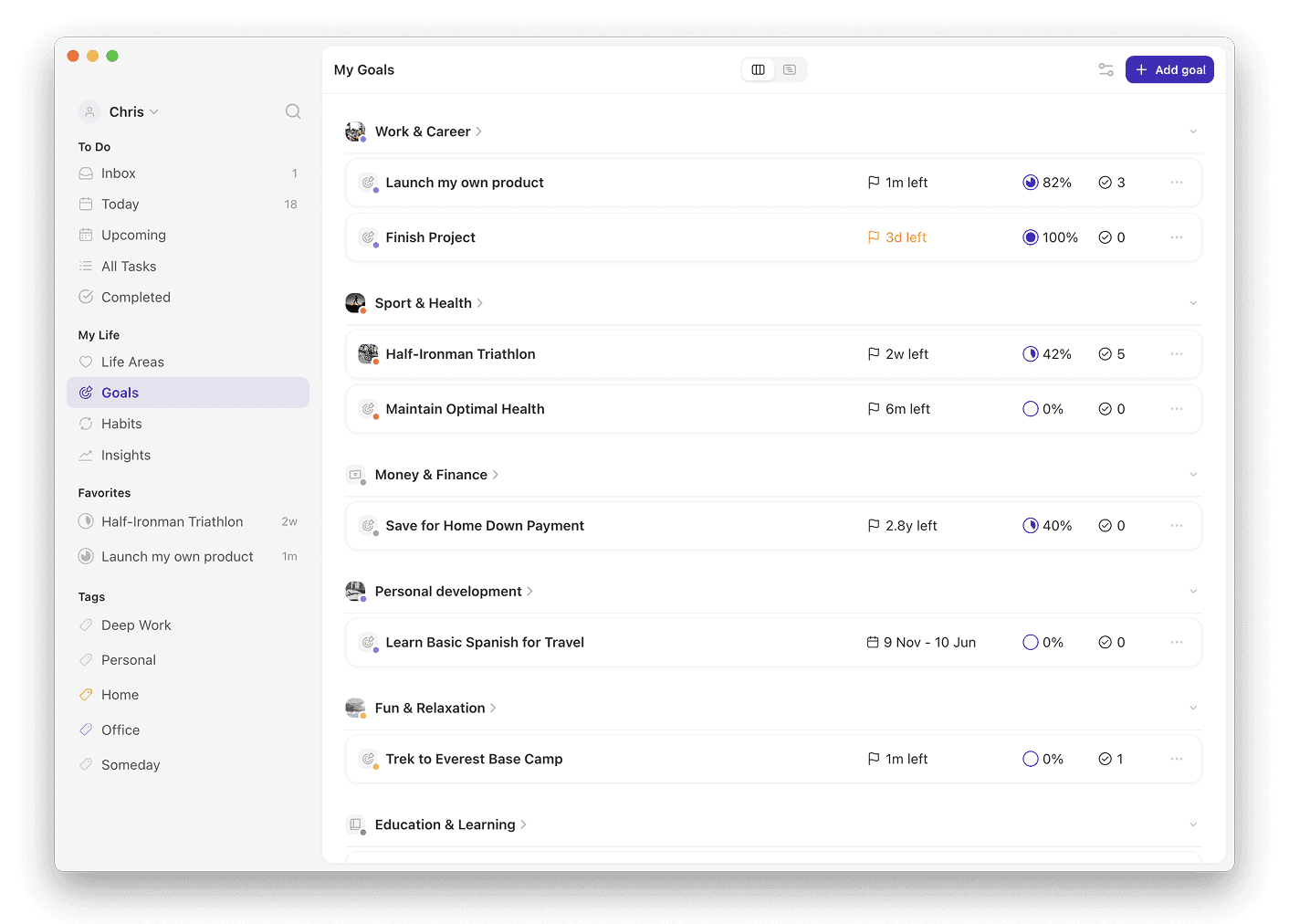
The either/or exists because the outcome is in one app and the behavior is in another. Griply keeps them in one structure. A life area holds your vision for that part of life, the goal underneath it is a measurable outcome with a start value, target value, and deadline, and the habit that does the daily work links to that goal directly.
The Goal Planner is where the outcome goal gets its number. You log progress yourself, and the chart draws a target line from your start value to your deadline, so the pace you need is visible next to the pace you are keeping. The Habit Tracker is where the process goal runs as a recurring habit with a schedule.
Both appear on the goal's Progress card. The goal's chart sits at the top, and every direct subgoal and every linked habit has its own box in the same card, beside it. The card puts the daily behavior and the goal's progress in one view, so you can see whether the emails and the revenue moved in the same direction this quarter.
Frequently asked questions
What is a process goal?
A process goal is a goal set on a behavior you can perform on demand, such as reviewing 20 flashcards every morning or sending ten cold emails every weekday. It measures whether you did the action, whatever the result.
What is the difference between process goals and outcome goals?
A process goal targets a behavior you control and can execute today. An outcome goal targets a result you can only influence, like a revenue number or a race position. Process goals tell you what to do this week, and outcome goals tell you why the behavior matters.
Should you set process goals or outcome goals?
Set both. Combining a process goal with an outcome goal outperforms either one alone, in training and in competition. Start with the process goal while the behavior is new, then add the outcome goal once you can perform the behavior reliably.
What is an example of a process goal?
Sending ten cold emails every weekday is a process goal, and closing $200k in revenue this year is the outcome goal it serves. Other examples: reviewing 20 flashcards each morning, running four times a week, or writing 500 words before opening email.
What app tracks process goals and outcome goals together?
Griply links a habit to the goal it serves, so the goal's Progress card shows that habit's box beside the goal's own progress chart. You log the outcome goal's number yourself, and the daily behavior sits under the outcome it is meant to advance.
Put the habit under the goal it serves
You do not have to pick a side. Start with the behavior you can perform on demand, add the number you are aiming at, and shift your attention to the outcome once the behavior is reliable. Keep the process goal running after that, because performance drops back when the behavior stops.
What makes this hard is where the two live. When the habit sits in the same structure as the goal it is aimed at, the question becomes something you can look at: here is the behavior, and here is whether the outcome moved with it.
Related Guides
Williamson, O., Swann, C., Bennett, K. J. M., Bird, M. D., Goddard, S. G., Schweickle, M. J., & Jackman, P. C. "The performance and psychological effects of goal setting in sport: A systematic review and meta-analysis." International Review of Sport and Exercise Psychology, 2024. https://doi.org/10.1080/1750984X.2022.2116723
Zimmerman, B. J., & Kitsantas, A. "Developmental Phases in Self-Regulation: Shifting from Process Goals to Outcome Goals." Journal of Educational Psychology, 1997. https://eric.ed.gov/?id=EJ543828
Simões, P., Vasconcelos-Raposo, J., Silva, A., & Fernandes, H. M. "Effects of a Process-Oriented Goal Setting Model on Swimmer's Performance." Journal of Human Kinetics, 2012. https://pmc.ncbi.nlm.nih.gov/articles/PMC3590857/
Filby, W. C., Maynard, I. W., & Graydon, J. K. "The effect of multiple-goal strategies on performance outcomes in training and competition." Journal of Applied Sport Psychology, 1999. https://coachsci.sdsu.edu/csa/vol93/filby.htm